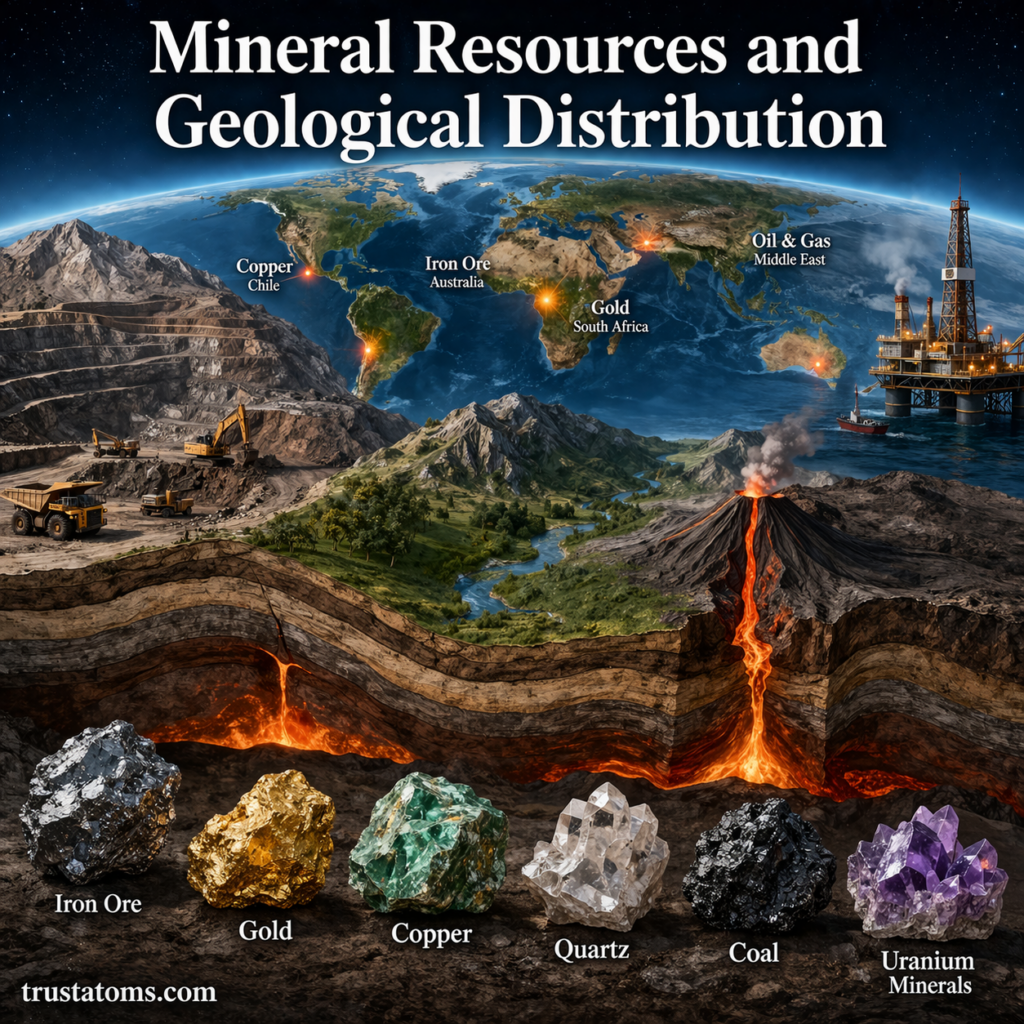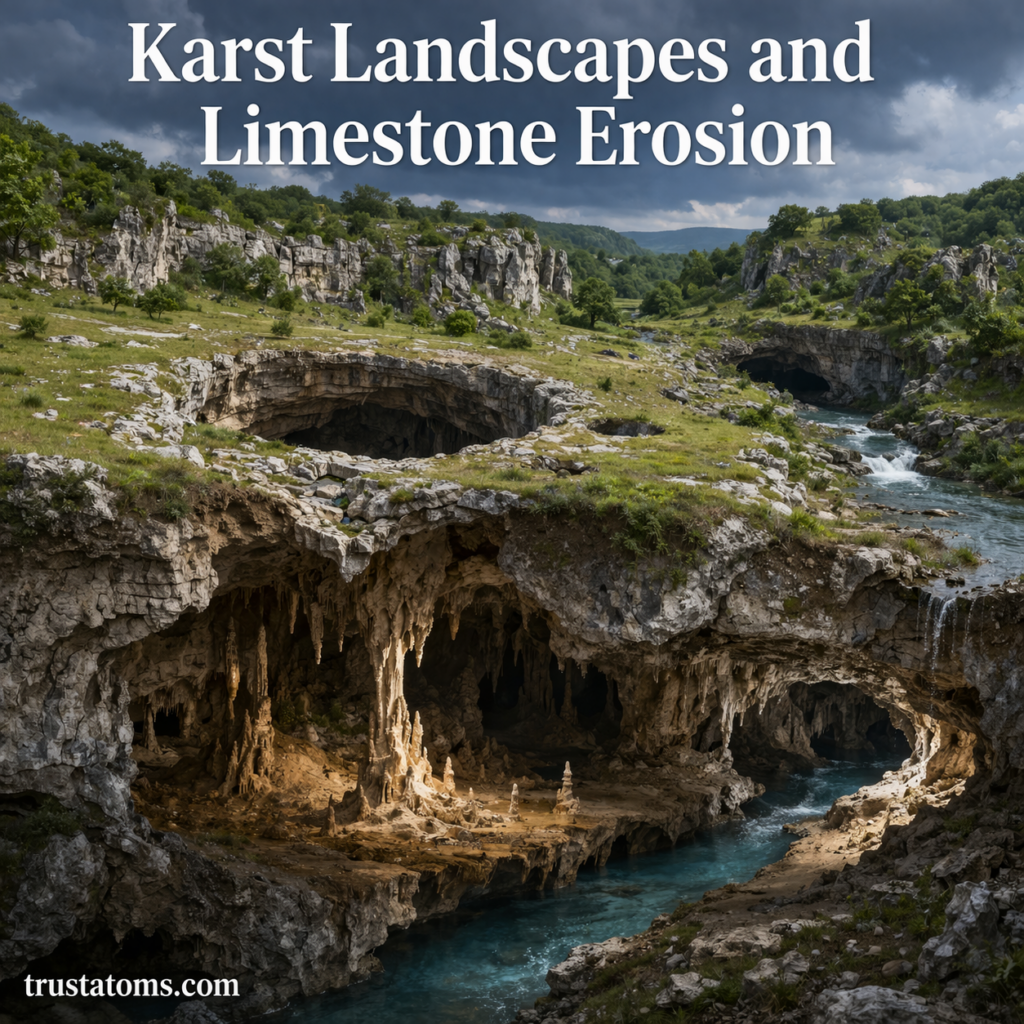
Karst landscapes are some of the most fascinating and unique landforms on Earth. Characterized by caves, sinkholes, disappearing rivers, and underground drainage systems, these environments are shaped primarily by the slow but powerful process of limestone erosion.
Understanding how karst landscapes form not only reveals the hidden dynamics of Earth’s surface but also highlights the importance of water in shaping the natural world.
What Is a Karst Landscape?
A karst landscape is a type of terrain formed when soluble rocks—most commonly limestone—are dissolved by water over time.
These regions are defined by:
- Underground drainage systems instead of surface rivers
- Sinkholes and depressions
- Caves and caverns
- Springs and disappearing streams
Karst terrain can be found all over the world, including parts of Europe, the United States (especially Kentucky and Florida), China, and Southeast Asia.
The Role of Limestone in Karst Formation
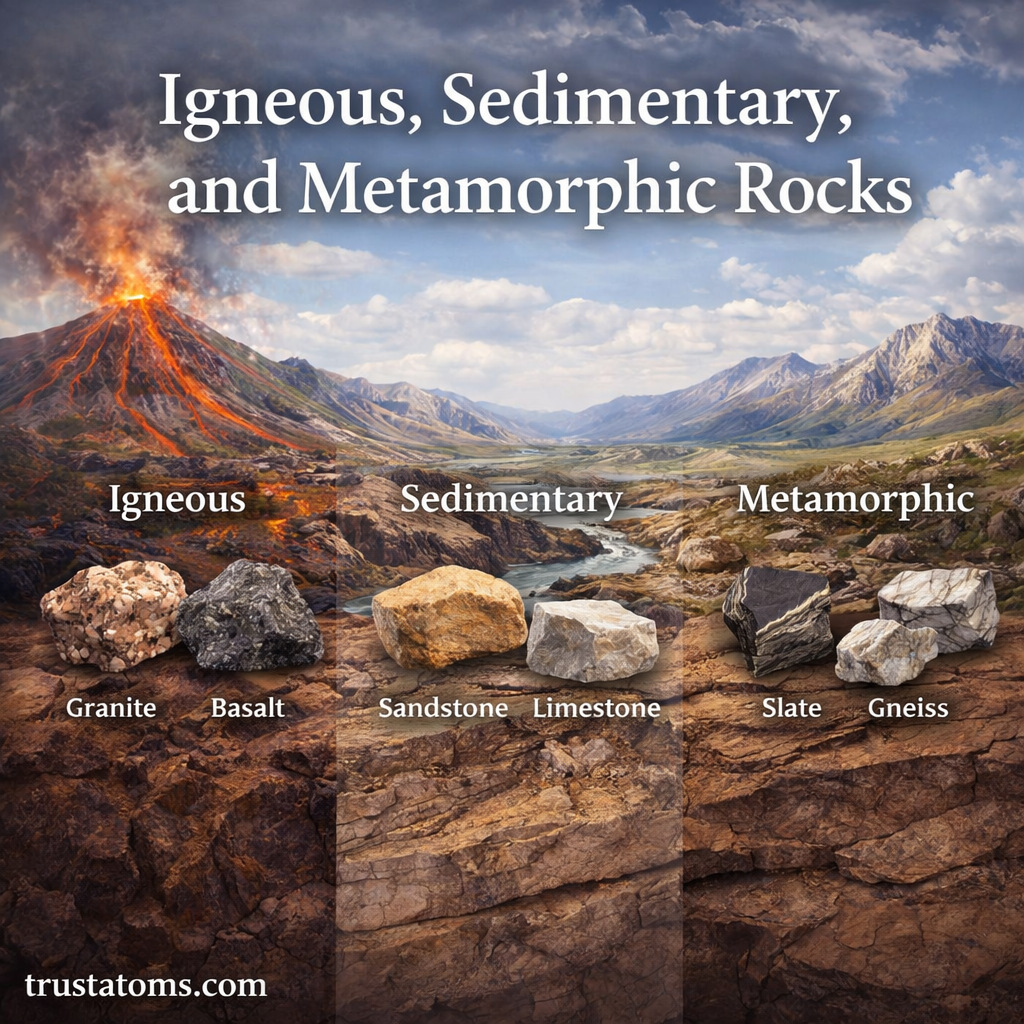
Limestone is a sedimentary rock primarily composed of calcium carbonate (CaCO₃). It forms from the remains of marine organisms like shells and corals.
What makes limestone special is its solubility in weakly acidic water.
Rainwater naturally absorbs carbon dioxide (CO₂) from the atmosphere and soil, forming a weak acid known as carbonic acid. When this acidic water comes into contact with limestone, it slowly dissolves the rock.
Key Chemical Process
- Water + carbon dioxide → carbonic acid
- Carbonic acid + limestone → dissolved calcium ions and bicarbonate
This process is called chemical weathering, and it is the foundation of karst landscape development.
How Karst Landscapes Form
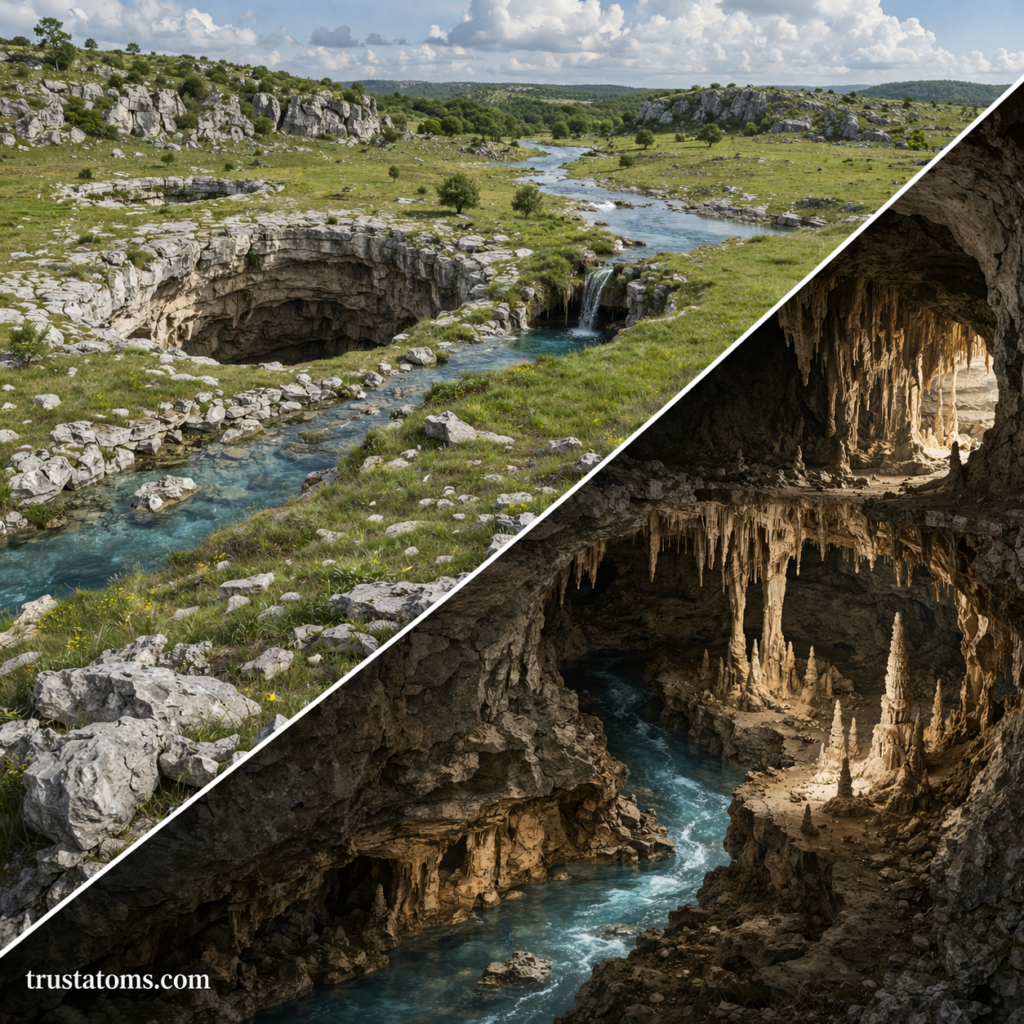
Karst landscapes develop over thousands to millions of years through a series of gradual steps.
1. Acidic Water Infiltration
Rainwater seeps into cracks and joints in limestone rock. Because the water is slightly acidic, it begins dissolving the rock along these pathways.
2. Enlargement of Cracks
Over time, small fractures widen into larger channels as more limestone dissolves. These channels allow more water to flow through, accelerating the process.
3. Formation of Underground Systems
As dissolution continues, extensive underground drainage systems form, including caves, tunnels, and caverns.
4. Surface Collapse
When underground cavities become too large to support the surface above, the ground collapses, forming sinkholes.
Common Karst Features
Karst landscapes are known for their distinctive and sometimes dramatic features.
Sinkholes
Sinkholes are depressions or holes in the ground caused by the collapse of a surface layer into an underground cavity.
They can vary in size from small pits to massive craters.
Caves and Caverns
Caves form as acidic water dissolves limestone along underground pathways. Over time, these spaces grow large enough for humans to explore.
Inside caves, mineral deposits can form:
- Stalactites (hang from the ceiling)
- Stalagmites (rise from the ground)
Disappearing Streams
In karst regions, rivers and streams may vanish underground through openings in the rock, continuing their flow beneath the surface.
Karst Towers
In some tropical regions, erosion leaves behind steep, isolated limestone hills known as karst towers, creating dramatic landscapes like those in southern China and Vietnam.
Types of Karst Landscapes
Karst terrain can vary depending on climate, rock composition, and geological history.
Tropical Karst
- Found in warm, humid regions
- Features steep limestone towers and deep valleys
- Rapid chemical weathering due to abundant rainfall
Temperate Karst
- Found in regions with moderate climates
- Features rolling hills, sinkholes, and cave systems
- Slower rates of erosion compared to tropical areas
Bare (Exposed) Karst
- Limestone is exposed at the surface
- Features sharp ridges and grooves known as “limestone pavement”
Covered Karst
- Limestone is buried under soil or vegetation
- Karst features are less visible but still present underground
Why Karst Landscapes Matter
Karst regions are more than just geological curiosities—they play an important role in ecosystems and human life.
Water Resources
- Karst aquifers supply drinking water to millions of people
- Water moves quickly through underground systems, making it both abundant and vulnerable
Unique Ecosystems
- Caves provide habitats for specialized species like bats and blind fish
- Karst regions often support rare and endemic plants and animals
Geological and Scientific Value
- Karst systems help scientists study groundwater flow and climate history
- Cave formations preserve records of past environmental conditions
Environmental Challenges in Karst Areas
Despite their importance, karst landscapes are highly sensitive to environmental changes.
Water Contamination
Because water moves quickly through karst systems with little filtration, pollutants can spread rapidly.
Common risks include:
- Agricultural runoff
- Industrial pollution
- Improper waste disposal
Sinkhole Hazards
Sinkholes can form suddenly, posing risks to buildings, roads, and infrastructure.
Resource Management
Overuse of groundwater in karst regions can lead to:
- Water shortages
- Land subsidence
- Ecosystem disruption
Key Differences: Karst vs Other Landscapes
Karst landscapes differ from other terrains in several important ways:
- Drainage: Mostly underground rather than surface rivers
- Erosion type: Dominated by chemical weathering instead of physical erosion
- Surface features: Characterized by depressions and irregular terrain
- Water movement: Rapid and less filtered
Final Thoughts
Karst landscapes are a powerful example of how water and chemistry work together to shape the Earth over time. Through the slow dissolution of limestone, entire underground worlds are created—complete with caves, rivers, and unique ecosystems.
While these landscapes are beautiful and scientifically valuable, they also require careful management due to their vulnerability. Understanding karst processes helps us protect water resources, prevent hazards, and appreciate the intricate systems beneath our feet.