The deep ocean is one of the least explored regions on Earth, yet it contains some of the planet’s most dramatic landscapes. Among these features, ocean trenches stand out as the deepest and most extreme environments, plunging miles below the ocean surface.
Understanding ocean trenches and deep-sea topography helps scientists uncover how Earth’s crust behaves, how plate tectonics operates beneath the oceans, and how life survives in extreme conditions.
What Are Ocean Trenches?
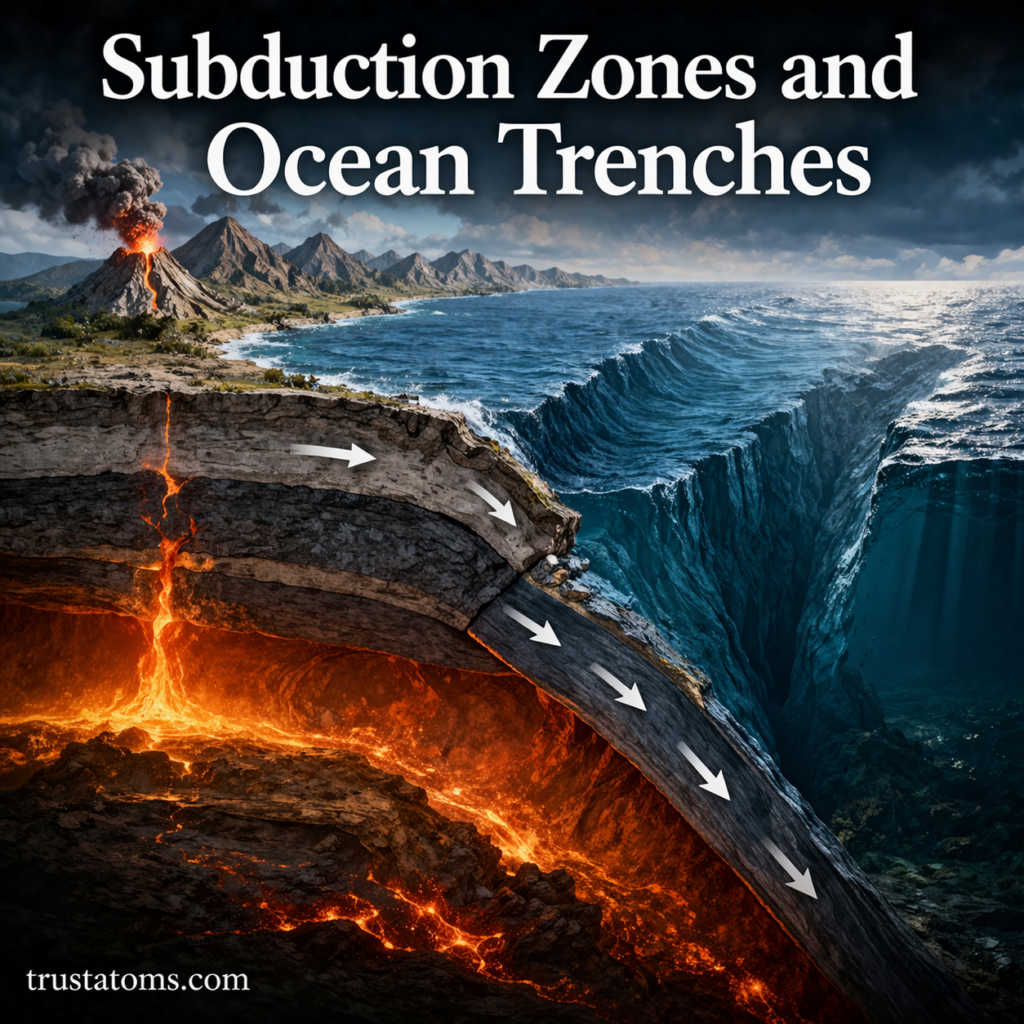
Ocean trenches are long, narrow depressions in the seafloor that form at convergent plate boundaries, where one tectonic plate is forced beneath another in a process called subduction.
Key features of ocean trenches:
- Extremely deep (some exceed 10,000 meters)
- Narrow and elongated in shape
- Located near volcanic arcs
- Associated with intense tectonic activity
The deepest known trench is the Mariana Trench, which reaches deeper than Mount Everest is tall.
How Ocean Trenches Form
Ocean trenches form through the process of subduction, driven by plate tectonics.
Step-by-Step Formation
- Two tectonic plates move toward each other
- The denser oceanic plate bends and sinks beneath the other
- A deep depression forms at the boundary
- The descending plate moves into the mantle
- Sediments accumulate along the trench
This process not only creates trenches but also drives volcanic activity nearby.
Characteristics of Ocean Trenches
Ocean trenches are unique environments with distinct physical and geological features.
Extreme Depth and Pressure
- Pressure increases dramatically with depth
- Temperatures are near freezing
- Sunlight cannot penetrate
Steep Walls
- Trenches often have sharp slopes
- Walls can drop rapidly over short distances
Sediment Accumulation
- Sediments from continents settle into trenches
- Some trenches have thick sediment layers
Deep-Sea Topography Beyond Trenches
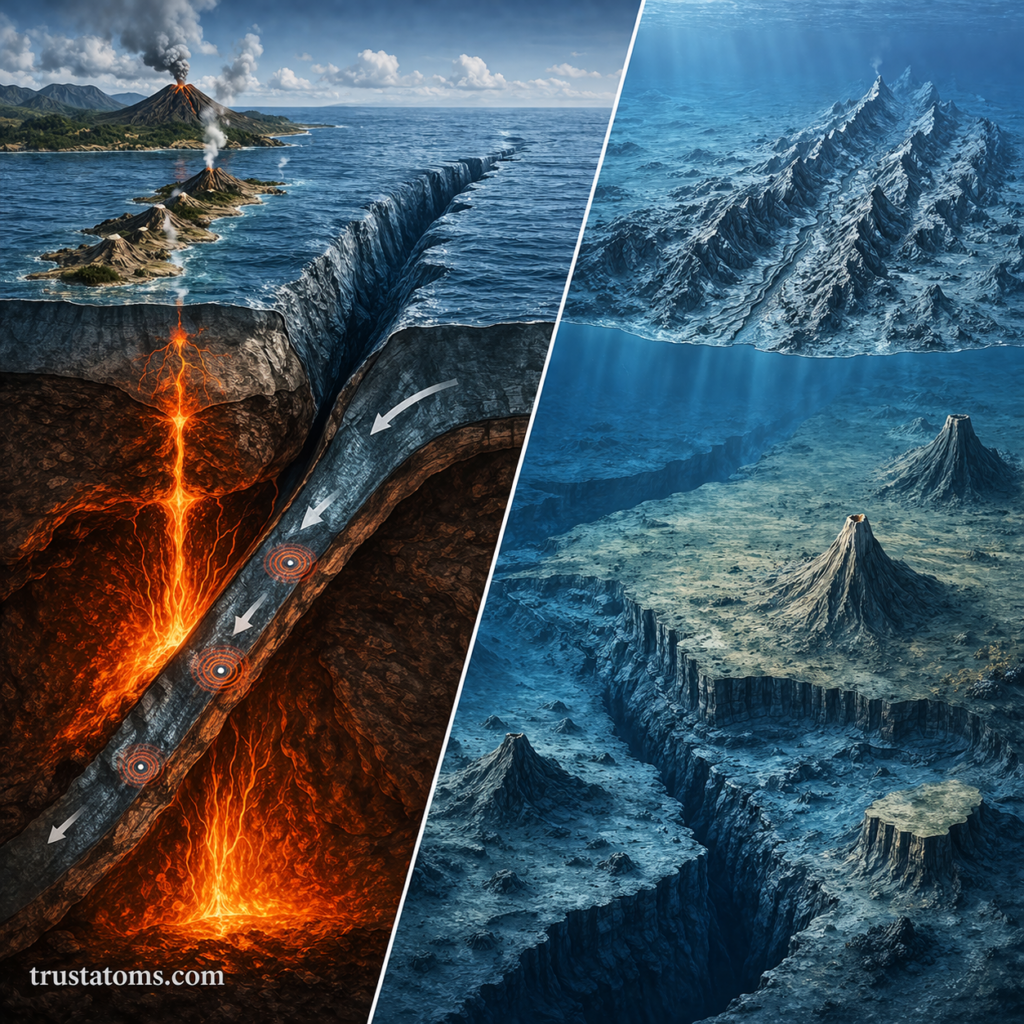
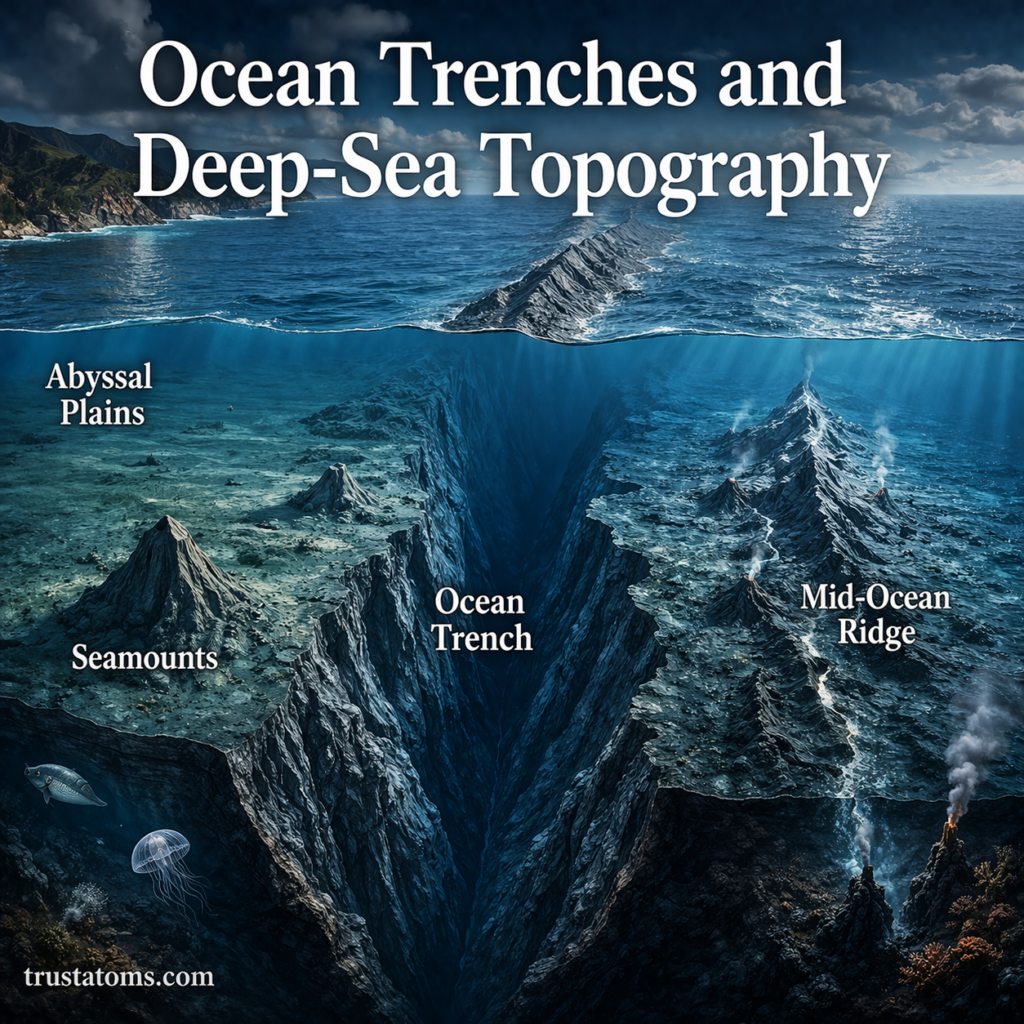
While trenches are the deepest features, the ocean floor includes a variety of other structures that create complex topography.
Mid-Ocean Ridges
These underwater mountain ranges form where tectonic plates move apart.
Features:
- Elevated ridges along divergent boundaries
- Central rift valleys
- Active volcanism
They are the opposite of trenches in terms of formation process.
Abyssal Plains
Abyssal plains are vast, flat areas of the ocean floor.
Characteristics:
- Extremely smooth and level
- Covered in fine sediment
- Found between ridges and trenches
These plains make up a large portion of the ocean floor.
Seamounts and Guyots
Seamounts are underwater volcanoes that rise from the seafloor.
- Seamounts: Cone-shaped, often volcanic
- Guyots: Flat-topped seamounts shaped by erosion
These features can form chains similar to island chains but remain submerged.
Oceanic Plateaus
Oceanic plateaus are large, elevated regions of thick oceanic crust.
- Formed by massive volcanic activity
- Cover large areas
- Less common than other features
The Role of Subduction Zones
Ocean trenches are closely linked to subduction zones, which are among the most geologically active regions on Earth.
Associated Phenomena
- Earthquakes (often very powerful)
- Volcanic arcs
- Tsunamis
Subduction zones recycle oceanic crust, helping maintain Earth’s balance.
Life in the Deep Sea
Despite extreme conditions, ocean trenches and deep-sea environments support life.
Adaptations of Deep-Sea Organisms
- Ability to withstand high pressure
- Slow metabolism
- Bioluminescence
Examples of deep-sea life include:
- Giant amphipods
- Deep-sea fish
- Microbial communities
These ecosystems rely on chemical energy rather than sunlight.
Why Ocean Trenches Matter
Ocean trenches play a critical role in Earth’s systems.
Plate Recycling
- Old oceanic crust is subducted and recycled
- Helps regulate Earth’s surface
Natural Hazards
- Major earthquakes originate near trenches
- Tsunami generation is often linked to subduction
Scientific Exploration
- Trenches provide insight into Earth’s interior
- Help scientists study extreme environments
Exploration of the Deep Ocean
Exploring ocean trenches is challenging due to extreme pressure and darkness.
Technologies Used
- Deep-sea submersibles
- Remotely operated vehicles (ROVs)
- Sonar mapping
These tools have allowed scientists to map and study previously unknown regions of the ocean floor.
Key Takeaways
- Ocean trenches are the deepest parts of the ocean, formed by subduction
- They are part of a larger system of deep-sea topography
- Features like ridges, plains, and seamounts shape the ocean floor
- Trenches are associated with earthquakes, volcanoes, and tsunamis
- Life exists even in extreme deep-sea conditions
Final Thoughts
Ocean trenches and deep-sea topography reveal a hidden world beneath the ocean’s surface. These features are not only essential to understanding plate tectonics but also highlight the incredible adaptability of life on Earth.
As exploration continues, the deep ocean remains one of the last frontiers—full of mystery, discovery, and insight into the forces shaping our planet.