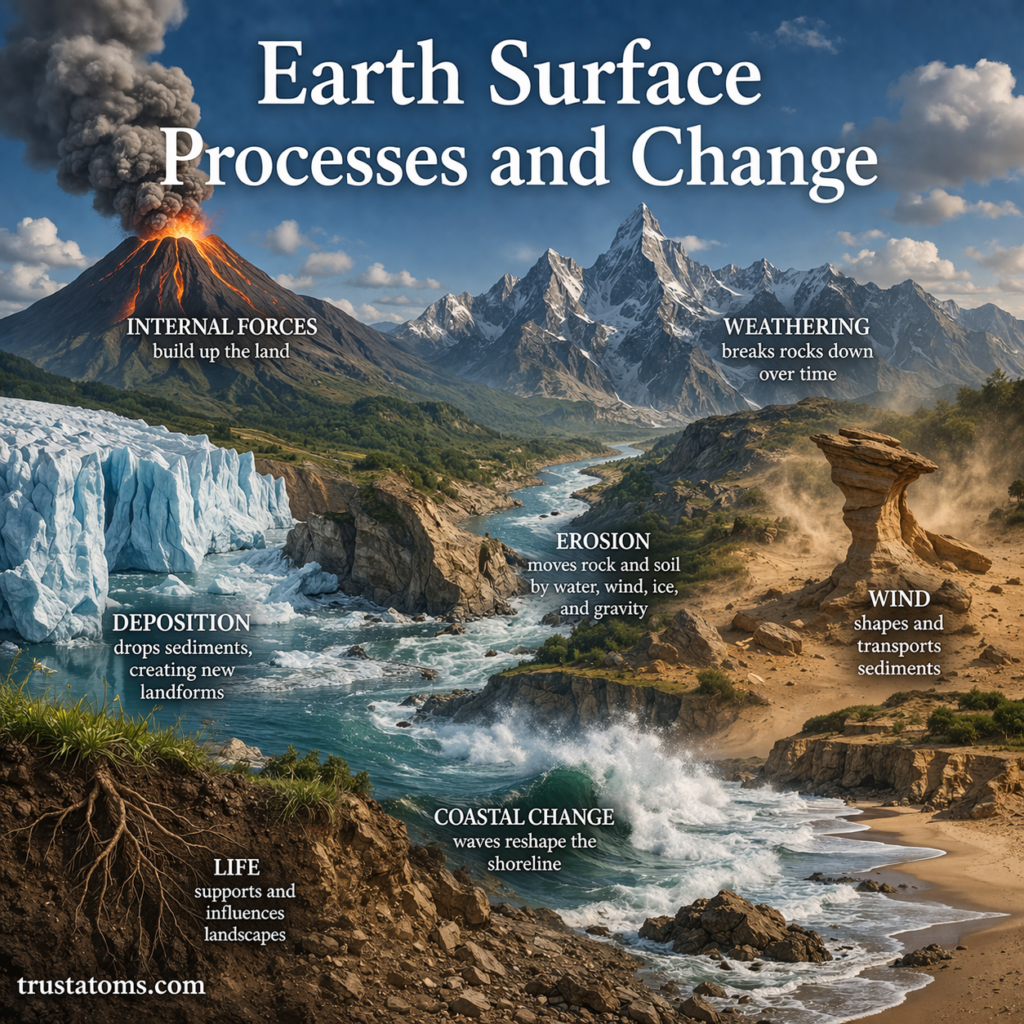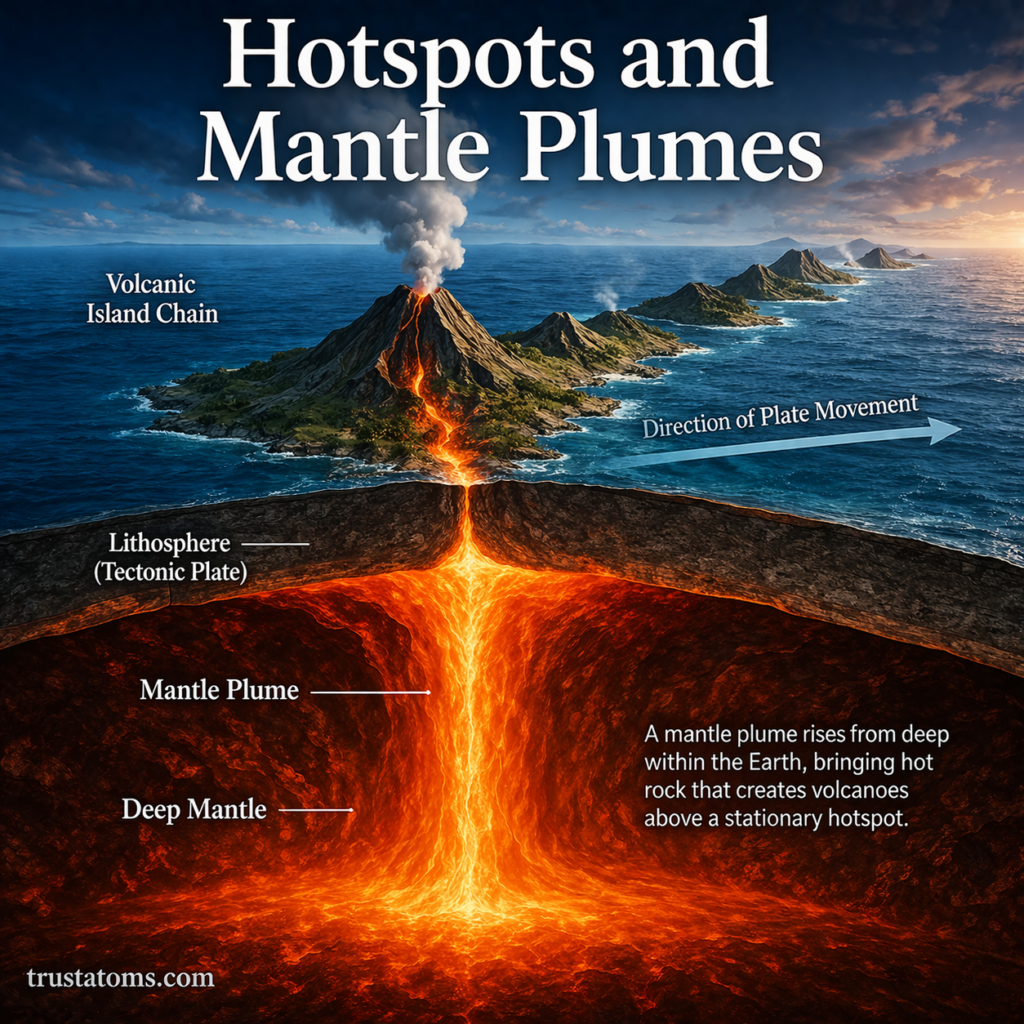
Hotspots are regions of persistent volcanic activity often found away from tectonic plate boundaries, while mantle plumes are proposed upwellings of unusually hot rock that can supply the heat responsible for some hotspots. As a tectonic plate moves over a relatively long-lived hotspot, successive volcanoes may form, creating island chains such as Hawaii.
Hotspots provide scientists with clues about Earth’s interior, volcanic activity, and plate movement. Studying these features connects mantle processes with surface geology, making them an important topic in Earth science. Although mantle plumes explain many observations, scientists continue investigating whether every hotspot has the same deep origin.
What Are Volcanic Hotspots?
A volcanic hotspot is a region where magma repeatedly reaches Earth’s surface over a long period, often within the interior of a tectonic plate. Hawaii is a well-known example, although hotspots can also occur near plate boundaries, as in Iceland.
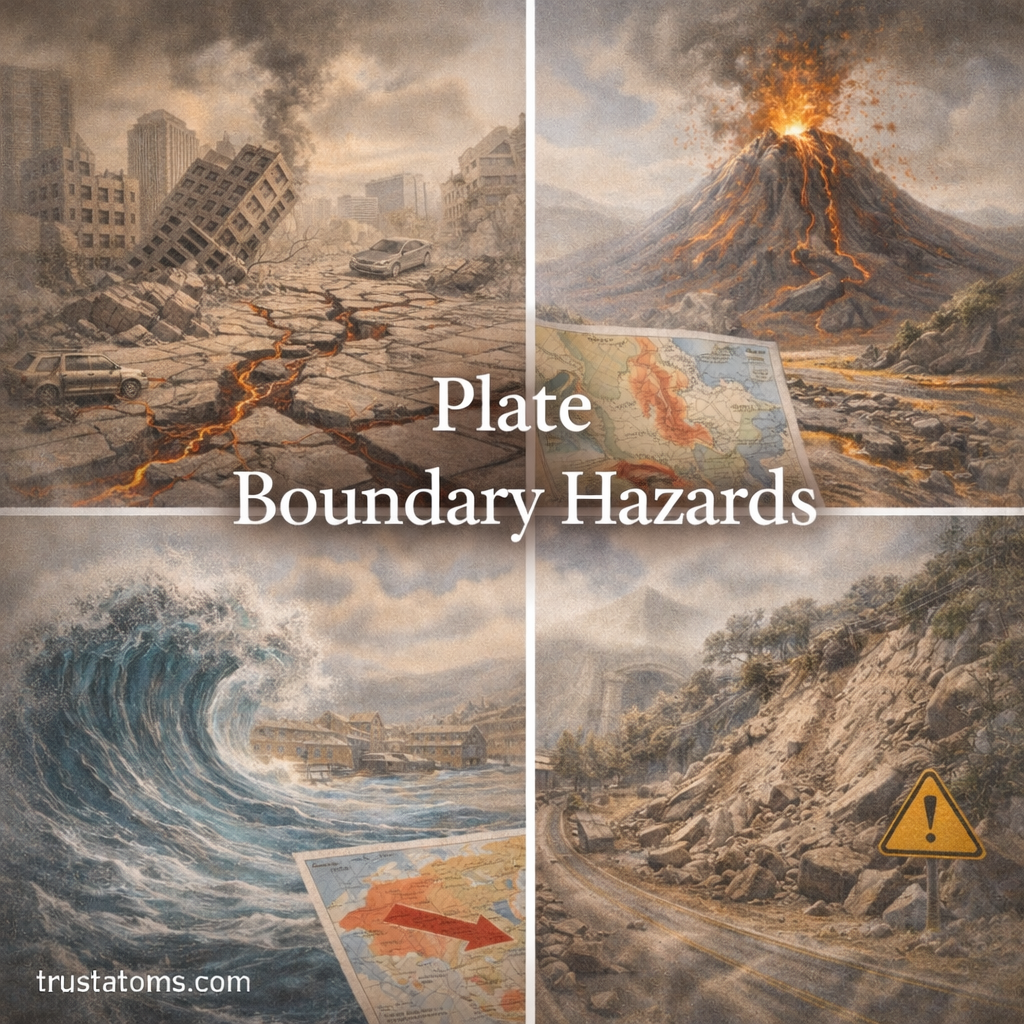
Most volcanoes are associated with transform, convergent, and divergent boundaries, particularly subduction zones and spreading centers. Hotspot volcanism demonstrates that magma generation can also occur away from these settings.
At ocean ridges, the separation of plates allows hot mantle material to rise and partially melt. These processes are explained in seafloor spreading mechanisms. Hotspots may involve additional mantle upwelling, unusual temperatures, or other conditions that promote melting.
Hotspots can also produce extensive geothermal activity. The relationship between subsurface heat, hot springs, and volcanic regions is explored in geothermal regions and volcanic activity.
What Is a Mantle Plume?
A mantle plume is a proposed column or broad upwelling of relatively hot, buoyant mantle rock. Some plume models suggest that these upwellings originate near the boundary between Earth’s core and mantle, approximately 2,900 kilometers beneath the surface.
Mantle rock is mostly solid, not a vast underground ocean of liquid magma. Over geological timescales, however, solid mantle material can flow slowly. As unusually hot material rises, decreasing pressure can allow a portion of it to melt.
The resulting magma may collect in reservoirs, move through fractures, and eventually erupt. Scientists distinguish the proposed deep plume from the hotspot, which is the volcanic region observed at or near Earth’s surface.
How Hotspots Form Volcanoes
In the classic mantle plume model, hotspot volcanism develops through a sequence of processes:
- Unusually hot mantle material rises toward the base of a tectonic plate.
- Decreasing pressure allows some mantle rock to melt, producing magma.
- Magma travels upward through weaknesses in the overlying rock.
- Repeated eruptions build a volcano or volcanic complex.
- Plate movement carries older volcanoes away from the main magma source, allowing new volcanoes to develop nearby.
This sequence describes an important model rather than a universal rule. Hotspots can migrate, magma supplies can vary, and not every volcanic region produces a neat chain of volcanoes.
How Hotspots Create Volcanic Island Chains
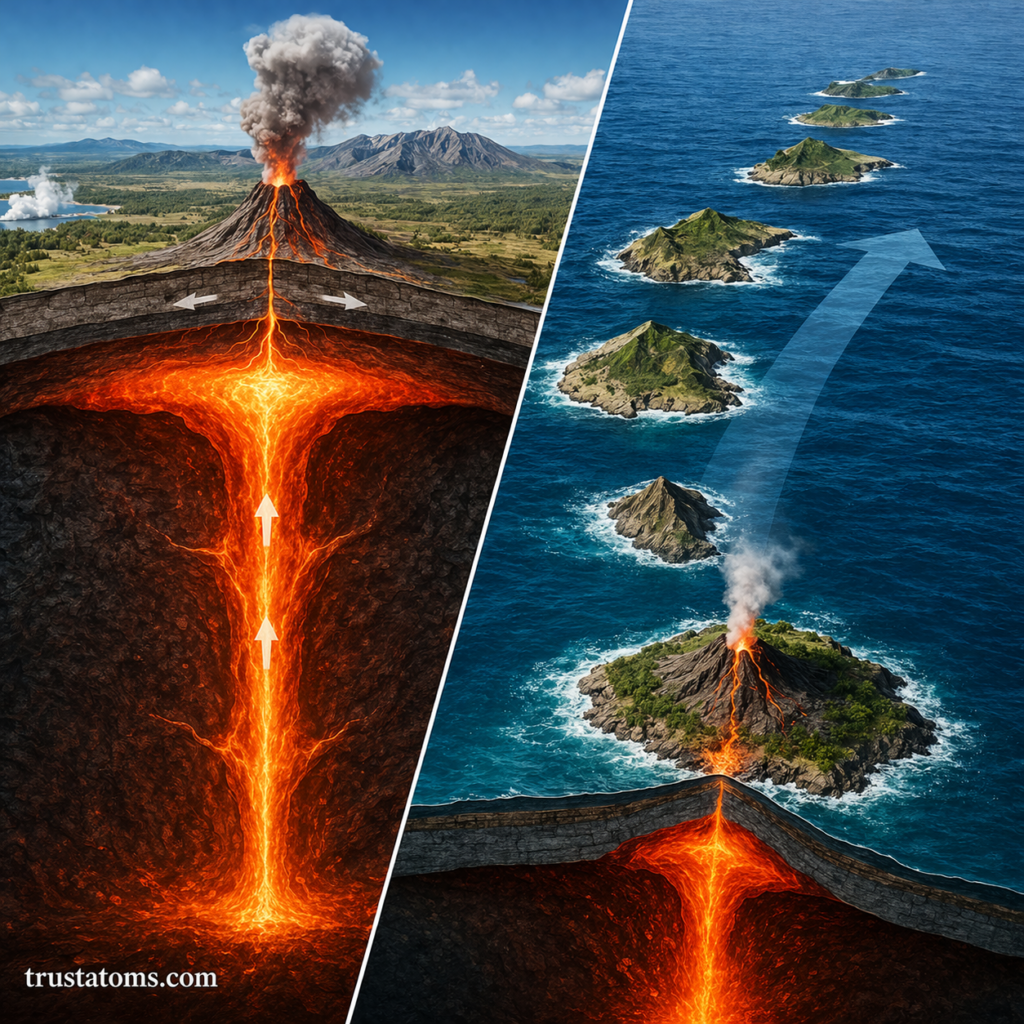
The Hawaiian Islands provide one of the clearest examples of a volcanic chain associated with plate movement. The youngest major islands lie toward the southeastern end, while progressively older islands and submerged volcanoes extend northwestward.
For a concrete example, the island of Hawaii contains active volcanoes, while Kauai, farther northwest, is approximately five million years old. This age difference reflects the Pacific Plate’s movement relative to the Hawaiian hotspot over millions of years, according to geological dating evidence.
Hotspot chains differ from many subduction-related island arcs. The distinctions between these volcanic settings are explored in volcanic arcs and island chains.
Continental Hotspots: The Yellowstone Example
Hotspot volcanism can also occur beneath continents. Yellowstone, in the western United States, is associated with extensive geothermal activity, past explosive eruptions, and a trail of older volcanic centers across the Snake River Plain.
Unlike the Hawaiian oceanic setting, continental crust is generally thicker and chemically different. Magma may interact with surrounding crustal rocks, contributing to complex volcanic systems and, in some cases, highly explosive eruptions.
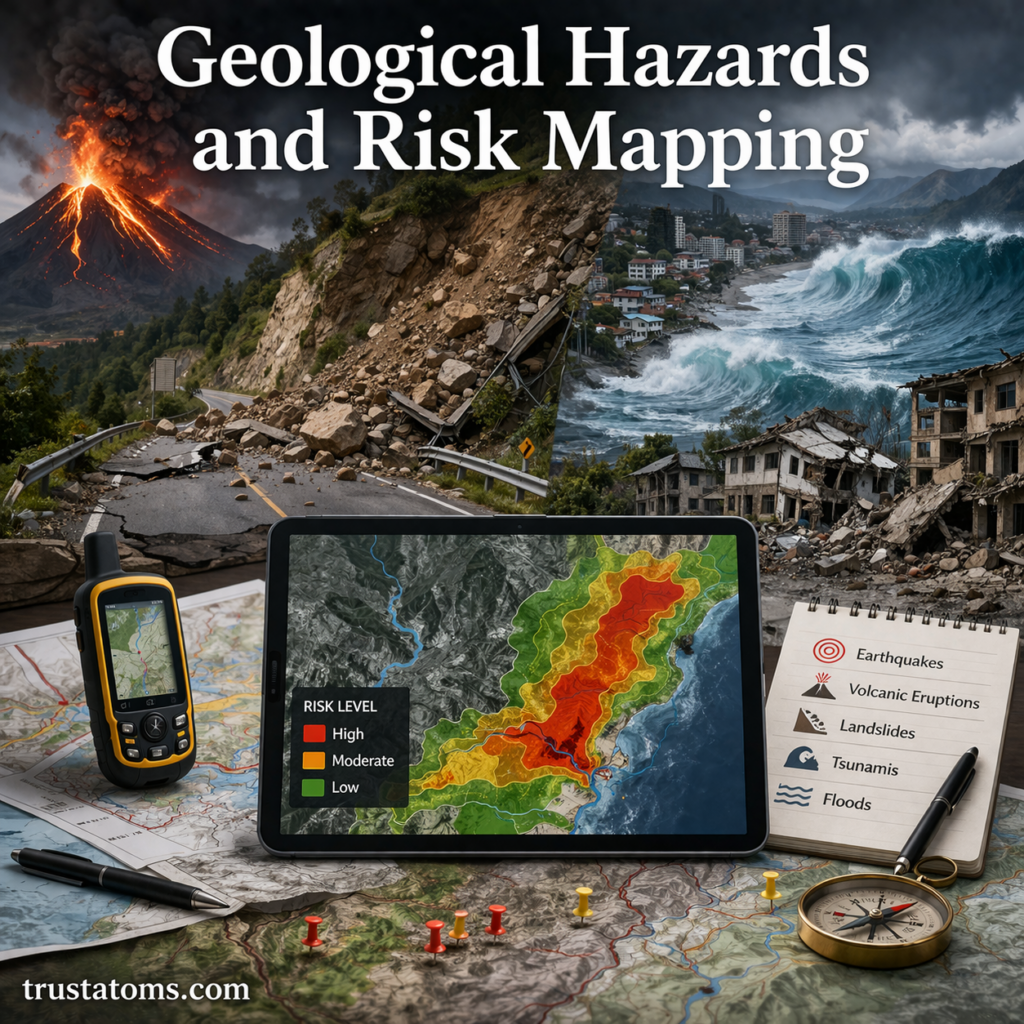
Yellowstone’s hot springs and geysers are heated by a subsurface magmatic system. Their presence does not mean an eruption is imminent; scientists monitor earthquakes, ground deformation, and geothermal activity to evaluate changes in the system.
Hotspot Volcanoes vs. Plate Boundary Volcanoes
| Feature | Hotspot Volcanism | Plate Boundary Volcanism |
|---|---|---|
| Typical location | Often within plates | Along convergent or divergent boundaries |
| Main melting processes | Potentially hot upwelling and decompression | Decompression or addition of water |
| Common landforms | Volcanic chains and broad volcanic regions | Volcanic arcs and mid-ocean ridges |
| Examples | Hawaii and Yellowstone | Andes and Mid-Atlantic Ridge |
These categories can overlap. Iceland, for example, lies along the Mid-Atlantic Ridge and is also associated with a mantle upwelling, demonstrating that hotspot and plate-boundary processes can operate together.
What Evidence Supports Mantle Plumes?
Scientists use several types of evidence to support the mantle plume theory. These observations are interpreted within the broader theory of plate tectonics, which explains how Earth’s outer plates move and interact.
- Volcanic age patterns: Chains such as Hawaii preserve evidence of plate movement relative to a volcanic source.
- Seismic tomography: Measurements of seismic wave speeds reveal mantle structures that may represent hot upwellings.
- Rock chemistry: Isotopic compositions in some hotspot lavas suggest contributions from mantle reservoirs with distinct histories.
- Elevated heat and volcanic output: Some regions exhibit extensive volcanism consistent with substantial mantle melting.
Evidence varies between hotspots, and seismic images require careful interpretation. Scientists continue debating the depth, structure, and origin of particular mantle upwellings, especially where shallow geological processes might also explain volcanism.
How Hotspot Volcanoes Change Over Time
In oceanic settings, volcanoes can grow from the seafloor until they emerge as islands. As plate motion carries them away from the main magma source, eruptions may become less frequent and eventually stop.
Erosion gradually lowers the islands, while cooling and subsidence of the underlying oceanic plate can contribute to their submergence. Former islands may become underwater seamounts or flat-topped guyots, sometimes after erosion near sea level.
Frequently Asked Questions
Are all hotspots caused by mantle plumes?
Not necessarily. Deep mantle plumes are a leading explanation for several major hotspots, but scientists also investigate shallower mantle convection, plate-related processes, and other mechanisms. Different hotspots may have different origins.
Do hotspots stay in the same place?
Hotspots can remain relatively stable compared with moving tectonic plates, but they are not perfectly stationary. Their positions may change as mantle material moves, complicating reconstructions of ancient plate motion.
Can hotspots create dangerous volcanic eruptions?
Yes. Oceanic hotspots can produce destructive lava flows and volcanic gases, while some continental hotspot systems have generated major explosive eruptions. Hazards depend on magma properties, geological setting, and the type of eruption.
Hotspots provide evidence of volcanic processes that can operate far from conventional plate boundaries, while mantle plume models offer explanations for how some of these regions receive heat and magma. The Hawaiian chain and Yellowstone illustrate how scientists combine volcanic ages, rock chemistry, and seismic observations to investigate Earth’s interior and reconstruct plate movement.
Sources: United States Geological Survey, Volcano Hazards Program; Smithsonian Institution, Global Volcanism Program; Turcotte and Schubert, Geodynamics.