What Is Base Dissociation Constant (Kb)?

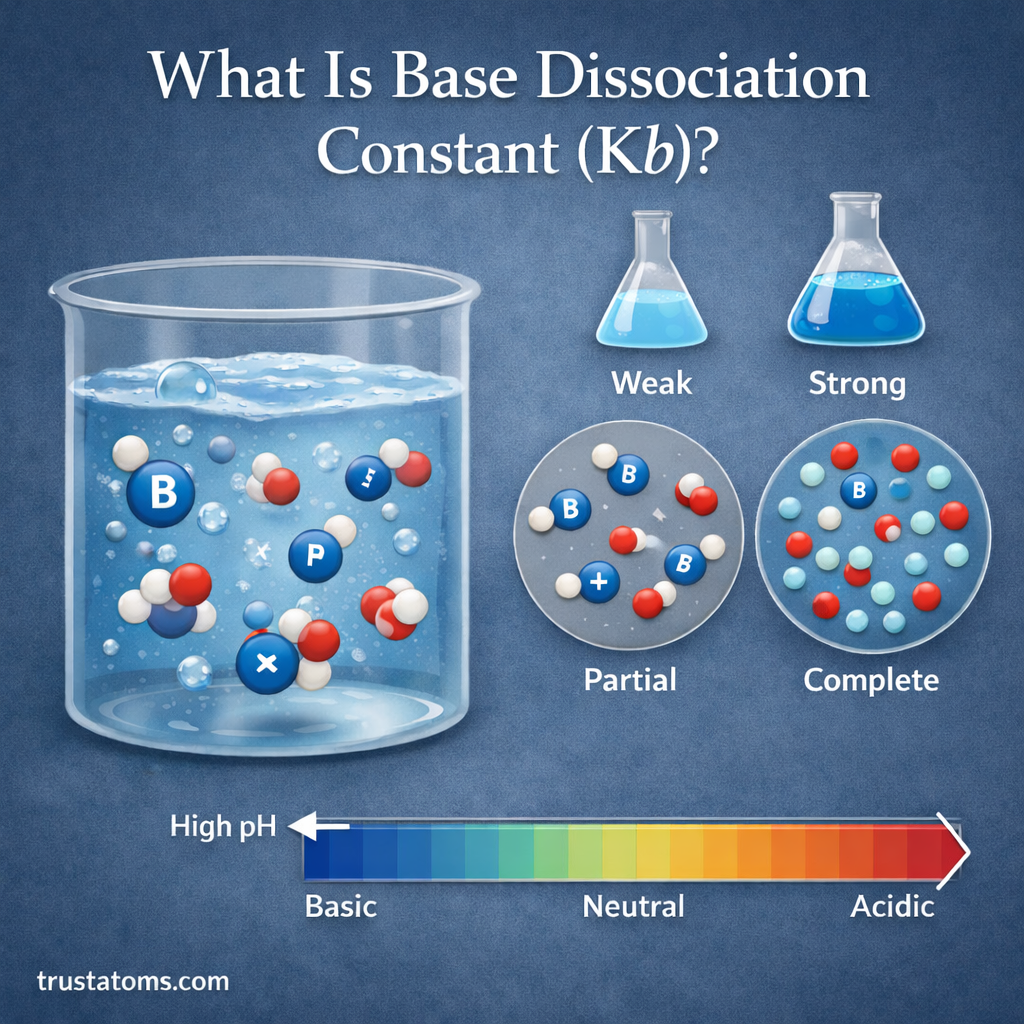
Simple chemistry illustration showing base molecules dissolving in water inside a beaker to explain the concept of base dissociation constant (Kb).
Educational chemistry illustration showing a base dissolving in water to represent how base dissociation constant (Kb) describes base strength. trustatoms.com.

In chemistry, understanding how substances behave in water is essential for studying reactions, biological systems, and industrial processes. One important concept used to measure the strength of a base is the base dissociation constant, commonly written as Kb.

The base dissociation constant helps chemists determine how strongly a base reacts with water to produce hydroxide ions. The larger the Kb value, the stronger the base.

This guide explains what the base dissociation constant is, how it works, how it is calculated, and why it matters in chemistry.

Continue reading “What Is Base Dissociation Constant (Kb)?”
What Is Acid Dissociation Constant (Ka)?

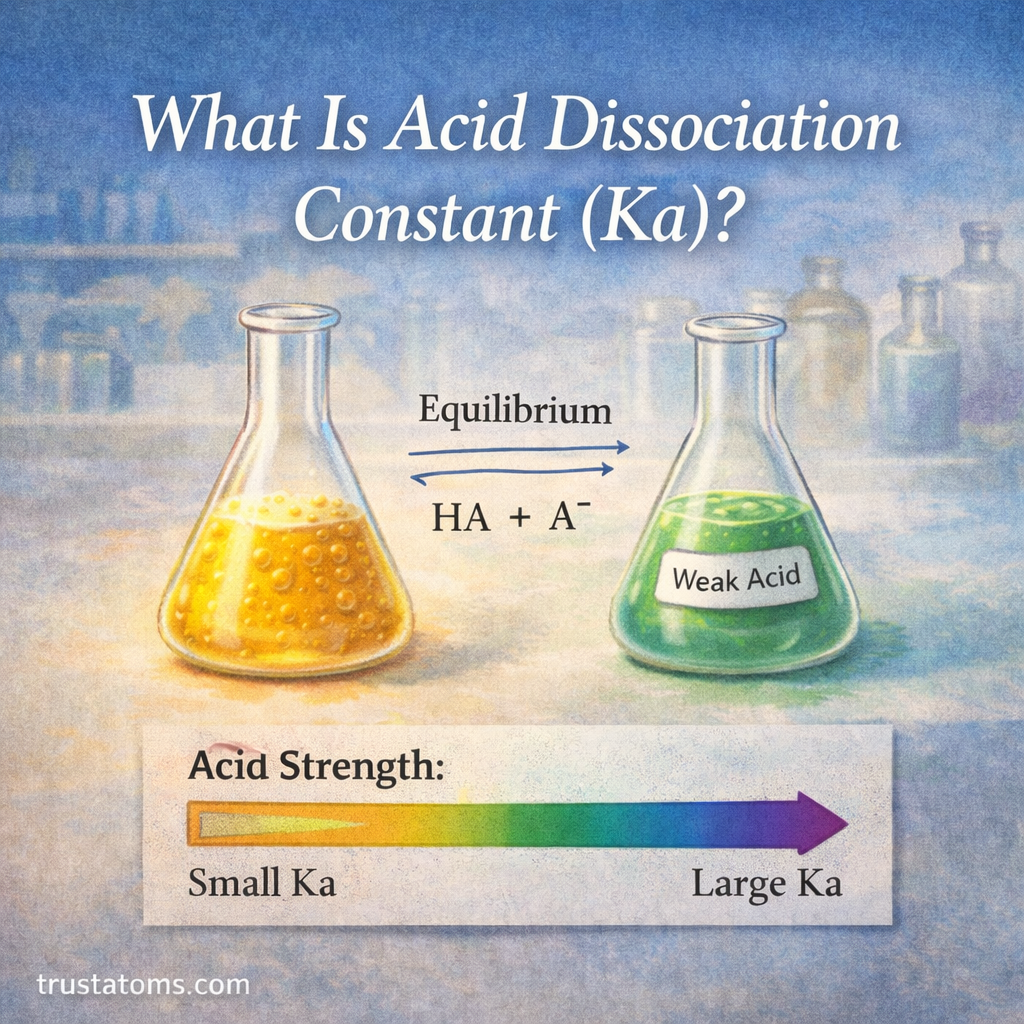
Educational chemistry illustration showing two laboratory flasks representing acid dissociation and equilibrium to explain the acid dissociation constant Ka.
Conceptual chemistry illustration showing acid dissociation equilibrium and how the acid dissociation constant (Ka) represents acid strength in solution. trustatoms.com.

The acid dissociation constant (Ka) is a value used in chemistry to measure how strongly an acid releases hydrogen ions (H⁺) in a solution. It helps scientists understand how completely an acid separates into its ions when dissolved in water.

In simple terms, Ka tells us how strong or weak an acid is based on how easily it donates hydrogen ions during a chemical reaction.

  • Large Ka value → stronger acid
  • Small Ka value → weaker acid

Because many chemical reactions depend on acids releasing hydrogen ions, the acid dissociation constant is an important concept in acid–base chemistry, biochemistry, environmental science, and industrial chemistry.

Continue reading “What Is Acid Dissociation Constant (Ka)?”

What Is the pH Scale?

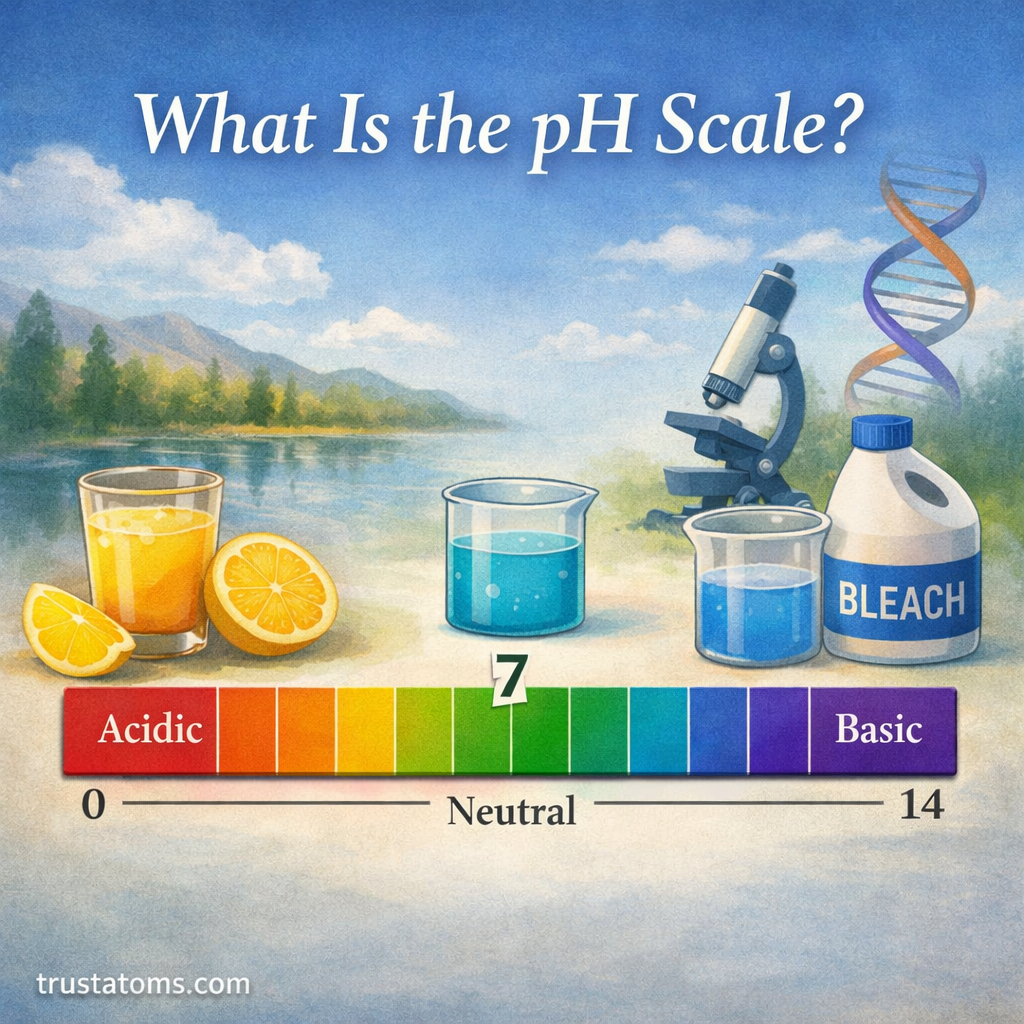
Illustrated pH scale diagram showing acidic to basic range from 0 to 14 with common examples like lemon juice, water, and bleach.
Simple educational illustration showing the pH scale from acidic to basic with everyday examples. trustatoms.com.

The pH scale is a measurement system used in chemistry to describe how acidic or basic (alkaline) a substance is. It plays a central role in chemistry, biology, environmental science, and even everyday activities such as cooking, cleaning, and maintaining drinking water.

The scale ranges from 0 to 14, with lower numbers representing stronger acids and higher numbers representing stronger bases. Substances with a pH of 7 are considered neutral.

Understanding the pH scale helps scientists and students predict chemical behavior, determine solution properties, and maintain balanced chemical environments in natural and industrial systems.

Continue reading “What Is the pH Scale?”

Strong vs Weak Bases

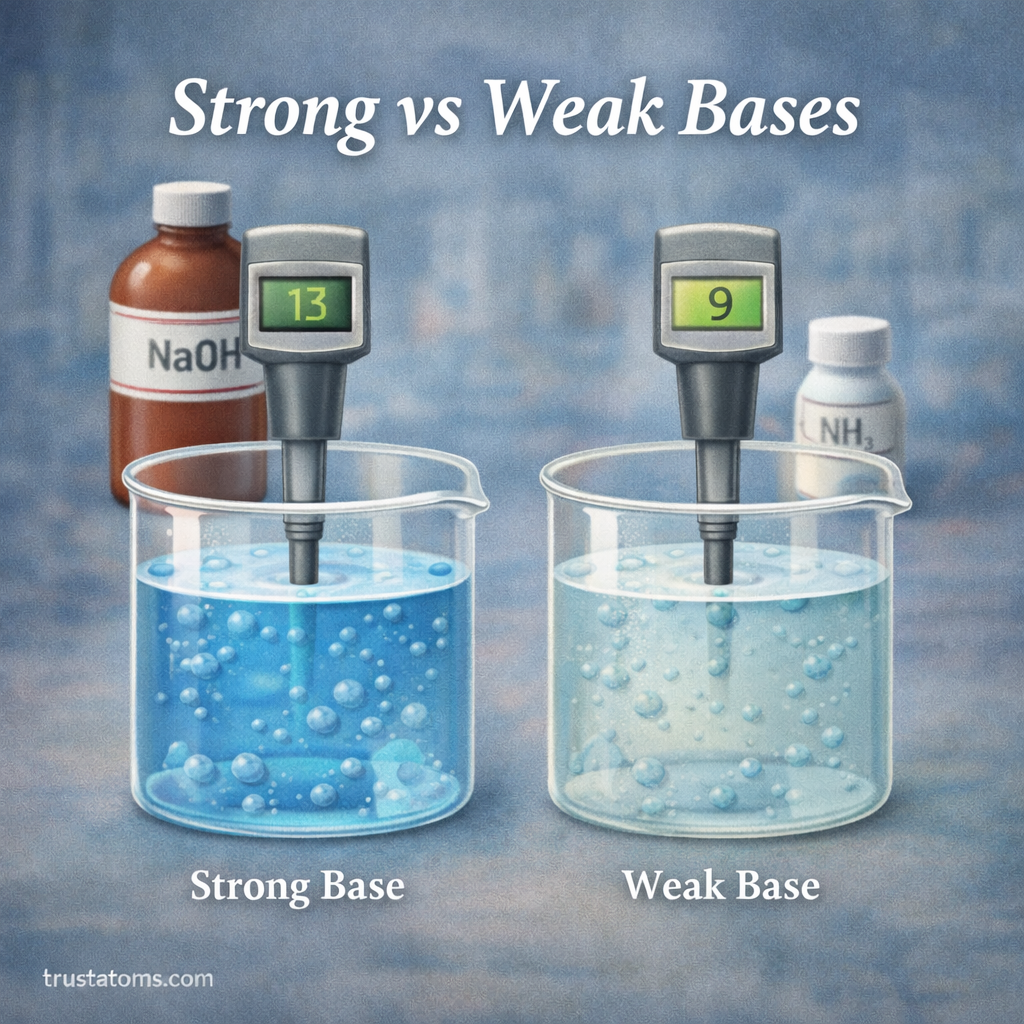
Educational chemistry illustration comparing strong and weak bases using two laboratory beakers to demonstrate differences in alkalinity.
Side-by-side illustration showing the difference between strong and weak bases in aqueous solutions. trustatoms.com.

Bases are an important category of chemical substances that play a role in many natural and industrial processes. From cleaning products and food preparation to biological systems and chemical manufacturing, bases influence countless reactions.

One of the most important ways chemists classify bases is by their strength, which depends on how completely they produce hydroxide ions in water.

In chemistry, bases are commonly divided into strong bases and weak bases. Understanding the difference between them helps explain pH behavior, chemical reactions, and how substances interact in solutions.

Continue reading “Strong vs Weak Bases”

Strong vs Weak Acids

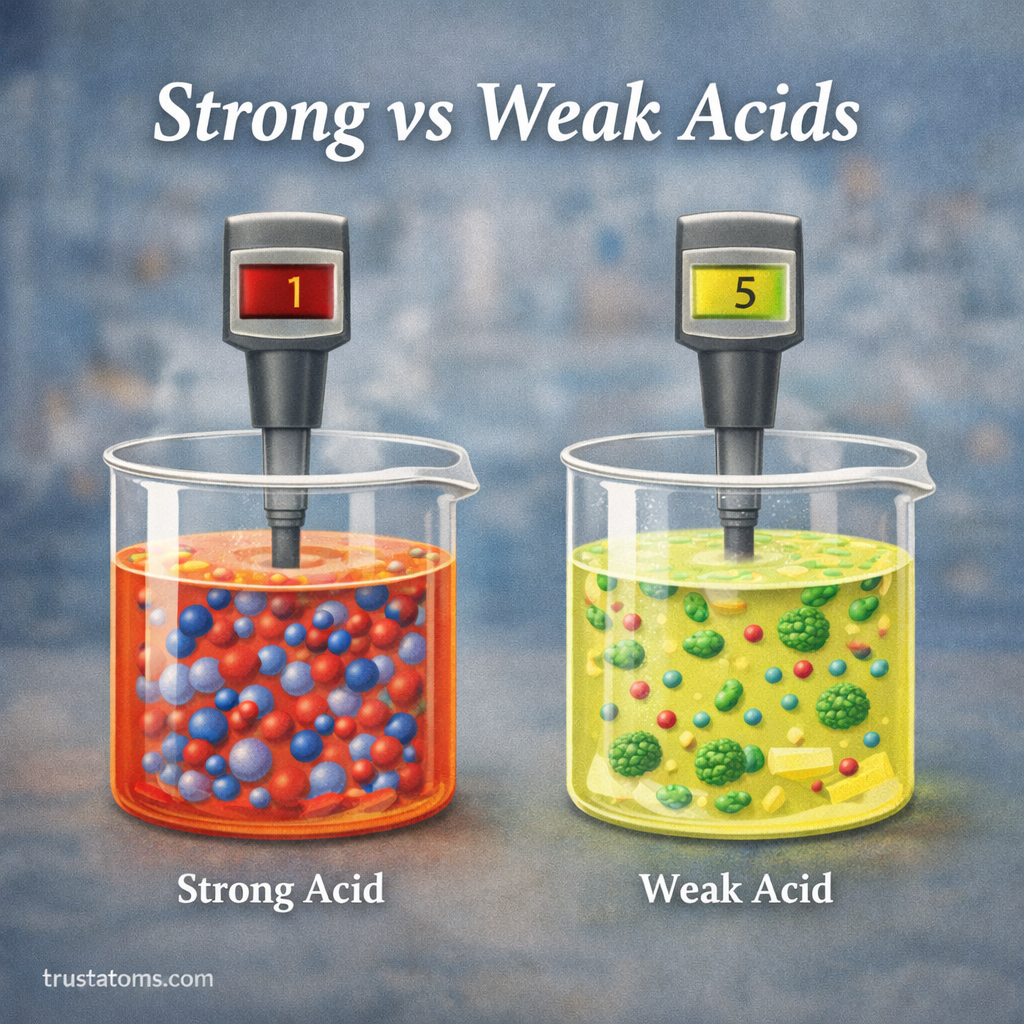
Educational chemistry illustration comparing strong and weak acids using two laboratory beakers to show differences in ionization and acidity levels.
Side-by-side chemistry illustration demonstrating the difference between strong and weak acids in aqueous solutions. trustatoms.com.

Acids are an important group of substances in chemistry. They play a role in everything from digestion and food chemistry to industrial manufacturing and environmental science. One of the most important ways scientists classify acids is by their strength, which refers to how completely an acid breaks apart in water.

In chemistry, acids are commonly divided into two categories: strong acids and weak acids. Understanding the difference between them helps explain many chemical reactions, pH behavior, and real-world applications.

Continue reading “Strong vs Weak Acids”

What Is a Limiting Reagent?

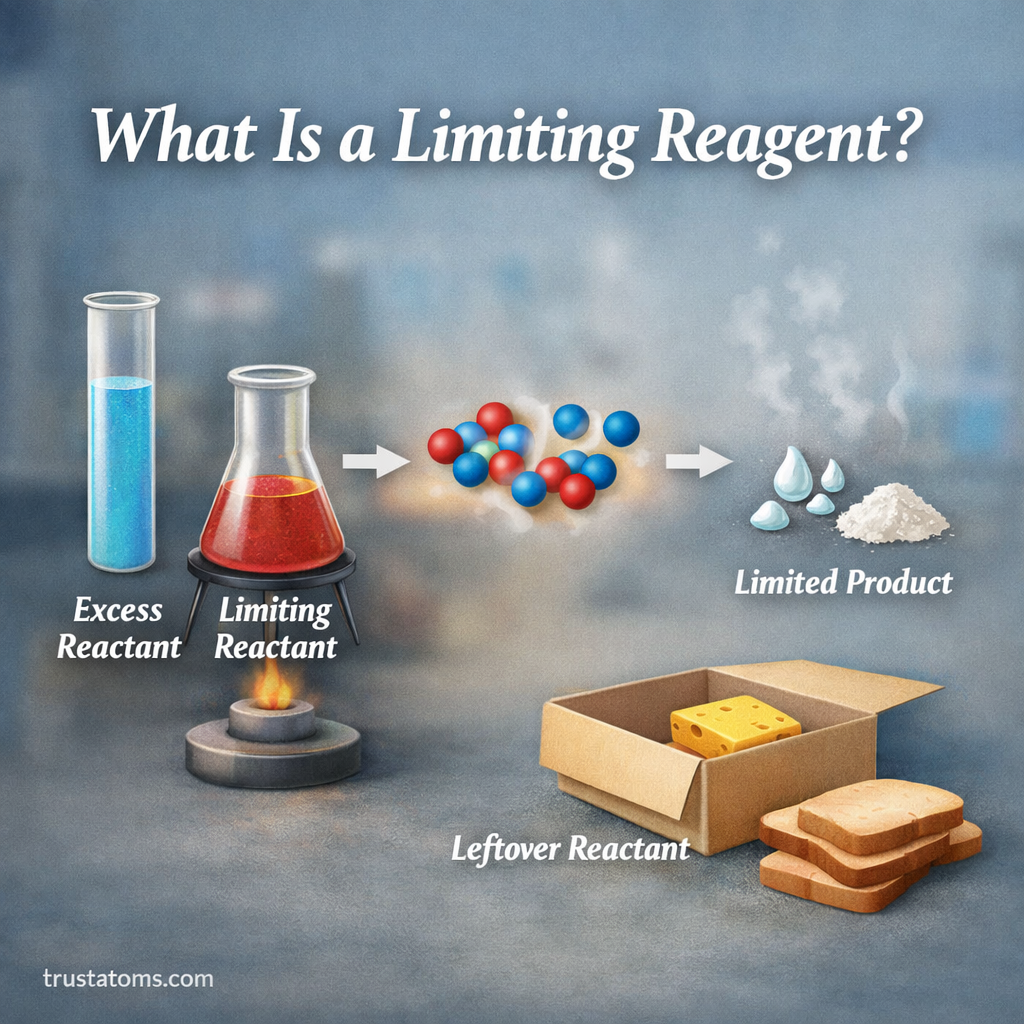
Educational chemistry illustration showing two reactants combining in a laboratory experiment where one reactant runs out first, demonstrating the concept of a limiting reagent.
Simple chemistry diagram illustrating how one reactant limits the amount of product formed in a reaction. trustatoms.com.

In many chemical reactions, substances combine in specific ratios based on a balanced chemical equation. However, the reactants available in the laboratory or in nature are not always present in exactly those ratios.

The limiting reagent (also called the limiting reactant) is the substance that runs out first during a chemical reaction, preventing more product from forming. Because it is consumed completely, it determines the maximum amount of product the reaction can produce.

Understanding limiting reagents is essential in chemistry because it helps scientists predict reaction yields, reduce waste, and optimize industrial chemical processes.

Continue reading “What Is a Limiting Reagent?”

What Is Percent Yield?

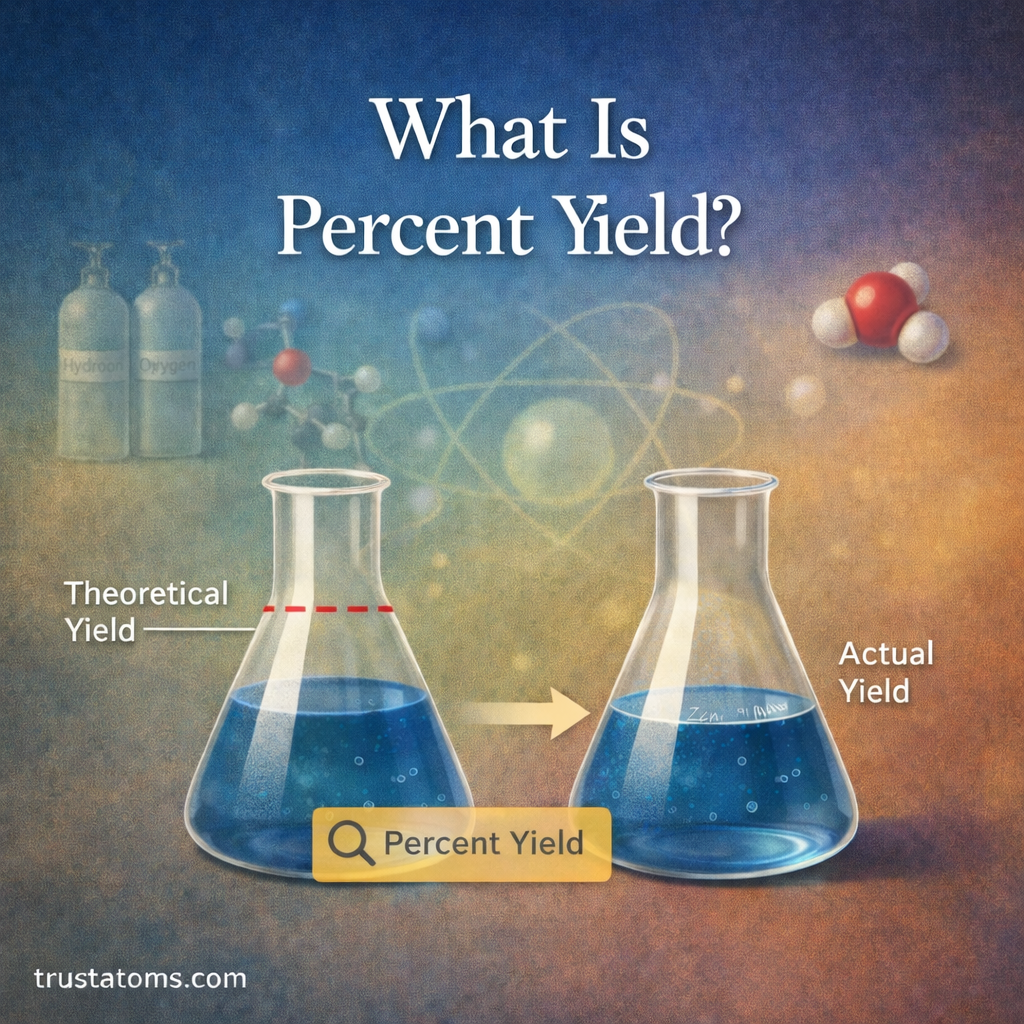
Chemistry illustration comparing theoretical yield and actual yield using laboratory flasks to explain the concept of percent yield.
Educational chemistry illustration comparing theoretical yield and actual yield to explain how percent yield measures reaction efficiency. trustatoms.com.

In chemistry, reactions rarely produce the exact amount of product predicted by calculations. Even with carefully controlled experiments, some materials may be lost, reactions may not go to completion, or side reactions may occur. Because of this, chemists use percent yield to measure how efficient a chemical reaction actually is.

Percent yield compares the amount of product obtained in a real experiment to the maximum amount that could theoretically be produced. This value helps scientists determine whether a reaction is working efficiently or if improvements are needed.

Understanding percent yield is an important skill in chemistry, especially when studying reaction efficiency, laboratory experiments, and industrial chemical processes.

Continue reading “What Is Percent Yield?”

What Is Reaction Yield?

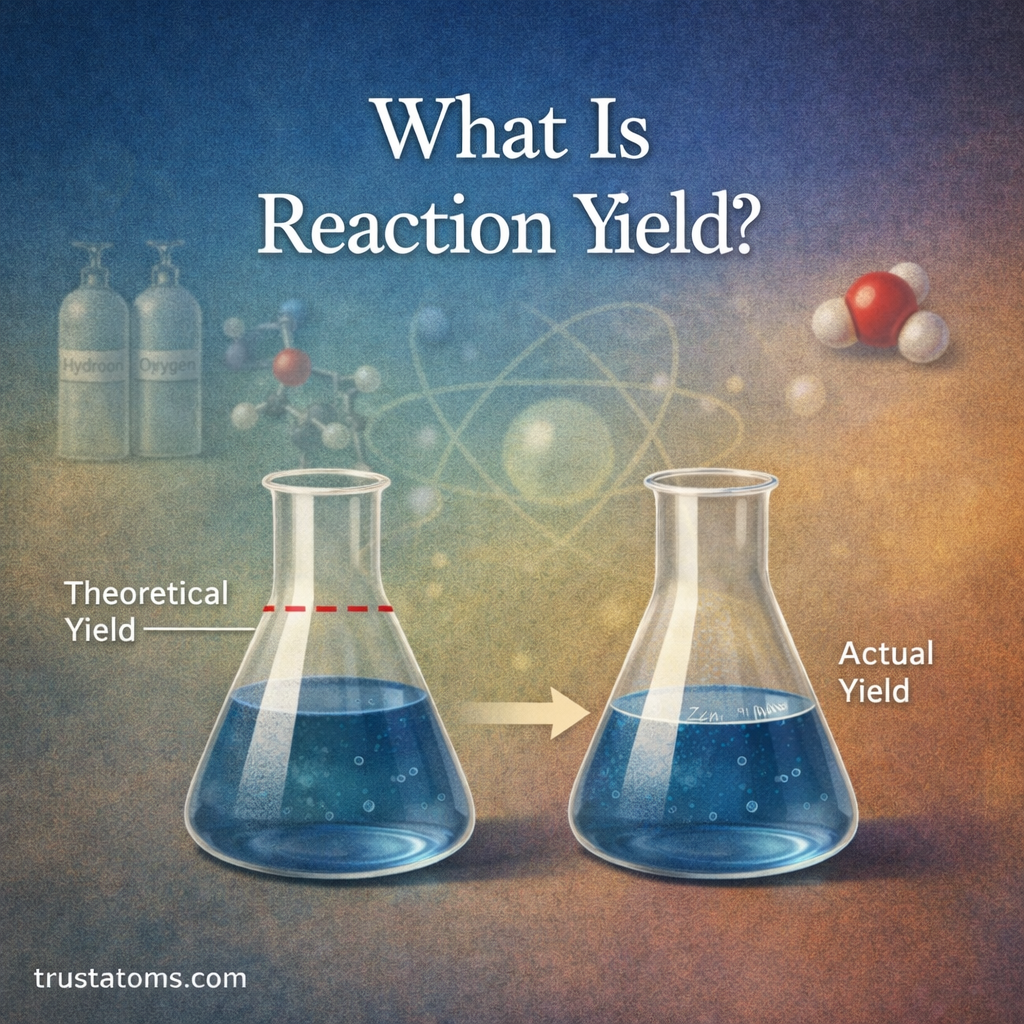
Educational chemistry illustration showing two laboratory flasks representing theoretical yield and actual yield in a chemical reaction.
Chemistry illustration comparing theoretical yield and actual yield to explain how reaction yield measures product efficiency. trustatoms.com.

In chemistry, not every reaction produces as much product as expected. Even when the chemical equation is balanced correctly and the experiment is carefully designed, the amount of product formed can vary. This is where reaction yield becomes important.

Reaction yield measures how much product a chemical reaction actually produces compared to how much it was expected to produce. It helps chemists evaluate the efficiency of reactions in laboratories, industrial manufacturing, and scientific research.

Understanding reaction yield is essential for predicting reaction outcomes, improving chemical processes, and reducing waste.

Continue reading “What Is Reaction Yield?”

How to Balance Chemical Equations

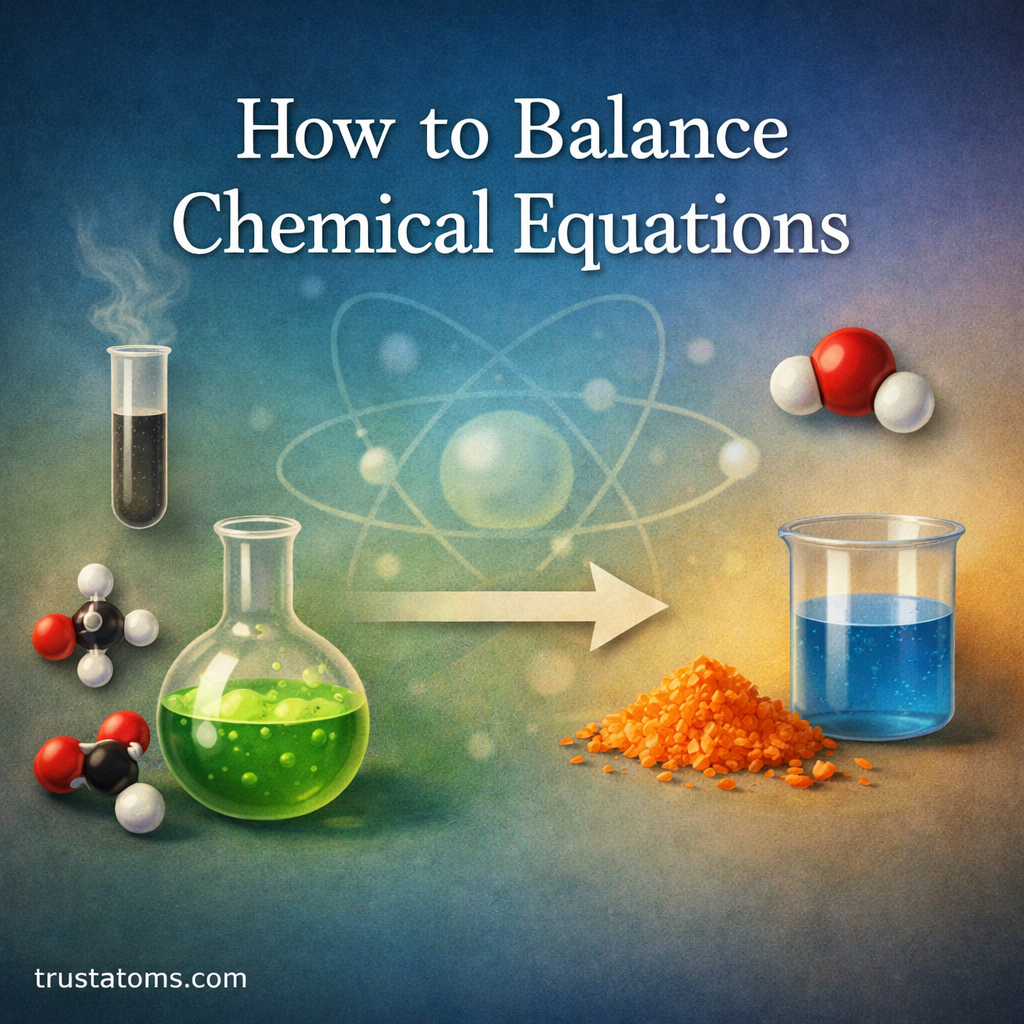
Illustrated chemistry diagram showing reactants turning into products with lab glassware and molecules representing how to balance chemical equations.
Educational chemistry illustration showing reactants converting into products to represent balancing chemical equations. trustatoms.com.

Chemical reactions describe how substances transform into new substances. Chemists represent these reactions using chemical equations, which show the reactants (starting materials) and the products (new substances formed).

However, chemical equations must follow one critical rule: the law of conservation of mass. This means matter cannot be created or destroyed during a reaction. The number of atoms of each element must be the same on both sides of the equation.

Balancing chemical equations ensures that this rule is satisfied and that the equation accurately reflects the reaction taking place.

Continue reading “How to Balance Chemical Equations”

What Is a Chemical Equation?

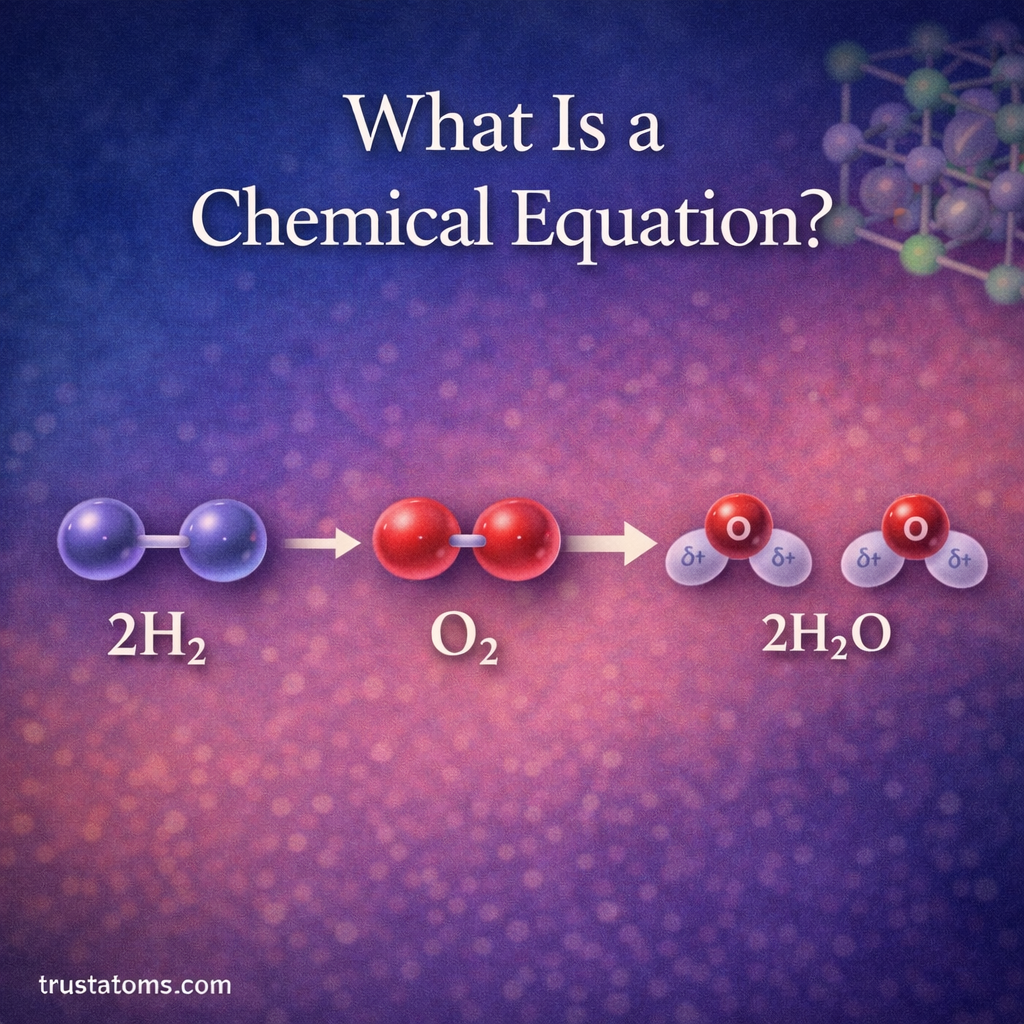
Chemistry diagram showing a chemical reaction where hydrogen and oxygen combine to form water, illustrating a chemical equation.
Simple chemistry illustration showing a reaction between hydrogen and oxygen forming water as an example of a chemical equation. trustatoms.com.

A chemical equation is a symbolic way of representing a chemical reaction. It shows the substances involved in the reaction and how they change into new substances.

Chemists use chemical equations to describe reactions clearly and concisely. Instead of writing long explanations, they use chemical formulas, symbols, and arrows to show how reactants transform into products.

Understanding chemical equations is essential for studying chemistry because they help explain how matter changes during reactions.

Continue reading “What Is a Chemical Equation?”