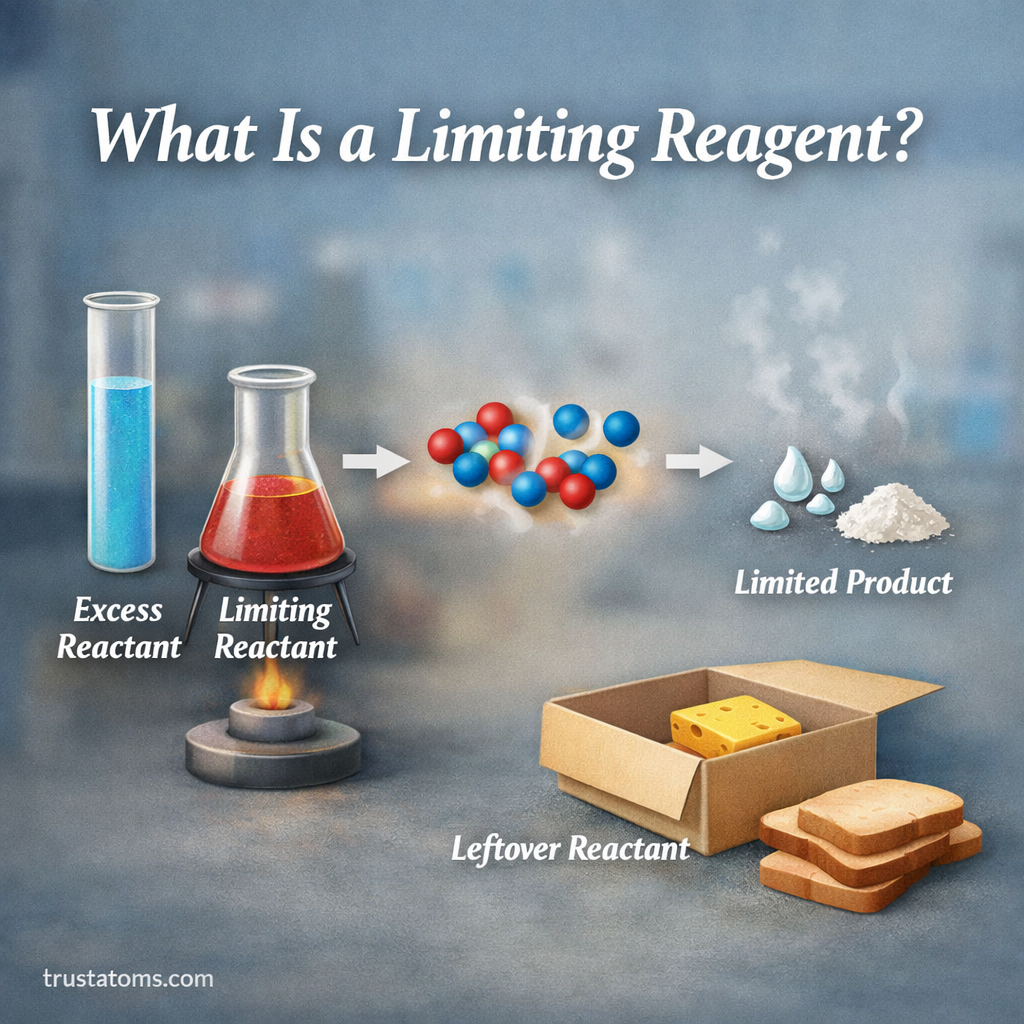
A limiting reagent, also called a limiting reactant, is the reactant that is completely consumed first in a chemical reaction when the reactants are not present in the required proportions. It determines the maximum amount of product that can form, assuming the reaction proceeds as represented by its balanced chemical equation.
In the study of chemistry, identifying limiting reagents helps scientists predict reaction yields, reduce unused materials, and plan laboratory or industrial reactions. The key is comparing available reactant amounts with the mole ratios required by the balanced equation.
Understanding Limiting Reagents With a Sandwich Example
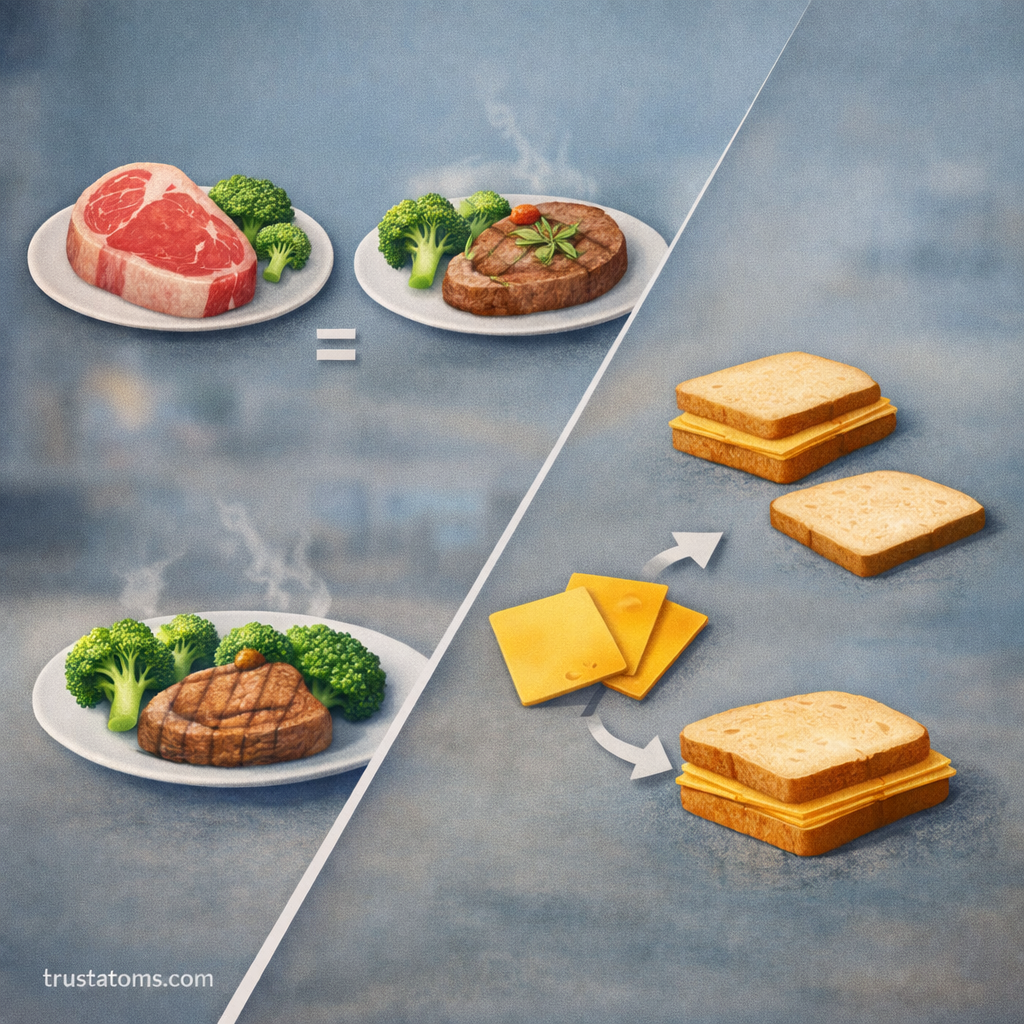
Imagine making cheese sandwiches. Each sandwich requires two slices of bread and one slice of cheese. You have 10 slices of bread and 3 slices of cheese.
The bread could make five sandwiches, but the cheese is enough for only three. Therefore, you can make three complete sandwiches, leaving four slices of bread unused.
Cheese is the limiting ingredient, while bread is in excess. Chemical reactions work similarly, except their required proportions come from balanced chemical equations rather than recipes.
Limiting Reagent in a Chemical Reaction
Chemical reactions follow stoichiometry, meaning reactants combine in fixed mole ratios defined by the balanced chemical equation. The coefficients indicate the relative amounts needed for the reaction.
Consider the formation of water:
2H₂ + O₂ → 2H₂O
Two moles of hydrogen react with one mole of oxygen to produce two moles of water. If 4 moles of hydrogen and 1 mole of oxygen are available, the oxygen can react with only 2 moles of hydrogen. Oxygen is limiting, and 2 moles of hydrogen remain.
Understanding limiting reactants in chemical reactions helps distinguish the substance that runs out from one that remains in excess. More detailed stoichiometric calculations in reaction systems use these relationships to predict product amounts and leftover reactants.
How to Identify the Limiting Reagent
The most reliable method is to calculate how much of the same product each reactant could produce independently. The reactant that gives the smaller product amount is limiting.
- Write and balance the chemical equation so the reactant and product ratios are correct.
- Convert each reactant quantity to moles, using its molar mass if the amount is given in grams.
- Use the coefficients to calculate the possible amount of a chosen product from each reactant.
- Compare the product amounts. The reactant producing the smaller amount is the limiting reagent.
- Use the limiting reagent to calculate theoretical yield and determine how much excess reactant remains.
When converting mass to moles, use the relationship: moles = mass in grams ÷ molar mass in grams per mole. Always compare mole quantities using the balanced equation rather than comparing masses directly.
Worked Example: Finding the Limiting Reagent and Theoretical Yield
Suppose a laboratory reaction combines 6.0 moles of hydrogen gas with 2.0 moles of oxygen gas. How much water can form, and which reactant will remain?
Balanced equation: 2H₂ + O₂ → 2H₂O
Step 1: Calculate Water From Hydrogen
The equation shows that 2 moles of hydrogen produce 2 moles of water. Therefore, 6.0 moles of hydrogen could produce 6.0 moles of water if sufficient oxygen were available.
Step 2: Calculate Water From Oxygen
Each mole of oxygen produces 2 moles of water. Therefore, 2.0 moles of oxygen could produce 4.0 moles of water.
Step 3: Compare the Possible Product Amounts
| Reactant | Available Amount | Possible Water Produced |
|---|---|---|
| Hydrogen (H₂) | 6.0 mol | 6.0 mol H₂O |
| Oxygen (O₂) | 2.0 mol | 4.0 mol H₂O |
Oxygen produces the smaller amount of water, so oxygen is the limiting reagent. The theoretical yield is 4.0 moles of water, equivalent to approximately 72 grams using a molar mass of 18.0 grams per mole.
Step 4: Calculate the Excess Hydrogen
Reacting 2.0 moles of oxygen requires 4.0 moles of hydrogen. Because 6.0 moles of hydrogen were initially available, 2.0 moles remain after the oxygen is completely consumed.
This result assumes the reaction proceeds to completion according to the balanced equation, without competing reactions or material losses.
What Happens When Reactants Are in Exact Proportions?
Not every mixture contains an excess reactant. If hydrogen and oxygen are supplied in exactly the required 2:1 mole ratio, both can be completely consumed together.
For example, 10 moles of hydrogen require exactly 5 moles of oxygen. With those amounts, neither reactant is present in excess, and both are fully consumed in the idealized complete reaction.
This is called a stoichiometric mixture. It is useful to recognize because not every limiting-reagent problem has one reactant left over.
What Is an Excess Reagent?
An excess reagent is a reactant supplied in a greater amount than the balanced equation requires relative to the limiting reagent. Some remains unreacted when the limiting reagent is fully consumed.
In some industrial processes, manufacturers deliberately supply one reactant in excess to favor the consumption of another. However, using too much excess material may increase costs, complicate separation, or generate additional waste.
The amount remaining can be calculated by subtracting the amount consumed from the initial amount, using the appropriate mole ratio.
How Limiting Reagents Determine Theoretical and Percent Yield
Theoretical yield is the maximum product amount predicted from the limiting reagent under the assumed reaction conditions. Actual yield is the amount of product collected or measured experimentally.
Actual reactions rarely reach 100% efficiency, which is why chemists calculate percent yield by comparing theoretical and actual results.
Percent yield = (actual yield ÷ theoretical yield) × 100%
For example, if the theoretical yield is 72 grams of water but only 63 grams are collected, the percent yield is 87.5%. Product loss during collection, incomplete reaction, and side reactions are possible reasons for a lower measured yield.
Where Limiting Reagent Calculations Are Used
Limiting reagent calculations are useful whenever reactant quantities affect production, cost, or experimental planning.
- Chemical manufacturing: estimating product output and reducing unnecessary consumption of expensive reactants.
- Pharmaceutical synthesis: planning reagent quantities and predicting the maximum amount of a desired compound.
- Laboratory experiments: selecting reactant amounts and comparing theoretical yield with collected product.
- Environmental treatment: calculating how much treatment chemical is required for a specified reaction with a contaminant.
These calculations provide a starting estimate. Actual industrial performance also depends on reaction kinetics, equilibrium, mixing, temperature, and separation efficiency.
Common Mistakes in Limiting Reagent Problems
- Using an unbalanced equation: incorrect coefficients produce incorrect reactant ratios.
- Comparing grams directly: reactants have different molar masses, so their masses cannot be compared without conversion.
- Choosing the smaller mole amount automatically: the required mole ratio must also be considered.
- Calculating yield from the excess reactant: theoretical yield must be based on the limiting reagent.
A useful check is to calculate the product amount from every reactant independently. If the results differ, the smallest possible product amount identifies the limiting reagent.
Frequently Asked Questions
Is the limiting reagent always the reactant with the smallest mass?
No. The limiting reagent depends on the available moles and the reaction’s required mole ratios, not simply on which reactant weighs less. A reactant with a larger mass can still be limiting.
Can two reactants both be limiting?
If two reactants are present in exactly the stoichiometric proportions, both can be consumed completely together. In this case, neither is in excess, and both determine the maximum possible reaction extent.
Does the limiting reagent always disappear completely in a real experiment?
Not necessarily. In idealized stoichiometry problems, the limiting reagent is assumed to be fully consumed. Real reactions may stop before completion because of equilibrium, slow reaction rates, or other experimental conditions.
A limiting reagent determines the theoretical maximum product because it is the reactant available in insufficient proportion to consume all the others. Comparing product amounts calculated from each reactant identifies the limiting substance and reveals how much excess material should remain. This method connects balanced chemical equations to practical decisions about experimental quantities, product yields, and chemical waste.
Sources: OpenStax, Chemistry 2e; Brown et al., Chemistry: The Central Science; IUPAC, Compendium of Chemical Terminology (Gold Book).