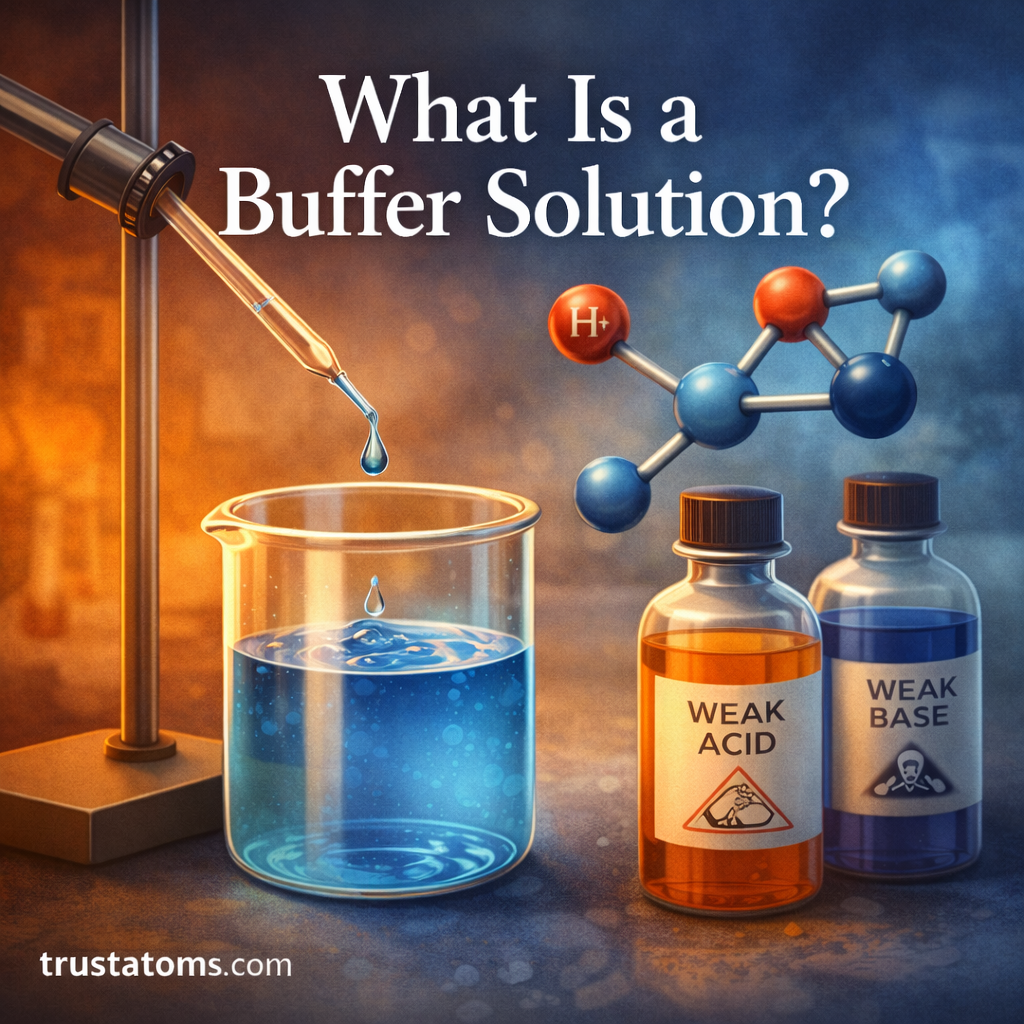
What Is a Buffer Solution?

Illustration explaining a buffer solution in chemistry with a beaker, pipette adding liquid, and bottles representing weak acid and weak base that stabilize pH.
Illustration showing how a buffer solution works by combining a weak acid and weak base to stabilize pH in a chemical system. trustatoms.com.

In chemistry, many reactions depend on the pH of a solution, which measures how acidic or basic it is. Some chemical systems require a stable pH to function properly. This is where buffer solutions play an important role.

A buffer solution is a special type of solution that resists changes in pH when small amounts of acid or base are added. Instead of allowing the solution to quickly become more acidic or more basic, a buffer stabilizes the pH and keeps it within a relatively narrow range.

Buffer solutions are essential in chemistry, biology, medicine, and many industrial processes.

Continue reading “What Is a Buffer Solution?”
What Is Reaction Rate?

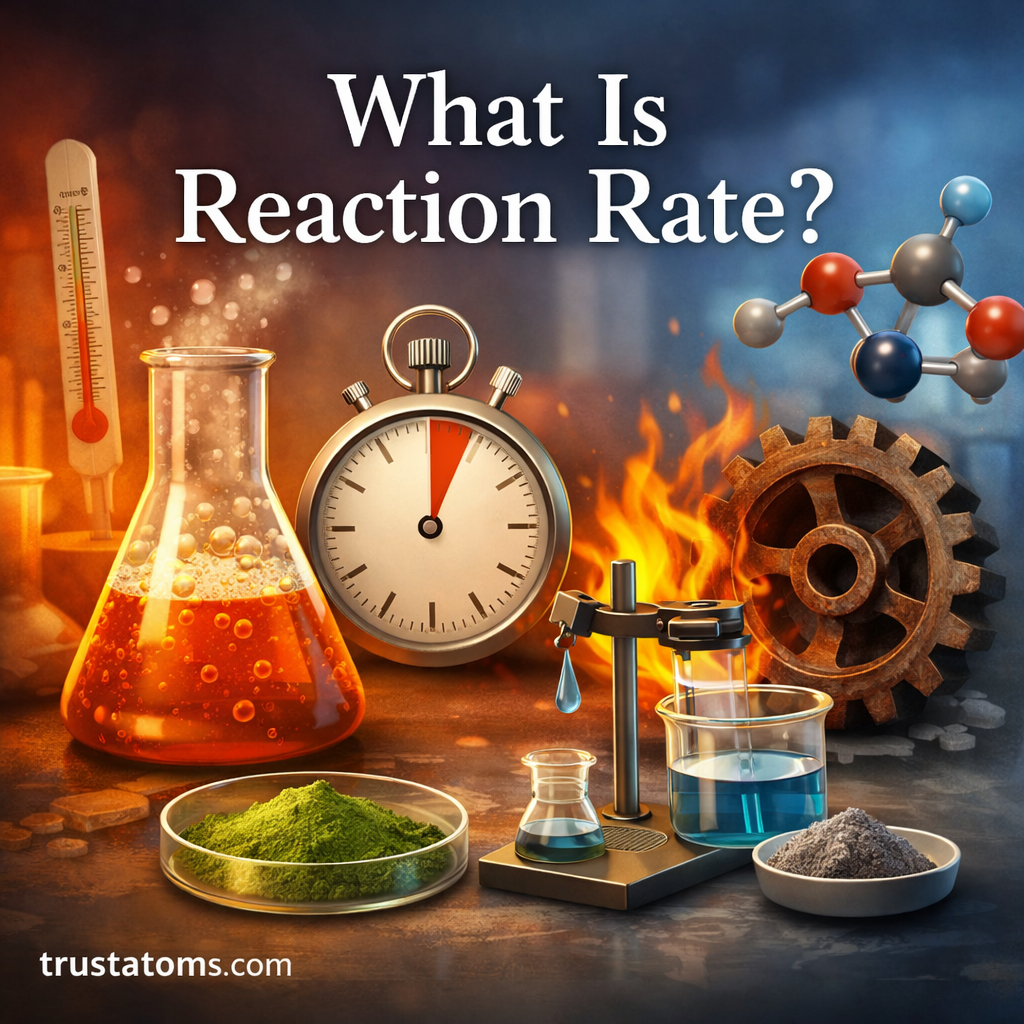
Illustration showing the concept of reaction rate in chemistry with lab equipment, molecules, and a timer representing how fast chemical reactions occur.
Illustration representing the concept of reaction rate in chemistry, showing how quickly reactants change into products. trustatoms.com.

Reaction rate is a fundamental concept in chemistry that describes how fast a chemical reaction occurs. Some reactions happen almost instantly—like fireworks exploding—while others occur very slowly, such as the rusting of iron or the formation of sedimentary rock.

Understanding reaction rates helps chemists control reactions in laboratories, optimize industrial processes, and predict how chemical systems behave in real-world environments.

In simple terms, the reaction rate tells us how quickly reactants are converted into products over time.

Continue reading “What Is Reaction Rate?”

What Is Concentration in Chemistry?

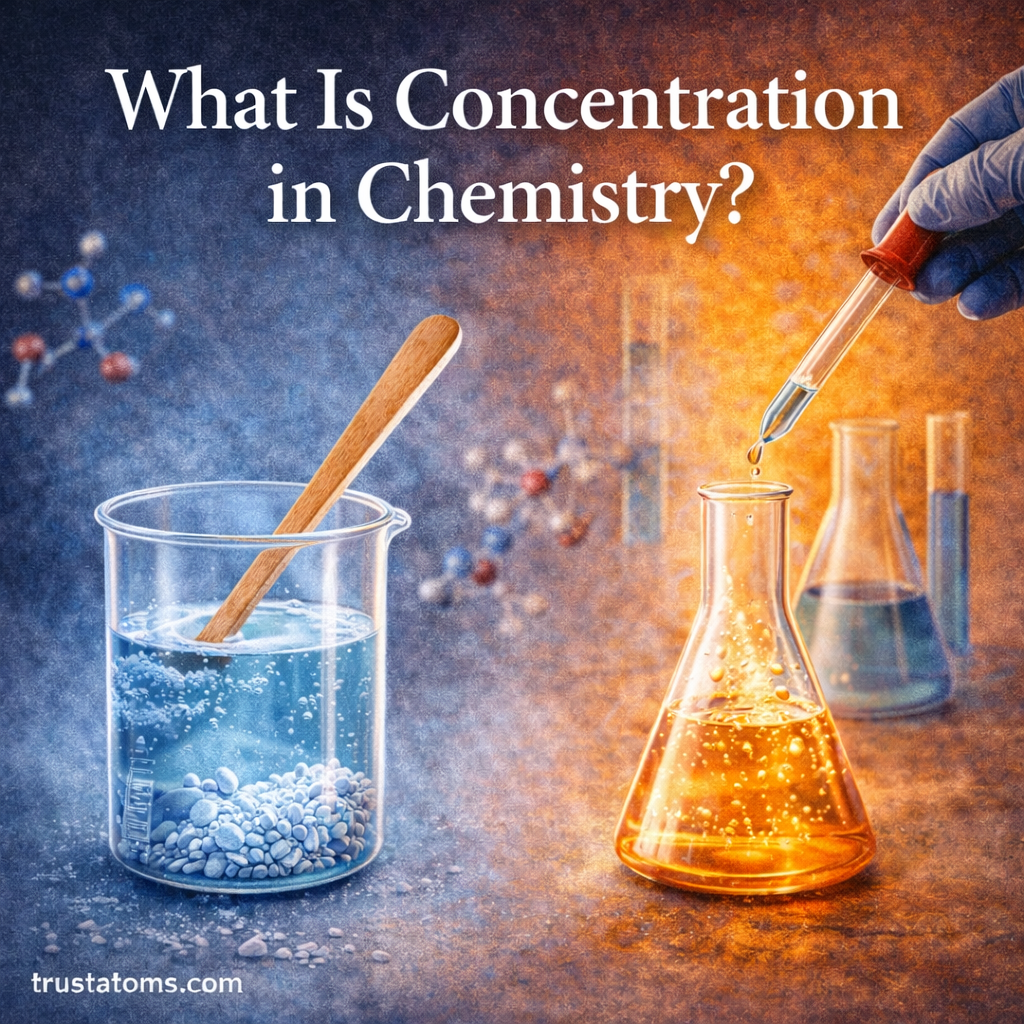
Illustration explaining concentration in chemistry, showing dilute and concentrated solutions in laboratory glassware.
Illustration demonstrating the difference between dilute and concentrated chemical solutions. trustatoms.com.

In chemistry, concentration refers to the amount of a substance (called a solute) that is present in a given amount of another substance (usually a solvent or solution). It describes how strong or diluted a chemical solution is.

For example, when sugar dissolves in water, the sugar is the solute and the water is the solvent. The concentration tells us how much sugar is dissolved in the water.

Understanding concentration is important in chemistry because it affects how reactions occur, how substances behave in solutions, and how chemical mixtures are measured and controlled in laboratories, medicine, and industry.

Continue reading “What Is Concentration in Chemistry?”

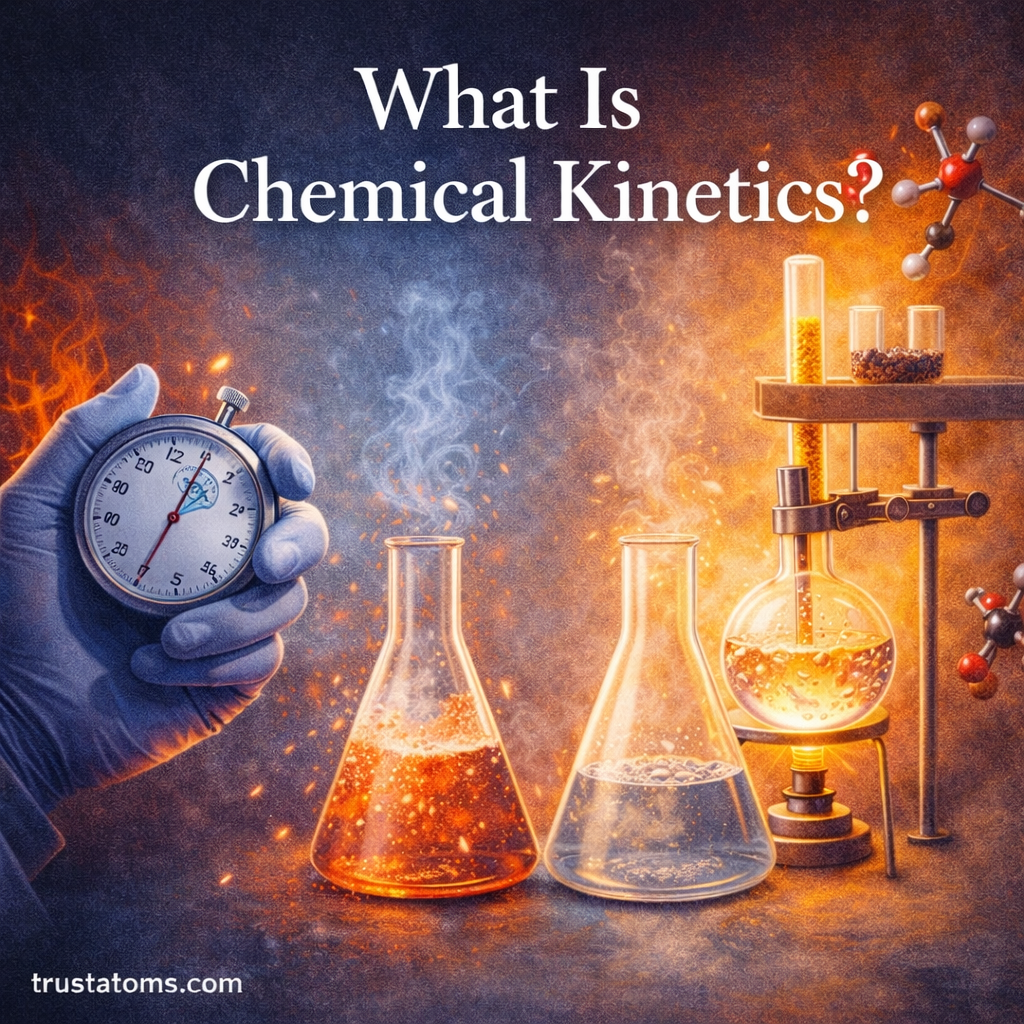
What Is Chemical Kinetics?

Illustration explaining chemical kinetics with laboratory flasks, a stopwatch representing reaction speed, and a heated reaction setup.
Conceptual illustration representing chemical kinetics and the study of reaction rates in chemistry. trustatoms.com.

Chemical kinetics is the branch of chemistry that studies how fast chemical reactions occur and what factors influence their speed. While thermodynamics explains whether a reaction can happen, chemical kinetics focuses on how quickly the reaction takes place and the steps involved in the process.

Understanding reaction rates is important in many fields, including medicine, environmental science, engineering, and industrial manufacturing. By studying chemical kinetics, scientists can control reactions to make them safer, more efficient, and more predictable.

Continue reading “What Is Chemical Kinetics?”

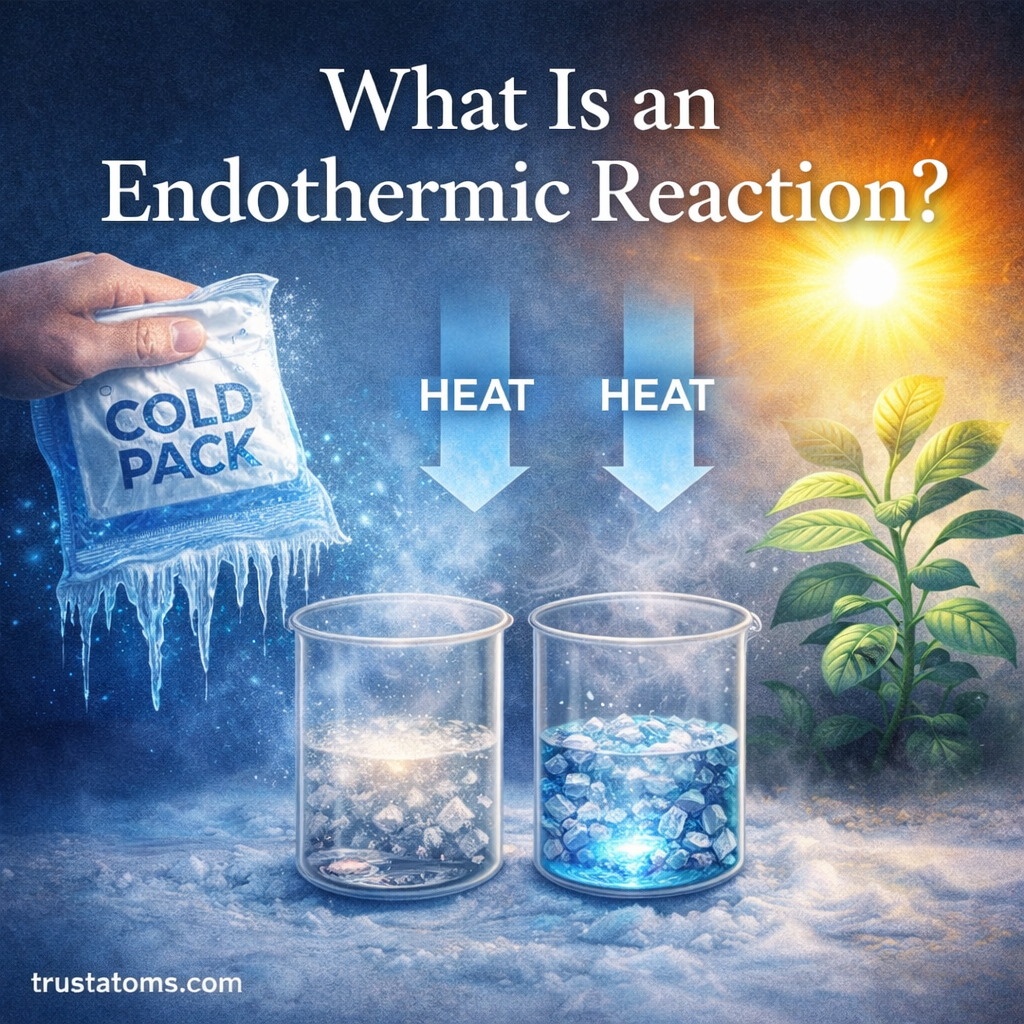
What Is an Endothermic Reaction?

Illustration explaining an endothermic reaction, showing a cold pack, laboratory beakers absorbing heat, and a plant using sunlight for photosynthesis.
Conceptual illustration showing how endothermic reactions absorb heat energy from their surroundings. trustatoms.com.

An endothermic reaction is a chemical reaction that absorbs energy from its surroundings, usually in the form of heat. Instead of releasing heat like exothermic reactions, endothermic reactions require a continuous input of energy for the reaction to occur.

This energy absorption often causes the surrounding environment to feel cooler. Because of this, endothermic reactions are commonly used to demonstrate energy transfer in chemistry labs and natural processes.

Endothermic reactions play an important role in both nature and technology, helping power biological processes, environmental cycles, and industrial chemical production.

Continue reading “What Is an Endothermic Reaction?”

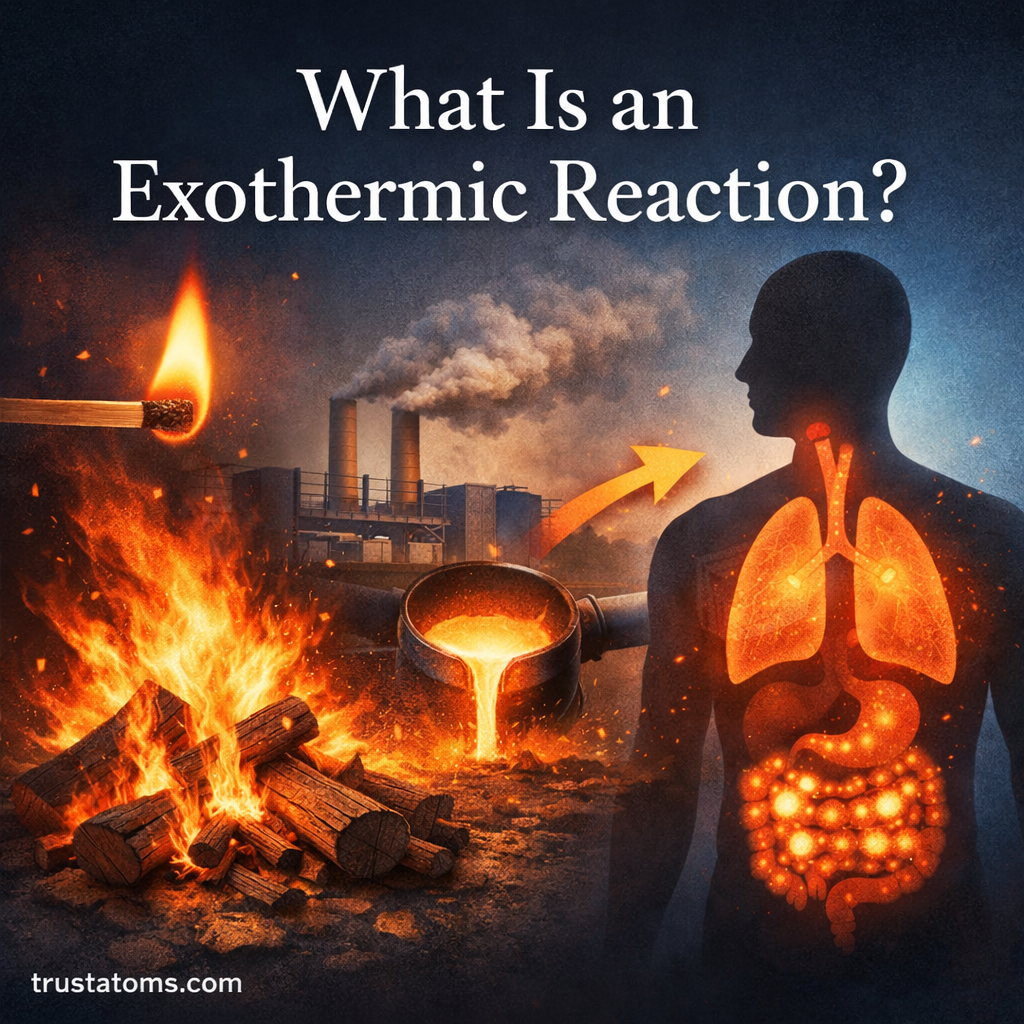
What Is an Exothermic Reaction?

Illustration showing heat energy being released during an exothermic reaction, with examples like combustion, industrial heat processes, and biological energy release.
Conceptual illustration showing examples of exothermic reactions that release energy as heat. trustatoms.com

Exothermic reactions are chemical reactions that release energy into their surroundings, usually in the form of heat. These reactions are common in everyday life—from lighting a match to burning fuel in a car engine. In chemistry, understanding exothermic reactions helps explain how energy flows through chemical processes and why certain reactions occur spontaneously.

When an exothermic reaction takes place, the total energy released by forming new chemical bonds is greater than the energy required to break the original bonds in the reactants. The extra energy is released into the environment, often causing the surroundings to become warmer.

Continue reading “What Is an Exothermic Reaction?”

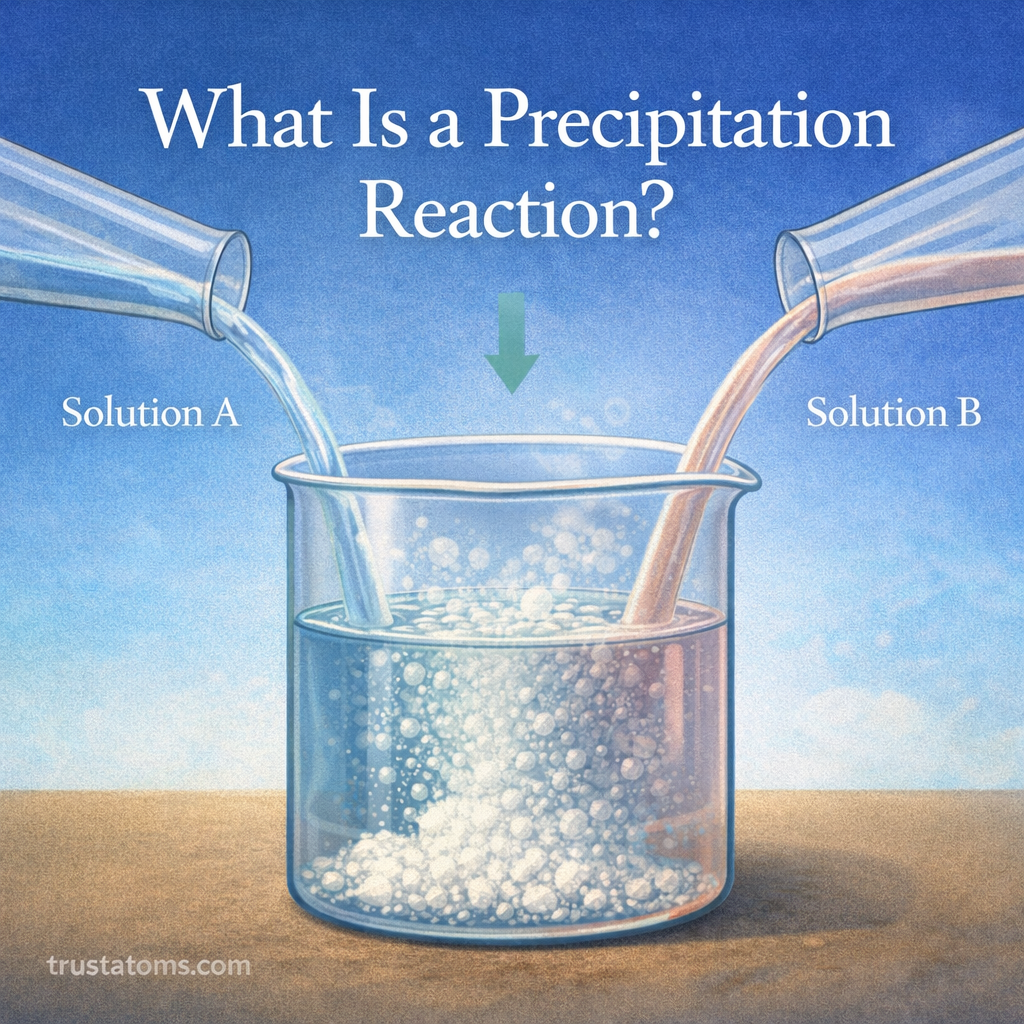
What Is a Precipitation Reaction?

Illustration showing two liquid solutions mixing in a beaker to form a solid precipitate during a precipitation reaction.
Illustration demonstrating a precipitation reaction where two dissolved solutions combine to form a solid precipitate in the liquid. trustatoms.com.

A precipitation reaction is a type of chemical reaction in which two dissolved substances react to form a solid that separates from the solution. The solid that forms is called a precipitate.

These reactions commonly occur when two aqueous (water-based) solutions are mixed together and an insoluble compound forms. The solid particles appear cloudy at first and then settle at the bottom of the container.

Precipitation reactions are important in chemistry because they help scientists identify substances, remove impurities, and understand how compounds interact in solution.

Continue reading “What Is a Precipitation Reaction?”

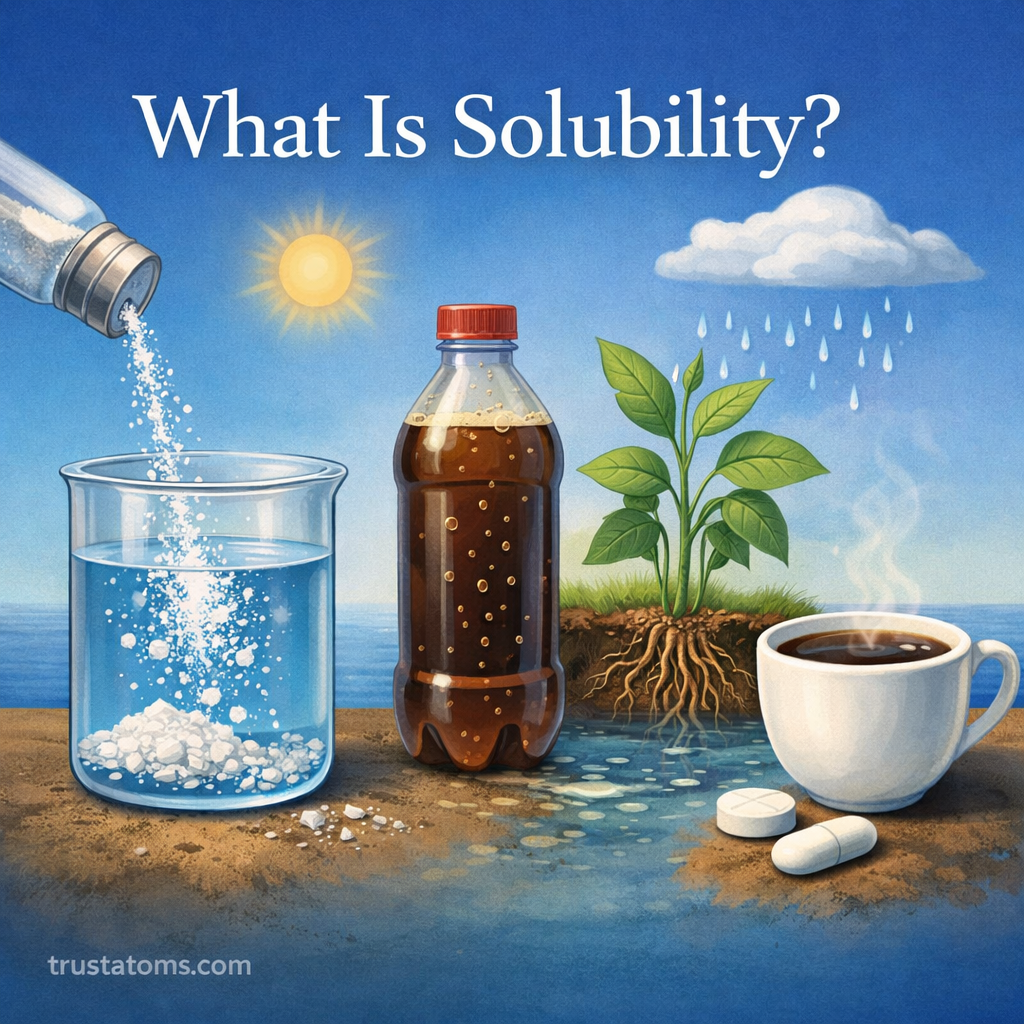
What Is Solubility?

Illustration explaining solubility with salt dissolving in water, soda bubbles, plant roots in water, and a cup of coffee.
Simple illustration showing examples of solubility such as salt dissolving in water, carbonation in soda, and substances dissolving in everyday liquids. trustatoms.com.

Solubility is one of the most important concepts in chemistry because it explains how and why substances dissolve in liquids. From sugar dissolving in coffee to oxygen dissolving in water for fish to breathe, solubility helps scientists understand how different materials interact.

In simple terms, solubility describes the ability of a substance to dissolve in another substance, usually a liquid. Understanding solubility helps explain many natural processes, industrial applications, and everyday experiences.

Continue reading “What Is Solubility?”

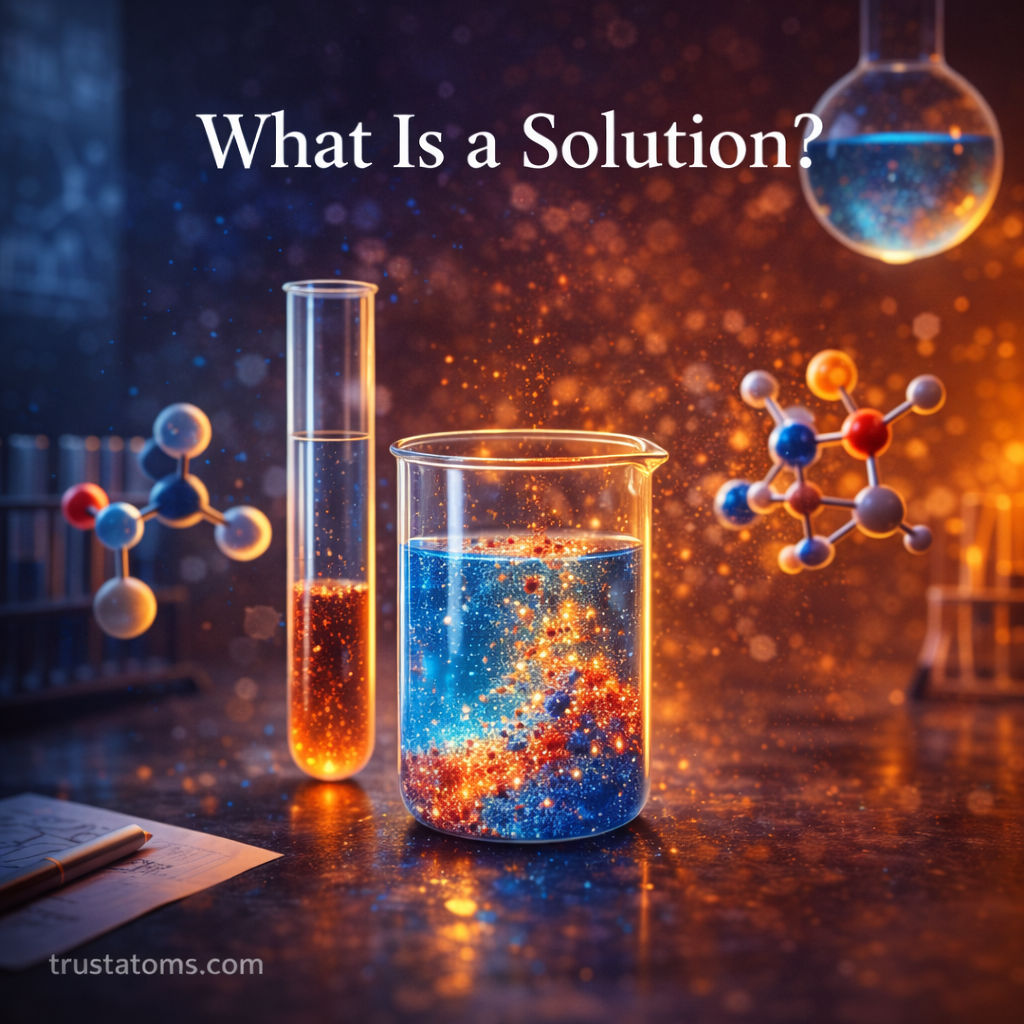
What Is a Solution?

Illustration showing a solute dissolving into a liquid solvent inside laboratory glassware representing a chemical solution.
Illustration showing particles dissolving in a liquid to form a chemical solution. trustatoms.com.

In chemistry, a solution is a type of mixture where one substance dissolves evenly into another. The result is a uniform mixture in which the individual components cannot be easily distinguished.

Solutions are extremely common in everyday life. From saltwater and sugar in coffee to air and metal alloys, many substances around us exist as solutions.

Understanding solutions helps explain how substances mix, dissolve, and interact in chemical systems.

Continue reading “What Is a Solution?”

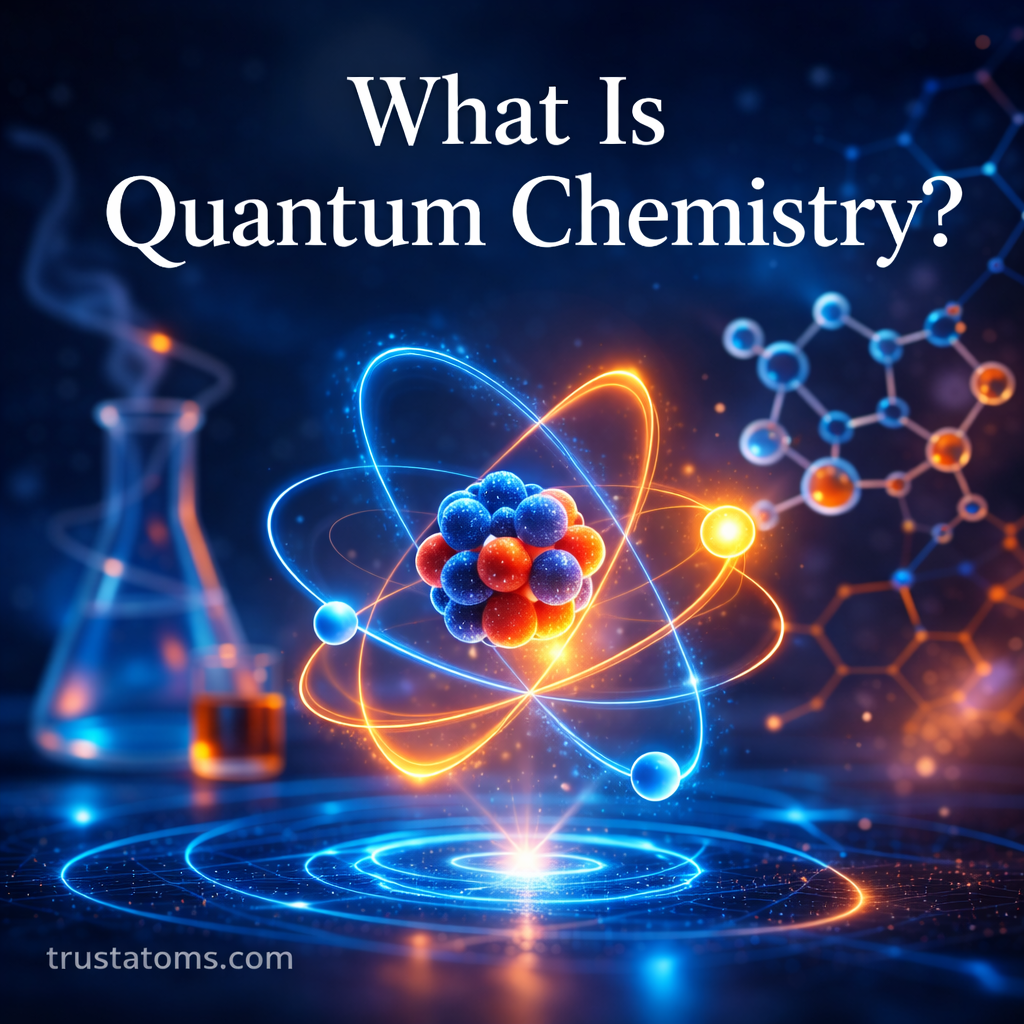
What Is Quantum Chemistry?

Illustration showing atomic and molecular structures representing quantum chemistry and electron behavior with the title “What Is Quantum Chemistry?”
Illustration representing how quantum mechanics explains electron behavior and molecular structure in quantum chemistry. trustatoms.com.

Quantum chemistry is the branch of chemistry that uses the principles of quantum mechanics to understand how atoms and molecules behave. It focuses on how electrons move, interact, and form chemical bonds at the smallest scales of matter.

Unlike classical chemistry, which often describes reactions and structures using simplified models, quantum chemistry explains chemical behavior using mathematical and physical laws that govern subatomic particles.

This field helps scientists understand why molecules form the shapes they do, how chemical reactions occur, and how energy moves through atomic systems.

Continue reading “What Is Quantum Chemistry?”