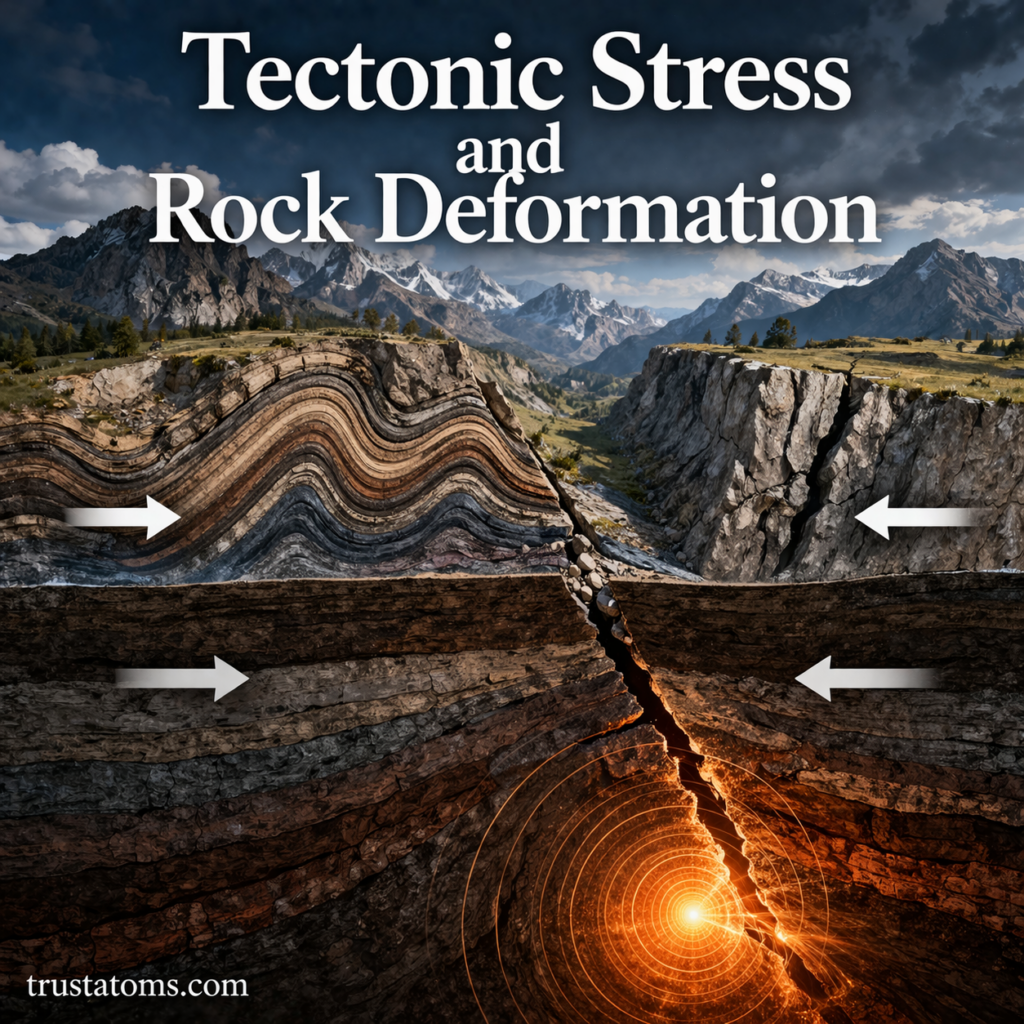
Tectonic stress is the force per unit area acting within Earth’s rocks, while rock deformation is the resulting change in their shape, size, or position. Forces generated by moving tectonic plates can compress, stretch, or shear rocks, producing folds, faults, mountain ranges, and earthquakes.
Rocks may deform slowly over thousands or millions of years or fracture suddenly when accumulated stress exceeds their resistance to failure. Understanding these responses is part of Earth science because geological structures preserve evidence of the forces that shaped Earth’s crust.
What Is Tectonic Stress?
Tectonic stress describes internal forces distributed through rock as Earth’s plates move and interact. Stress is measured in units of pressure, such as pascals or megapascals, and may act differently in different directions.
When stress changes, rocks may undergo strain, meaning a measurable change in shape or dimensions. The relationship between stress and strain depends on rock composition, temperature, pressure, and how quickly deformation occurs.
At locked faults, deformation can store elastic energy before sudden slipping releases part of it. This process is examined in Tectonic Stress Accumulation.
Over longer periods, compressional forces can shorten and thicken the crust, contributing to the geological processes described in Mountain Building Processes.
The Three Main Types of Tectonic Stress
Geologists commonly describe three simplified stress types: compression, tension, and shear. Natural rocks frequently experience combinations of these forces rather than one perfectly isolated type.
Compressional Stress: Rocks Are Pushed Together
Compressional stress occurs when forces squeeze rock from opposing directions. It commonly produces shortening, thickening, folding, and reverse or thrust faulting.
Compression is especially prominent at convergent plate boundaries, where tectonic plates approach each other. The Himalayas provide a major example of crustal shortening and thickening associated with continental collision.
Tensional Stress: Rocks Are Pulled Apart
Tensional stress develops when rocks are stretched. If extension continues, the crust can become thinner and fracture along normal faults, where one block moves downward relative to another.
This deformation occurs in continental rift zones and near divergent plate boundaries. The East African Rift system illustrates how crustal extension can create long valleys bounded by faults.
Shear Stress: Rocks Move Sideways
Shear stress acts parallel to a surface and tends to distort rock or cause adjacent blocks to slide past each other. It commonly produces strike-slip faults with predominantly horizontal displacement.
The San Andreas Fault in California is a familiar example of shear-related deformation along a transform plate boundary. Sudden movement on locked fault segments can generate damaging earthquakes.
How Stress Causes Rock Deformation
Rock deformation can be elastic, meaning recoverable, or permanent, meaning the rock retains a changed shape or structure after the applied stress is reduced.
Elastic Deformation and Stored Energy
Elastic deformation occurs when rock changes shape under stress but can recover that change when the stress is removed. A familiar comparison is a spring that stretches slightly and returns to its original length.
Rocks are much stiffer than ordinary springs, but they can still store elastic strain energy. When a fault suddenly ruptures, some of that stored energy is released through seismic waves, frictional heating, and rock damage.
Permanent Deformation: Folding and Faulting
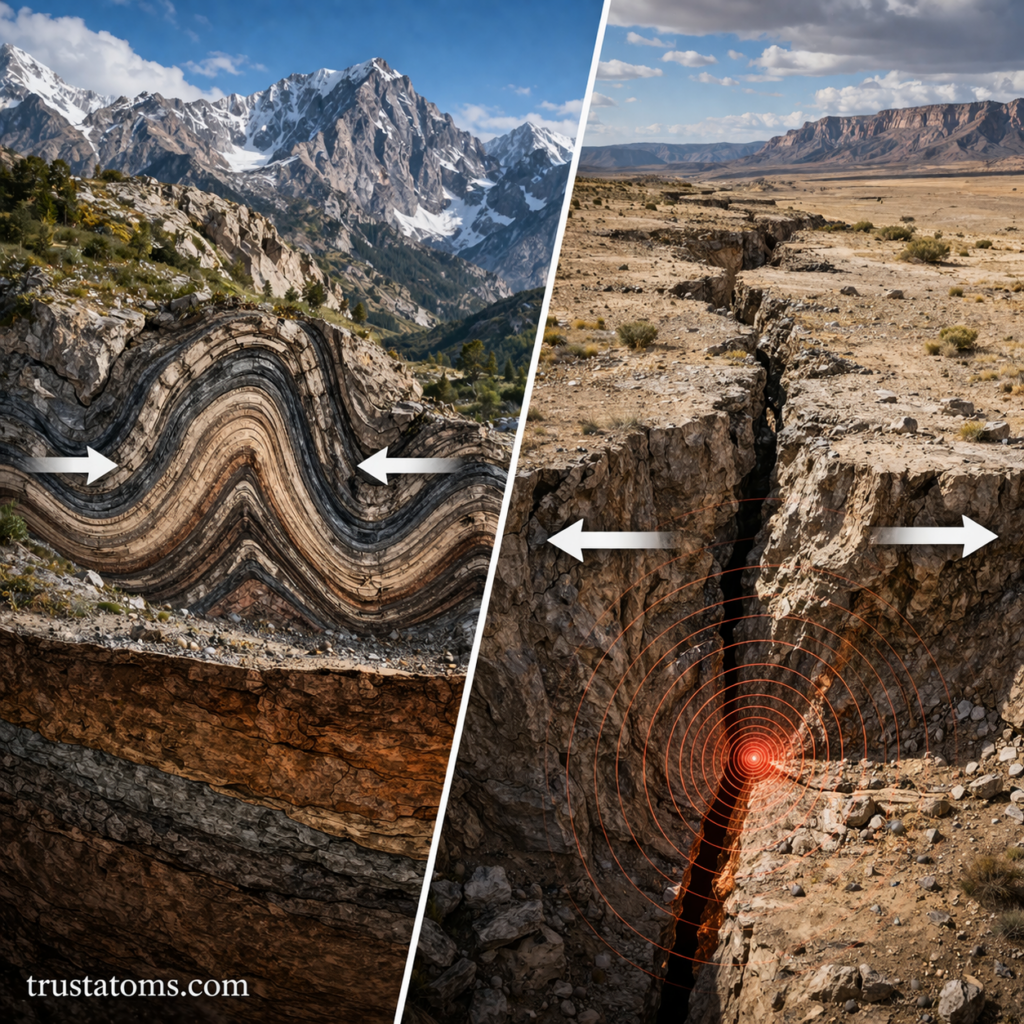
Permanent deformation includes ductile (folding) and brittle (faulting) behavior. Ductile deformation changes rock shape without forming a throughgoing fracture, while brittle deformation involves cracking or slipping along fractures.
Folds form when rock layers bend, often under compression. Common fold shapes include anticlines, which arch upward, and synclines, which bend downward.
Faults form when rocks fracture and displacement occurs across the fracture surface. A fracture without measurable displacement is generally called a joint rather than a fault.
Why Some Rocks Bend While Others Break
The same rock can behave differently under different physical conditions. Several factors determine whether deformation is predominantly elastic, ductile, or brittle.
- Temperature: Higher temperatures generally make sustained ductile deformation easier.
- Confining pressure: Greater surrounding pressure suppresses the opening of fractures and can favor ductile behavior.
- Rock composition: Mineral properties, grain size, and existing fractures influence strength and deformation.
- Strain rate: Slowly applied deformation often allows more time for ductile processes than rapid loading.
- Fluids: Water and other fluids can influence chemical reactions, rock strength, and effective pressure along faults.
These factors help explain why shallow crustal rocks commonly fracture while rocks deeper in the crust may deform through slow mineral-scale processes. The transition is gradual and varies between geological settings.
A Concrete Example of Rock Strain
Imagine a rock layer originally measuring 100 meters across. If tectonic compression shortens it to 95 meters, the layer has experienced 5 meters of shortening.
Its engineering strain, calculated as the change in length divided by the original length, is minus 0.05, or 5% shortening. The negative sign indicates compression rather than extension.
In nature, this shortening might be accommodated through folding, fault displacement, or distributed ductile deformation. Measuring the resulting structures helps geologists reconstruct how much a region has changed shape.
How Tectonic Stress Shapes Earth’s Surface
Different tectonic settings produce recognizable patterns of deformation. Their distribution reflects the movements of Earth’s Major Tectonic Plates and the mechanical properties of the surrounding crust.
| Tectonic setting | Common deformation | Resulting feature |
|---|---|---|
| Continental collision | Compression, folding, thrust faulting | Mountain belts |
| Continental rifting | Extension and normal faulting | Rift valleys |
| Transform boundary | Shearing and strike-slip faulting | Fault zones and offset landforms |
| Subduction margin | Compression and fault slip | Accretionary wedges and earthquakes |
These structures preserve evidence of past tectonic movement. For example, folded sedimentary layers exposed in a mountain range reveal deformation that may have occurred far beneath the surface before erosion uncovered them.
How Geologists Measure Rock Deformation
Geologists study deformation using field observations, laboratory experiments, and modern geophysical instruments. Each method provides information at a different spatial or temporal scale.
- Geological mapping: Measurements of tilted layers, folds, and fault offsets reveal deformation patterns.
- GNSS observations: Satellite positioning systems detect gradual crustal movement and strain accumulation.
- Satellite radar: Interferometric radar measurements reveal changes in ground position, including deformation associated with earthquakes.
- Rock mechanics experiments: Laboratory tests measure how rock samples respond to controlled stress, pressure, and temperature.
These measurements help researchers evaluate active faults and estimate seismic hazards. They cannot, however, reliably determine the exact date and location of a future earthquake.
Frequently Asked Questions
What is the difference between stress and strain?
Stress describes the internal force per unit area acting within rock, while strain measures the deformation that results. A rock can experience stress without undergoing large permanent deformation.
Can rocks fold without breaking?
Yes. Under suitable temperatures, pressures, and deformation rates, rocks can deform ductilely and develop folds without forming major fractures. This behavior is especially common in deeper parts of the crust.
Does every fault produce earthquakes?
No. Some faults are inactive, while others accommodate movement through gradual creep or slow-slip events. Earthquakes occur when fault movement is sufficiently sudden to generate detectable seismic waves.
Tectonic stress determines how forces act within Earth’s crust, while rock deformation records the resulting changes. Compression can build folded mountain belts, extension can create rift valleys, and shear can displace faults, leaving geological evidence that scientists use to reconstruct tectonic history and assess earthquake hazards.
Sources: U.S. Geological Survey, Earthquake Hazards Program; Fossen, Structural Geology; Twiss and Moores, Structural Geology.