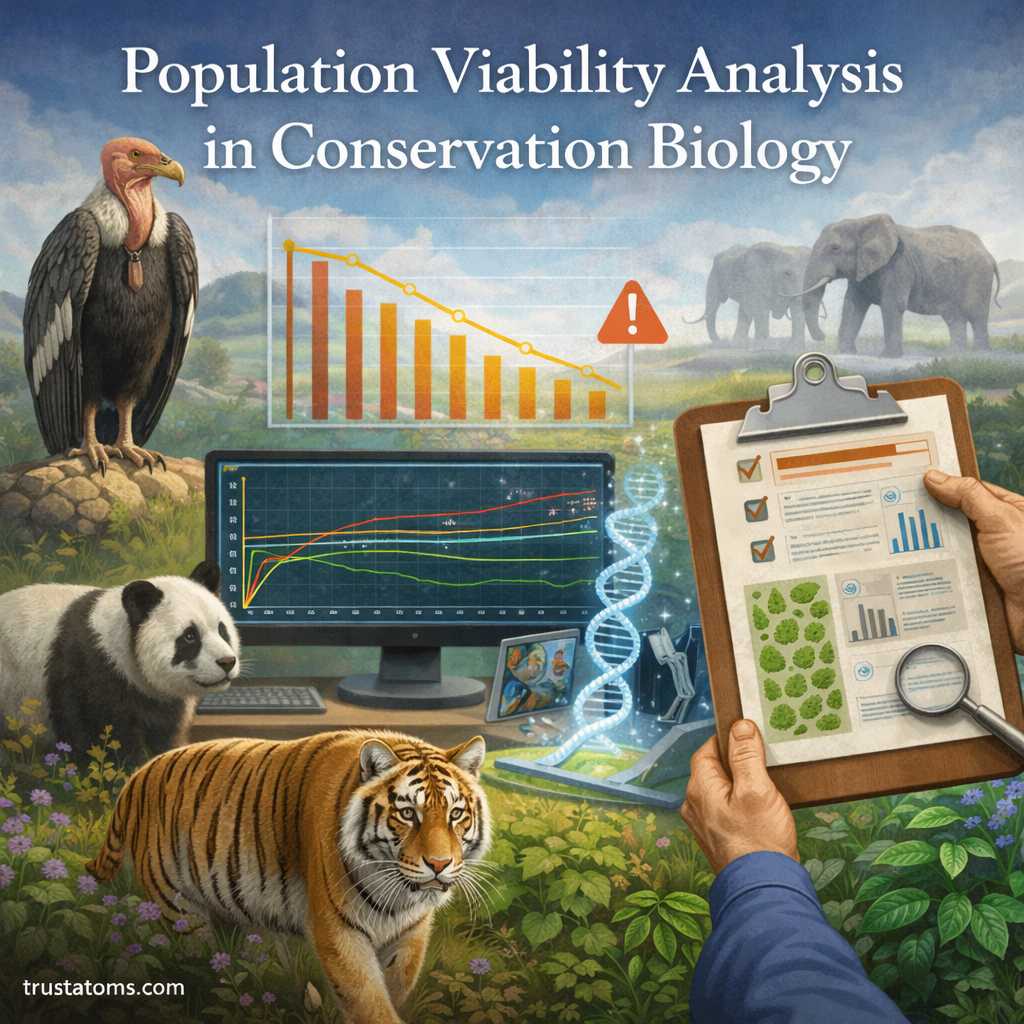
Population Viability Analysis (PVA) is a scientific method used by conservation biologists to estimate the likelihood that a species population will survive or go extinct over time. By combining ecological data, demographic information, and mathematical models, researchers can predict how populations respond to environmental pressures such as habitat loss, climate change, disease, and human activity.
In conservation biology, PVA helps decision-makers evaluate risks and design strategies that improve the survival chances of endangered species. Rather than relying on guesswork, conservationists can use quantitative modeling to assess long-term population stability and guide wildlife management efforts.
What Is Population Viability Analysis?
Population Viability Analysis is a modeling approach used to assess the probability that a species population will persist in a given environment over a specified time period.
It typically answers questions such as:
- How likely is a population to go extinct in the next 50 or 100 years?
- What population size is needed for long-term survival?
- How do environmental changes affect species survival?
- Which conservation actions will be most effective?
PVA models simulate population changes by incorporating biological and environmental variables. These simulations allow researchers to test different scenarios and evaluate conservation strategies before implementing them in the real world.
Why Population Viability Analysis Matters
Many species face declining populations due to human activity and environmental changes. Without careful planning, conservation efforts may fail to protect vulnerable species.
Population Viability Analysis helps conservationists:
- Identify populations at high risk of extinction
- Determine minimum viable population sizes
- Evaluate habitat protection strategies
- Assess the impact of environmental threats
- Guide species recovery programs
By forecasting possible future outcomes, PVA provides valuable insight for long-term conservation planning.
Key Factors Included in PVA Models
Population viability models rely on multiple biological and ecological parameters that influence population growth or decline.
Population Size
The current population size is one of the most critical factors affecting survival.
Small populations are more vulnerable to:
- Genetic problems
- Environmental disasters
- Random fluctuations in reproduction or survival
As populations shrink, the risk of extinction increases.
Birth and Death Rates
Demographic data are essential for predicting population trends.
Key variables include:
- Birth rates (reproductive success)
- Death rates (mortality)
- Age structure of the population
- Life expectancy
These factors determine whether a population grows, declines, or remains stable.
Environmental Variation
Natural environments are constantly changing. Weather patterns, food availability, and disease outbreaks can all influence population survival.
Environmental variation may include:
- Droughts
- Floods
- Temperature changes
- Habitat disturbances
PVA models incorporate these fluctuations to simulate real-world conditions.
Genetic Diversity
Low genetic diversity can weaken a population’s ability to adapt to environmental changes.
Genetic factors considered in PVA include:
- Inbreeding depression
- Loss of genetic variation
- Reduced reproductive success
Maintaining genetic diversity is often critical for long-term population survival.
Catastrophic Events
Rare but severe events can dramatically affect small populations.
Examples include:
- Wildfires
- Hurricanes
- Disease outbreaks
- Human disturbances
PVA simulations may include the probability of catastrophic events occurring over time.
Types of Population Viability Models

Several modeling approaches are used in Population Viability Analysis, depending on the species and available data.
Deterministic Models
Deterministic models use fixed values for variables such as birth and death rates.
These models assume stable conditions and produce a single projected outcome for population growth or decline.
While useful for basic analysis, deterministic models do not capture the uncertainty of real ecosystems.
Stochastic Models
Stochastic models incorporate randomness into population simulations.
They account for unpredictable changes in:
- Weather patterns
- Reproduction rates
- Mortality events
- Environmental conditions
Because natural ecosystems are inherently variable, stochastic models are often more realistic for conservation planning.
Individual-Based Models
Individual-based models simulate the life history of each organism in a population.
These models track factors such as:
- Individual reproduction
- Survival probabilities
- Movement patterns
- Genetic relationships
Although computationally complex, these models provide highly detailed population simulations.
Steps in Conducting a Population Viability Analysis
Population Viability Analysis typically follows a structured process.
1. Data Collection
Researchers gather biological and ecological data about the species.
This may include:
- Population counts
- Age structure
- Reproductive rates
- Mortality rates
- Habitat characteristics
Accurate data are essential for building reliable models.
2. Model Construction
Scientists use specialized software to create a population model.
The model incorporates:
- Demographic parameters
- Environmental variability
- Genetic considerations
- Potential threats
These variables help simulate population dynamics over time.
3. Scenario Testing
Once the model is built, researchers run multiple simulations under different conditions.
Examples of scenarios include:
- Habitat loss
- Climate change impacts
- Increased mortality rates
- Conservation interventions
Comparing scenarios helps identify which strategies best support population survival.
4. Risk Assessment
The final step involves estimating the probability of extinction or population decline.
Researchers may calculate:
- Extinction probability over a time period
- Expected population size
- Genetic diversity trends
- Sensitivity to environmental changes
These results inform conservation planning and policy decisions.
Real-World Applications of Population Viability Analysis
Population Viability Analysis has been widely used in conservation efforts around the world.
Endangered Species Recovery
PVA helps guide recovery programs for threatened species.
Examples include:
- Large mammals such as tigers and elephants
- Rare birds with declining habitats
- Amphibians affected by disease
- Marine species vulnerable to overfishing
These analyses help determine how large populations must become to remain sustainable.
Habitat Conservation Planning
PVA can help identify critical habitats needed for species survival.
Conservation planners may use PVA results to:
- Design protected areas
- Maintain wildlife corridors
- Reduce habitat fragmentation
Protecting the right habitats is essential for maintaining viable populations.
Wildlife Reintroduction Programs
When species are reintroduced into their native habitats, PVA can estimate the likelihood that the population will establish successfully.
The analysis may determine:
- How many individuals must be released
- Which habitats provide the best survival conditions
- How genetic diversity should be managed
This helps improve the success rate of reintroduction projects.
Climate Change Risk Assessment
Climate change is altering ecosystems worldwide.
Population viability models can predict how species populations might respond to:
- Rising temperatures
- Changing precipitation patterns
- Habitat shifts
- Increased environmental stress
These predictions allow conservationists to plan adaptive strategies.
Limitations of Population Viability Analysis
While PVA is a powerful conservation tool, it also has limitations.
Data Limitations
Reliable population data can be difficult to obtain, especially for rare or elusive species.
Incomplete or inaccurate data may affect model reliability.
Model Assumptions
All models rely on assumptions about biological processes and environmental conditions.
If these assumptions are incorrect, predictions may not reflect real outcomes.
Environmental Complexity
Ecosystems are extremely complex, and not all ecological interactions can be fully captured in a model.
Unexpected environmental changes may influence populations in ways that models cannot predict.
Uncertainty in Long-Term Forecasts
The farther into the future a model predicts, the greater the uncertainty becomes.
Long-term predictions should therefore be interpreted cautiously.
The Future of Population Viability Analysis
Advances in technology and ecological data are improving the accuracy and usefulness of PVA.
Emerging developments include:
- Integration with satellite habitat data
- Improved genetic analysis tools
- Use of artificial intelligence for ecological modeling
- Larger ecological databases for species monitoring
These innovations are helping scientists build more realistic models that better reflect ecological complexity.
As biodiversity loss accelerates globally, population viability analysis will continue to play an essential role in guiding conservation decisions.
Conclusion
Population Viability Analysis is one of the most important tools used in conservation biology to assess extinction risk and guide species protection strategies. By combining demographic data, ecological factors, and predictive modeling, PVA allows scientists to simulate future population trends and evaluate conservation options.
Although no model can perfectly predict the future, population viability analysis provides valuable insights into the long-term survival of species. When used alongside field research and habitat conservation efforts, it helps scientists and policymakers make informed decisions that protect biodiversity and support ecosystem stability.