Acids are an important group of substances in chemistry. They play a role in everything from digestion and food chemistry to industrial manufacturing and environmental science. One of the most important ways scientists classify acids is by their strength, which refers to how completely an acid breaks apart in water.
In chemistry, acids are commonly divided into two categories: strong acids and weak acids. Understanding the difference between them helps explain many chemical reactions, pH behavior, and real-world applications.
What Is an Acid?
An acid is a substance that releases hydrogen ions (H⁺) when dissolved in water.
This definition comes from the Arrhenius theory of acids and bases, which states:
- Acids produce hydrogen ions (H⁺) in aqueous solutions.
- Bases produce hydroxide ions (OH⁻).
When an acid dissolves in water, it may break apart into ions. The extent of this ionization determines whether the acid is considered strong or weak.
What Makes an Acid Strong or Weak?
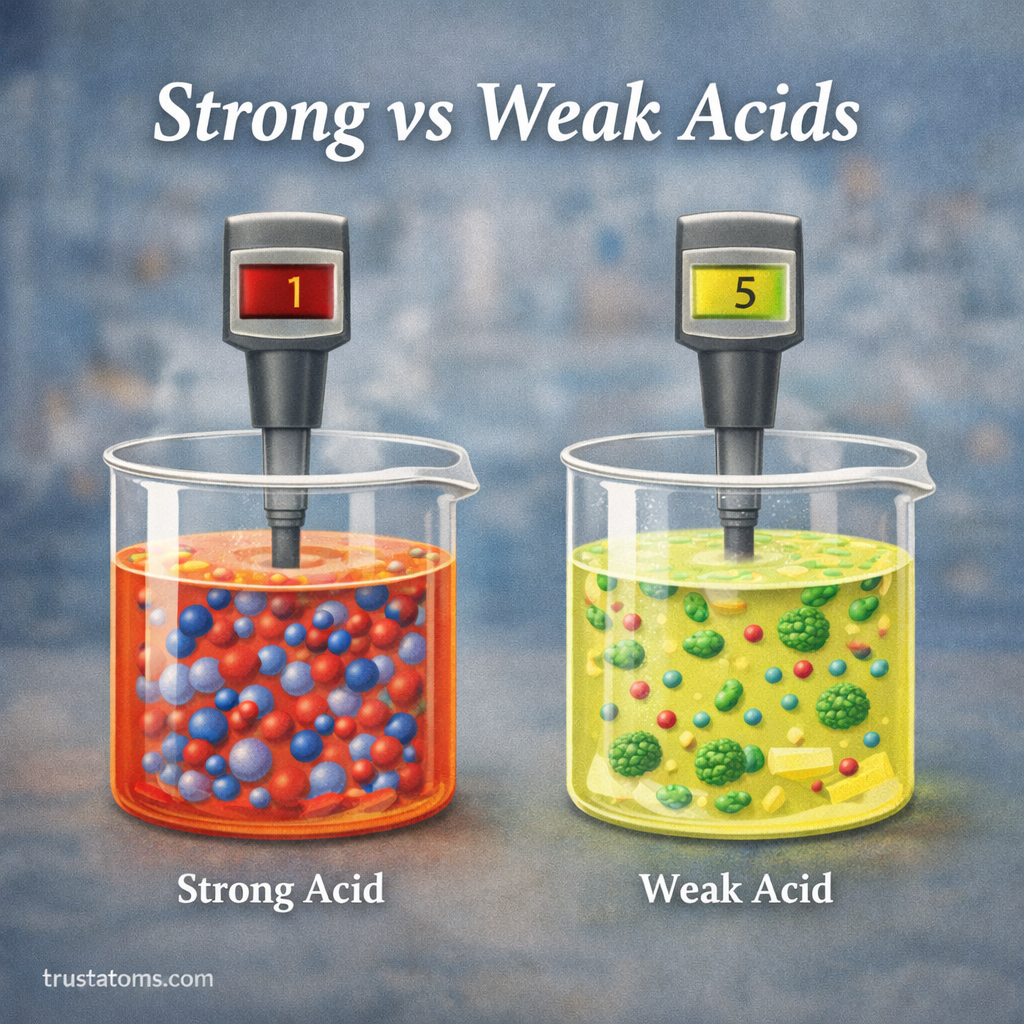
The strength of an acid depends on how completely it ionizes in water.
- Strong acids completely dissociate into ions.
- Weak acids only partially dissociate.
This means strong acids release more hydrogen ions in solution, making them more reactive and resulting in lower pH values.
Key factors that influence acid strength include:
- Bond strength between hydrogen and the rest of the molecule
- Molecular structure
- Stability of the ions produced
- Ability of the molecule to release hydrogen ions
What Are Strong Acids?
Strong acids are acids that fully dissociate in water. Nearly every molecule of the acid separates into ions when dissolved.
This means a strong acid produces a high concentration of hydrogen ions, which leads to very low pH values.
Common Strong Acids
Some acids are well known for behaving as strong acids in water.
Examples include:
- Hydrochloric acid (HCl)
- Nitric acid (HNO₃)
- Sulfuric acid (H₂SO₄) (first dissociation)
- Hydrobromic acid (HBr)
- Hydroiodic acid (HI)
- Perchloric acid (HClO₄)
These acids are widely used in laboratories and industrial processes because of their high reactivity.
Characteristics of Strong Acids
Strong acids generally have the following properties:
- Completely ionize in water
- Produce very low pH solutions
- Highly conductive in aqueous solutions
- Often highly corrosive
- React strongly with bases and metals
Because they release hydrogen ions readily, strong acids are powerful chemical reagents.
What Are Weak Acids?
Weak acids are acids that only partially dissociate in water. This means most molecules remain intact while only a small portion releases hydrogen ions.
Because fewer hydrogen ions are produced, weak acids typically have higher pH values compared to strong acids.
Common Weak Acids
Many acids encountered in everyday life are weak acids.
Examples include:
- Acetic acid (CH₃COOH)
- Carbonic acid (H₂CO₃)
- Citric acid
- Lactic acid
- Phosphoric acid (H₃PO₄)
Weak acids are often found in foods, beverages, and biological systems.
Characteristics of Weak Acids
Weak acids generally share several traits:
- Partial ionization in water
- Higher pH than strong acids
- Reversible ionization reactions
- Lower electrical conductivity than strong acids
- Often safer to handle in dilute solutions
Although weaker, these acids still play essential roles in many chemical and biological processes.
Strong vs Weak Acids: Key Differences
Understanding the differences between strong and weak acids is essential for predicting chemical behavior.
Ionization Behavior
Strong acids:
- Dissociate completely in water
- Produce many hydrogen ions
Weak acids:
- Dissociate only partially
- Produce fewer hydrogen ions
Chemical Equilibrium
Strong acids:
- Reaction proceeds nearly completely toward ion formation
Weak acids:
- Establish an equilibrium between molecules and ions
This equilibrium is described by the acid dissociation constant (Ka), which measures the strength of a weak acid.
pH Levels
Strong acids typically have:
- Very low pH values (often below 3)
Weak acids typically have:
- Moderate pH values (often between 3 and 7)
However, pH also depends on the concentration of the acid.
Why Some Acids Are Stronger Than Others
Acid strength depends on how easily a molecule releases a hydrogen ion.
Several chemical factors influence this process.
Bond Strength
If the bond between hydrogen and the rest of the molecule is weak, the hydrogen ion can separate more easily, making the acid stronger.
Stability of the Conjugate Base
After losing a hydrogen ion, the remaining molecule becomes a conjugate base.
If this conjugate base is stable, the acid is more likely to release hydrogen ions, increasing its strength.
Molecular Structure
The arrangement of atoms in a molecule can influence:
- Charge distribution
- Bond polarity
- Electron stability
These structural factors help determine how easily hydrogen ions are released.
Real-World Examples of Strong and Weak Acids
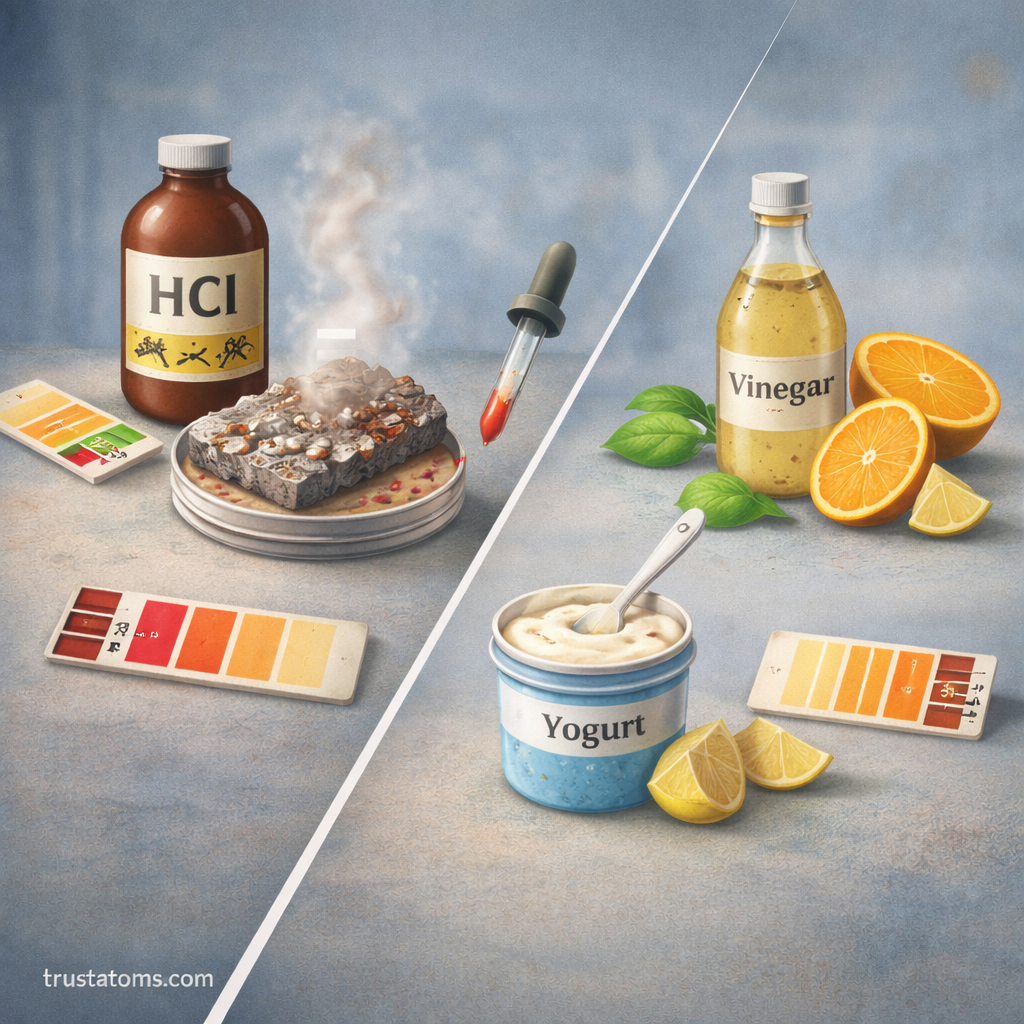
Acids are common in everyday environments, industries, and biological systems.
Household and Food Acids
Many foods contain weak acids that contribute to flavor and preservation.
Examples include:
- Vinegar (acetic acid)
- Citrus fruits (citric acid)
- Carbonated drinks (carbonic acid)
These acids are generally safe in the concentrations found in food.
Industrial Applications
Strong acids are widely used in manufacturing and chemical processing.
Common uses include:
- Metal cleaning and refining
- Fertilizer production
- Petroleum processing
- Chemical synthesis
Because of their high reactivity, strong acids require careful handling and safety precautions.
Biological Systems
Weak acids are critical in biological chemistry.
For example:
- Carbonic acid helps regulate blood pH
- Lactic acid forms during muscle activity
- Amino acids contribute to protein structure
These acids help maintain chemical balance inside living organisms.
Strong and Weak Acids in Chemical Reactions
The strength of an acid influences how it behaves during chemical reactions.
Strong acids tend to:
- React quickly
- Drive reactions toward completion
- Fully dissociate before reacting
Weak acids often:
- Participate in equilibrium reactions
- React more gradually
- Influence buffer systems
Understanding these behaviors helps chemists control reactions in laboratories and industrial processes.
Final Thoughts
Strong and weak acids differ primarily in how completely they release hydrogen ions in water. Strong acids fully dissociate, producing large numbers of hydrogen ions, while weak acids only partially dissociate and establish equilibrium in solution.
This distinction affects pH levels, reaction behavior, conductivity, and chemical reactivity. From industrial chemistry to biological systems, recognizing the difference between strong and weak acids is essential for understanding how chemical reactions occur in the natural and engineered world.