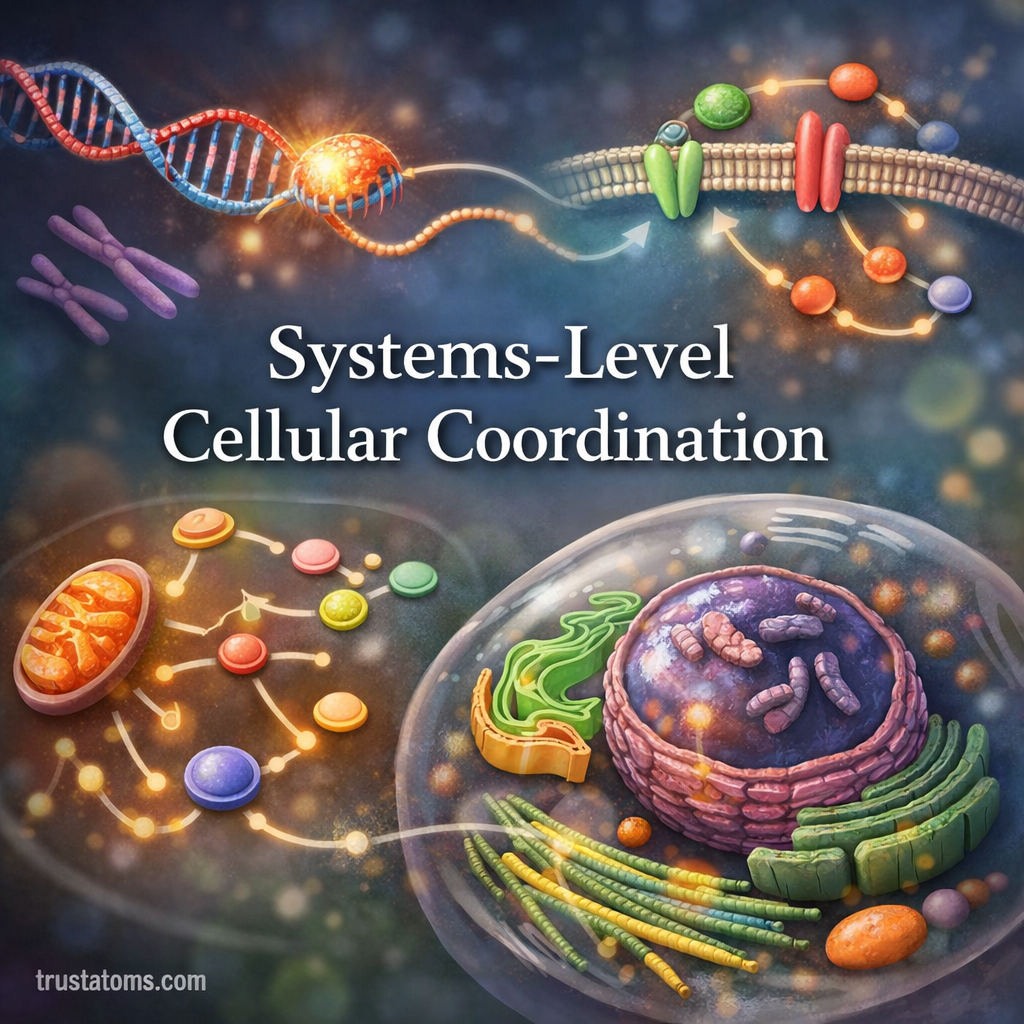
Modern biology increasingly views cells not as collections of isolated parts but as highly coordinated systems. Every moment, thousands of biochemical reactions, signaling events, and structural processes occur inside a cell. For life to function, these activities must be tightly synchronized.
Systems-level cellular coordination refers to the integration of genes, proteins, signaling pathways, and cellular structures so that a cell behaves as a unified and adaptive biological system.
Understanding this coordination helps explain how cells grow, respond to their environment, repair damage, and maintain stability.
What Is Systems-Level Cellular Coordination?
Systems-level cellular coordination is the collective regulation of cellular components and processes that ensures a cell functions efficiently and maintains homeostasis.
Instead of examining individual molecules in isolation, systems biology looks at how networks of molecules interact.
Key elements involved in this coordination include:
- Genetic regulation
- Signaling pathways
- Metabolic networks
- Structural organization
- Feedback mechanisms
Together, these systems form a dynamic network that allows the cell to respond to internal and external changes.
The Role of Genetic Organization in Cellular Coordination
Cellular coordination begins with the organization and regulation of genetic information.
DNA is stored within chromosomes in the nucleus, forming the genome that contains the instructions for building and regulating the cell. Chromosomal organization ensures that genes can be activated or silenced when needed.
How Genetic Regulation Coordinates Cellular Activity
Gene regulation ensures the right proteins are produced at the right time.
Major mechanisms include:
- Transcription factors that activate or repress genes
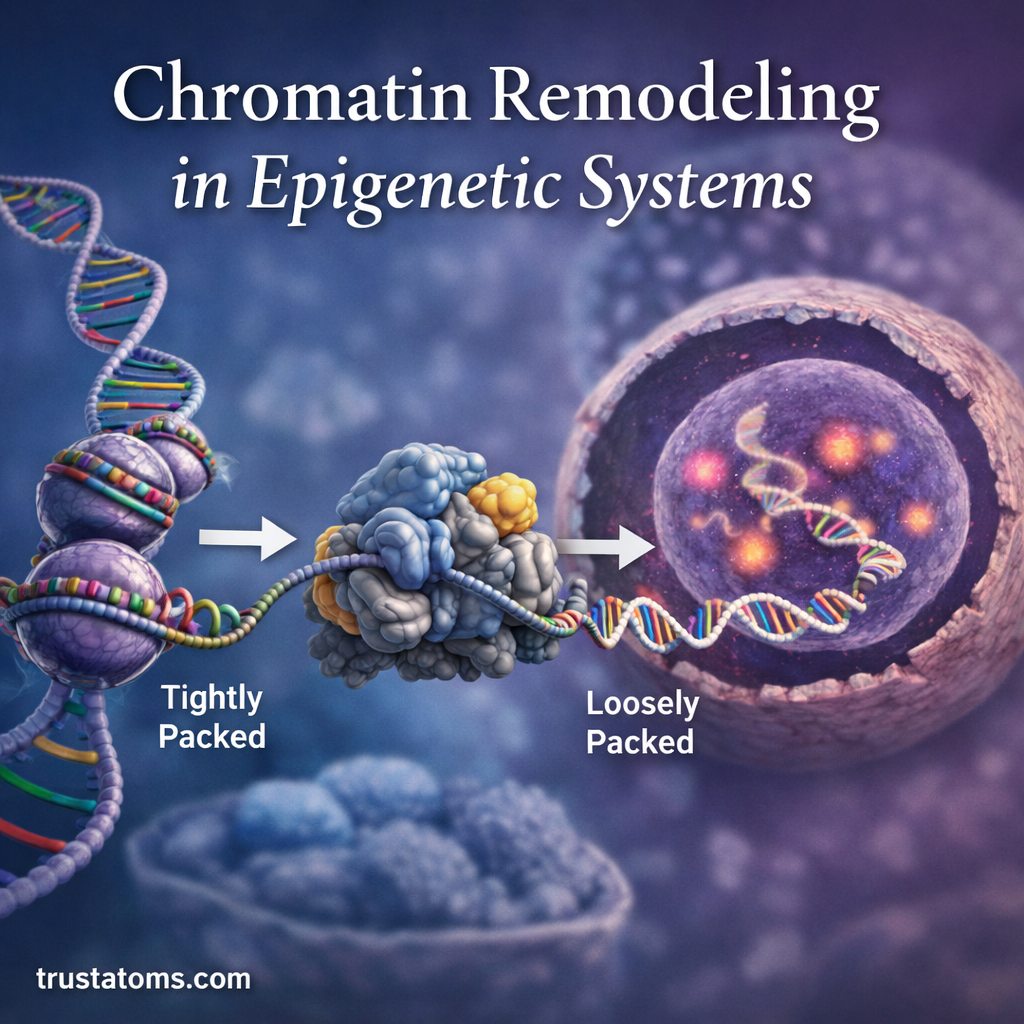
- Epigenetic modifications that control DNA accessibility
- RNA processing and degradation
- Regulatory RNA molecules such as microRNAs
This regulation allows cells to adjust protein production in response to environmental signals or developmental stages.
Cellular Signaling Networks
Cells must constantly sense and respond to their environment. This is accomplished through cell signaling networks.
Signaling pathways transmit information from outside the cell to internal molecular machinery.
Major Components of Signaling Systems
- Receptors
Proteins on the cell surface detect external signals such as hormones or nutrients. - Signal transduction pathways
Cascades of molecules relay signals inside the cell. - Effector proteins
These molecules produce the final cellular response.
Common signaling pathways include:
- MAP kinase pathways
- Calcium signaling
- G-protein coupled receptor signaling
- Hormonal signaling pathways
These networks allow cells to coordinate behaviors such as growth, division, and metabolism.
Metabolic Network Integration
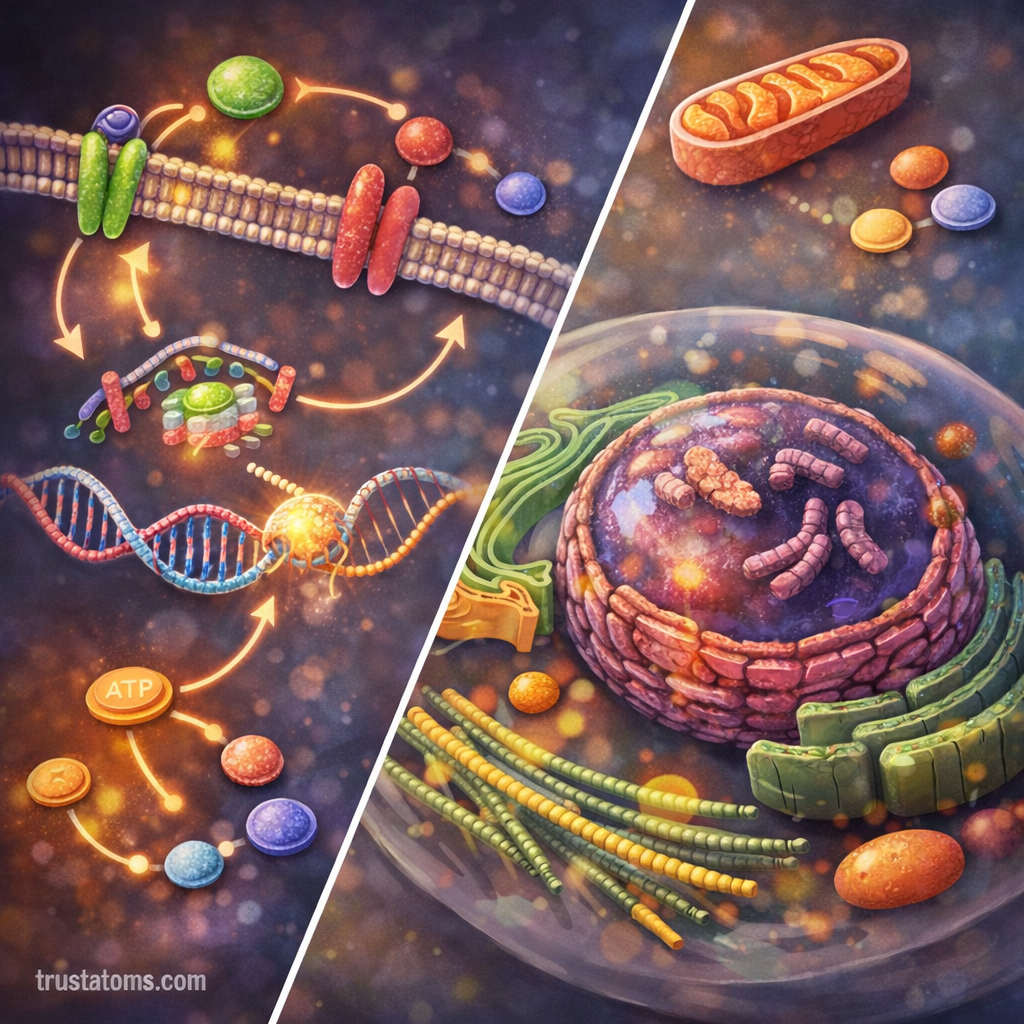
Cells contain thousands of metabolic reactions that must be precisely regulated.
Metabolic networks coordinate:
- Energy production
- Biomolecule synthesis
- Waste removal
- Cellular maintenance
How Metabolic Coordination Works
Metabolism is regulated through several mechanisms:
- Enzyme activation and inhibition
- Feedback inhibition
- Allosteric regulation
- Hormonal control
For example, when energy levels drop, cells increase pathways that produce ATP while slowing energy-consuming processes.
This ensures that energy supply matches cellular demand.
Structural Organization of the Cell
Coordination within cells also depends on physical organization.
Different cellular compartments perform specialized functions:
- Nucleus – genetic information storage and gene regulation
- Mitochondria – energy production
- Endoplasmic reticulum – protein and lipid synthesis
- Golgi apparatus – protein modification and transport
- Cytoskeleton – structural support and intracellular transport
This compartmentalization allows reactions to occur efficiently while minimizing interference between processes.
Feedback and Control Mechanisms
Biological systems rely heavily on feedback loops to maintain stability.
Two major types of feedback exist:
Negative Feedback
Negative feedback stabilizes systems by counteracting changes.
Example:
- If ATP levels rise, enzymes that produce ATP slow down.
This maintains metabolic balance.
Positive Feedback
Positive feedback amplifies signals and can drive processes to completion.
Example:
- Activation of certain enzymes during blood clotting cascades.
Both mechanisms are essential for maintaining coordinated cellular responses.
Coordination During the Cell Cycle
One of the most important examples of systems-level coordination is the cell cycle, the process by which a cell grows and divides.
The cell cycle is regulated by a network of proteins called cyclins and cyclin-dependent kinases (CDKs).
Key phases include:
- G1 Phase – cell growth and preparation
- S Phase – DNA replication
- G2 Phase – preparation for division
- M Phase – mitosis and cell division
Checkpoints ensure that each phase is completed correctly before the next begins.
This coordination prevents errors such as DNA damage or improper chromosome segregation.
Systems Biology and Modern Research
The study of cellular coordination has advanced rapidly through systems biology, a field that combines biology, mathematics, and computational modeling.
Researchers analyze entire biological networks rather than isolated molecules.
Techniques used in systems biology include:
- Genomics
- Proteomics
- Metabolomics
- Computational modeling
- Network analysis
These approaches help scientists understand how cellular systems behave as integrated networks.
Why Systems-Level Coordination Matters
Understanding how cells coordinate their activities is essential for explaining many biological phenomena.
It helps scientists understand:
- Development and differentiation
- Immune responses
- Metabolic diseases
- Neurodegenerative disorders
- Cancer progression
In many diseases, coordination between cellular systems breaks down. Studying these failures helps researchers develop new medical treatments.
Final Thoughts
Cells are far more than collections of independent molecules. They are highly organized systems where genes, proteins, metabolic reactions, and signaling networks work together in coordinated ways.
Systems-level cellular coordination ensures that cells:
- Maintain stability
- Adapt to environmental changes
- Grow and divide correctly
- Support complex biological functions
As systems biology continues to evolve, scientists are gaining deeper insights into how life operates at the cellular level—revealing the intricate networks that make living systems possible.