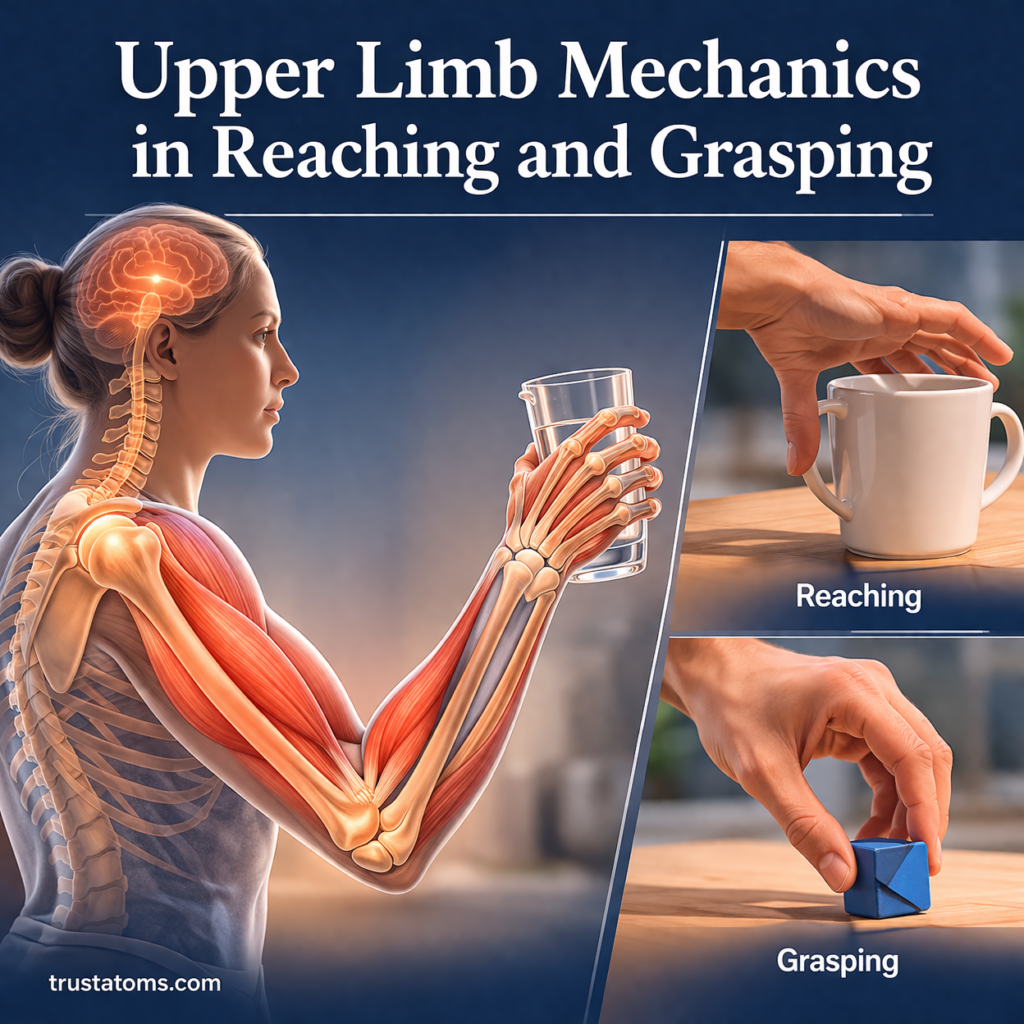
Reaching and grasping are essential human movements used in everyday tasks—from picking up a cup to typing on a keyboard. These actions rely on precise coordination between the shoulder, elbow, wrist, and hand, along with input from the nervous system.
Upper limb mechanics refers to how these structures work together to allow smooth, accurate, and controlled movement. Understanding this system is important in anatomy, rehabilitation, and performance optimization.
What Are Reaching and Grasping?
Reaching and grasping are two closely related but distinct actions:
- Reaching: Moving the arm toward an object
- Grasping: Shaping the hand and applying force to hold or manipulate the object
These actions often occur together, but each involves different mechanical and neurological processes.
Phases of Reaching and Grasping
The movement can be broken into coordinated phases:
1. Planning Phase
Before movement begins, the brain:
- Identifies the object
- Determines its size, shape, and position
- Plans the appropriate movement strategy
2. Reaching Phase
The arm moves toward the object:
- Shoulder initiates movement
- Elbow extends to position the hand
- Wrist stabilizes for accuracy
3. Grasping Phase
The hand prepares to interact with the object:
- Fingers open and adjust shape
- Thumb positions for opposition
- Grip force is scaled based on object properties
4. Manipulation Phase
Once grasped, the object can be:
- Lifted
- Rotated
- Moved or adjusted
Key Joints Involved
Upper limb mechanics depend on multiple joints working together.
Shoulder Joint
- Provides the largest range of motion
- Positions the arm in space
- Allows flexion, extension, abduction, and rotation
Elbow Joint
- Acts as a hinge for bending and straightening
- Controls distance between hand and body
Wrist Joint
- Stabilizes hand position
- Adjusts angle for precision tasks
Hand and Finger Joints
- Enable fine motor control
- Adapt to object shape and size
- Provide grip strength and dexterity
Muscle Coordination in the Upper Limb
Muscles work in coordinated patterns to produce smooth movement.
Major Muscle Groups
- Deltoid: lifts and positions the arm
- Biceps brachii: flexes the elbow
- Triceps brachii: extends the elbow
- Forearm muscles: control wrist and finger movement
- Intrinsic hand muscles: enable fine motor control
Muscle Synergy
Rather than acting alone, muscles work together:
- Agonists produce movement
- Antagonists control and stabilize motion
- Stabilizers maintain joint alignment
This coordination ensures accuracy and efficiency.
Types of Grips
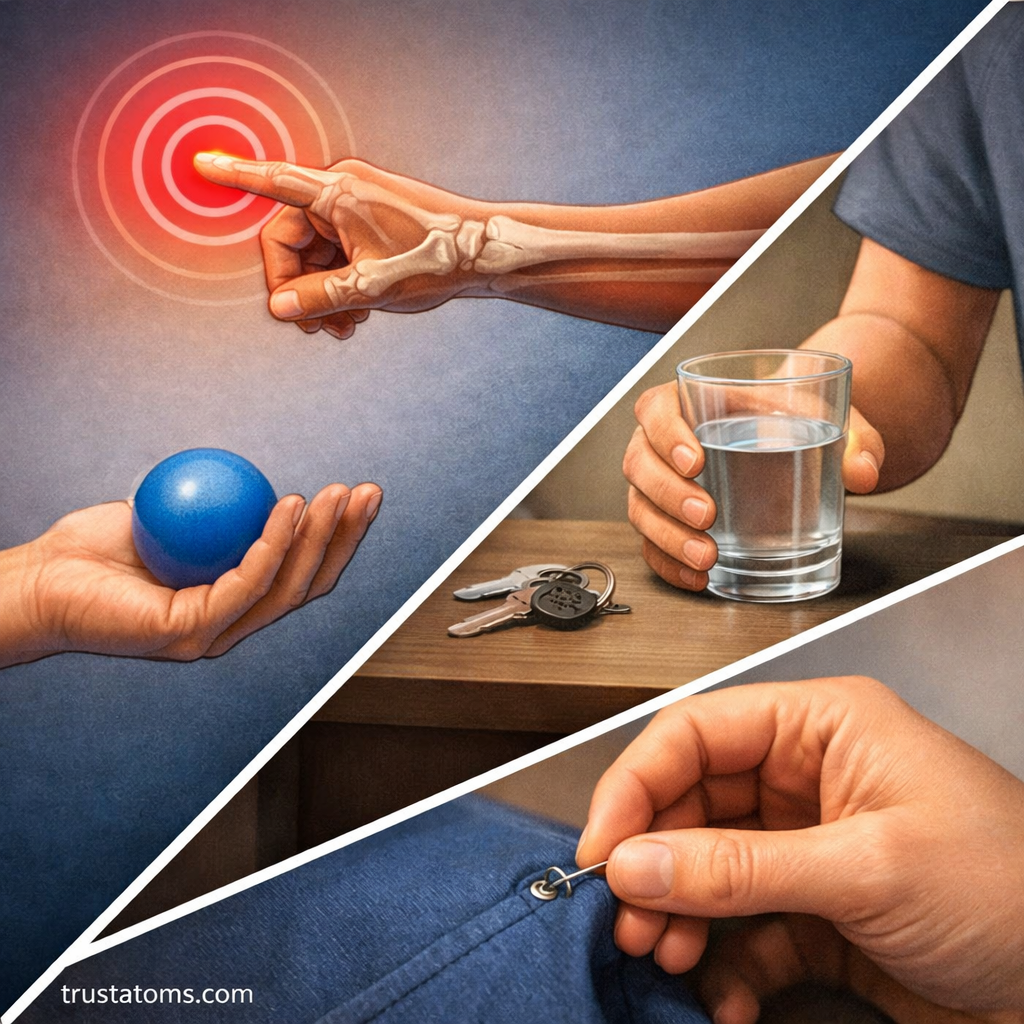
Different tasks require different grasp patterns.
Power Grip
- Uses the whole hand
- Strong and stable
- Example: holding a hammer
Precision Grip
- Uses fingertips and thumb
- Allows fine control
- Example: picking up a small object
Hook Grip
- Fingers hold without thumb involvement
- Used for carrying objects
- Example: holding a bag handle
Each grip type depends on hand structure and muscle control.
Role of the Nervous System
Reaching and grasping rely heavily on neural control.
Motor Control
- The brain sends signals to muscles
- Coordinates timing and force of movement
Sensory Feedback
- Vision guides hand toward the object
- Touch provides information about grip and texture
- Proprioception tracks limb position
Feedback Adjustment
The body continuously adjusts movement:
- Corrects errors in real time
- Refines grip force
- Maintains accuracy
Biomechanics of Movement
Several mechanical principles guide upper limb function:
Range of Motion
- Shoulder provides wide movement range
- Distal joints (wrist and fingers) refine precision
Force Control
- Grip force must match object weight and texture
- Too little force causes slipping
- Too much force wastes energy
Coordination
- Smooth movement requires timing between joints
- Efficient motion minimizes unnecessary effort
Common Issues in Upper Limb Mechanics
Problems in reaching and grasping can arise from injury or dysfunction.
Musculoskeletal Issues
- Rotator cuff injuries
- Tendonitis
- Joint stiffness
Neurological Conditions
- Stroke
- Parkinson’s disease
- Peripheral nerve damage
Functional Impacts
- Reduced coordination
- Weak grip strength
- Difficulty performing daily tasks
Early intervention and therapy can improve outcomes.
Improving Reaching and Grasping Ability
Enhancing upper limb mechanics can benefit both daily life and performance.
Practical Strategies
- Strengthen shoulder and arm muscles
- Improve flexibility and joint mobility
- Practice fine motor tasks (e.g., writing, gripping small objects)
- Use coordination exercises to improve control
Rehabilitation Focus
- Restore range of motion
- Rebuild strength
- Retrain motor patterns
Consistent practice supports long-term improvement.
Why Upper Limb Mechanics Matter
Reaching and grasping are essential for independence and daily function. From simple tasks like eating to complex actions like using tools, these movements are central to human interaction with the environment.
Understanding upper limb mechanics helps:
- Improve motor performance
- Prevent injuries
- Support rehabilitation
- Enhance precision and control
Final Thoughts
Upper limb mechanics in reaching and grasping demonstrate the complexity of human movement. Each action requires precise coordination between joints, muscles, and the nervous system to achieve smooth and effective results.
By understanding how these systems work together, we can better appreciate human anatomy and improve movement efficiency in both everyday life and specialized activities.