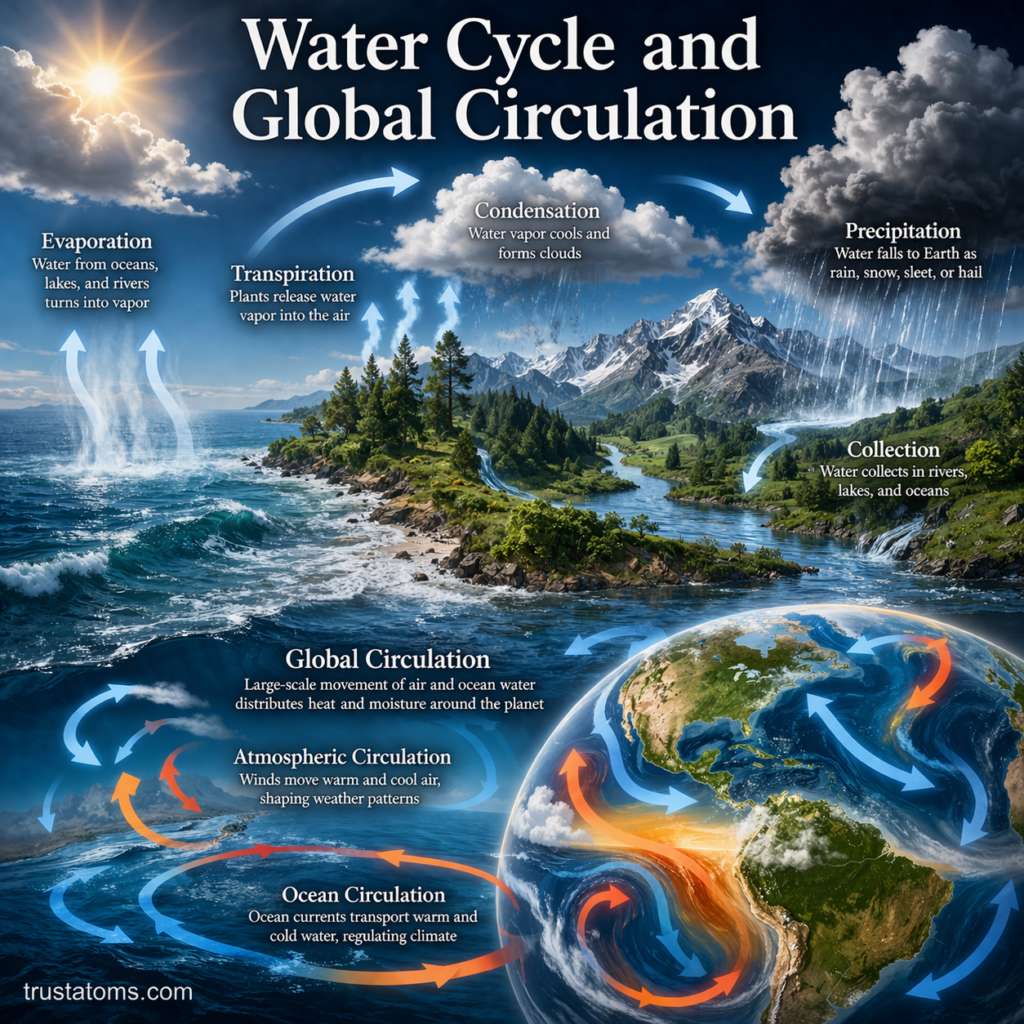
The water cycle and global circulation are two interconnected systems that shape Earth’s climate, weather, and life-support processes. Together, they explain how water moves around the planet and how energy is redistributed through the atmosphere and oceans.
Understanding these systems is essential for grasping how rainfall forms, how winds develop, and how climate patterns are maintained.
What Is the Water Cycle?
The water cycle (also called the hydrologic cycle) describes the continuous movement of water between Earth’s surface and the atmosphere.
Water constantly changes form and location through a repeating process.
Key stages of the water cycle
- Evaporation: Water turns into vapor from oceans, lakes, and rivers
- Transpiration: Plants release water vapor into the air
- Condensation: Water vapor cools and forms clouds
- Precipitation: Water falls as rain, snow, or hail
- Collection: Water gathers in oceans, rivers, and groundwater
This cycle is powered primarily by energy from the Sun.
Evaporation and Transpiration
Evaporation and transpiration are the starting points of the water cycle.
Evaporation
- Occurs when sunlight heats water
- Transforms liquid water into water vapor
- Most evaporation happens over oceans
Transpiration
- Water released from plant leaves
- Adds moisture to the atmosphere
- Plays a key role in local climate regulation
Together, these processes are sometimes called evapotranspiration.
Condensation and Cloud Formation
As water vapor rises, it cools and condenses into tiny droplets.
What happens during condensation
- Water vapor turns back into liquid
- Clouds begin to form
- Energy is released into the atmosphere
Cloud formation is essential for precipitation and weather patterns.
Precipitation and Water Movement
When cloud droplets grow large enough, they fall to Earth.
Types of precipitation
- Rain
- Snow
- Sleet
- Hail
Once precipitation reaches the ground:
- Some water infiltrates soil and becomes groundwater
- Some flows into rivers and oceans (runoff)
- Some returns to the atmosphere through evaporation
What Is Global Circulation?
Global circulation refers to the large-scale movement of air and water around the planet.
It redistributes heat from the equator toward the poles, helping balance Earth’s temperature.
Atmospheric Circulation
The atmosphere moves in patterns driven by temperature differences and Earth’s rotation.
Major circulation cells
- Hadley Cell (tropical regions)
- Ferrel Cell (mid-latitudes)
- Polar Cell (near the poles)
Key effects
- Creates global wind patterns
- Influences weather systems
- Drives storm formation
Ocean Circulation
Oceans also play a major role in global circulation.
Surface currents
- Driven by wind patterns
- Move warm and cold water across the globe
Deep ocean currents
- Driven by differences in temperature and salinity
- Known as thermohaline circulation
These currents act like a global conveyor belt, distributing heat and nutrients.
How the Water Cycle and Circulation Work Together
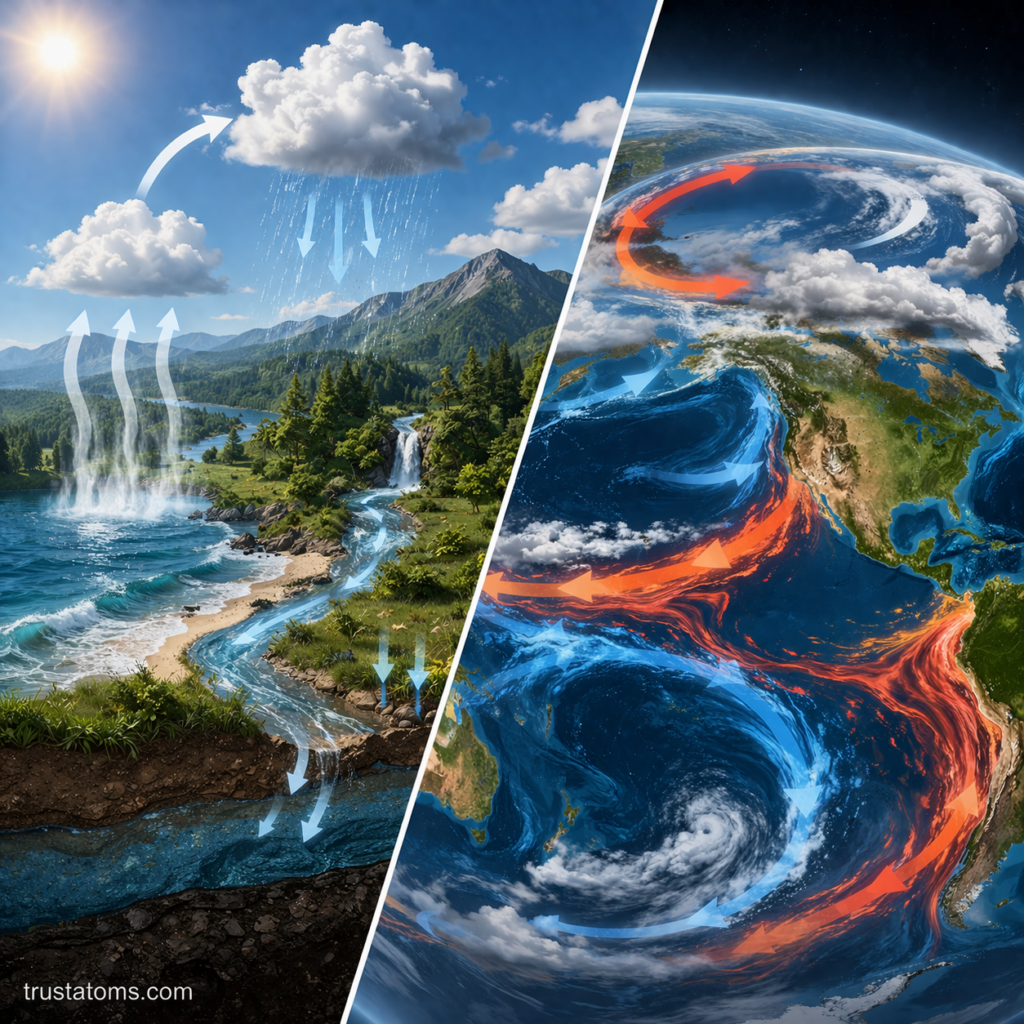
The water cycle and global circulation are deeply connected.
Key interactions
- Evaporation adds moisture to the atmosphere
- Winds move this moisture across regions
- Precipitation redistributes water globally
- Ocean currents influence evaporation rates
This interaction drives weather systems and climate patterns.
Impact on Weather and Climate
Together, these systems control many aspects of Earth’s environment.
Weather impacts
- Storm formation
- Rainfall patterns
- Wind systems
Climate impacts
- Regional temperature differences
- Seasonal changes
- Long-term climate stability
Without these processes, Earth would have extreme temperature imbalances.
Human Impact on the Water Cycle
Human activities are influencing the water cycle and circulation systems.
Major impacts
- Deforestation reduces transpiration
- Urbanization increases runoff
- Climate change alters precipitation patterns
- Warming oceans affect evaporation rates
These changes can lead to:
- Droughts
- Flooding
- Shifts in weather patterns
Why These Systems Matter
The water cycle and global circulation are essential for life on Earth.
Key importance
- Distribute fresh water
- Regulate global temperatures
- Support ecosystems
- Maintain weather systems
They ensure that water and energy are continuously cycled across the planet.
Water Cycle and Circulation in Simple Terms
Think of these systems as Earth’s distribution networks:
- The water cycle moves water
- Global circulation moves heat and air
Together, they keep the planet balanced and livable.
Final Thoughts
The water cycle and global circulation are fundamental to understanding Earth’s climate system. They connect oceans, atmosphere, land, and living organisms into one continuous process.
As climate change continues to affect these systems, understanding how they work becomes increasingly important for predicting future environmental changes.