Lasers are everywhere — in barcode scanners, fiber-optic communication, medical devices, manufacturing tools, and scientific research labs.
But behind every laser beam is a deeply quantum process.
Laser emission is not just bright light. It is a controlled release of energy from atoms and molecules governed by the rules of quantum mechanics. Understanding how lasers work requires exploring how electrons behave inside atoms — and how light itself can trigger more light.
In this guide, we’ll break down laser emission in quantum systems in clear, step-by-step terms.
What Is a Laser?
The word LASER stands for:
Light Amplification by Stimulated Emission of Radiation
Each part of that phrase matters:
- Light → electromagnetic radiation
- Amplification → increase in intensity
- Stimulated emission → triggered photon release
- Radiation → energy emitted as waves
A laser produces light that is:
- Monochromatic (one wavelength)
- Coherent (waves in phase)
- Highly directional
- Intense
These properties arise from quantum behavior at the atomic level.
Quantum Energy Levels in Atoms
In classical physics, energy can vary continuously.
In quantum systems, energy exists in discrete levels.
Electrons inside atoms:
- Occupy specific energy states
- Cannot exist between those states
- Absorb or emit energy equal to the difference between levels
When an electron moves:
- Absorption → electron jumps to a higher energy level
- Emission → electron falls to a lower energy level
The emitted energy appears as a photon.
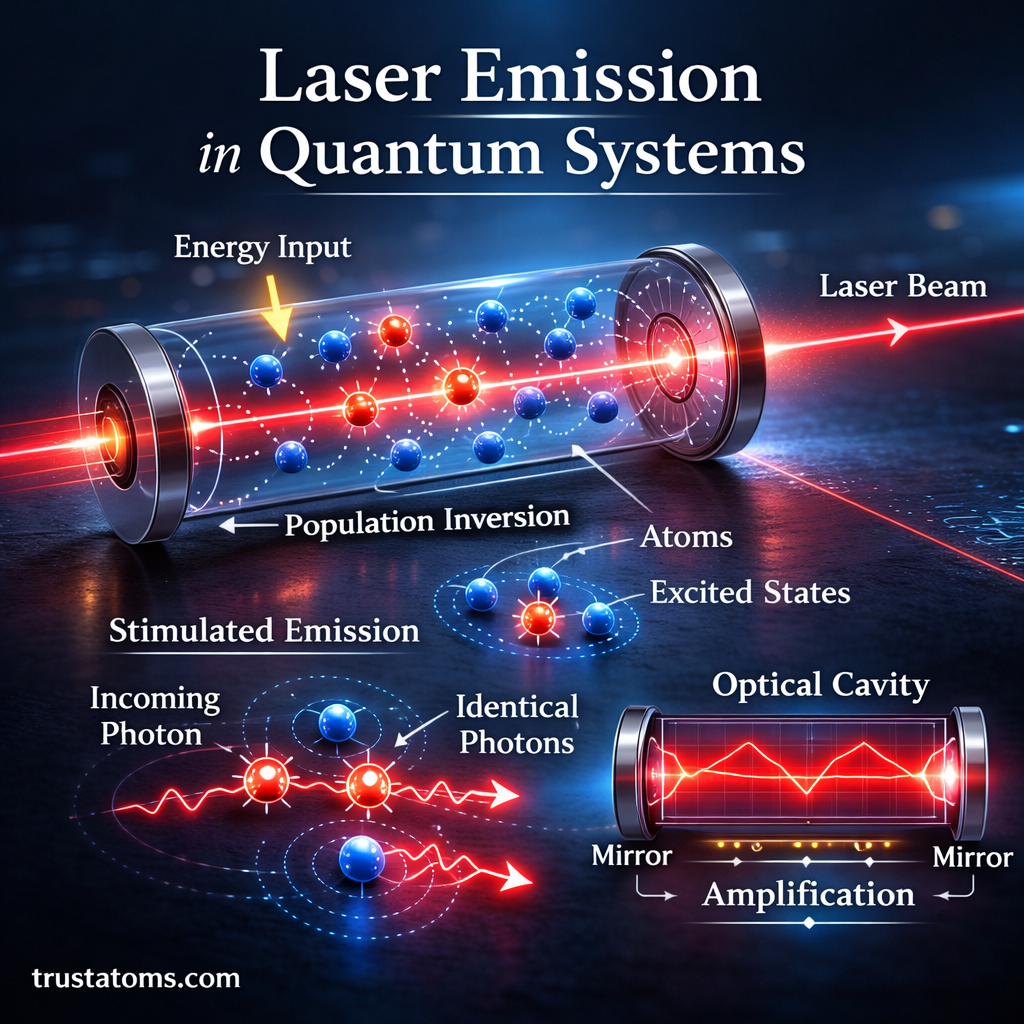
Spontaneous Emission
Spontaneous emission occurs when:
- An excited electron naturally falls back to a lower energy level
- A photon is emitted randomly
Key characteristics:
- Random direction
- Random phase
- Random timing
Ordinary light bulbs produce light primarily through spontaneous emission.
But lasers require something more controlled.
Stimulated Emission: The Core of Laser Action
Stimulated emission is the quantum process that makes lasers possible.
Here’s how it works:
- An atom is in an excited state.
- A photon with matching energy passes by.
- The photon interacts with the excited atom.
- The atom releases a second photon.
The crucial part:
The emitted photon is identical to the incoming photon.
They share:
- Same wavelength
- Same direction
- Same phase
- Same frequency
This creates perfectly aligned light waves — the foundation of coherence.
Population Inversion
Under normal conditions:
- Most atoms remain in lower energy states
- Few atoms are excited
For laser emission to occur, we need the opposite situation.
This is called population inversion.
Population inversion means:
- More atoms are in excited states than in lower states
Achieving this requires external energy input, known as pumping.
Common pumping methods include:
- Electrical discharge
- Optical pumping (using light)
- Chemical reactions
Without population inversion, stimulated emission cannot dominate.
The Three Essential Components of a Laser
Every laser system contains three core parts.
1. Gain Medium
The material where stimulated emission occurs.
Examples:
- Ruby crystal
- Helium-neon gas
- Semiconductor materials
- Fiber optics doped with rare-earth elements
The gain medium determines the wavelength of the laser.
2. Energy Source (Pump)
Provides energy to create population inversion.
3. Optical Cavity
Two mirrors placed at opposite ends of the gain medium:
- One fully reflective
- One partially reflective
Photons bounce back and forth:
- Stimulating more emission
- Amplifying light
Eventually, a concentrated beam exits through the partially reflective mirror.
Why Laser Light Is Unique
Laser light differs from ordinary light in four important ways.
Monochromatic
Laser light has a very narrow wavelength range.
Coherent
The waves move in phase — peaks and troughs align.
Directional
The beam spreads very little over distance.
High Intensity
Energy is concentrated in a small area.
These properties arise directly from stimulated emission in a controlled quantum system.
Types of Lasers
Different quantum systems produce different kinds of lasers.
Solid-State Lasers
- Use solid crystals
- Example: Ruby laser
Gas Lasers
- Use excited gases
- Example: Helium-neon laser
Semiconductor Lasers
- Found in laser pointers and electronics
- Compact and efficient
Fiber Lasers
- Use optical fibers as gain medium
- Highly stable and efficient
Each type relies on the same quantum principles.
The Role of Quantum Mechanics
Laser emission highlights several core quantum principles:
- Discrete energy levels
- Photon-electron interactions
- Probability of emission
- Wave-particle duality
The process cannot be explained fully by classical physics.
Stimulated emission, in particular, emerges from quantum electrodynamics — the theory describing interactions between light and matter.
Applications of Laser Emission
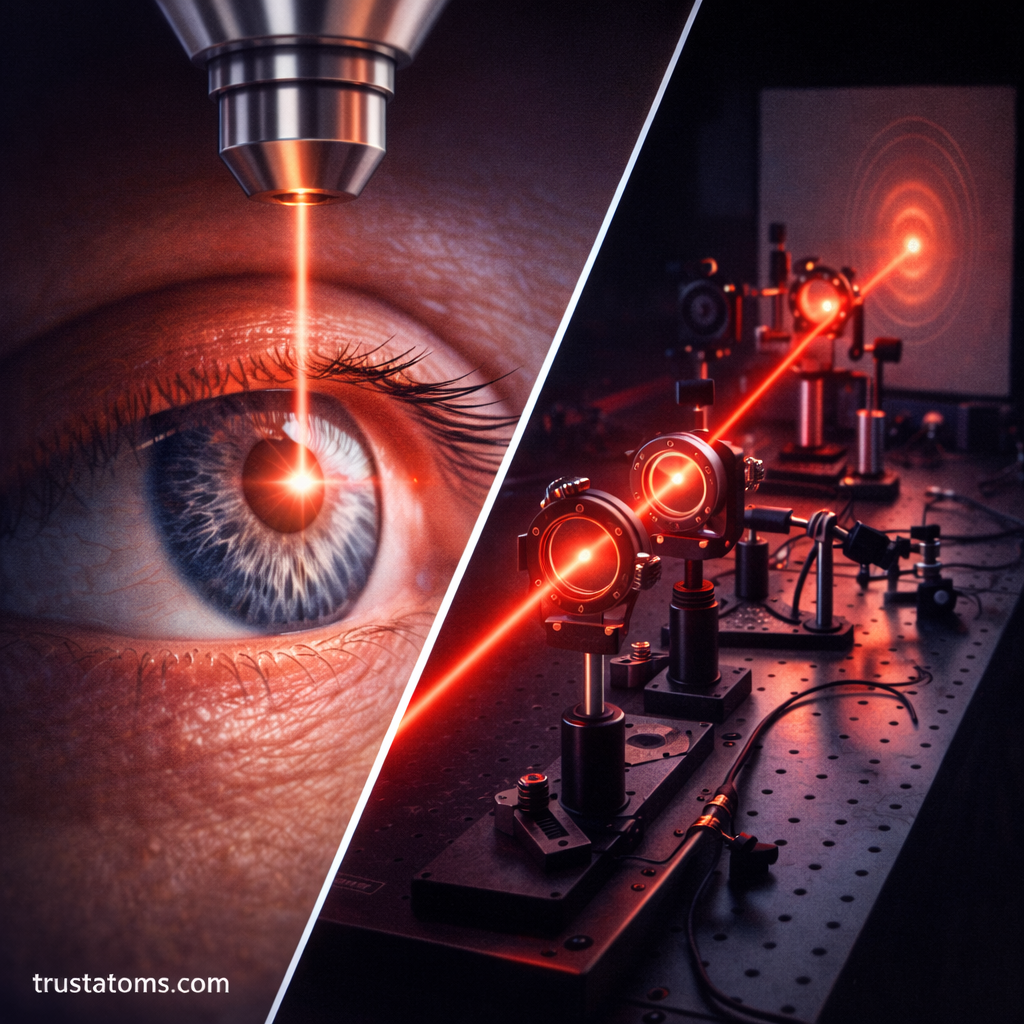
Laser systems are central to modern technology.
Medicine
- Eye surgery
- Tumor removal
- Precision cutting
Communications
- Fiber-optic data transmission
- High-speed internet
Manufacturing
- Metal cutting
- Welding
- Engraving
Scientific Research
- Spectroscopy
- Atomic clocks
- Quantum computing
Lasers also play a role in experimental physics, including studies of atomic behavior and fundamental constants.
Laser Emission and Quantum Computing
In emerging technologies:
- Lasers manipulate trapped ions
- Control qubits
- Enable ultra-precise measurements
Because laser light is coherent and controllable, it is ideal for quantum experiments.
Common Misconceptions
“Lasers are just brighter light bulbs.”
Laser light is fundamentally different due to stimulated emission and coherence.
“All lasers are dangerous.”
Many lasers are low power and safe under normal use.
“Lasers only produce visible light.”
Lasers can produce:
- Infrared
- Ultraviolet
- Microwave radiation
Visibility depends on wavelength.
Why Laser Emission Matters in Physics
Laser emission represents one of the most practical applications of quantum theory.
It connects:
- Atomic energy levels
- Electromagnetic radiation
- Probability theory
- Optical amplification
Lasers demonstrate how quantum principles can be harnessed to produce precise, controllable energy.
What began as theoretical physics is now essential to medicine, telecommunications, manufacturing, and computing.
Final Thoughts
Laser emission in quantum systems is a powerful example of how microscopic rules shape macroscopic technology.
At the atomic scale:
- Electrons jump between discrete energy levels.
- Photons stimulate identical photon release.
- Population inversion enables amplification.
At the human scale:
- Surgeons perform delicate procedures.
- Engineers transmit information across oceans.
- Scientists probe the structure of matter.
The laser is not just a beam of light.
It is quantum mechanics made visible.