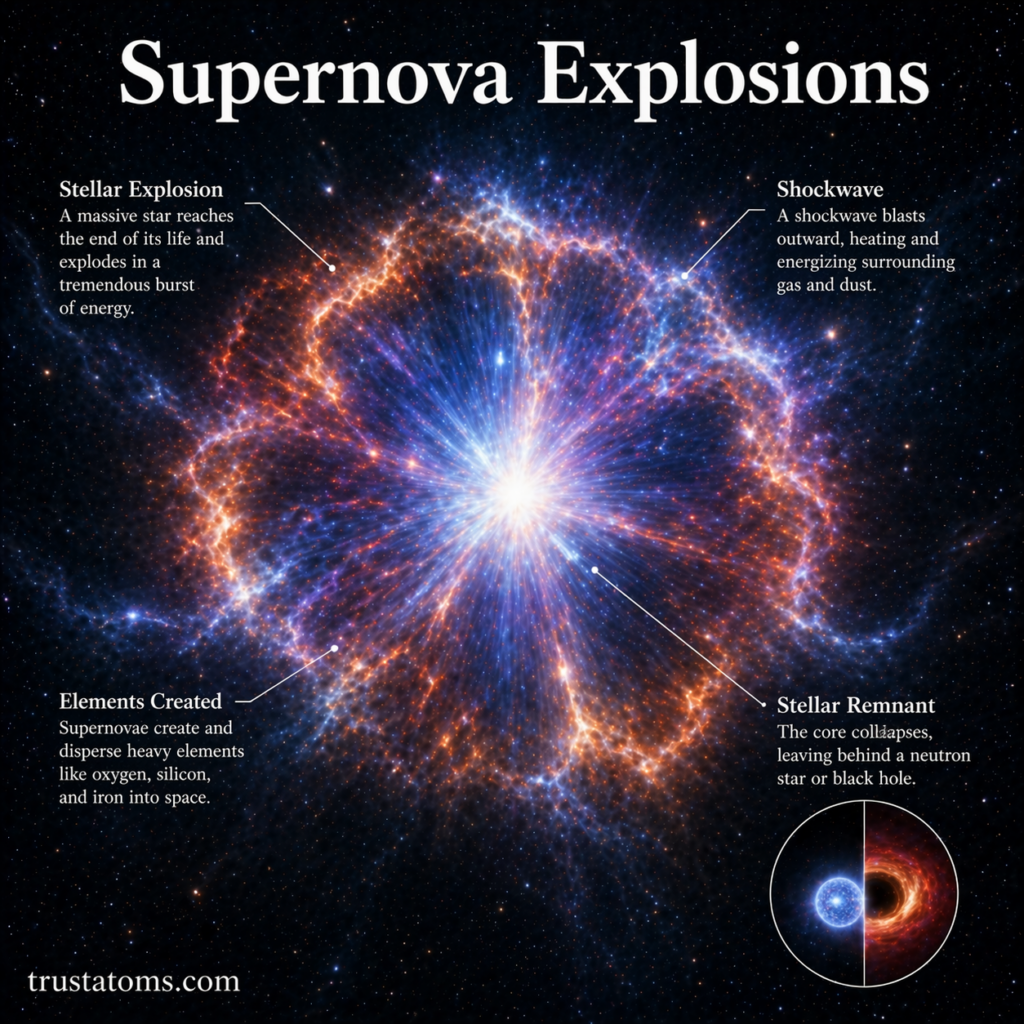
Supernova explosions are among the most powerful and dramatic events in the universe. In a matter of seconds, a dying star can release more energy than our Sun will emit over its entire lifetime.
These cosmic explosions not only mark the end of certain stars but also play a crucial role in shaping galaxies and creating the elements necessary for planets—and life itself.
What Is a Supernova?
A supernova is a massive explosion that occurs during the final stages of a star’s life.
Key characteristics
- Extremely bright (can outshine entire galaxies temporarily)
- Releases vast amounts of energy
- Ejects stellar material into space at high speeds
- Leaves behind a stellar remnant (neutron star or black hole)
Supernovae are rare in any single galaxy but occur frequently across the universe.
Types of Supernova Explosions
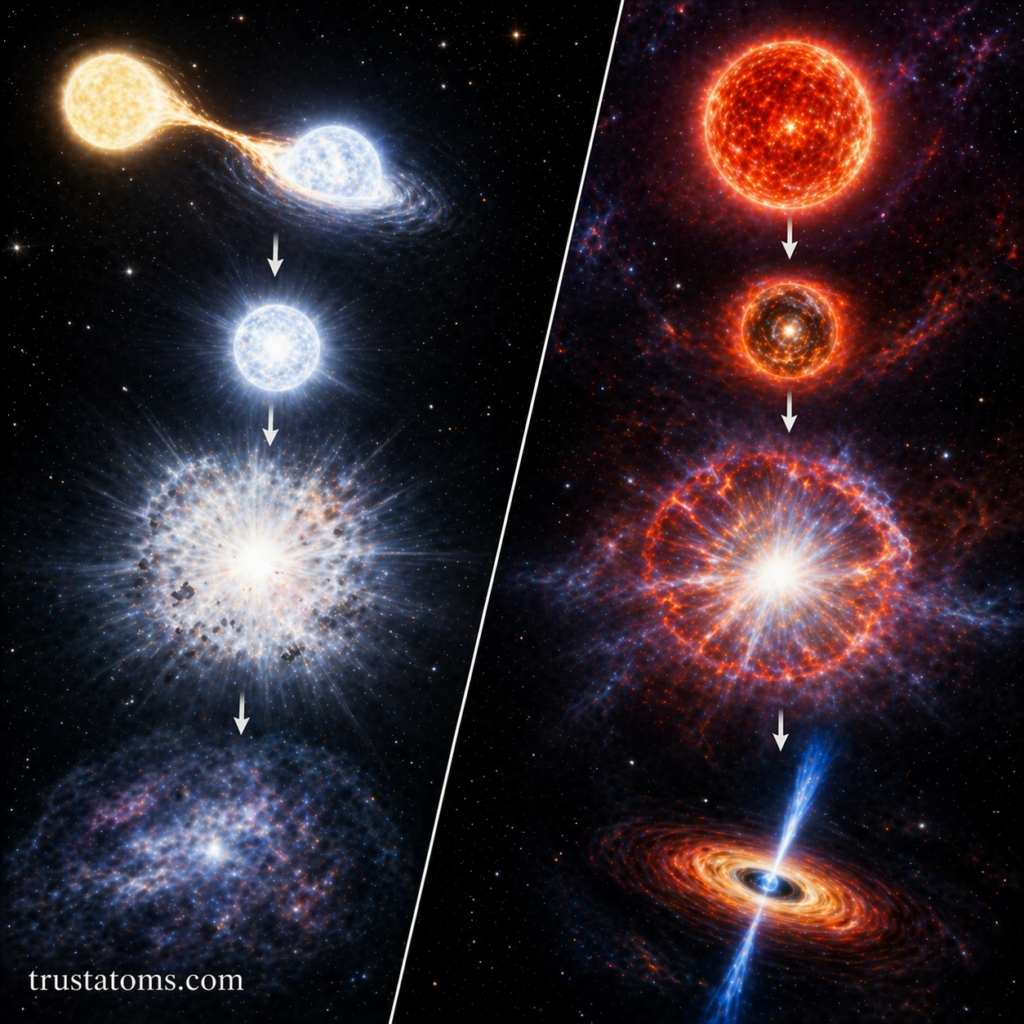
There are two main types of supernovae, based on how they form.
Type I Supernova
Occurs in binary star systems.
How it happens
- A white dwarf pulls material from a companion star
- Its mass increases over time
- When it reaches a critical limit, runaway fusion occurs
- The star explodes completely
Result
- No core remains
- Entire star is destroyed
Type II Supernova
Occurs in massive stars.
How it happens
- A massive star runs out of nuclear fuel
- The core collapses under gravity
- Outer layers rebound and explode
- A supernova is triggered
Result
- Leaves behind a neutron star or black hole
What Causes a Supernova?
The trigger depends on the type, but both involve a loss of balance inside the star.
Key causes
- Collapse of the core due to gravity
- Sudden release of energy from nuclear reactions
- Instability caused by mass buildup (in white dwarfs)
When the forces inside a star can no longer maintain equilibrium, the result is a catastrophic explosion.
How Powerful Are Supernovae?
Supernovae are among the most energetic events known.
Energy output
- Can release more energy in seconds than the Sun in billions of years
- Emit intense light, radiation, and shock waves
- Visible across vast distances in space
Impact
- Shockwaves can trigger new star formation
- Surrounding space is enriched with heavy elements
What Happens After a Supernova?
After the explosion, different outcomes occur depending on the original star’s mass.
Possible remnants
- Neutron star (dense collapsed core)
- Black hole (if the core is massive enough)
- Expanding cloud of gas and dust (supernova remnant)
These remnants continue to influence their surroundings for millions of years.
Supernova Remnants
A supernova remnant is the expanding shell of gas and dust left behind.
Features
- Expands outward at high speed
- Glows due to energized particles
- Can form complex and beautiful structures
Why they matter
- Spread heavy elements into space
- Contribute to the formation of new stars and planets
Why Supernovae Are Important
Supernovae are essential to the evolution of the universe.
Their role
- Create and distribute heavy elements (carbon, oxygen, iron)
- Enrich interstellar space
- Trigger new star formation
- Help shape galaxies
Without supernovae, many of the elements needed for life would not exist.
Key Takeaways
- Supernovae are explosive deaths of stars
- Two main types: Type I (white dwarf) and Type II (massive star)
- They release enormous energy and light
- Leave behind neutron stars, black holes, or remnants
- Play a key role in cosmic evolution
Final Thoughts
Supernova explosions are not just dramatic endings—they are powerful beginnings. These events recycle matter, spread essential elements, and help create new generations of stars and planets.
By studying supernovae, scientists gain a deeper understanding of how the universe evolves and how the building blocks of life are formed.