Black holes are among the most mysterious and powerful objects in the universe. While they may seem like cosmic voids, many black holes are actually born from the dramatic deaths of massive stars.
Understanding how black holes form from stellar collapse reveals not only how stars end their lives, but also how gravity behaves under the most extreme conditions.
What Is a Black Hole?
A black hole is a region of space where gravity is so strong that nothing—not even light—can escape.
Key features
- Extreme gravitational pull
- No visible surface
- Surrounded by an event horizon (the point of no return)
- Often accompanied by an accretion disk of glowing matter
Black holes cannot be seen directly, but their presence is detected through their effects on nearby matter and light.
How Black Holes Form from Stellar Collapse
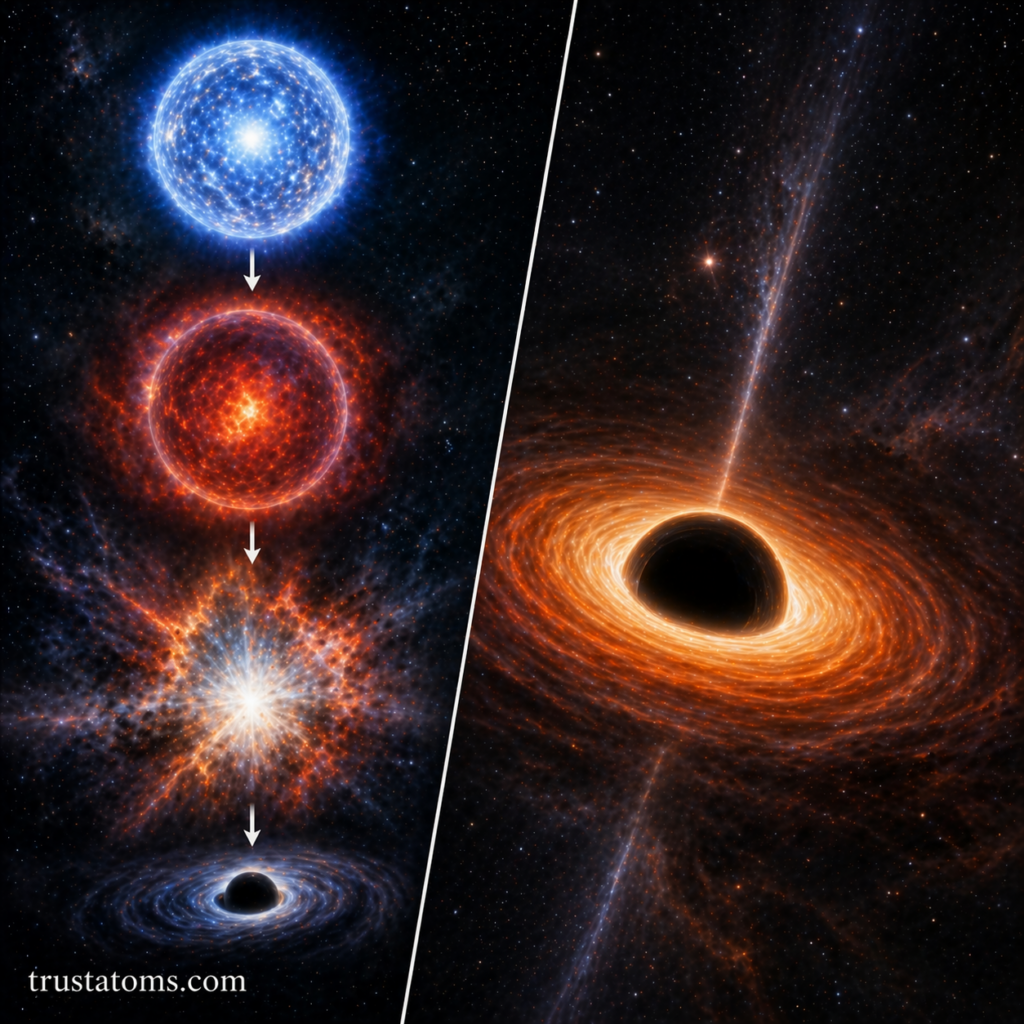
Black holes commonly form when massive stars reach the end of their life cycles.
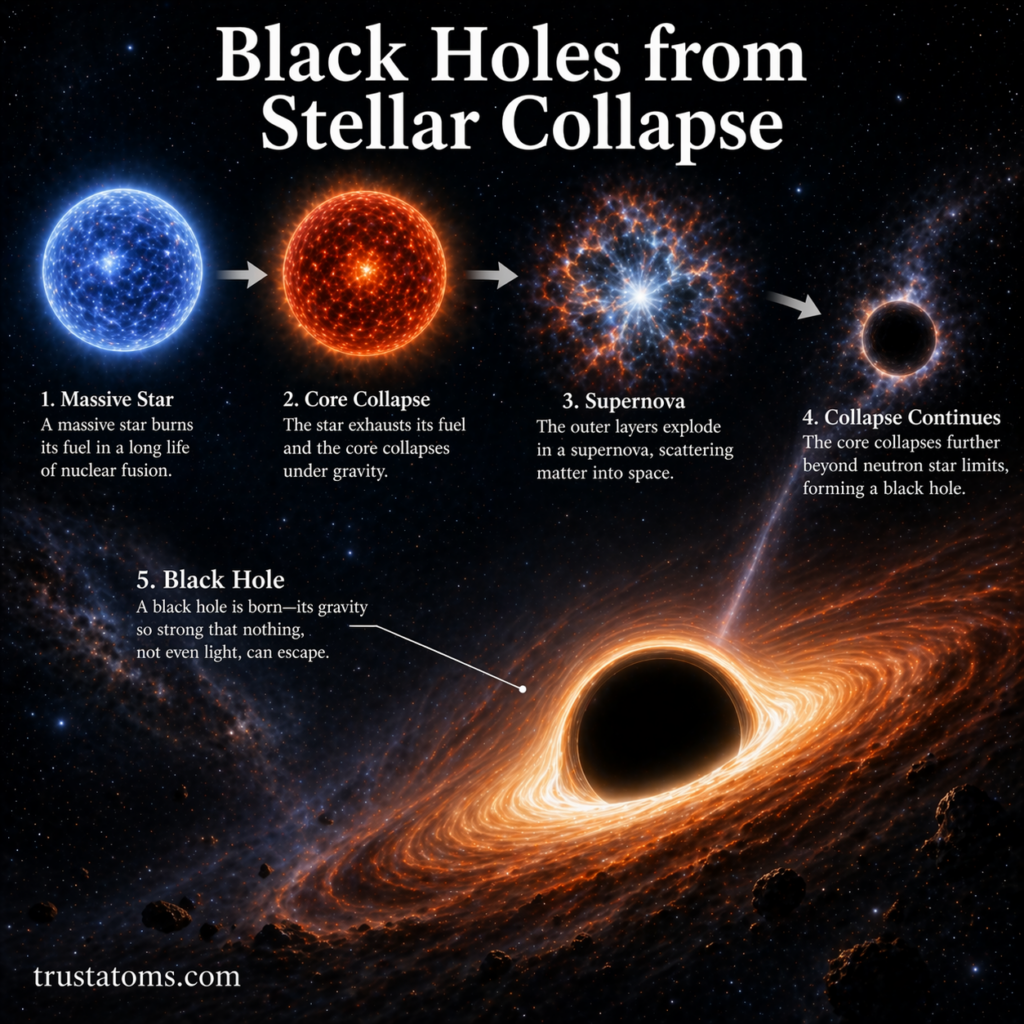
Step-by-step process
- A massive star (typically 20+ times the Sun’s mass) exhausts its nuclear fuel
- Fusion in the core stops
- Gravity causes the core to collapse rapidly
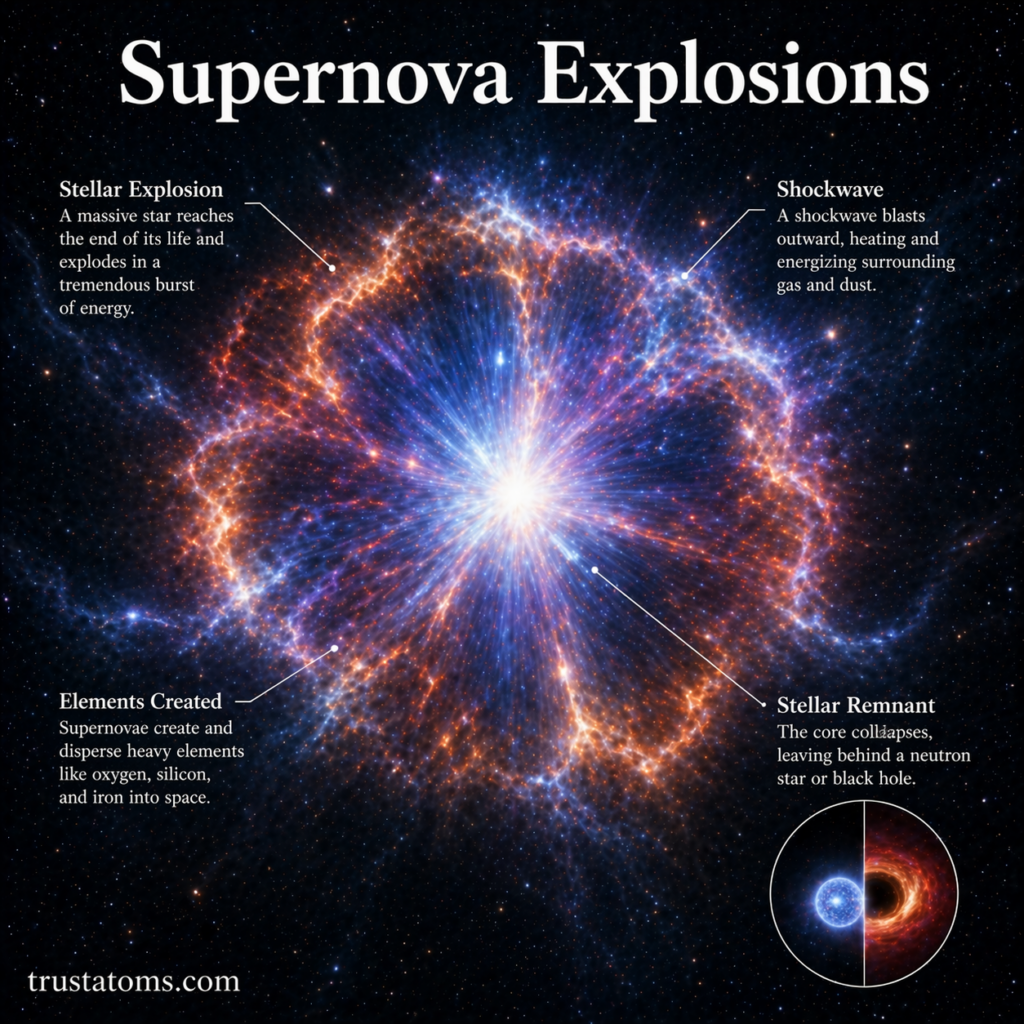
- Outer layers explode in a supernova
- The remaining core collapses beyond neutron star limits
- A black hole forms
This process is known as stellar collapse.
The Role of Mass in Black Hole Formation
Not all stars become black holes—mass is the deciding factor.
Outcomes based on mass
- Low to medium-mass stars → white dwarfs
- Massive stars → neutron stars
- Very massive stars → black holes
Why mass matters
- Greater mass means stronger gravity
- If gravity overcomes all internal forces, collapse continues indefinitely
- This leads to the formation of a black hole
What Is the Event Horizon?
The event horizon is the boundary surrounding a black hole.
Key concepts
- Marks the point where escape is impossible
- Anything crossing it cannot return
- Defines the “size” of a black hole
Once matter passes the event horizon, it is permanently trapped.
Inside a Black Hole: The Singularity
At the center of a black hole lies the singularity.
What we know
- A point of infinite density (according to current theories)
- Gravity becomes extremely strong
- Known laws of physics break down
The singularity remains one of the biggest mysteries in modern science.
Accretion Disks and Energy Emission
Although black holes themselves emit no light, their surroundings can be extremely bright.
Accretion disk
- A rotating disk of gas and dust spiraling into the black hole
- Friction heats the material to very high temperatures
- Emits intense radiation (X-rays and visible light)
Why it matters
- Makes black holes detectable
- Powers some of the brightest objects in the universe
Supernova and Direct Collapse
Black holes can form in slightly different ways depending on how the star collapses.
Supernova route
- Star explodes violently
- Leaves behind a black hole core
Direct collapse
- Star collapses without a visible explosion
- Forms a black hole quietly
Both processes result in the same outcome: an incredibly dense gravitational object.
How Big Are Stellar Black Holes?
Black holes formed from stars are called stellar-mass black holes.
Typical sizes
- Mass: 3 to 100 times the Sun
- Event horizon: only a few kilometers wide
Despite their relatively small size, their gravitational influence is enormous.
Why Black Holes Matter
Black holes are essential to understanding the universe.
Their importance
- Help test theories of gravity and relativity
- Influence the motion of stars and galaxies
- Play a role in galaxy formation
- Provide insight into extreme physics conditions
They are not just cosmic endpoints—they actively shape the universe around them.
Key Takeaways
- Black holes form from the collapse of very massive stars
- Stellar collapse occurs after fusion stops in the core
- Mass determines whether a star becomes a neutron star or black hole
- The event horizon marks the point of no return
- Black holes can be detected through surrounding radiation
Final Thoughts
Black holes formed from stellar collapse are some of the most fascinating objects in astronomy. They represent the ultimate triumph of gravity over all other forces, creating regions of space where our current understanding of physics is pushed to its limits.
By studying black holes, scientists continue to unlock deeper insights into the nature of space, time, and the universe itself.