Neutron stars and pulsars are among the most extreme and fascinating objects in the universe. Born from the explosive deaths of massive stars, these dense remnants push the limits of physics and offer insight into some of the most powerful forces in nature.
Despite their small size, neutron stars pack enormous mass and energy, making them key objects of study in modern astronomy.
What Is a Neutron Star?
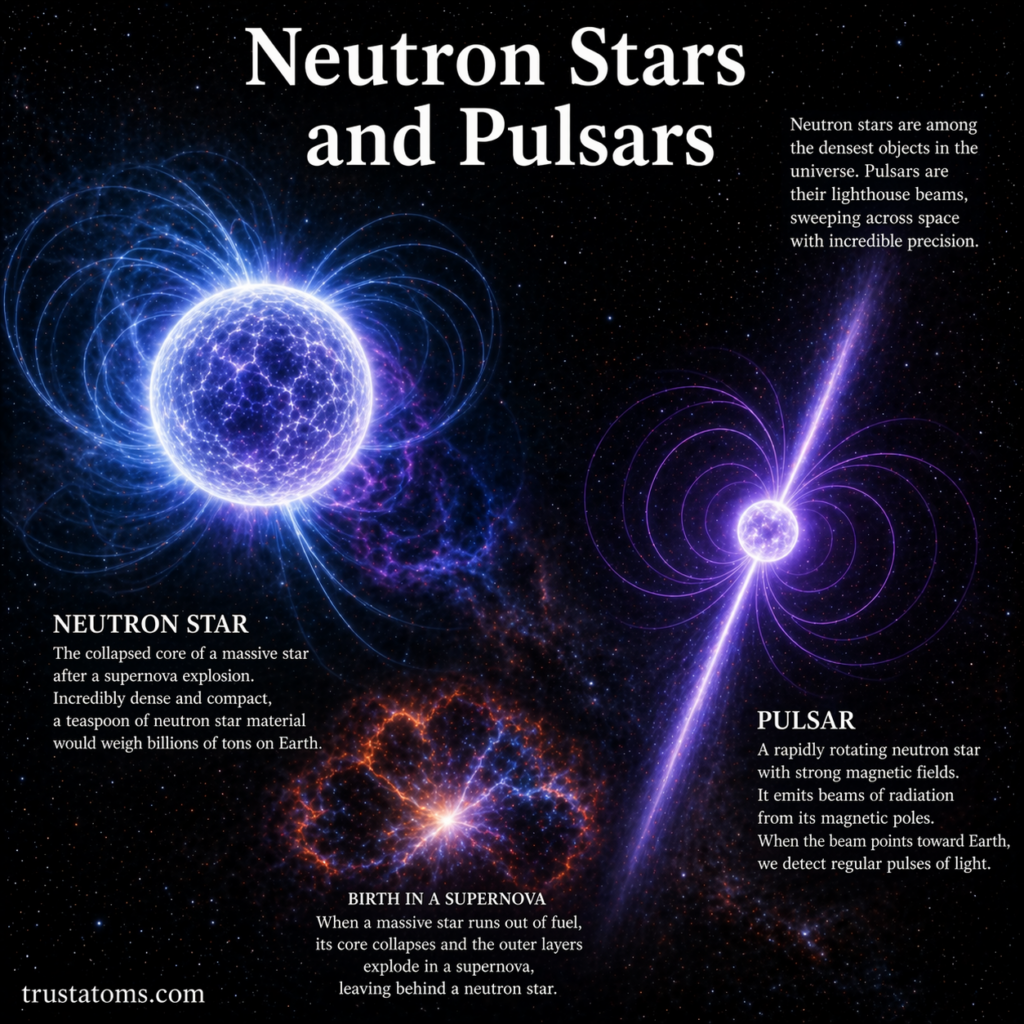
A neutron star is the collapsed core of a massive star that has undergone a supernova explosion.
Key characteristics
- Extremely dense (more mass than the Sun in a city-sized object)
- Typically about 20 kilometers (12 miles) in diameter
- Composed mostly of tightly packed neutrons
- Possess incredibly strong gravity
To put it into perspective, a teaspoon of neutron star material would weigh billions of tons on Earth.
How Neutron Stars Form
Neutron stars are created during the violent death of massive stars.
The process
- A massive star exhausts its nuclear fuel
- The core collapses under gravity
- Outer layers explode in a supernova
- The core compresses into an ultra-dense neutron star
Why neutrons?
- Extreme pressure forces electrons and protons to combine
- This creates neutrons, forming a tightly packed structure
This process results in one of the densest objects in the universe.
Structure of a Neutron Star
Neutron stars have unique internal layers due to their extreme conditions.
Layers include
- Outer crust: solid layer of atomic nuclei and electrons
- Inner crust: denser material with free neutrons
- Core: possibly exotic matter (still not fully understood)
The physics inside neutron stars is still an active area of research.
What Is a Pulsar?
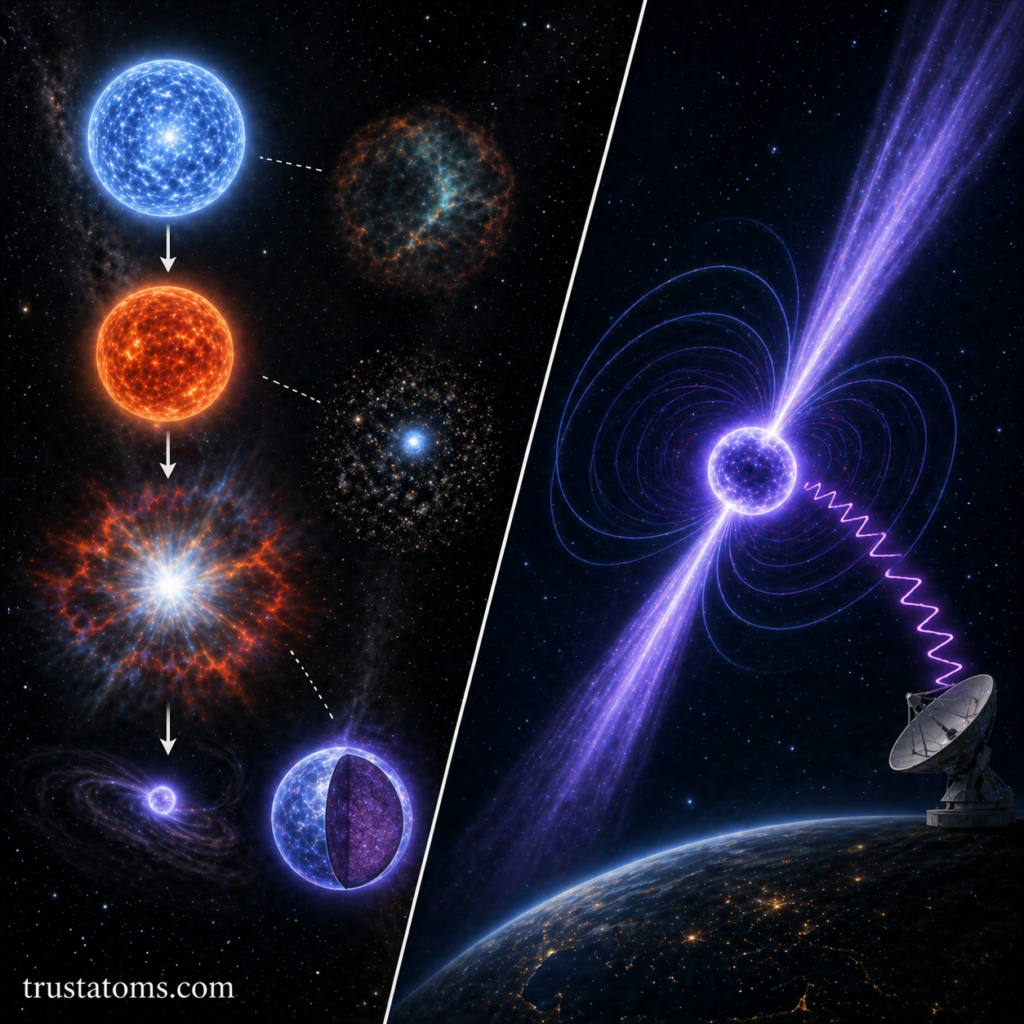
A pulsar is a type of neutron star that emits beams of radiation from its magnetic poles.
How pulsars work
- Neutron stars rotate rapidly
- Radiation beams sweep through space like a lighthouse
- If aligned with Earth, we detect regular pulses
Key features
- Highly regular pulses (milliseconds to seconds)
- Strong magnetic fields
- Extremely fast rotation speeds
Pulsars are some of the most precise natural clocks in the universe.
Why Do Neutron Stars Spin So Fast?
Neutron stars rotate rapidly due to conservation of angular momentum.
The idea
- As the original star collapses, its size shrinks dramatically
- Rotation speeds up (like a spinning figure skater pulling in their arms)
Result
- Some neutron stars spin hundreds of times per second
- These are called millisecond pulsars
This rapid rotation contributes to their powerful radiation emissions.
Magnetars: A Special Type of Neutron Star
Magnetars are neutron stars with extraordinarily strong magnetic fields.
Characteristics
- Magnetic fields trillions of times stronger than Earth’s
- Can release powerful bursts of energy
- Associated with gamma-ray bursts and X-ray flares
Magnetars represent the most magnetic objects known in the universe.
Neutron Stars vs Other Stellar Remnants
Compared to white dwarfs
- Much smaller and denser
- Form from more massive stars
Compared to black holes
- Less massive
- Still have a physical surface
- Do not trap light completely
Neutron stars sit between white dwarfs and black holes in terms of mass and density.
Why Neutron Stars and Pulsars Matter
These objects provide valuable insights into physics and the universe.
Their importance
- Help test theories of gravity and matter under extreme conditions
- Serve as precise cosmic timekeepers (pulsars)
- Contribute to the study of gravitational waves
- Reveal details about supernova explosions
Neutron stars are natural laboratories for studying the laws of physics.
Key Takeaways
- Neutron stars are ultra-dense remnants of massive stars
- Pulsars are rotating neutron stars that emit detectable radiation pulses
- They form after supernova explosions
- Some neutron stars (magnetars) have incredibly strong magnetic fields
- They play a crucial role in understanding extreme physics
Final Thoughts
Neutron stars and pulsars are extraordinary objects that challenge our understanding of matter, gravity, and energy. Despite their small size, they hold immense power and provide scientists with valuable clues about how the universe works at its most extreme limits.
As research continues, these fascinating remnants will remain at the forefront of astronomical discovery.