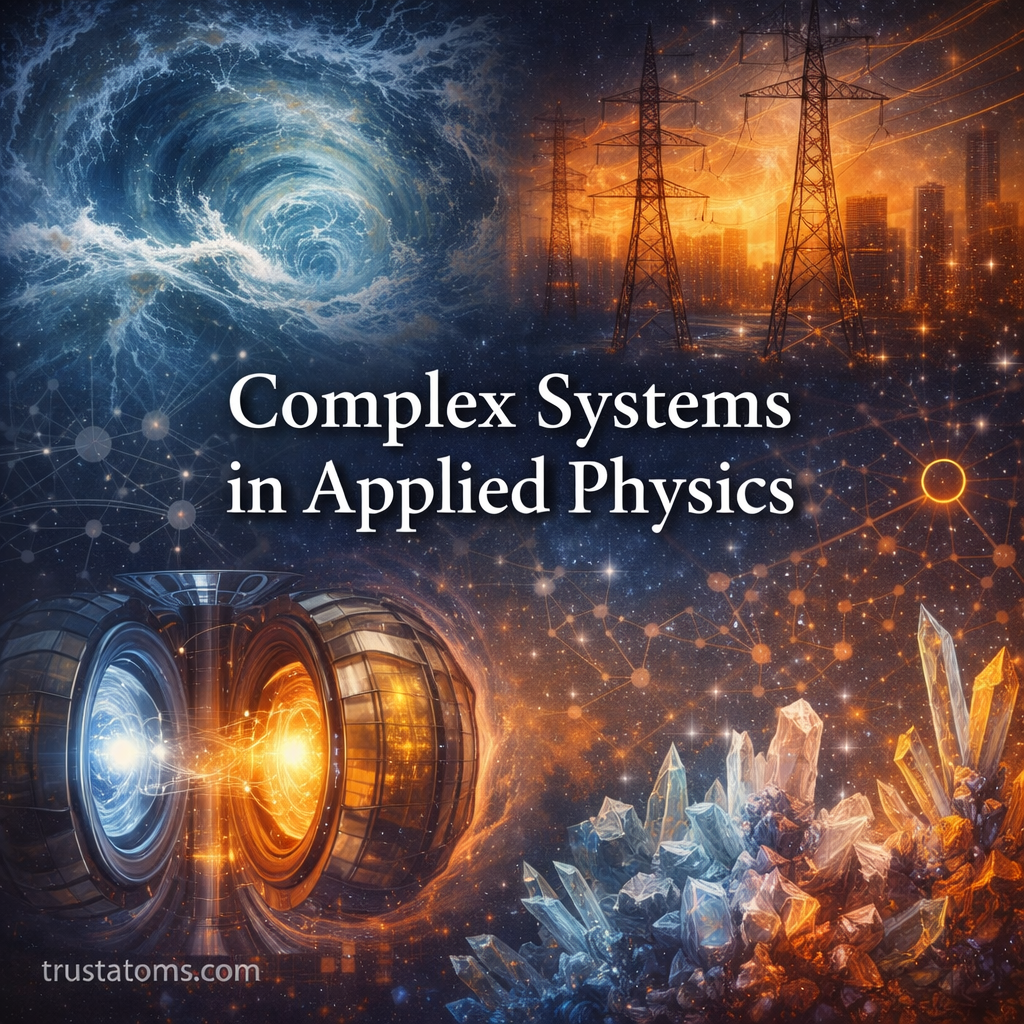
Complex systems are everywhere in applied physics—from turbulent air flowing over an aircraft wing to electrical grids powering entire cities. Unlike simple systems that can be described with a few equations and predictable outcomes, complex systems involve many interacting parts whose collective behavior produces surprising, emergent patterns.
Understanding complex systems is essential for solving real-world engineering and scientific challenges. In applied physics, it bridges theory and practical problem-solving across energy, materials, climate, medicine, and technology.
What Is a Complex System?
A complex system is a system made up of many interacting components whose overall behavior cannot be understood simply by analyzing each part separately.
Key characteristics include:
- Many interconnected elements
- Nonlinear interactions
- Feedback loops
- Emergent behavior
- Sensitivity to small changes
The whole behaves differently from the sum of its parts.
How Complex Systems Differ from Simple Systems
Simple Systems
- Few interacting components
- Linear cause-and-effect relationships
- Predictable behavior
- Solutions often found analytically
Example: A single pendulum under ideal conditions.
Complex Systems
- Large number of interacting elements
- Nonlinear relationships
- Emergent collective behavior
- Often require computational modeling
Example: Turbulent airflow around an aircraft.
Applied physics focuses on understanding and controlling such complexity in real-world applications.
Core Features of Complex Systems in Physics
1. Nonlinearity
In nonlinear systems:
- Output is not proportional to input
- Small disturbances can produce large effects
- Interactions amplify or dampen changes
This is common in fluid dynamics, plasma physics, and electrical networks.
2. Emergence
Emergence occurs when:
- Local interactions produce global patterns
- System-level behavior cannot be predicted from individual parts alone
Examples include:
- Pattern formation in chemical reactions
- Synchronization in oscillating systems
- Collective motion in particle systems
3. Feedback Loops
Feedback mechanisms regulate system behavior.
- Positive feedback amplifies changes
- Negative feedback stabilizes systems
These mechanisms appear in climate models, laser systems, and biological regulation.
4. Self-Organization
Some complex systems spontaneously organize without external control.
Examples include:
- Crystal formation
- Convection cells in heated fluids
- Magnetic domain alignment
Self-organization is central to materials science and condensed matter physics.
Examples of Complex Systems in Applied Physics

Turbulence in Fluid Dynamics
Turbulence is one of the most studied complex phenomena in physics.
Characteristics include:
- Chaotic eddies
- Energy cascades across scales
- Irregular but structured flow patterns
Despite being governed by deterministic equations, turbulence remains difficult to predict precisely.
Applications:
- Aircraft design
- Weather modeling
- Pipeline engineering
Electrical Power Grids
Modern power grids are vast networks of:
- Generators
- Transmission lines
- Substations
- Consumers
They must remain stable despite fluctuating demand and supply.
Small failures can cascade into large-scale blackouts. Understanding network dynamics and feedback stabilization is critical in applied physics and engineering.
Plasma in Fusion Reactors
Plasma behavior inside fusion devices is highly complex.
It involves:
- Magnetic confinement
- Instabilities
- Energy transport across multiple scales
Predicting plasma behavior requires computational simulations that incorporate nonlinear interactions and emergent structures.
Materials and Phase Transitions
Materials can undergo sudden changes in structure when:
- Temperature shifts
- Pressure changes
- External fields vary
These phase transitions often involve collective interactions between particles, producing macroscopic transformations from microscopic behavior.
Understanding these transitions is essential for:
- Semiconductor design
- Superconductors
- Advanced materials engineering
Mathematical Tools for Studying Complex Systems
Applied physicists use advanced mathematical and computational tools, including:
- Nonlinear differential equations
- Network theory
- Statistical mechanics
- Agent-based modeling
- Computational simulations
Often, exact solutions are impossible. Instead, researchers rely on:
- Numerical approximations
- Simulations
- Probabilistic descriptions
Computational physics plays a major role in managing real-world complexity.
Why Complex Systems Matter in Applied Physics
Complex systems research allows scientists and engineers to:
- Predict system stability
- Prevent cascading failures
- Design resilient infrastructure
- Optimize performance in dynamic environments
- Understand limits of predictability
Modern challenges—from renewable energy integration to climate forecasting—depend on mastering complex interactions.
Complexity and Predictability
Not all complex systems are chaotic, but many exhibit limited predictability.
Factors that reduce predictability include:
- Nonlinearity
- Sensitivity to initial conditions
- High dimensionality
- Strong coupling between components
Applied physics focuses not only on understanding complexity but also on controlling it.
Interdisciplinary Connections
Complex systems in applied physics connect to:
- Engineering
- Biology
- Economics
- Computer science
- Environmental science
For example:
- Neural networks in AI are inspired by physical network models.
- Epidemic modeling borrows techniques from statistical physics.
- Climate models rely heavily on fluid dynamics and thermodynamics.
This cross-disciplinary reach makes complexity science one of the most influential areas of modern physics.
Challenges in Modeling Complex Systems
Even with powerful computers, challenges remain:
- Incomplete data
- Computational limits
- Sensitivity to modeling assumptions
- Multiscale interactions
Physicists must balance realism with computational feasibility.
Often, simplified models capture essential behavior while ignoring unnecessary details.
The Future of Complex Systems Research
Advances in:
- High-performance computing
- Machine learning
- Data-driven modeling
- Network science
are accelerating progress in applied physics.
Researchers increasingly combine physics-based equations with AI-assisted analysis to improve forecasting and system design.
Understanding complexity is no longer optional—it is central to innovation.
Final Thoughts
Complex systems in applied physics reveal how interconnected components generate collective behavior that cannot be reduced to simple rules. From turbulent fluids and power grids to plasma confinement and advanced materials, complexity shapes modern technology and scientific progress.
Applied physics does not merely observe complexity—it seeks to harness, stabilize, and optimize it.
By studying nonlinear interactions, feedback loops, and emergent behavior, physicists unlock the principles that govern the dynamic systems powering our world.