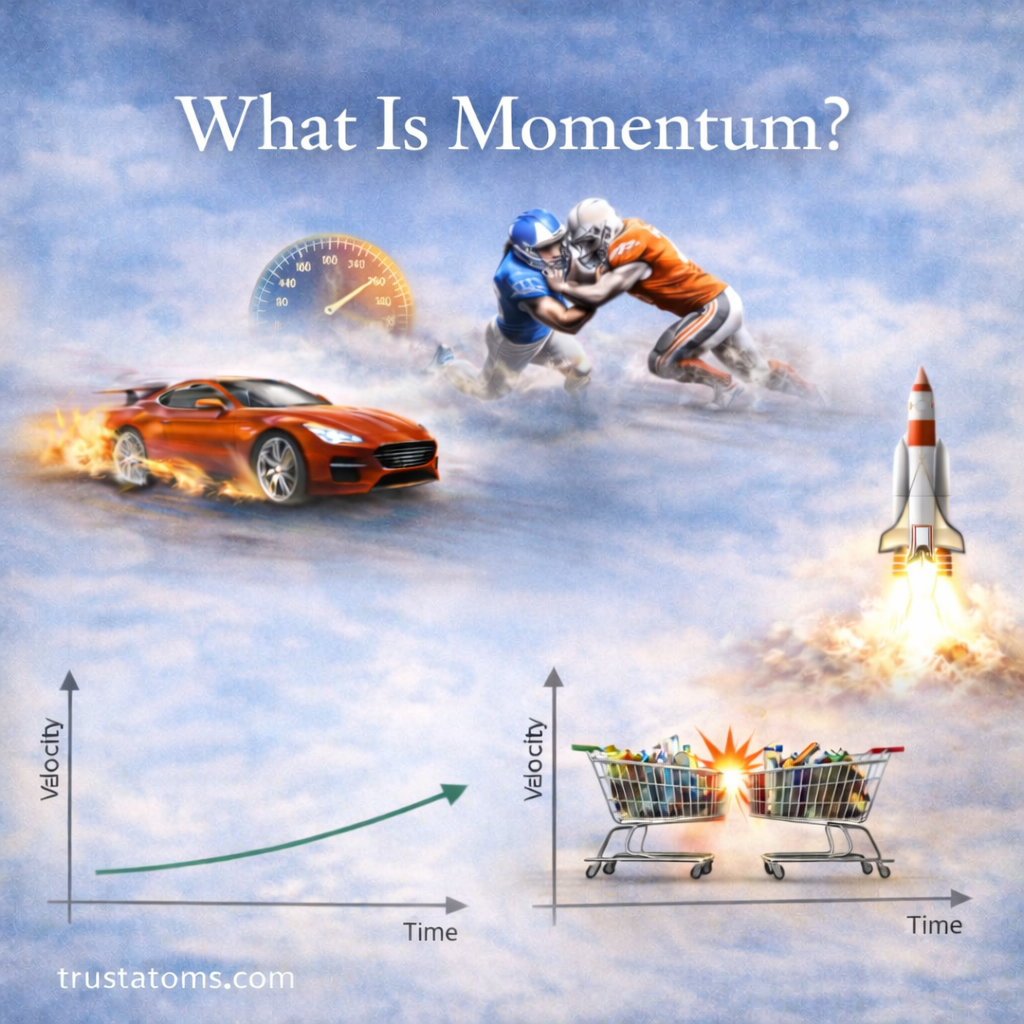
Momentum is a fundamental concept in physics that describes how much motion an object has. The more momentum something has, the harder it is to stop.
Momentum helps explain car crashes, sports collisions, rocket propulsion, and even how objects move in space.
In this guide, you’ll learn what momentum is, how it’s calculated, and why it plays a crucial role in understanding motion.
Definition of Momentum
Momentum is the quantity of motion an object possesses.
In physics, momentum depends on two things:
- Mass
- Velocity
An object with greater mass or greater velocity has greater momentum.
Momentum is a vector quantity, meaning it has:
- Magnitude (how much)
- Direction (which way)
The Formula for Momentum

Momentum is calculated using the formula:
p = mv
Where:
- p = momentum
- m = mass (kg)
- v = velocity (m/s)
This formula shows:
- Doubling mass doubles momentum
- Doubling velocity doubles momentum
Both factors are equally important.
Units of Momentum
In the International System (SI), momentum is measured in:
kilogram meters per second (kg·m/s)
Because momentum equals mass × velocity.
Why Momentum Matters
Momentum tells us how difficult it is to stop a moving object.
For example:
- A truck moving slowly can have the same momentum as a small car moving quickly.
- A fast baseball has more momentum than a slow one.
Momentum explains why:
- Heavier vehicles require longer stopping distances.
- Safety systems are essential in collisions.
Conservation of Momentum
One of the most important principles in physics is:
The Law of Conservation of Momentum.
It states:
In a closed system with no external forces, total momentum remains constant.
This means momentum can be transferred between objects, but the total amount stays the same.
Example: Ice Skaters
If two ice skaters push off each other:
- One moves left
- The other moves right
Their momenta are equal in magnitude and opposite in direction.
Total momentum before = Total momentum after
Example: Collisions
When two objects collide:
- Momentum transfers between them.
- Total system momentum remains constant (if no external forces act).
Types of collisions include:
- Elastic collisions – Objects bounce apart, conserving momentum and kinetic energy.
- Inelastic collisions – Objects stick together, conserving momentum but not kinetic energy.
Momentum vs Force
Momentum and force are related but not the same.
Force causes a change in momentum.
Newton’s Second Law can also be written as:
Force = change in momentum ÷ time
This shows:
- Large forces cause rapid momentum changes.
- Small forces cause gradual momentum changes.
This relationship explains:
- Why airbags reduce injury (they increase stopping time, reducing force).
- Why catching a ball with soft hands reduces impact.
Impulse and Momentum
Impulse measures how force changes momentum over time.
Impulse = Force × Time
Impulse equals the change in momentum.
This is why:
- Bending your knees when landing reduces injury.
- Helmets increase the time over which your head stops, reducing force.
Impulse spreads momentum change over a longer time interval.
Real-World Examples of Momentum
Momentum appears everywhere in daily life.
1. Sports
- A moving football transfers momentum during a tackle.
- A bat transfers momentum to a baseball.
The greater the velocity, the greater the momentum.
2. Car Crashes
In a collision:
- Vehicles exchange momentum.
- Heavier vehicles tend to undergo less acceleration.
Safety features manage how quickly momentum changes.
3. Rocket Propulsion
Rockets move by expelling gas downward.
- Gas gains downward momentum.
- Rocket gains upward momentum.
Total momentum of the system remains conserved.
4. Walking
When you walk:
- You push backward on the ground.
- The ground pushes you forward.
Momentum transfers between you and Earth.
Momentum in Space
In space, momentum is especially important because friction is minimal.
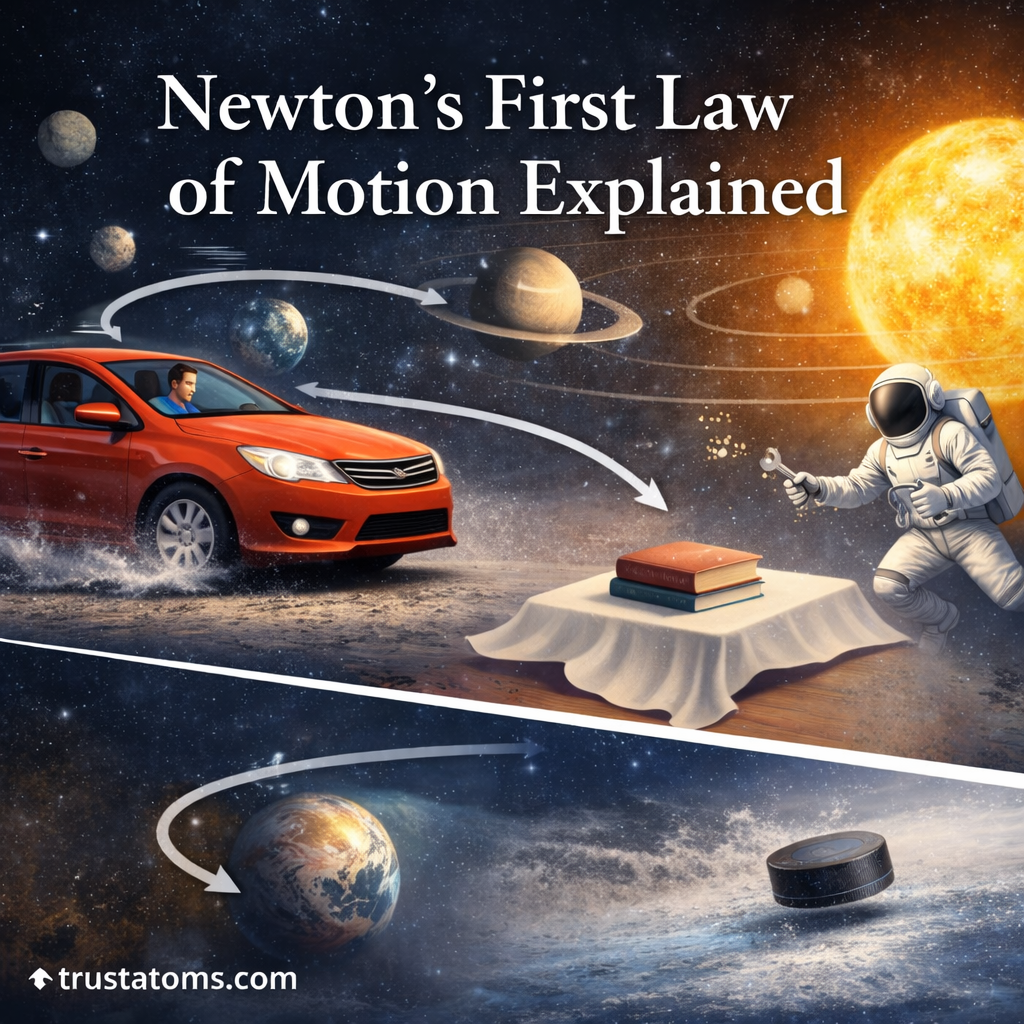
An astronaut pushing a tool will:
- Move backward
- While the tool moves forward
Momentum is conserved because there are no significant external forces.
Common Misconceptions
“Momentum Is the Same as Energy”
They are related but different.
Momentum depends on velocity directly.
Kinetic energy depends on velocity squared.
“Heavier Objects Always Have More Momentum”
Not necessarily.
A lighter object moving very fast can have more momentum than a heavier slow object.
“Momentum Disappears After a Collision”
Momentum transfers between objects but does not disappear in a closed system.
Why Understanding Momentum Is Important
Momentum helps explain:
- Vehicle safety design
- Sports performance
- Space travel
- Ballistics
- Engineering systems
It connects motion, force, and collisions into a predictable framework.
Without momentum, we couldn’t accurately describe interactions between moving objects.
Quick Summary
Momentum:
- Equals mass × velocity
- Is a vector quantity
- Is measured in kg·m/s
- Is conserved in closed systems
The more mass and speed an object has, the more momentum it carries.
Final Thoughts
Momentum measures how much motion an object has and how difficult it is to stop.
Calculated using p = mv, momentum depends on both mass and velocity.
Through conservation laws, impulse, and collisions, momentum explains how motion transfers between objects.
From sports to space travel, momentum is one of the most powerful tools in physics for understanding motion.