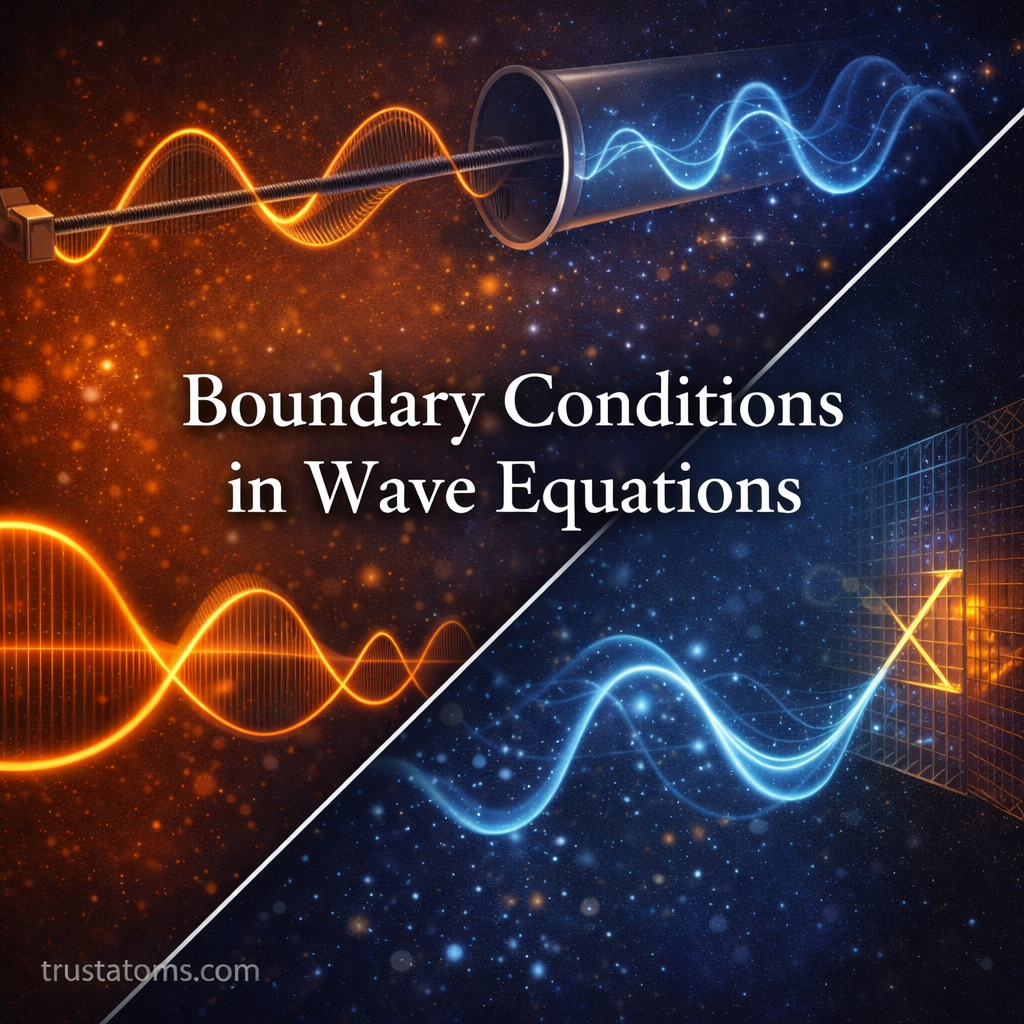
Wave equations describe how vibrations, oscillations, and disturbances move through space and time. From sound traveling through air to light propagating in space, wave behavior is governed by precise mathematical relationships.
But solving a wave equation is only part of the story.
To determine the actual physical behavior of a system, we must also specify boundary conditions. These conditions define what happens at the edges of the system and ultimately determine which wave patterns are allowed.
In physics, boundary conditions transform general equations into meaningful, real-world solutions.
What Is a Wave Equation?
A wave equation is a mathematical expression that describes how a wave evolves over time.
In simple terms, it relates:
- Spatial variation (how the wave changes across space)
- Time variation (how the wave changes over time)
Wave equations appear in:
- Acoustics (sound waves)
- Optics (light waves)
- Quantum mechanics (matter waves)
- Electromagnetism (radio waves)
- Mechanical vibrations (strings and membranes)
However, without boundary conditions, these equations have infinitely many possible solutions.
What Are Boundary Conditions?
Boundary conditions are constraints applied at the edges of a physical system.
They define:
- What the wave is allowed to do at boundaries
- Whether motion is restricted or free
- How energy reflects or transmits at surfaces
In practical terms, boundary conditions determine which wave patterns can physically exist.
Why Boundary Conditions Matter
The same wave equation can produce very different results depending on the boundary conditions applied.
For example:
- A vibrating guitar string fixed at both ends produces standing waves.
- A string fixed at one end and free at the other behaves differently.
- Sound in a closed pipe differs from sound in an open pipe.
Boundary conditions select the allowed frequencies and shapes of waves.
They turn mathematical possibilities into physical realities.
Types of Boundary Conditions in Wave Physics
1. Fixed Boundary (Dirichlet Condition)
A fixed boundary forces the wave displacement to be zero at that point.
Example:
- Ends of a tightly clamped string
- Fixed edges of a drum membrane
This creates nodes—points where the wave amplitude is always zero.
2. Free Boundary (Neumann Condition)
A free boundary allows displacement but restricts the slope (rate of change).
Example:
- Open end of an air column
- Free end of a rope
These boundaries create antinodes—points of maximum amplitude.
3. Periodic Boundary Conditions
In periodic boundaries:
- The wave pattern repeats itself
- The system behaves as if it loops back on itself
These are used in:
- Solid-state physics
- Crystallography
- Computational simulations
Periodic conditions simplify analysis of large repeating systems.
4. Mixed Boundary Conditions
Some systems combine different boundary types.
Examples include:
- A string fixed at one end and free at the other
- Electromagnetic waves encountering layered materials
Mixed conditions create unique wave patterns and frequency distributions.
Standing Waves and Boundary Constraints
When waves reflect from boundaries, they interfere with themselves.
If boundary conditions are restrictive, only specific wavelengths “fit” into the system.
For example, in a string fixed at both ends:
- The wave must have zero displacement at both endpoints.
- Only certain wavelengths satisfy this requirement.
- These allowed wavelengths correspond to harmonic frequencies.
This leads to quantization of frequencies.
The system cannot vibrate at arbitrary frequencies—only specific allowed modes exist.
Boundary Conditions in Different Physical Systems
Vibrating Strings
In string instruments:
- Fixed ends create nodes.
- Only specific standing wave modes form.
- The allowed frequencies determine pitch.
This is why a guitar string produces discrete musical notes.
Sound Waves in Air Columns
In pipes:
- Closed ends act like fixed boundaries.
- Open ends act like free boundaries.
This explains why:
- Flutes and organ pipes produce different harmonic structures.
- Open and closed pipes have different fundamental frequencies.
Electromagnetic Waves
For electromagnetic waves:
- Conducting surfaces enforce specific electric and magnetic field constraints.
- Waveguides restrict allowed modes.
- Cavities produce resonant frequencies.
These principles are essential in:
- Microwave engineering
- Fiber optics
- Antenna design
Quantum Wave Functions
In quantum mechanics, wave equations describe probability amplitudes.
When particles are confined:
- The wave function must satisfy boundary conditions.
- Only discrete energy levels are allowed.
This explains:
- Energy quantization in atoms
- Electron behavior in quantum wells
- Stability of atomic orbitals
Boundary conditions lead directly to quantum energy levels.
Mathematical Role of Boundary Conditions
Solving a wave equation typically involves:
- Writing the general solution.
- Applying boundary constraints.
- Solving for allowed constants or frequencies.
Without boundary conditions:
- Solutions remain general.
- Physical predictions cannot be made.
Boundary constraints eliminate impossible solutions and preserve only physically meaningful ones.
Reflection, Transmission, and Interfaces
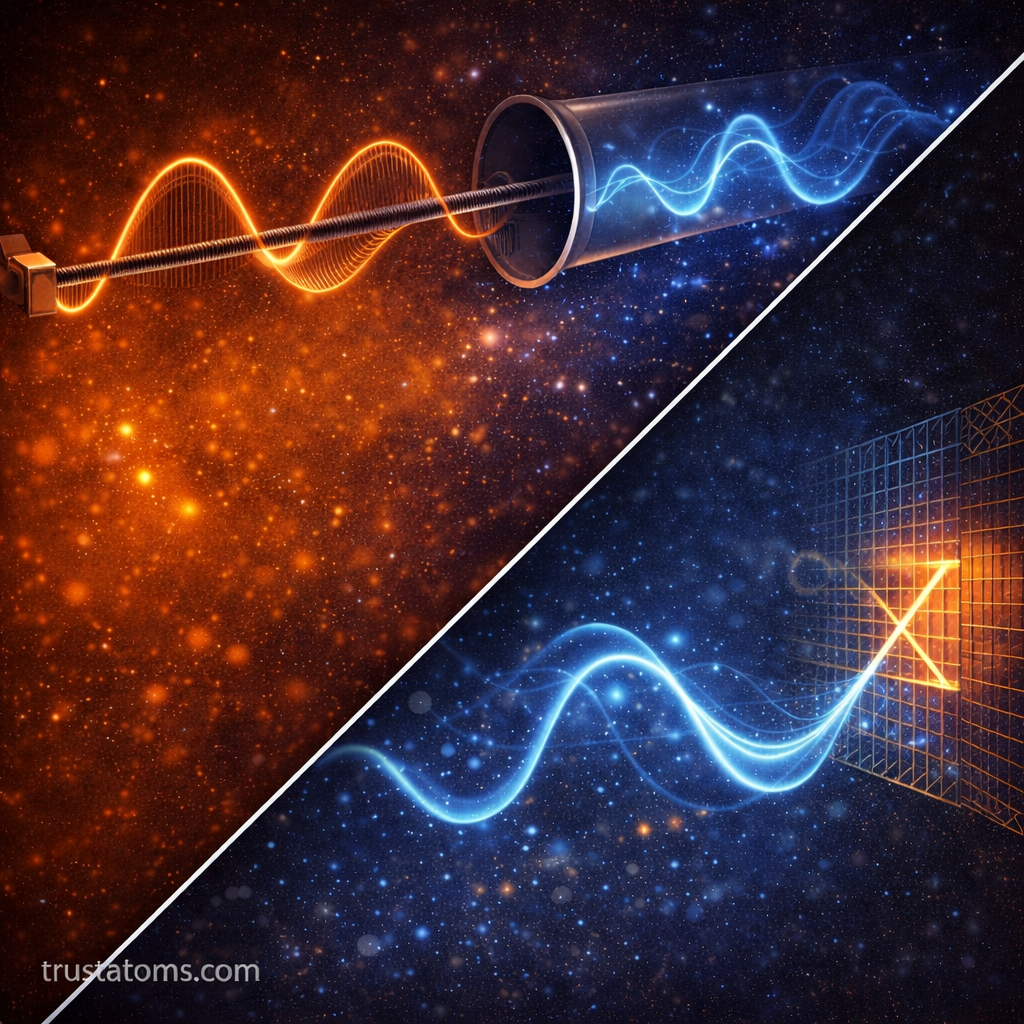
When a wave reaches a boundary between two materials:
- Part of the wave may reflect.
- Part may transmit.
- The amplitudes adjust according to continuity conditions.
These interface boundary conditions explain:
- Echoes in acoustics
- Reflection of light at surfaces
- Refraction and wave speed changes
The behavior of waves at boundaries governs much of applied physics.
Energy and Stability Implications
Boundary conditions influence:
- Energy confinement
- Resonance amplification
- Stability of oscillations
- Mode structure
Improper boundary control in engineering systems can lead to:
- Structural vibration damage
- Resonance failures
- Signal distortion
Understanding boundary effects helps prevent unwanted oscillations.
Common Mistakes in Understanding Boundary Conditions
Many learners assume:
- The wave equation alone determines behavior.
- All frequencies are possible.
- Boundaries only slightly modify solutions.
In reality:
- Boundary conditions are equally important as the equation itself.
- They determine which solutions survive.
- They often introduce quantization and resonance effects.
Ignoring boundaries leads to incomplete physical predictions.
Real-World Applications
Boundary conditions are central to:
- Musical acoustics
- Building vibration control
- Earthquake wave modeling
- Optical cavity design
- Microwave resonators
- Semiconductor physics
Nearly every wave-based technology relies on carefully controlled boundary behavior.
Final Thoughts
Boundary conditions in wave equations are not minor details—they are fundamental constraints that determine how waves behave in real systems.
The wave equation provides the governing rule.
Boundary conditions define the physical possibilities.
Together, they explain standing waves, resonance, quantization, and energy confinement across physics.
Understanding boundary conditions allows physicists and engineers to design stable structures, tune musical instruments, build communication systems, and model quantum phenomena.
In wave physics, the edges of a system shape everything within it.