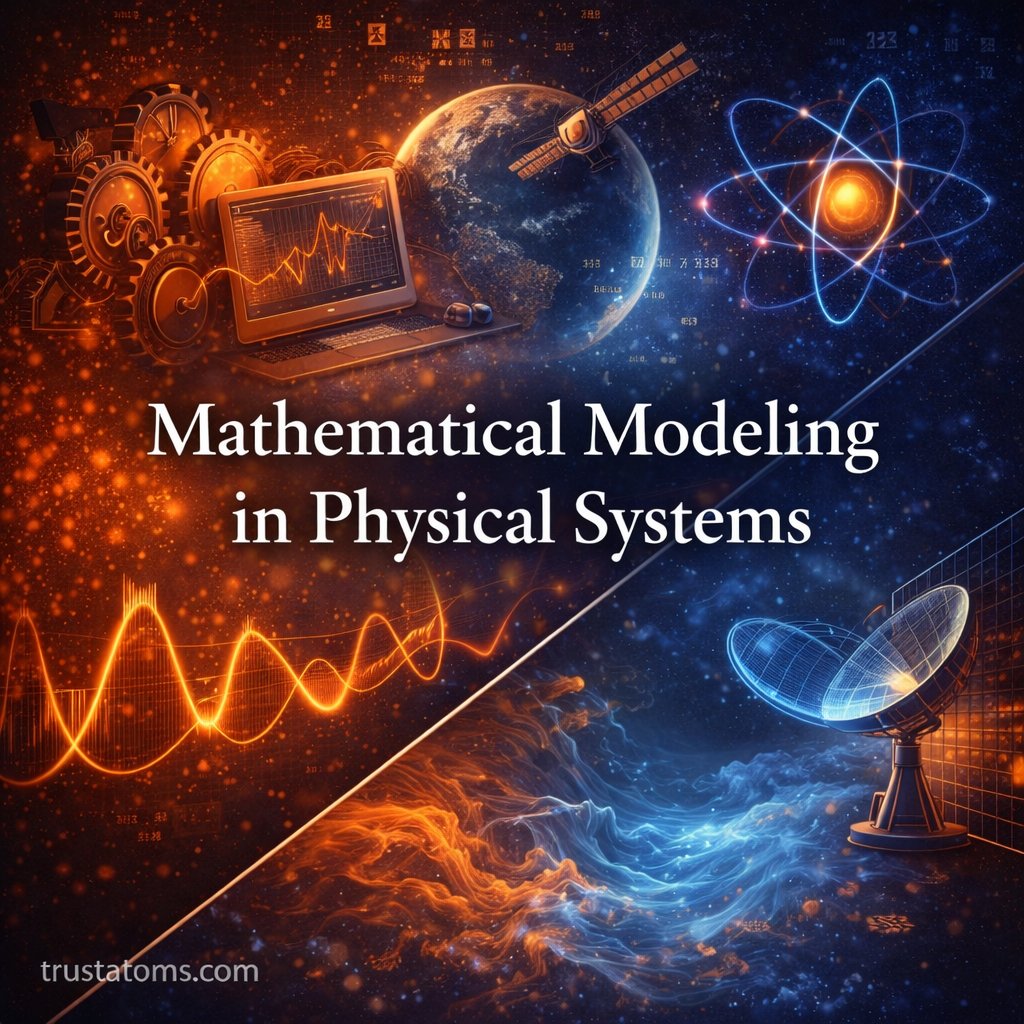
Mathematical modeling is one of the most powerful tools in physics. It allows scientists to describe, predict, and understand physical systems using equations, logical structures, and computational simulations.
From planetary motion to quantum particles, mathematical models translate physical laws into forms that can be analyzed and tested. Without modeling, modern science and engineering would not exist in their current form.
In applied and theoretical physics alike, modeling connects observation to prediction.
What Is Mathematical Modeling?
Mathematical modeling is the process of representing a physical system using mathematical expressions and logical relationships.
A model typically includes:
- Variables representing measurable quantities
- Equations describing relationships between variables
- Assumptions that simplify complex reality
- Initial and boundary conditions
The goal is not to recreate reality perfectly—but to capture essential behavior accurately enough to make predictions.
Why Mathematical Models Matter in Physics
Physical systems are often too complex to analyze directly.
Mathematical models allow physicists to:
- Predict system behavior before experimentation
- Identify underlying principles
- Test hypotheses efficiently
- Design engineering solutions
- Explore extreme or inaccessible conditions
For example:
- Climate models predict temperature trends.
- Orbital mechanics models guide spacecraft navigation.
- Electromagnetic models design communication systems.
Modeling transforms theory into usable insight.
Types of Mathematical Models in Physics

1. Analytical Models
These models use exact mathematical equations that can be solved directly.
Characteristics:
- Closed-form solutions
- Clear relationships between variables
- Often apply to idealized systems
Example: Motion of a projectile without air resistance.
Analytical models provide deep theoretical insight but may oversimplify complex systems.
2. Numerical Models
When equations cannot be solved exactly, numerical methods approximate solutions using computational algorithms.
Used for:
- Fluid dynamics simulations
- Weather prediction
- Plasma physics
- Structural stress analysis
Numerical modeling relies heavily on computers and iterative calculations.
3. Statistical Models
Some systems involve randomness or many interacting particles.
Statistical models describe:
- Average behavior
- Probability distributions
- Macroscopic outcomes from microscopic interactions
Examples include:
- Thermodynamics
- Gas behavior
- Quantum statistical mechanics
Statistical modeling connects large-scale behavior to particle-level physics.
4. Deterministic vs. Stochastic Models
Deterministic models:
- Produce the same output from the same input
- Do not include randomness
Stochastic models:
- Include probabilistic components
- Account for noise and uncertainty
Both types are essential in modern physical modeling.
Core Components of a Physical Model
Every strong mathematical model includes several foundational elements.
Variables
Quantities that change over time or space, such as:
- Position
- Velocity
- Temperature
- Electric field strength
Governing Equations
These equations describe how variables interact.
Examples include:
- Conservation laws
- Force relationships
- Energy balance principles
Initial Conditions
Initial values determine how the system begins evolving.
Boundary Conditions
Constraints at system edges determine allowed behavior.
Together, these elements define the model’s predictive power.
Steps in Building a Mathematical Model
Creating a model typically follows a structured process:
- Define the physical problem clearly
- Identify relevant variables
- Apply known physical laws
- Simplify assumptions where appropriate
- Solve the equations analytically or numerically
- Compare predictions with experimental data
- Refine the model if necessary
Modeling is iterative. Improvements occur as new data emerges.
Applications Across Physics
Mechanics
Models describe:
- Motion of objects
- Rotational dynamics
- Vibrational systems
Engineering design relies heavily on mechanical modeling.
Electromagnetism
Models help predict:
- Electric field distributions
- Wave propagation
- Signal transmission
These models are essential in telecommunications and electronics.
Fluid Dynamics
Fluid modeling explains:
- Airflow over wings
- Ocean currents
- Blood flow in arteries
Because fluid equations are highly nonlinear, numerical methods dominate this field.
Quantum Physics
Wave functions and probability amplitudes are modeled mathematically to describe particle behavior.
Quantum models explain:
- Atomic energy levels
- Semiconductor behavior
- Laser operation
Astrophysics
Mathematical modeling predicts:
- Stellar evolution
- Galaxy formation
- Gravitational interactions
Observations confirm many predictions derived purely from equations.
Advantages of Mathematical Modeling
Mathematical models allow scientists to:
- Explore scenarios impossible to test experimentally
- Reduce costs and risks in engineering
- Identify optimal system configurations
- Reveal hidden relationships
Models often predict phenomena before they are observed.
Limitations of Mathematical Models
No model is perfect.
Common limitations include:
- Oversimplified assumptions
- Sensitivity to input parameters
- Incomplete data
- Computational constraints
A model is only as reliable as its assumptions and validation.
Understanding these limits is crucial for responsible application.
Modeling and Simulation in Modern Physics
With advances in computing power, simulations now complement theoretical modeling.
Simulations allow:
- Visualization of complex systems
- Real-time parameter adjustments
- Large-scale multi-variable analysis
Fields such as climate science, fusion research, and aerospace engineering depend heavily on simulation-based modeling.
Modern physics is increasingly computational.
The Balance Between Simplicity and Accuracy
A key challenge in modeling is choosing the right level of complexity.
Too simple:
- Important effects are ignored
Too complex:
- Model becomes computationally impractical
Effective models strike a balance:
- Simple enough to analyze
- Detailed enough to remain realistic
This balance is at the heart of applied physics.
The Future of Mathematical Modeling
Emerging trends include:
- Machine learning–assisted modeling
- Hybrid physics-AI systems
- High-performance parallel simulations
- Data-driven parameter optimization
These approaches enhance traditional mathematical frameworks rather than replace them.
The core principles of modeling remain rooted in physical law.
Final Thoughts
Mathematical modeling in physical systems transforms observation into understanding and prediction.
It provides structure to complexity, turning physical intuition into measurable, testable outcomes. From engineering design to cosmological exploration, mathematical models guide innovation and discovery.
In physics, equations are not just symbols on paper—they are maps of reality.
When carefully constructed and validated, mathematical models reveal the hidden order governing the universe.