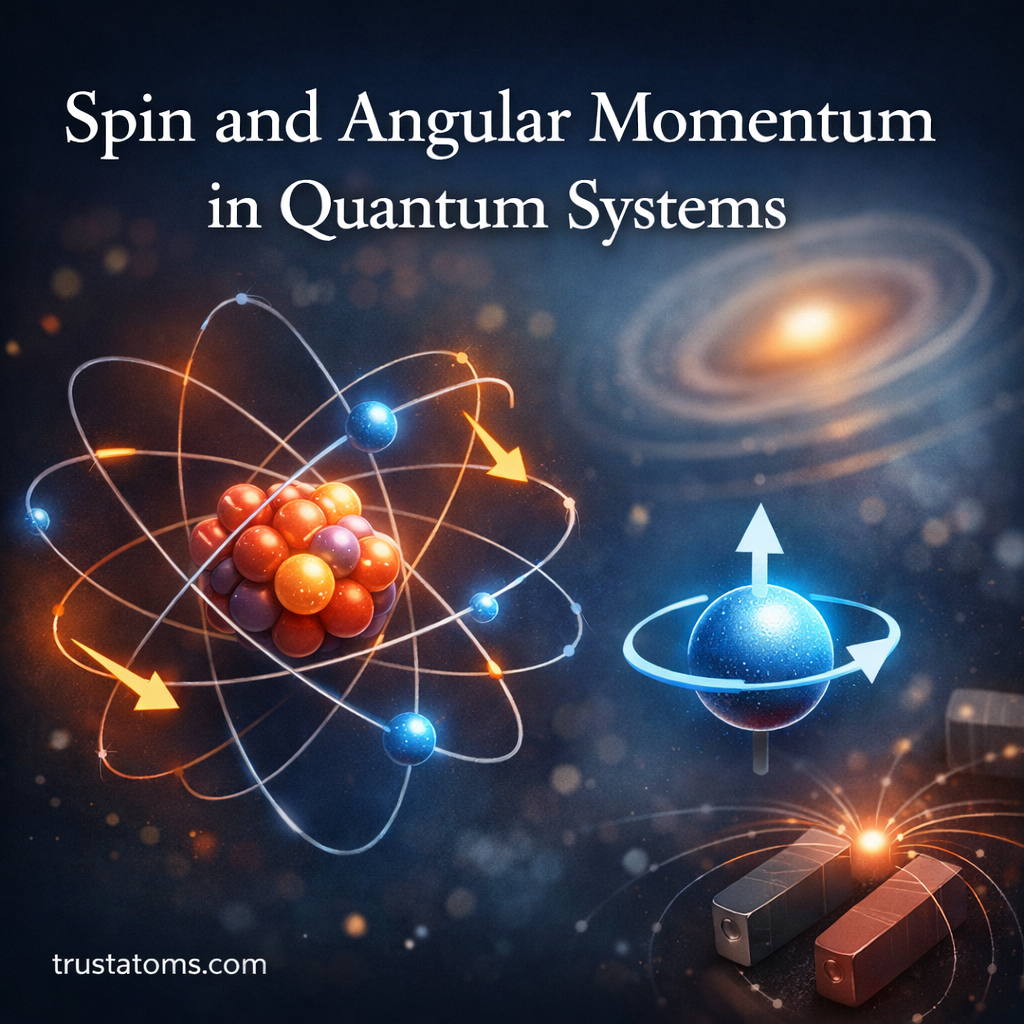
Quantum mechanics reveals a world that behaves very differently from everyday physics. Among its most fascinating concepts are spin and angular momentum — properties that shape atomic structure, chemistry, magnetism, and even modern technologies like MRI and quantum computing.
In classical physics, angular momentum describes how objects rotate. But in quantum systems, angular momentum is quantized, and spin does not mean what you might expect. This article breaks down both ideas clearly and shows how they connect to real physical phenomena.
What Is Angular Momentum in Physics?
In classical mechanics, angular momentum is the rotational equivalent of linear momentum.
It depends on:
- An object’s mass
- Its velocity
- Its distance from the axis of rotation
For example:
- A spinning wheel has angular momentum.
- A planet orbiting a star has orbital angular momentum.
- A figure skater spins faster by pulling in their arms, conserving angular momentum.
In quantum mechanics, angular momentum still exists — but it behaves differently.
Quantization of Angular Momentum
One of the key discoveries of early quantum theory was that angular momentum cannot take just any value.
Instead, it is quantized.
For a particle in quantum mechanics:
- The magnitude of angular momentum is restricted to specific values.
- The component along a chosen axis (usually the z-axis) is also quantized.
Mathematically, the total angular momentum magnitude is:
√[l(l + 1)]ħ
Where:
- l = angular momentum quantum number (0, 1, 2, 3…)
- ħ = reduced Planck constant
The z-component is:
mₗħ
Where:
- mₗ ranges from –l to +l in integer steps
This means angular momentum comes in discrete “chunks” rather than continuous values.
Orbital Angular Momentum
Orbital angular momentum arises from a particle’s motion through space.
In atoms:
- Electrons orbiting the nucleus possess orbital angular momentum.
- The quantum number l determines the shape of electron orbitals.
- Each l value corresponds to familiar subshells:
| l Value | Subshell | Shape |
|---|---|---|
| 0 | s | Spherical |
| 1 | p | Dumbbell |
| 2 | d | Clover-like |
| 3 | f | Complex shapes |
Orbital angular momentum explains:
- Atomic structure
- Spectral lines
- Chemical bonding patterns
But orbital motion is only part of the story.
What Is Spin in Quantum Mechanics?
Spin is an intrinsic form of angular momentum.
Unlike orbital angular momentum:
- Spin does not arise from motion through space.
- It is a fundamental property of particles.
Every elementary particle has a fixed spin value.
Examples:
- Electron: spin 1/2
- Proton: spin 1/2
- Photon: spin 1
- Higgs boson: spin 0
The electron’s spin is especially important because it shapes atomic behavior and magnetism.
Why Spin Is Not Literal Spinning
It is tempting to imagine spin as a tiny particle physically rotating.
But this picture fails.
If an electron were physically spinning like a sphere:
- Its surface would need to move faster than light to match observed spin properties.
- This violates relativity.
Instead, spin is a purely quantum mechanical property with no classical analog.
It behaves mathematically like angular momentum — but it does not represent physical rotation.
Spin Quantum Numbers
For a spin-1/2 particle like an electron:
- Total spin magnitude: √[s(s + 1)]ħ where s = 1/2
- Spin projection: ±1/2 ħ
This leads to two allowed states:
- Spin up
- Spin down
These two states are fundamental to:
- Atomic structure
- The Pauli exclusion principle
- Quantum computing qubits
The Pauli Exclusion Principle
Spin explains why electrons fill atomic orbitals the way they do.
The Pauli exclusion principle states:
No two identical fermions can occupy the same quantum state simultaneously.
Because electrons have spin:
- Each orbital can hold two electrons.
- They must have opposite spin states.
This principle determines:
- The structure of the periodic table
- Chemical reactivity
- Stability of matter
Without spin, atoms as we know them would not exist.
Addition of Angular Momenta

In quantum systems, angular momenta combine in specific ways.
If a particle has:
- Orbital angular momentum (L)
- Spin angular momentum (S)
They combine to form total angular momentum (J).
But unlike classical vectors, quantum angular momenta follow special combination rules.
For example:
If L = 1 and S = 1/2
Possible total angular momentum values are:
J = 3/2 or J = 1/2
This leads to:
- Fine structure in atomic spectra
- Energy level splitting
- Observable spectral shifts
Spin and Magnetic Moments
Spin is directly connected to magnetism.
Particles with spin behave like tiny magnets.
For electrons:
- Spin generates a magnetic moment.
- This interacts with external magnetic fields.
Important consequences include:
- The Zeeman effect (splitting of spectral lines in magnetic fields)
- Nuclear magnetic resonance (NMR)
- MRI technology
- Electron spin resonance (ESR)
Spin is not just theoretical — it powers real-world medical imaging and research tools.
Spin-Statistics Theorem
One of the deepest results in quantum field theory connects spin to particle behavior.
Particles fall into two categories:
Fermions (half-integer spin):
- Electrons
- Protons
- Neutrons
- Obey Pauli exclusion principle
Bosons (integer spin):
- Photons
- Gluons
- Higgs bosons
- Can occupy the same quantum state
This distinction explains:
- Stability of matter (fermions)
- Superconductivity
- Lasers
- Bose-Einstein condensates
Spin determines the very structure of physical reality.
Measurement and Uncertainty
Angular momentum components cannot all be measured precisely at once.
In quantum mechanics:
- Total angular momentum magnitude can be known.
- One component (usually z) can be known.
- The other components remain uncertain.
This reflects the Heisenberg uncertainty principle and the non-commuting nature of angular momentum operators.
Quantum systems fundamentally limit what can be simultaneously known.
Why Spin and Angular Momentum Matter
Spin and angular momentum are not abstract mathematical curiosities.
They explain:
- Why atoms have structure
- Why the periodic table exists
- Why magnets work
- Why lasers function
- Why matter is stable
- How quantum computers encode information
These concepts sit at the foundation of modern physics.
Without them, there would be no chemistry, no solid materials, and no stable universe as we understand it.
Final Thoughts
Spin and angular momentum reveal how quantum systems differ radically from classical intuition.
Angular momentum becomes quantized.
Spin emerges as an intrinsic property without classical equivalent.
Together, they shape atomic structure, particle interactions, and the deep architecture of matter itself.
Understanding these principles offers insight into the hidden order beneath the physical world — where discrete quantum rules govern everything from electrons to stars.