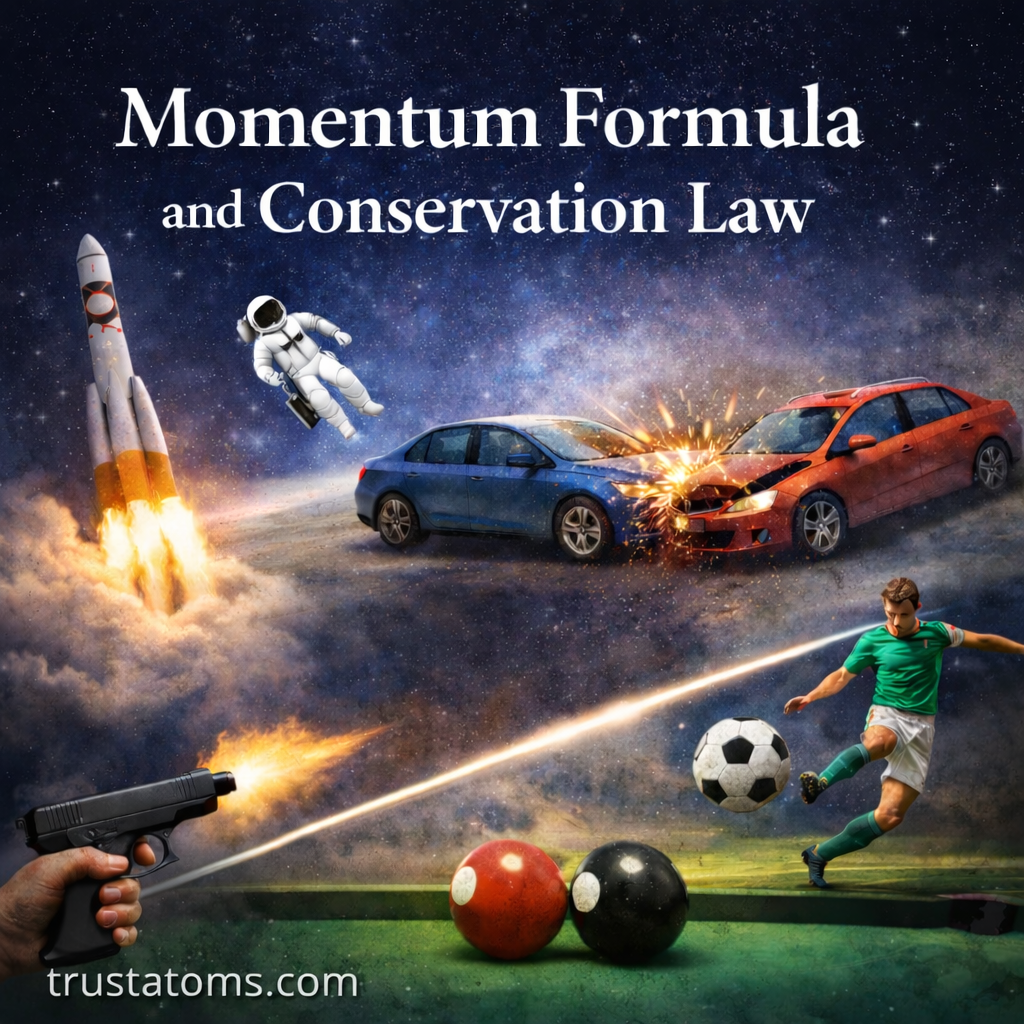
Momentum is one of the most important concepts in physics. It explains why a moving truck is harder to stop than a bicycle, why airbags save lives, and how rockets launch into space.
In this guide, we’ll break down the momentum formula, what it means, and how the law of conservation of momentum works in real-world situations.
What Is Momentum in Physics?
Momentum measures how much motion an object has.
In simple terms:
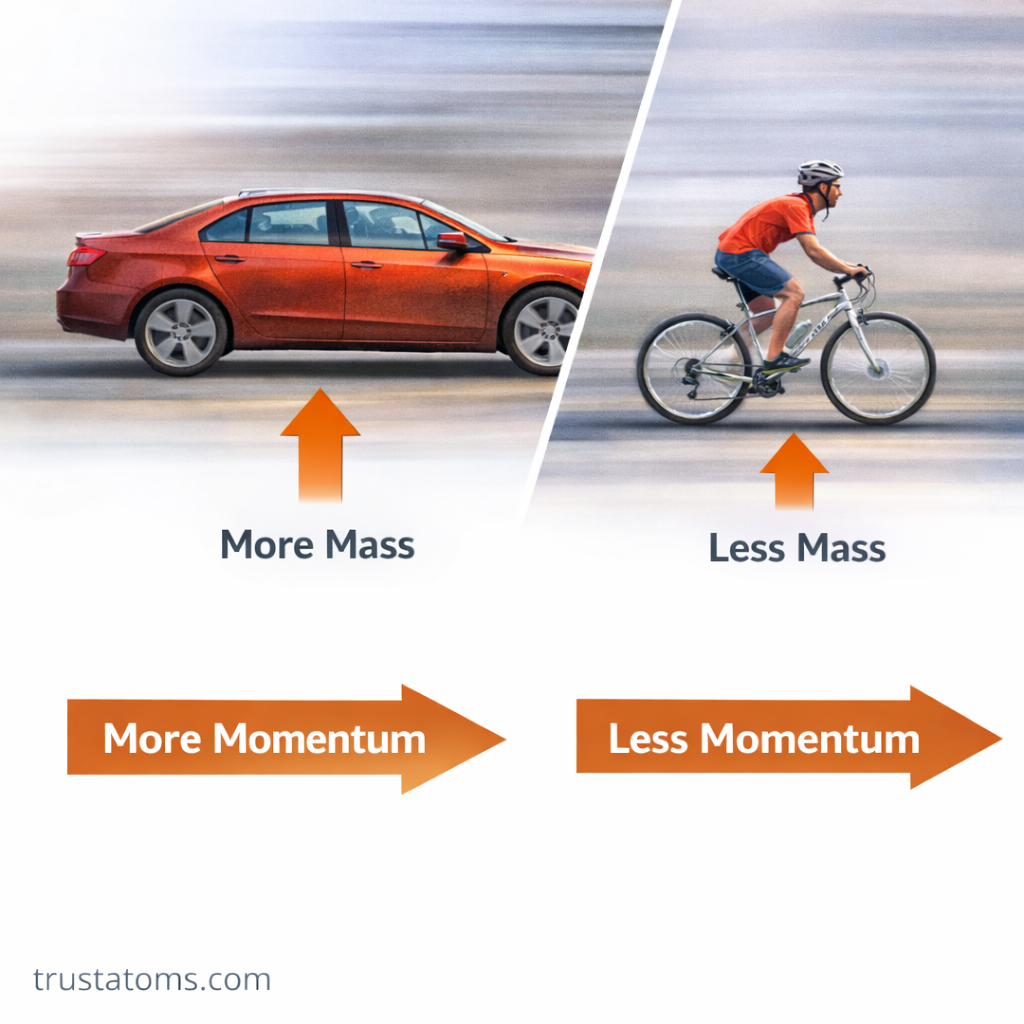
- The heavier an object is, the more momentum it has.
- The faster it moves, the more momentum it has.
Momentum combines mass and velocity into one quantity.
Because velocity includes direction, momentum also has direction. That means it’s a vector quantity.
The Momentum Formula
The formula for momentum is:
p = m × v
Where:
- p = momentum
- m = mass (in kilograms)
- v = velocity (in meters per second)
Units of Momentum
Momentum is measured in:
kg·m/s (kilogram meters per second)
Example Calculation of Momentum
Let’s say:
- A car has a mass of 1,000 kg
- It is moving at 20 m/s
Using the formula:
p = 1,000 × 20
p = 20,000 kg·m/s
Now compare that to:
- A bicycle with mass 100 kg
- Moving at the same speed (20 m/s)
p = 100 × 20
p = 2,000 kg·m/s
Even at the same speed, the car has 10 times more momentum because it has more mass.
Why Momentum Matters
Momentum helps explain:
- Car crashes
- Sports impacts
- Rocket propulsion
- Collisions between objects
- Explosions
It also connects directly to force through Newton’s Second Law.
In fact, force can be described as the rate of change of momentum.
The Law of Conservation of Momentum
The law of conservation of momentum states:
The total momentum of a closed system remains constant if no external forces act on it.
In simpler terms:
Momentum before an event = Momentum after the event
This law applies especially to collisions.
Understanding “Closed System”
A closed system means:
- No outside forces interfere
- Only internal forces between objects act
Examples:
- Two ice skaters pushing off each other
- Two billiard balls colliding on a frictionless table
- A gun firing a bullet (recoil)
Types of Collisions
1. Elastic Collisions
- Objects bounce off each other
- Kinetic energy is conserved
- Momentum is conserved
Example: Billiard balls colliding
2. Inelastic Collisions
- Objects stick together or deform
- Kinetic energy is NOT conserved
- Momentum is still conserved
Example: Car crashes
Even if energy changes form (heat, sound, deformation), momentum always remains conserved in a closed system.
Example of Momentum Conservation
Imagine:
- A 2 kg object moving at 4 m/s
- It collides with a stationary 2 kg object
- After collision, they stick together
Step 1: Calculate initial momentum
p = 2 × 4 = 8 kg·m/s
Step 2: After collision, total mass = 4 kg
Using conservation:
8 = 4 × v
v = 2 m/s
After collision, both objects move together at 2 m/s.
Total momentum before = total momentum after.
Real-Life Examples of Momentum Conservation
Rocket Launch
Rockets move upward because exhaust gases are pushed downward.
Momentum of gases downward equals momentum of rocket upward.
Recoil of a Gun
When a bullet moves forward, the gun moves backward.
Total momentum remains balanced.
Ice Skaters Pushing Apart
When two skaters push each other, both move in opposite directions with equal and opposite momentum.
Momentum vs Force: What’s the Difference?
Momentum describes motion.
Force changes momentum.
The relationship is:
Force = Change in momentum ÷ Time
This is another form of Newton’s Second Law.
If a force acts for a longer time, the change in momentum is greater. That’s why airbags and helmets increase impact time — reducing injury.
Key Takeaways
- Momentum equals mass times velocity.
- It is measured in kg·m/s.
- Momentum is a vector (has direction).
- In a closed system, total momentum is conserved.
- Conservation of momentum applies to all collisions.
- It explains rockets, recoil, crashes, and sports physics.
Understanding momentum gives you a powerful tool for analyzing motion, impacts, and energy transfer in the physical world.
It’s one of the foundational ideas in physics — simple formula, massive implications.