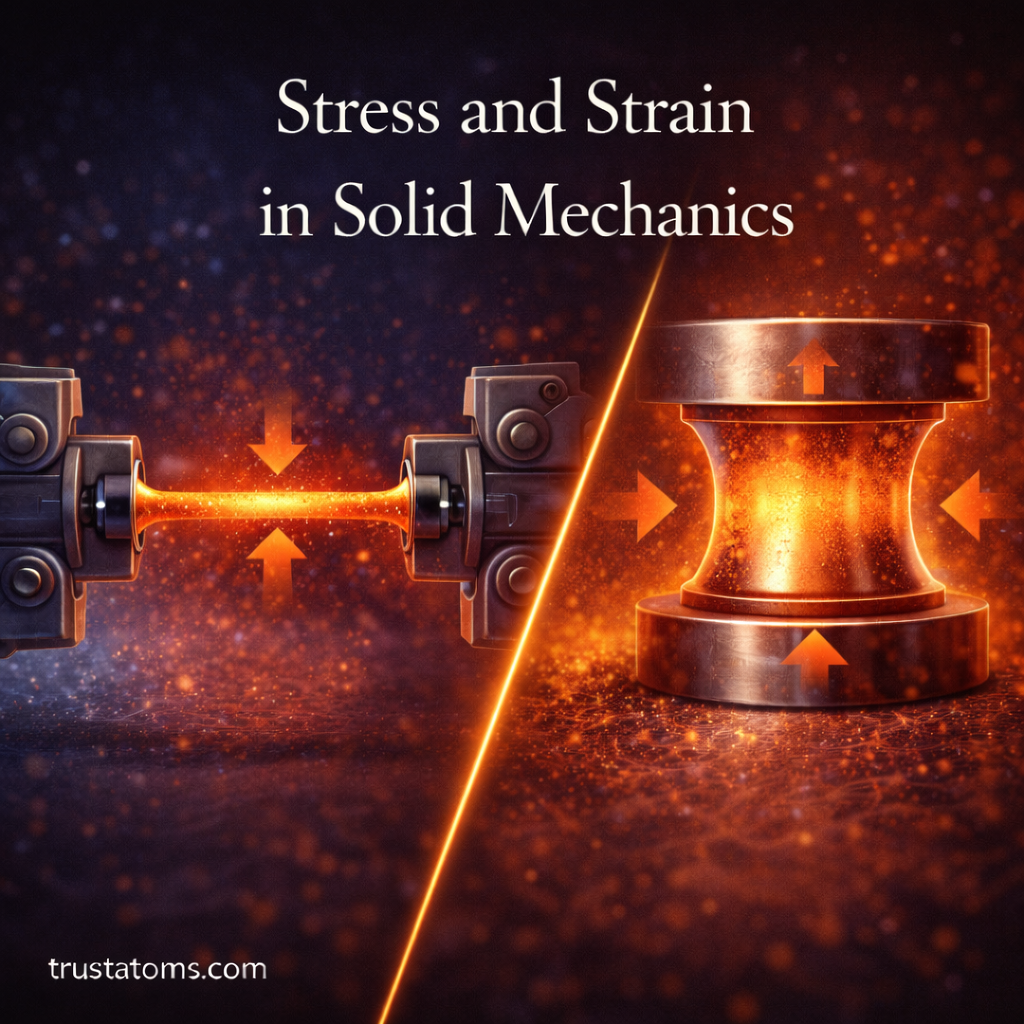
Every structure around us — from bridges and skyscrapers to smartphones and aircraft — must withstand forces without failing.
The science that studies how solid materials respond to applied forces is called solid mechanics.
At its core are two fundamental concepts:
- Stress
- Strain
Understanding stress and strain allows engineers and physicists to predict how materials will deform, bend, stretch, compress, or break under load.
What Is Stress?
Stress describes the internal force experienced by a material per unit area.
When a force is applied to an object:
- The object resists deformation.
- Internal forces develop inside it.
- These internal forces divided by area define stress.
Stress is not the total force applied — it is how that force is distributed within the material.
For example:
- A sharp knife cuts easily because force is concentrated over a small area.
- A snowshoe prevents sinking because force is spread over a large area.
Types of Stress
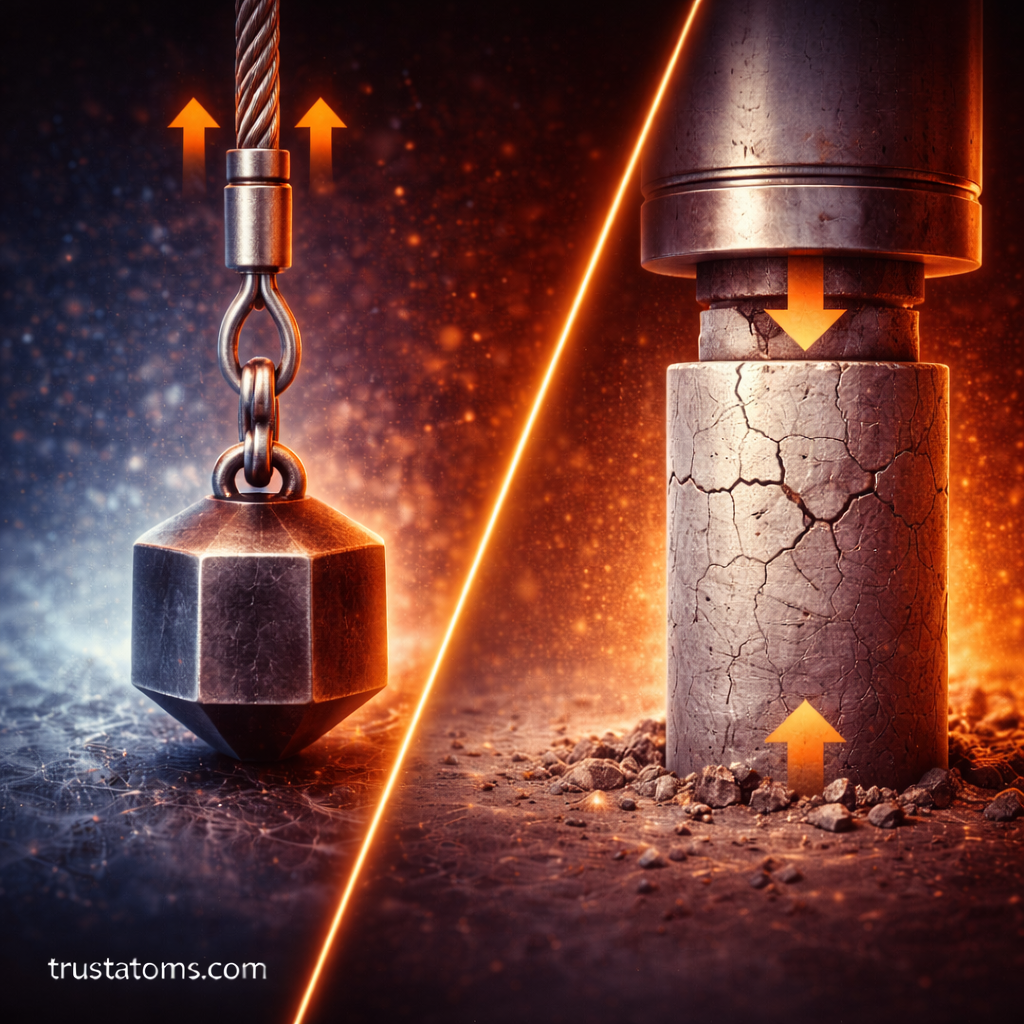
There are several types of stress depending on how forces are applied.
Tensile Stress
- Occurs when a material is pulled apart.
- Example: stretching a rope.
Compressive Stress
- Occurs when a material is squeezed.
- Example: a column supporting a building.
Shear Stress
- Occurs when forces act parallel to a surface.
- Example: scissors cutting paper.
Torsional Stress
- Occurs when an object is twisted.
- Example: turning a screwdriver.
Real-world structures often experience multiple types of stress simultaneously.
What Is Strain?
Strain measures how much a material deforms due to stress.
It describes the relative change in shape or size compared to the original dimensions.
Key idea:
- Stress = cause
- Strain = effect
Strain does not measure force — it measures deformation.
Types of Strain
Just as stress has types, strain does too.
Tensile Strain
- Change in length divided by original length.
- Occurs when a material is stretched.
Compressive Strain
- Occurs when a material shortens under compression.
Shear Strain
- Angular distortion due to shear forces.
Volumetric Strain
- Change in volume relative to original volume.
Strain tells us how much the material changes shape under stress.
The Stress–Strain Relationship
The relationship between stress and strain determines how a material behaves.
In many materials, at small deformations:
- Stress is proportional to strain.
- This linear region represents elastic behavior.
This proportional relationship is governed by elastic constants such as:
- Young’s modulus (tension/compression)
- Shear modulus
- Bulk modulus
These constants measure material stiffness.
Young’s Modulus and Material Stiffness
Young’s modulus measures how resistant a material is to stretching or compressing.
High Young’s modulus:
- Steel
- Diamond
- Glass
- Very stiff materials
Low Young’s modulus:
- Rubber
- Polymers
- Easily deformed materials
The higher the modulus, the smaller the strain for a given stress.
Elastic vs. Plastic Behavior
In the elastic region:
- Deformation is reversible.
- Remove the load → material returns to original shape.
Beyond the yield point:
- Plastic deformation begins.
- Deformation becomes permanent.
Understanding this transition is critical for structural safety.
Stress–Strain Curve Explained
A typical stress–strain curve includes several regions:
- Linear elastic region
- Yield point
- Plastic deformation region
- Ultimate strength
- Fracture point
Important features:
- Slope of linear region → stiffness
- Yield strength → start of permanent change
- Ultimate strength → maximum stress
- Fracture → failure
Different materials show very different curves.
Factors Affecting Stress and Strain
Several variables influence how materials respond to forces:
- Material composition
- Temperature
- Loading rate
- Presence of defects
- Microstructure
For example:
- Metals become more brittle at low temperatures.
- High strain rates can increase strength temporarily.
- Cracks concentrate stress and promote failure.
Stress Concentration
Stress is not always evenly distributed.
Sharp corners, holes, or cracks can concentrate stress.
This is called stress concentration.
Even if the average stress is low:
- Local stress near a crack tip can be very high.
- This can trigger sudden fracture.
Designers often smooth edges and avoid sharp transitions to reduce stress concentration.
Hooke’s Law in Solid Mechanics
For small deformations, stress and strain are proportional.
This is known as Hooke’s Law.
It applies only within the elastic region.
Beyond that:
- The relationship becomes nonlinear.
- Permanent structural changes occur.
Hooke’s Law provides a first approximation for many engineering calculations.
Real-World Applications
Understanding stress and strain is essential in:
- Bridge construction
- Aircraft design
- Automotive safety
- Earthquake engineering
- Biomedical implants
- Manufacturing processes
Engineers must ensure:
- Materials can withstand expected loads.
- Deformations remain within safe limits.
- Failure does not occur unexpectedly.
Failure Mechanisms
Materials can fail in different ways depending on stress and strain conditions.
Common failure types include:
- Brittle fracture
- Ductile fracture
- Fatigue failure (repeated loading)
- Creep failure (long-term loading at high temperature)
Studying stress and strain helps predict and prevent these failures.
Why Stress and Strain Matter in Physics
Stress and strain connect microscopic atomic interactions to large-scale structural behavior.
They help explain:
- Why some materials bend while others snap.
- Why skyscrapers sway in wind.
- Why airplane wings flex during flight.
- Why bones can absorb impact without breaking.
Solid mechanics bridges fundamental physics and practical engineering.
Key Takeaways
Stress:
- Internal force per unit area
- Describes intensity of loading
Strain:
- Measure of deformation
- Describes material response
Together, they define how materials behave under force.
Final Thoughts
Stress and strain are foundational concepts in solid mechanics.
They explain how materials respond when forces act upon them — whether stretching, compressing, twisting, or shearing.
From microscopic atomic bonds to massive engineering structures, the interplay between stress and strain determines strength, flexibility, durability, and safety.
Without understanding these principles, modern engineering would not be possible.