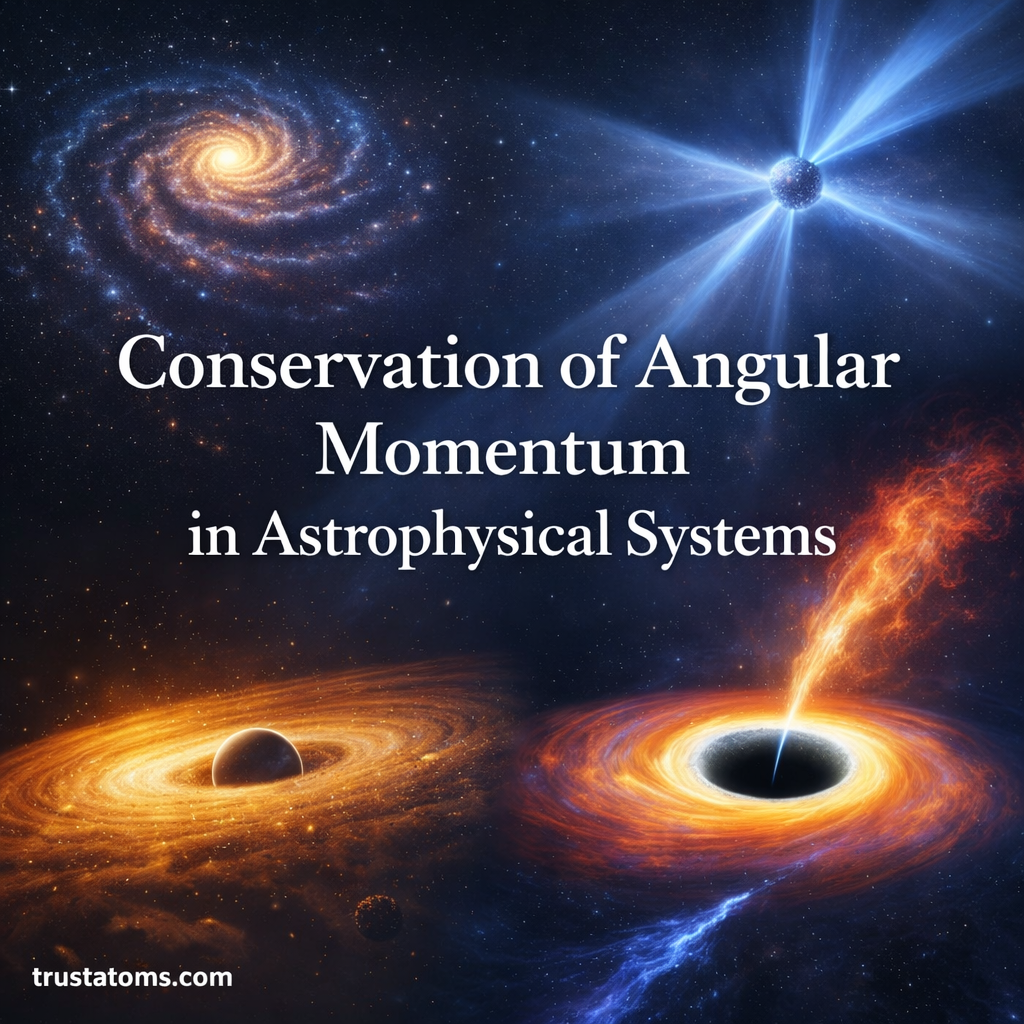
The conservation of angular momentum is one of the most powerful principles in physics. It explains why spinning ice skaters rotate faster when they pull in their arms — and on a much larger scale, why stars collapse into rapidly spinning neutron stars and why galaxies form rotating disks.
In astrophysics, angular momentum shapes the structure and evolution of planets, stars, black holes, and entire galaxies.
This article explores what angular momentum is, why it is conserved, and how it governs some of the most dramatic events in the universe.
What Is Angular Momentum?
Angular momentum describes rotational motion.
For a simple rotating object, it depends on:
- How fast it spins
- How its mass is distributed
- How far the mass is from the axis of rotation
In physics terms, angular momentum increases when:
- An object rotates faster.
- Its mass moves farther from the center.
- Its total mass increases.
In astrophysical systems, objects often contain enormous mass and extend over vast distances — meaning angular momentum can be enormous.
The Law of Conservation of Angular Momentum
The conservation law states:
If no external torque acts on a system, its total angular momentum remains constant.
This principle comes from fundamental symmetries in physics. If the laws of physics are the same regardless of orientation in space, angular momentum must be conserved.
In space, external torques are often negligible, especially during gravitational collapse. As a result, angular momentum becomes a dominant factor in how cosmic structures evolve.
Why Angular Momentum Matters in Space
In astrophysics, gravity pulls matter inward. But angular momentum resists this collapse in the direction perpendicular to the rotation axis.
This competition between gravity and rotation determines:
- Whether a cloud forms a star
- Whether material forms a disk
- How fast compact objects spin
- The structure of galaxies
Without angular momentum conservation, the universe would look very different.
Star Formation and Rotational Speed
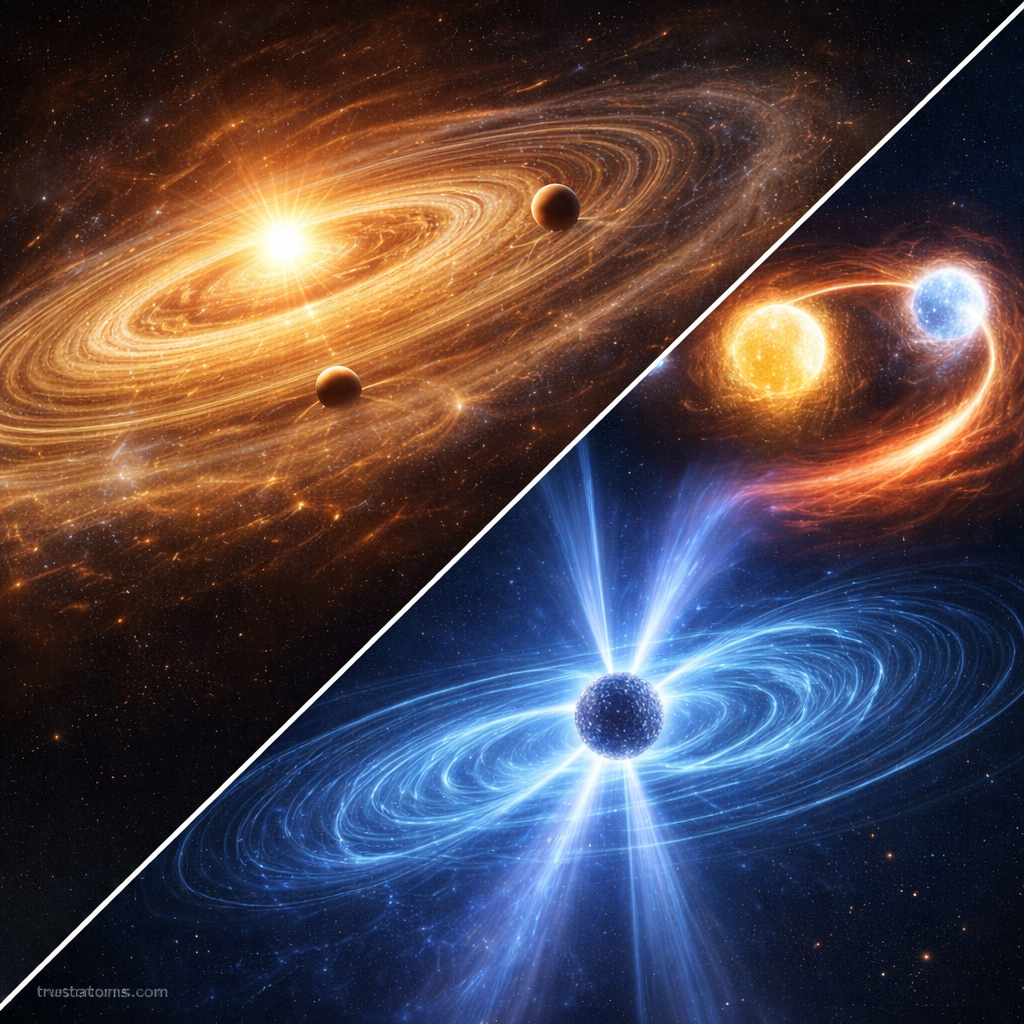
Stars form from large clouds of gas and dust called molecular clouds.
These clouds:
- Are cold and diffuse
- Often rotate slowly
- Span light-years in diameter
When gravity causes the cloud to collapse:
- Its radius decreases dramatically.
- Its rotation speed increases.
This happens for the same reason a spinning skater speeds up when pulling in their arms: the system must conserve angular momentum.
Resulting Effects
As the cloud collapses:
- It flattens into a rotating disk.
- A protostar forms at the center.
- Material spirals inward.
This disk often becomes the birthplace of planets.
Formation of Planetary Systems
Conservation of angular momentum explains why planets orbit in the same general direction and plane.
As the rotating disk evolves:
- Dust particles collide and stick together.
- Larger bodies form.
- Orbital motion aligns with the original cloud’s rotation.
This leads to relatively orderly planetary systems, like our own solar system.
Neutron Stars and Pulsars
One of the most dramatic examples of angular momentum conservation occurs when massive stars die.
When a large star explodes as a supernova:
- Its core collapses.
- The radius shrinks from thousands of kilometers to about 10–20 kilometers.
- Angular momentum must remain constant.
Because the radius shrinks so drastically, the rotation rate increases enormously.
The result:
- A neutron star spinning many times per second.
- In extreme cases, hundreds of times per second.
These rapidly spinning neutron stars are observed as pulsars.
Black Holes and Accretion Disks
Black holes also demonstrate angular momentum conservation.
When matter falls toward a black hole:
- It cannot fall straight in if it has angular momentum.
- Instead, it forms an accretion disk.
- The disk rotates at high speeds.
Friction and magnetic effects gradually move matter inward, but the overall rotational behavior remains governed by conservation laws.
Spinning black holes also drag spacetime around them — an effect known as frame dragging.
Galaxy Formation and Rotation
Entire galaxies obey angular momentum conservation.
When large regions of matter collapse under gravity:
- Small initial rotations amplify.
- Rotating disks form.
- Spiral arms develop.
This explains why many galaxies exhibit rotating disk structures.
Elliptical galaxies, on the other hand, often result from mergers that redistribute angular momentum in complex ways.
Angular Momentum Transfer in Astrophysical Systems
Although total angular momentum is conserved, it can be redistributed within a system.
Common mechanisms include:
- Gravitational interactions
- Magnetic fields
- Tidal forces
- Collisions and mergers
Examples:
- The Earth–Moon system exchanges angular momentum through tides.
- Binary stars transfer angular momentum through mass exchange.
- Galaxy mergers redistribute rotational energy.
Conservation does not mean “no change” — it means the total remains constant.
Mathematical Insight (Conceptual)
Angular momentum depends on:
- Mass
- Distance from the axis
- Rotation speed
When the radius decreases:
- Rotation speed must increase to keep angular momentum constant.
This inverse relationship is what makes collapsing astrophysical objects spin faster.
Real-World Astrophysical Observations
Astronomers observe angular momentum conservation in:
- Rapidly spinning pulsars
- Accretion disks around black holes
- Protoplanetary disks around young stars
- Rotational patterns in spiral galaxies
- Binary star orbital evolution
These observations strongly confirm the predictive power of conservation laws.
Why This Principle Is So Fundamental
Conservation of angular momentum is tied to deep physical symmetry.
It is:
- Independent of scale
- Valid from laboratory experiments to galaxy clusters
- A consequence of fundamental spacetime symmetry
Along with conservation of energy and momentum, it forms a backbone of classical and modern physics.
Common Misconceptions
“Gravity Causes Rotation”
Gravity does not create angular momentum from nothing.
If a system begins with zero total angular momentum, it must remain zero unless acted on by an external torque.
Small initial rotations become amplified during collapse — but they are not created spontaneously.
“Objects Spin Faster Because Gravity Pushes Them”
Objects spin faster because their radius decreases while angular momentum remains constant — not because gravity “pushes” rotation directly.
Final Thoughts
Conservation of angular momentum in astrophysical systems explains:
- Why stars and planets rotate
- Why neutron stars spin at extreme speeds
- Why galaxies form rotating disks
- Why black holes develop accretion disks
From collapsing gas clouds to entire galaxies, this single principle governs some of the most spectacular structures in the universe.
It shows how a simple conservation law — rooted in symmetry — can shape cosmic evolution on unimaginable scales.