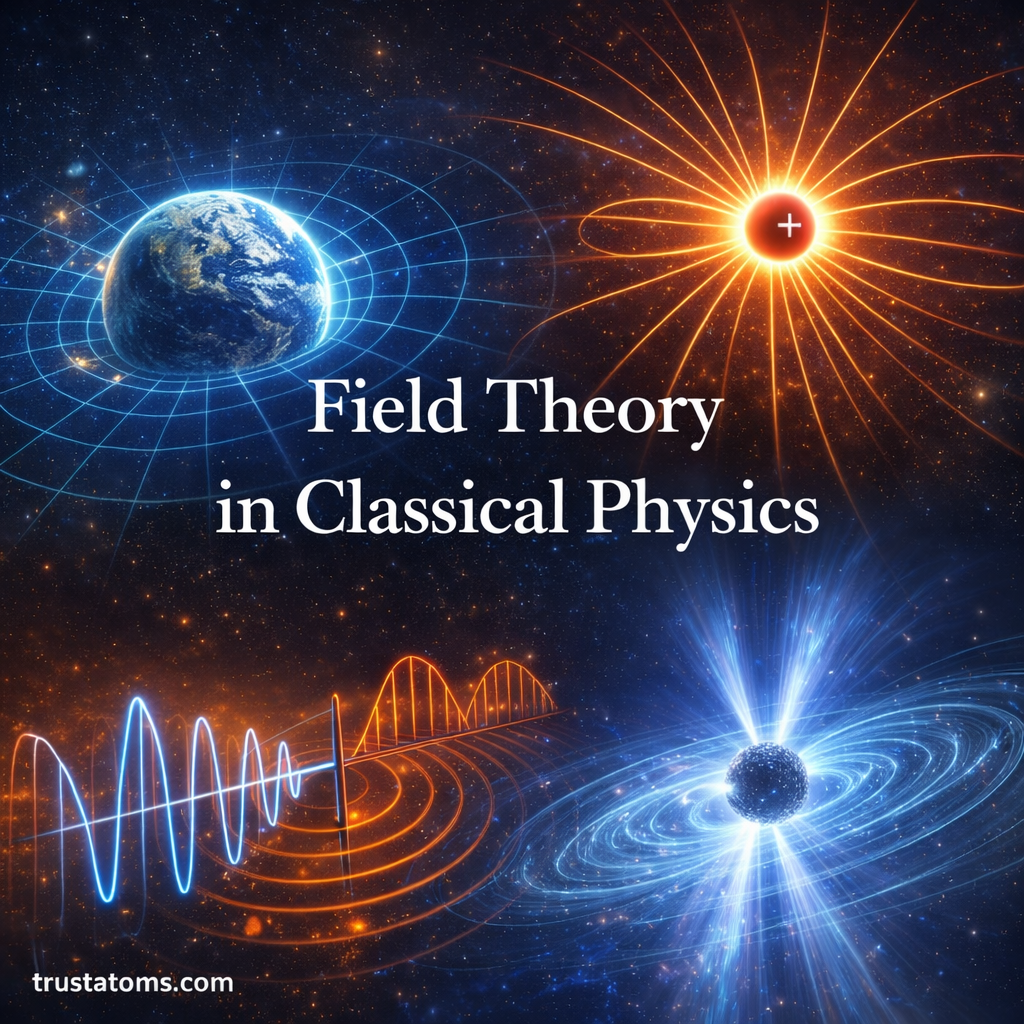
Field theory in classical physics provides one of the most powerful ways to describe how forces act across space. Instead of imagining objects pulling or pushing each other directly, field theory describes how physical quantities exist at every point in space and influence matter locally.
From gravity shaping planetary motion to electric and magnetic forces guiding charged particles, classical field theory forms the foundation of modern physics.
This article explains what a field is, how classical field theory developed, and why it remains essential in science today.
What Is a Field in Physics?
A field is a physical quantity defined at every point in space (and often time).
Unlike a single object, a field is spread out continuously.
Examples include:
- Temperature in a room
- Wind speed in the atmosphere
- Gravitational influence around Earth
- Electric force surrounding a charged particle
A field assigns a value to each point:
- Scalar fields have magnitude only (like temperature).
- Vector fields have magnitude and direction (like wind or electric force).
This concept allows physicists to describe how forces act without requiring direct contact between objects.
Why Field Theory Replaced “Action at a Distance”
Before field theory, forces like gravity were described as acting instantly across space. This idea is called action at a distance.
However, this raised deep questions:
- How does one object influence another without touching it?
- What carries the force?
- How fast does the influence travel?
Field theory provided a solution:
Objects create fields in space. Other objects respond locally to those fields.
This eliminates the need for mysterious instantaneous influence.
Gravitational Field in Classical Physics
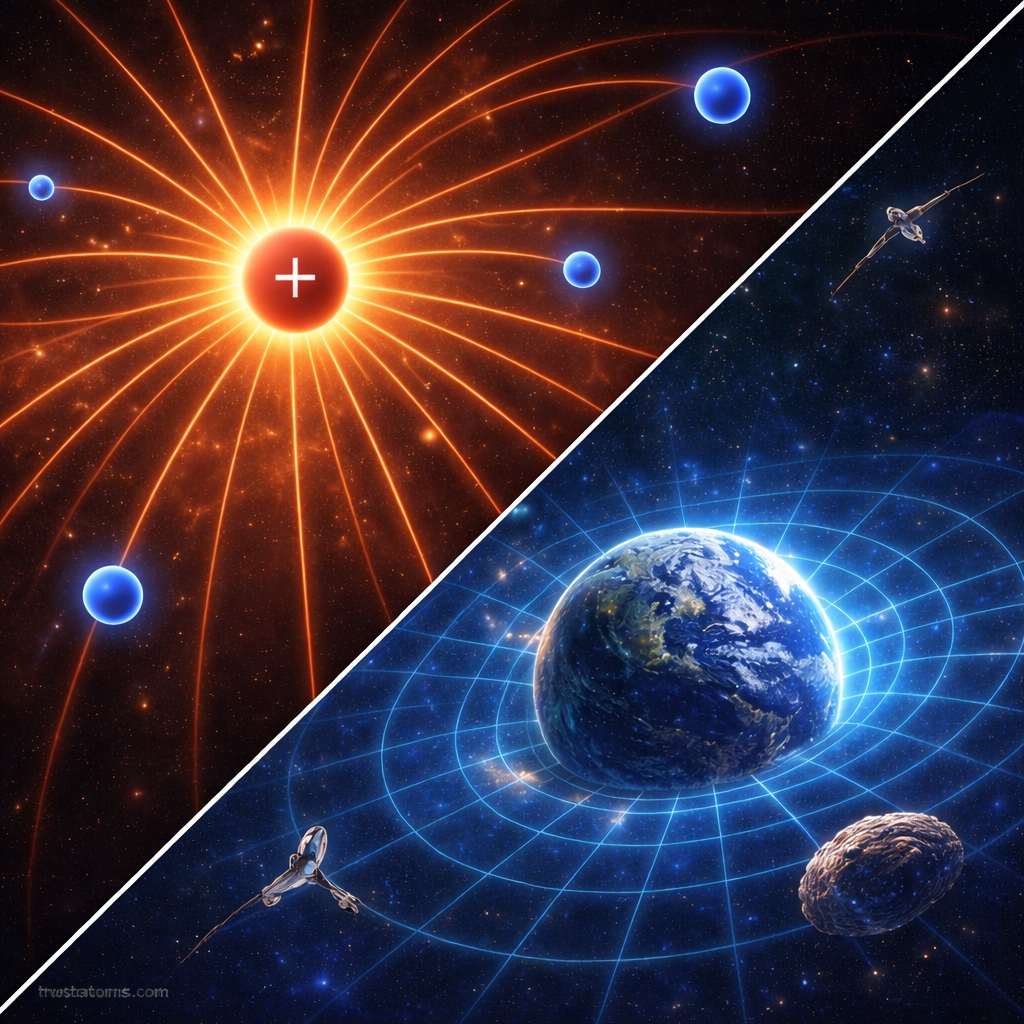
In classical mechanics, gravity can be described as a gravitational field surrounding mass.
Key ideas:
- Every mass produces a gravitational field.
- The field weakens with distance.
- Other masses respond to the field at their location.
This framework explains:
- Planetary orbits
- Falling objects
- Tides
- Satellite motion
The gravitational field exists whether or not another object is present to feel it.
Electric and Magnetic Fields
One of the greatest triumphs of classical field theory is electromagnetism.
Electric Fields
An electric field:
- Surrounds charged particles.
- Points away from positive charges.
- Points toward negative charges.
- Decreases with distance.
Charged particles placed in this field experience force.
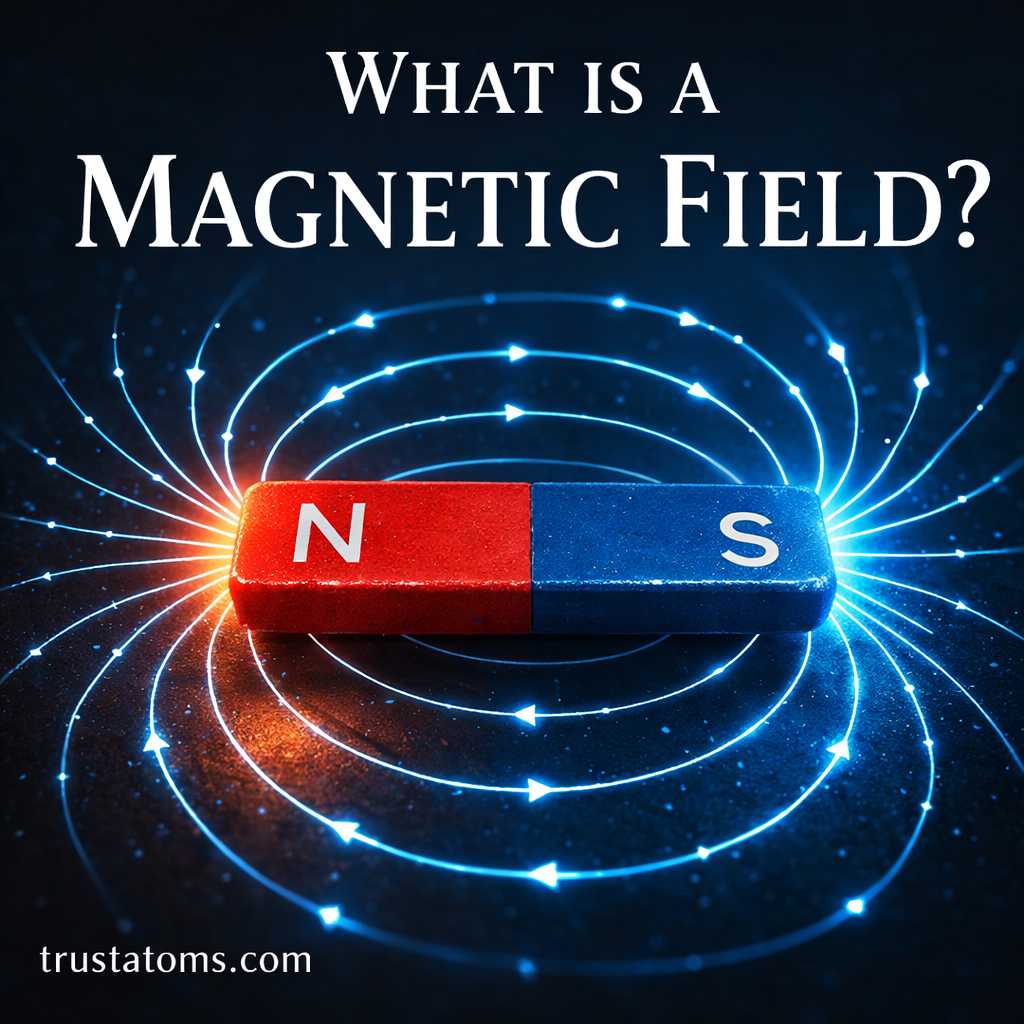
Magnetic Fields
Magnetic fields arise from:
- Moving electric charges.
- Magnetic materials.
They form loops and influence other moving charges.
Electric and magnetic fields are deeply interconnected. Changing electric fields can create magnetic fields, and vice versa.
Maxwell’s Equations and Classical Field Theory
James Clerk Maxwell unified electricity and magnetism into a complete classical field theory.
His equations describe how:
- Electric charges create electric fields.
- Currents create magnetic fields.
- Changing fields propagate as waves.
This led to a groundbreaking discovery:
Light is an electromagnetic wave.
Field theory not only explained forces but also predicted new physical phenomena.
Scalar vs Vector Fields
Understanding field types is essential.
Scalar Fields
These assign one number to each point.
Examples:
- Temperature distribution
- Pressure in a fluid
- Gravitational potential
Vector Fields
These assign both magnitude and direction.
Examples:
- Electric field
- Magnetic field
- Fluid velocity
Vector fields are central to classical field theory because forces have direction.
Field Lines and Visualization
Physicists often use field lines to visualize vector fields.
Field lines:
- Show direction.
- Indicate strength by density.
- Never cross.
For example:
- Electric field lines radiate outward from positive charges.
- Magnetic field lines form closed loops.
While field lines are visual tools, the field itself is continuous throughout space.
Wave Propagation in Fields
Fields can also support waves.
Examples:
- Electromagnetic waves (light, radio waves)
- Sound waves in air (pressure field oscillations)
- Water waves (surface displacement field)
In classical field theory, waves arise when disturbances travel through a field.
These waves carry energy and momentum without transporting matter permanently.
Energy in Classical Fields
Fields are not just mathematical constructs — they contain energy.
For example:
- Electric fields store electric potential energy.
- Magnetic fields store magnetic energy.
- Gravitational fields represent stored gravitational potential energy.
Energy density can be defined at every point in space.
This idea was revolutionary because it shifted energy from being purely “object-based” to being distributed in space.
Field Theory vs Particle Theory
Classical physics uses both particles and fields.
Particles:
- Have mass and position.
- Move under forces.
Fields:
- Exist continuously in space.
- Influence particle motion.
Modern physics increasingly views fields as fundamental, with particles emerging from field behavior.
However, classical field theory remains grounded in continuous physical quantities.
Applications of Classical Field Theory
Field theory is essential in:
- Electrical engineering
- Fluid dynamics
- Astrophysics
- Plasma physics
- Mechanical wave analysis
- Optics
Engineers use field equations to design:
- Electric circuits
- Antennas
- Motors
- Communication systems
Physicists use field theory to model:
- Planetary motion
- Electromagnetic radiation
- Atmospheric patterns
Limitations of Classical Field Theory
While powerful, classical field theory has limits.
It does not fully explain:
- Atomic structure
- Quantum effects
- Relativistic corrections at extreme speeds
These challenges led to:
- Quantum field theory
- General relativity
However, classical field theory remains extremely accurate for everyday scales.
Why Field Theory Is Foundational
Field theory transformed physics by:
- Eliminating action at a distance
- Describing forces locally
- Unifying electricity and magnetism
- Predicting electromagnetic waves
It introduced a new way of thinking:
Space is not empty. It is filled with structured physical quantities.
This perspective underlies much of modern science.
Final Thoughts
Field theory in classical physics provides a framework for understanding how forces operate across space.
From gravity to electromagnetism, classical fields explain:
- How objects influence one another
- How waves travel
- How energy is stored and transferred
Even as physics advanced into quantum and relativistic domains, classical field theory remains one of the most elegant and practical tools in science.
It reshaped how we understand space, forces, and the structure of the physical world.