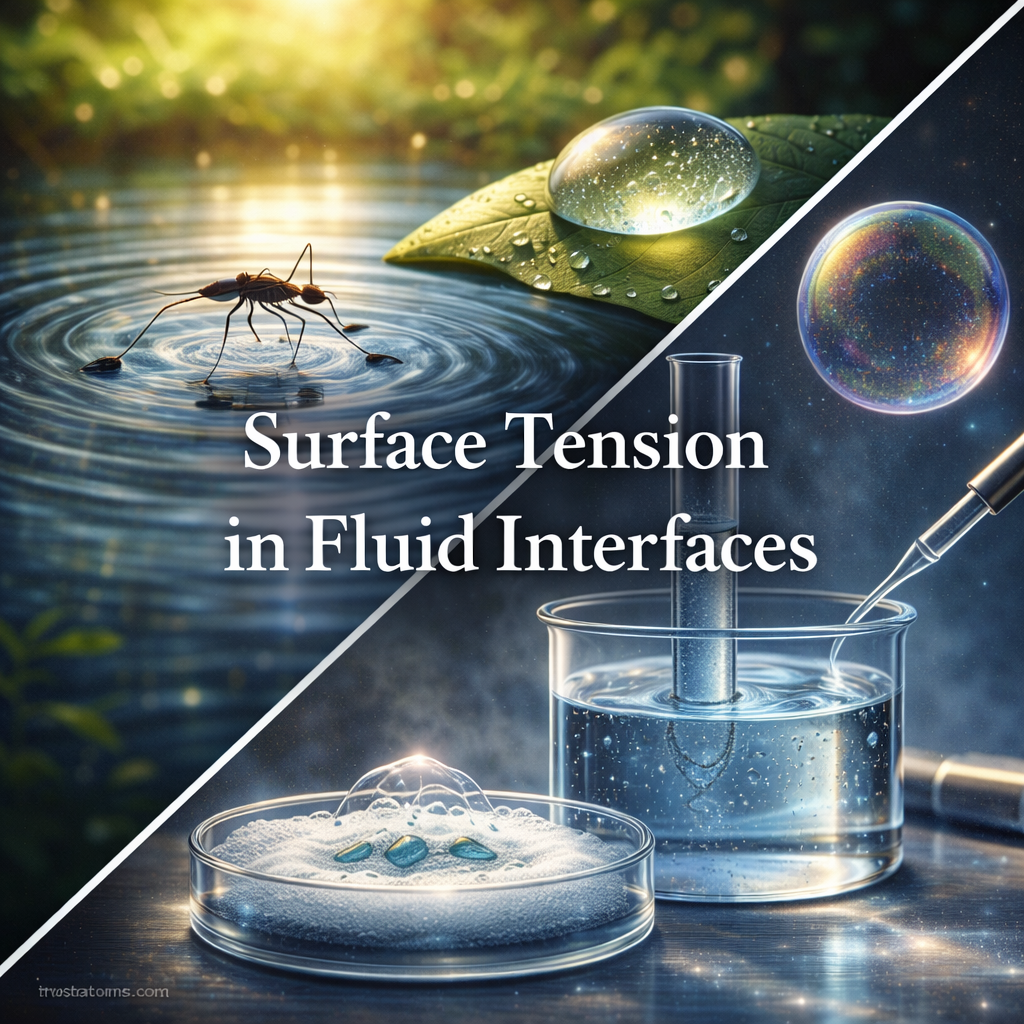
Surface tension is one of the most fascinating and visually striking phenomena in physics. It explains why water forms droplets, why insects can walk on ponds, and why bubbles maintain their spherical shape.
At its core, surface tension arises from molecular forces acting at the boundary between fluids — most commonly between a liquid and air.
In this article, we’ll explore what surface tension is, why it occurs, how it’s measured, and why it plays a critical role in nature and technology.
What Is Surface Tension?
Surface tension is the tendency of a liquid surface to behave like a stretched elastic membrane.
It occurs at the interface between:
- Liquid and air
- Liquid and another liquid
- Liquid and solid
The molecules inside a liquid are attracted equally in all directions by neighboring molecules.
But molecules at the surface:
- Have no liquid molecules above them
- Experience a net inward attraction
- Are pulled toward the bulk of the liquid
This imbalance creates surface tension.
The Molecular Origin of Surface Tension
Surface tension arises from intermolecular forces.
In water, these forces are primarily:
- Hydrogen bonding
- Cohesive attraction between water molecules
At the surface:
- Molecules are less tightly surrounded
- They occupy a higher energy state
- The system minimizes energy by reducing surface area
That’s why droplets form spheres — a sphere has the smallest surface area for a given volume.
Why Liquids Form Spheres
Surface tension drives liquids to minimize exposed surface area.
A sphere:
- Has the lowest surface area-to-volume ratio
- Represents the most energy-efficient shape
This explains:
- Raindrops in the air
- Soap bubbles
- Liquid droplets on waxed surfaces
Gravity can distort droplets, but at small scales, surface tension dominates.
Surface Tension Formula (Conceptual)
Surface tension is defined as:
Force per unit length along the surface.
It can also be described as:
Energy per unit area.
Higher surface tension means:
- Stronger cohesive forces
- More resistance to surface deformation
Water has relatively high surface tension compared to many other liquids.
Examples of Surface Tension in Action

Surface tension produces several everyday effects.
1. Water Striders Walking on Water
Certain insects can stand on water because:
- Their weight is distributed across long legs
- The water surface resists breaking
Surface tension provides an upward force that balances gravity.
2. Capillary Action
Capillary action occurs when liquid rises in narrow tubes.
This happens because:
- Adhesive forces between liquid and surface pull liquid upward
- Surface tension maintains the curved surface
This process helps:
- Plants transport water
- Ink flow in pens
- Water move through porous materials
3. Soap and Detergents
Soap reduces surface tension.
It works by:
- Disrupting cohesive forces
- Allowing water to spread more easily
- Improving cleaning efficiency
This is why soapy water spreads over surfaces more than pure water.
Surface Tension at Liquid–Liquid Interfaces
Surface tension also exists between two liquids.
This is called interfacial tension.
For example:
- Oil and water do not mix
- Molecules prefer interacting with similar molecules
- The interface forms a boundary
Emulsifiers can reduce interfacial tension and allow mixing.
Measuring Surface Tension
Physicists measure surface tension using methods such as:
- Capillary rise measurement
- Drop weight method
- Pendant drop analysis
- Ring or plate methods
These techniques determine how much force is needed to deform or break the surface.
Surface Energy and Thermodynamics
Surface tension is closely related to thermodynamics.
The surface of a liquid has:
- Higher energy than the interior
- Fewer stabilizing molecular interactions
Systems tend to minimize energy.
Reducing surface area lowers total energy, which explains droplet formation and bubble stability.
Temperature and Surface Tension
Surface tension depends strongly on temperature.
As temperature increases:
- Molecular motion increases
- Cohesive forces weaken
- Surface tension decreases
At the boiling point, surface tension drops significantly.
At the critical point, it approaches zero.
Surface Tension vs Viscosity
Surface tension and viscosity are often confused.
They are different properties:
- Surface tension affects the interface between fluids.
- Viscosity describes resistance to flow within a fluid.
A liquid can have:
- High surface tension but low viscosity (water).
- Low surface tension but high viscosity (oil).
Industrial and Scientific Applications
Surface tension plays a role in many fields.
Engineering
- Inkjet printing
- Spray coatings
- Fuel atomization
Biology
- Lung function (pulmonary surfactants reduce surface tension)
- Cell membranes
- Blood flow in capillaries
Materials Science
- Thin film formation
- Microfluidics
- Nanotechnology
Controlling surface tension is crucial in modern manufacturing.
Surface Tension in Microgravity
In microgravity environments:
- Surface tension becomes dominant
- Fluids form large spheres
- Liquid behavior changes dramatically
Understanding this is important for:
- Space missions
- Fuel storage in spacecraft
- Fluid management systems
Why Surface Tension Matters in Physics
Surface tension demonstrates how microscopic molecular forces produce macroscopic behavior.
It connects:
- Molecular physics
- Thermodynamics
- Fluid mechanics
- Materials science
Despite being a “simple” phenomenon, it reveals deep insights into intermolecular forces and energy minimization.
Final Thoughts
Surface tension in fluid interfaces arises from molecular attractions at the boundary of liquids.
It explains:
- Droplet formation
- Bubble shapes
- Capillary action
- Biological and industrial processes
From water striders walking on ponds to spacecraft fuel systems, surface tension influences both everyday life and advanced technology.
Understanding it highlights how small-scale molecular forces shape large-scale physical behavior.