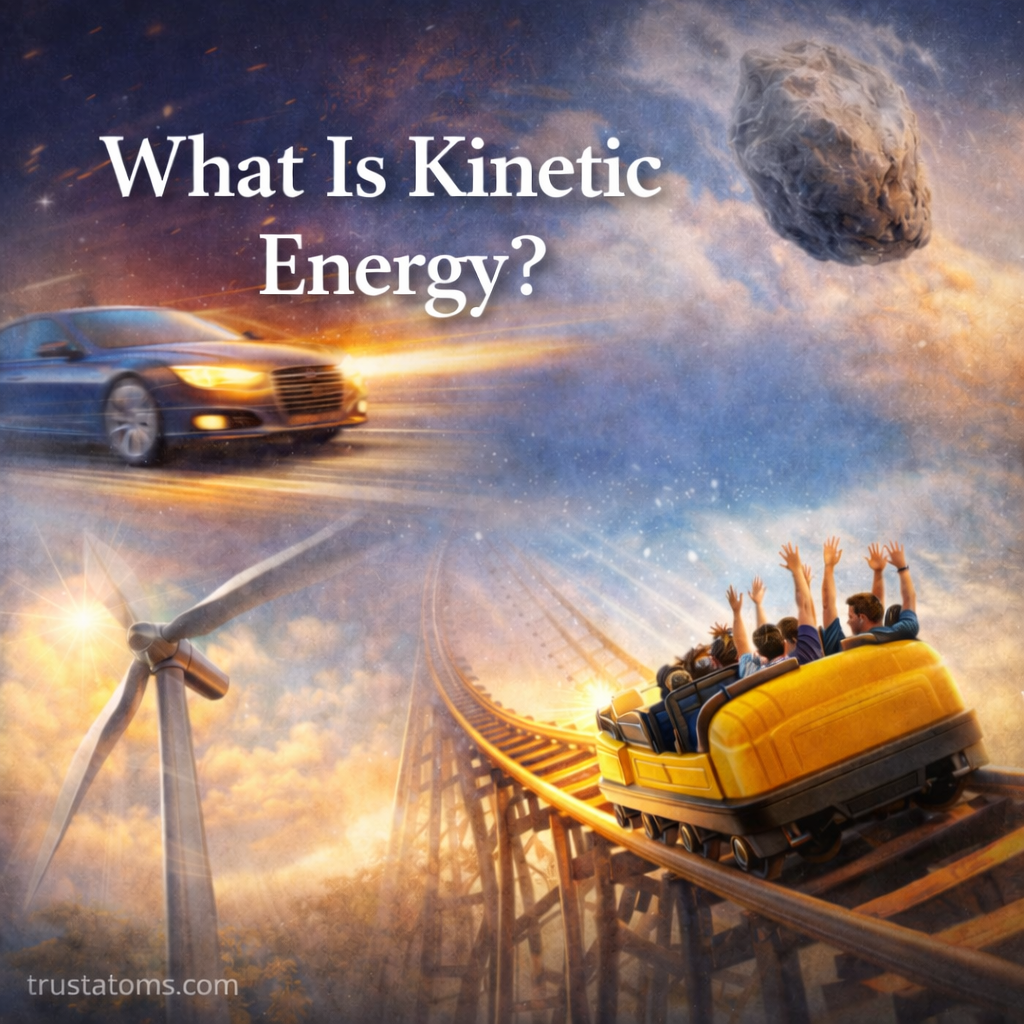
Kinetic energy is the energy an object has because it is moving.
Every time something moves — a car on the highway, a falling apple, or even air molecules in the wind — it has kinetic energy.
In this guide, you’ll learn:
- What kinetic energy is
- The kinetic energy formula
- How mass and speed affect it
- Real-life examples
- How it connects to other physics concepts
What Is Kinetic Energy?
Kinetic energy is the energy of motion.
If an object is moving, it has kinetic energy.
If it is not moving, its kinetic energy is zero.
The faster something moves, the more kinetic energy it has.
The heavier something is, the more kinetic energy it has (if moving at the same speed).
Kinetic energy depends on both mass and velocity.
The Kinetic Energy Formula
The formula for kinetic energy is:
KE = ½mv²
Where:
- KE = kinetic energy (in joules)
- m = mass (in kilograms)
- v = velocity (in meters per second)
Units of Kinetic Energy
Kinetic energy is measured in:
Joules (J)
1 joule = 1 kg·m²/s²
Why Velocity Is Squared
Notice that velocity is squared (v²).
This means:
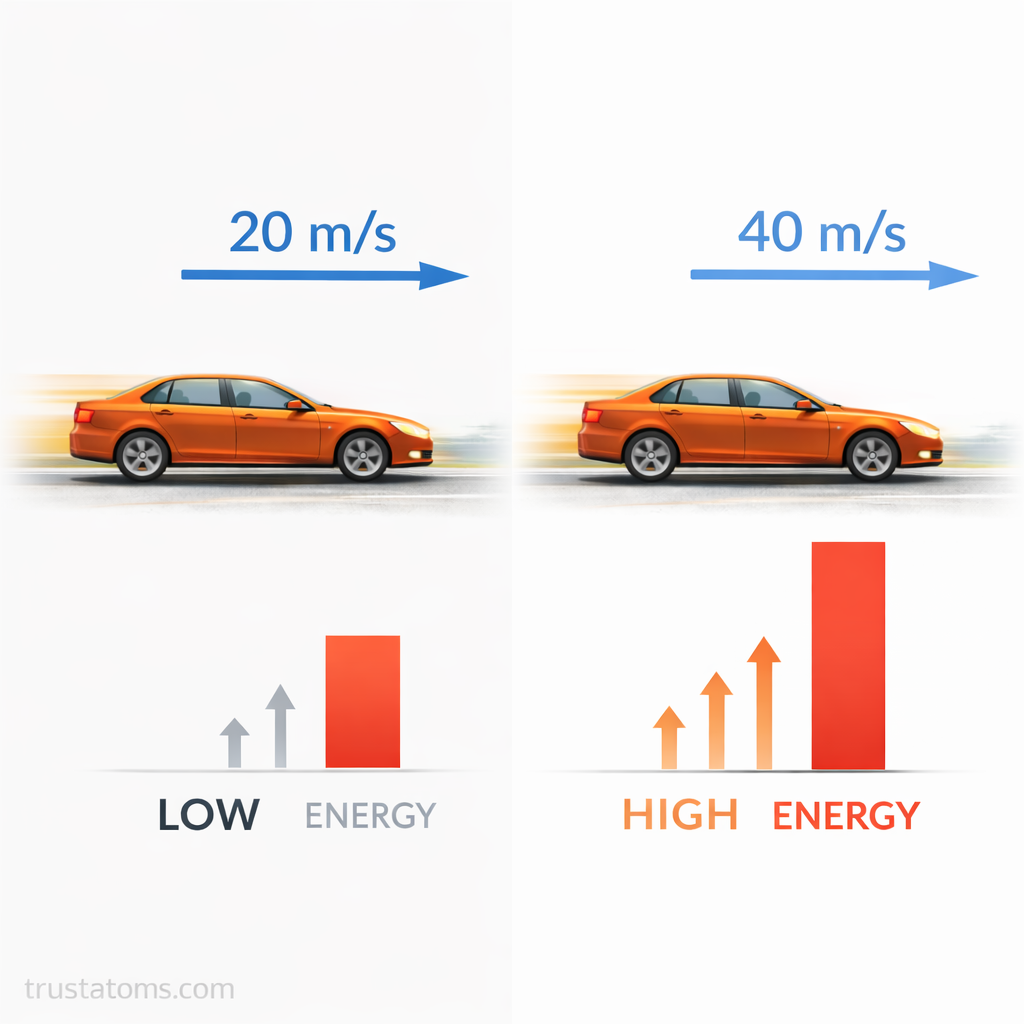
- If speed doubles, kinetic energy becomes four times larger.
- If speed triples, kinetic energy becomes nine times larger.
Speed affects kinetic energy much more dramatically than mass does.
That’s why high-speed car crashes are far more dangerous than low-speed ones.
Example Calculation
Let’s calculate the kinetic energy of a 1,000 kg car moving at 20 m/s.
KE = ½ × 1,000 × (20)²
KE = 500 × 400
KE = 200,000 J
Now, if the speed doubles to 40 m/s:
KE = ½ × 1,000 × (40)²
KE = 500 × 1,600
KE = 800,000 J
The speed doubled, but the kinetic energy became four times greater.
Everyday Examples of Kinetic Energy
Kinetic energy is everywhere.
Moving Vehicles
Cars, trains, airplanes, and bicycles all have kinetic energy when in motion.
Falling Objects
A falling rock gains kinetic energy as gravity increases its speed.
Sports
A baseball thrown toward a batter carries kinetic energy.
A soccer ball kicked across a field has kinetic energy.
Wind and Water
Flowing rivers and wind turbines rely on kinetic energy from moving water and air.
Kinetic Energy vs Potential Energy
Kinetic energy is often paired with potential energy.
- Potential energy = stored energy
- Kinetic energy = motion energy
For example:
- A roller coaster at the top of a hill has gravitational potential energy.
- As it rolls down, potential energy converts into kinetic energy.
Energy changes form, but total energy remains conserved.
Relationship Between Kinetic Energy and Work
In physics, work and kinetic energy are directly connected.
The Work-Energy Theorem states:
The work done on an object equals its change in kinetic energy.
If you apply a force to accelerate something, you increase its kinetic energy.
For example:
- Pushing a shopping cart makes it move.
- The force you apply does work.
- That work increases its kinetic energy.
Kinetic Energy and Momentum: What’s the Difference?
Kinetic energy and momentum both describe motion, but they are not the same.
Momentum:
- Depends on mass and velocity
- Has direction (vector)
- Measured in kg·m/s
Kinetic Energy:
- Depends on mass and velocity squared
- Has no direction (scalar)
- Measured in joules
An object can have high momentum but relatively lower kinetic energy depending on speed and mass distribution.
Factors That Affect Kinetic Energy
Two main factors determine kinetic energy:
1. Mass
More mass = more kinetic energy (if speed stays constant)
2. Speed
More speed = dramatically more kinetic energy (because of v²)
In most real-world scenarios, speed has the greater impact.
Why Kinetic Energy Matters
Kinetic energy explains:
- Car crash damage
- Sports impacts
- Power generation
- Engineering safety design
- Ballistics and motion analysis
Engineers calculate kinetic energy to design:
- Airbags
- Helmets
- Braking systems
- Structural supports
Understanding kinetic energy helps predict how much force is involved in motion-related events.
Key Takeaways
- Kinetic energy is the energy of motion.
- The formula is KE = ½mv².
- It is measured in joules.
- Speed affects kinetic energy more than mass.
- It connects directly to work and energy conservation.
- It plays a major role in engineering and safety.
Kinetic energy is one of the most fundamental ideas in physics. Once you understand it, you can analyze everything from car crashes to roller coasters to wind power systems.
Motion isn’t just movement — it’s stored power in action.