Kinetic energy is the energy an object has because it is moving.
From speeding cars to flowing rivers, kinetic energy explains how motion carries power. In this guide, you’ll learn the kinetic energy formula, how to use it, and see clear step-by-step examples.
What Is the Kinetic Energy Formula?
The formula for kinetic energy is:
KE = ½mv²
Where:
- KE = kinetic energy (in joules, J)
- m = mass (in kilograms, kg)
- v = velocity (in meters per second, m/s)
Units of Kinetic Energy
Kinetic energy is measured in joules (J).
1 joule = 1 kg·m²/s²
Why the Formula Includes Velocity Squared
Notice the velocity is squared (v²).
This means:
- If speed doubles → kinetic energy becomes 4 times larger.
- If speed triples → kinetic energy becomes 9 times larger.
- Small increases in speed cause large increases in energy.
This is why high-speed impacts are much more destructive than low-speed ones.
How to Calculate Kinetic Energy (Step-by-Step)
Follow these steps:
- Identify the mass (m) in kilograms.
- Identify the velocity (v) in meters per second.
- Square the velocity (v²).
- Multiply mass by v².
- Multiply the result by ½.
Example 1: Moving Car
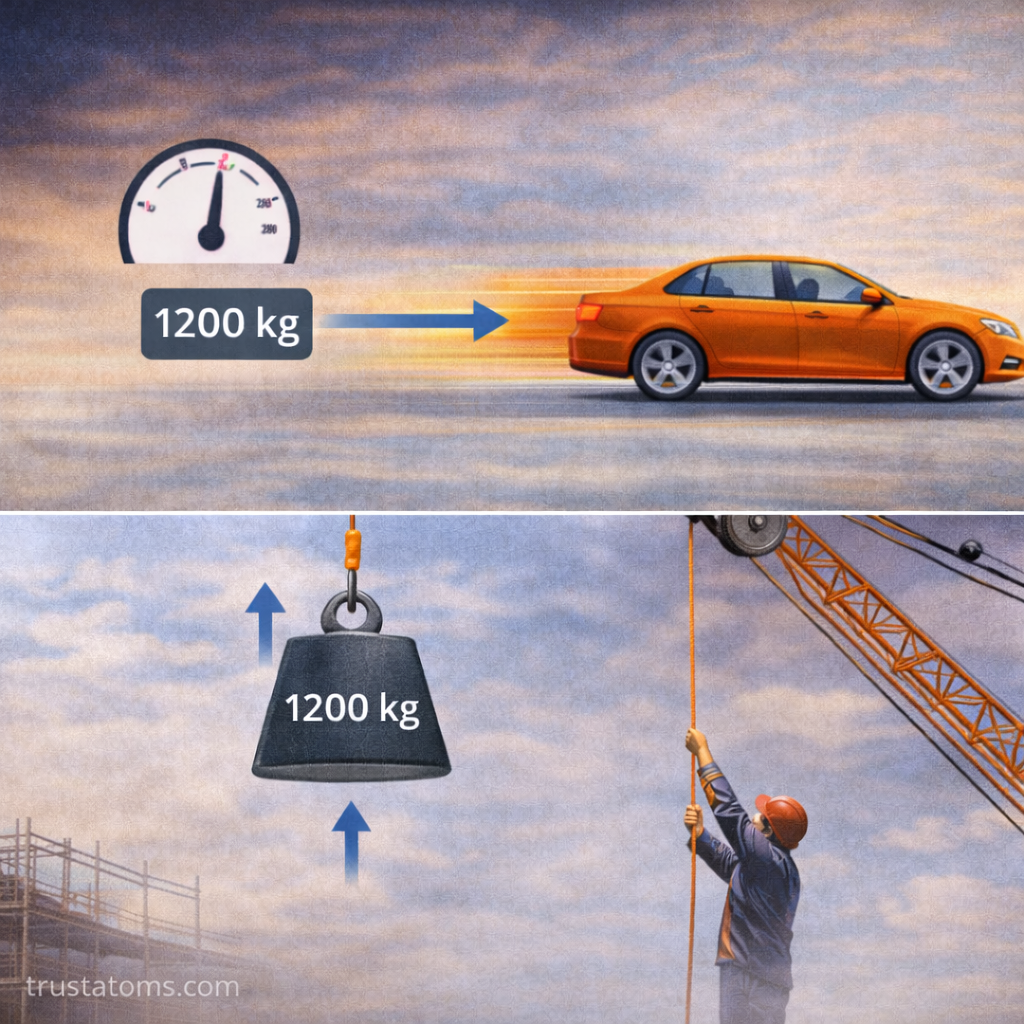
A car has:
- Mass = 1,200 kg
- Speed = 25 m/s
Step 1: Square the velocity
25² = 625
Step 2: Multiply by mass
1,200 × 625 = 750,000
Step 3: Multiply by ½
KE = ½ × 750,000
KE = 375,000 J
The car has 375,000 joules of kinetic energy.
Example 2: Running Athlete
A runner has:
- Mass = 70 kg
- Speed = 6 m/s
Step 1: 6² = 36
Step 2: 70 × 36 = 2,520
Step 3: KE = ½ × 2,520
KE = 1,260 J
The runner has 1,260 joules of kinetic energy.
Example 3: Falling Object
A rock with mass 5 kg falls at 10 m/s.
Step 1: 10² = 100
Step 2: 5 × 100 = 500
Step 3: KE = ½ × 500
KE = 250 J
The falling rock has 250 joules of kinetic energy.
Comparing the Effect of Speed
Let’s compare a 1,000 kg car at two different speeds.
At 20 m/s:
KE = ½ × 1,000 × (20)²
KE = ½ × 1,000 × 400
KE = 200,000 J
At 40 m/s:
KE = ½ × 1,000 × (40)²
KE = ½ × 1,000 × 1,600
KE = 800,000 J
The speed doubled, but the kinetic energy became four times larger.
Speed has the greatest impact on kinetic energy.
Real-World Applications of the Kinetic Energy Formula
The formula is used in:
- Car crash analysis
- Airbag and helmet design
- Roller coaster engineering
- Ballistics and projectile motion
- Power generation (wind turbines and hydropower)
Engineers calculate kinetic energy to predict how much force or damage motion can cause.
Kinetic Energy and Work
The Work-Energy Theorem states:
Work done on an object = Change in kinetic energy
If you apply force to accelerate an object, you increase its kinetic energy.
For example:
- Pushing a box makes it move.
- The force you apply does work.
- That work becomes kinetic energy.
Common Mistakes When Using the Formula
Avoid these common errors:
- Forgetting to square the velocity.
- Using mass in grams instead of kilograms.
- Using speed in km/h instead of m/s.
- Forgetting to multiply by ½.
Always convert units properly before calculating.
Key Takeaways
- The kinetic energy formula is KE = ½mv².
- It depends on mass and velocity.
- Velocity has a squared effect.
- Kinetic energy is measured in joules.
- It explains motion in vehicles, sports, falling objects, and engineering systems.
Understanding the kinetic energy formula gives you the ability to analyze motion mathematically and predict how powerful movement can be.
It’s one of the most essential tools in physics.