When most people think of matter, they think of solids, liquids, and gases. But there’s a fourth fundamental state that dominates the visible universe: plasma.
Plasma is often described as an “ionized gas,” but what does that actually mean? And how does ionization transform ordinary matter into something that behaves completely differently?
In this article, we’ll explore ionization in plasma states, how it happens, where plasma exists, and why it plays a critical role in physics, energy research, and space science.
What Is Ionization?
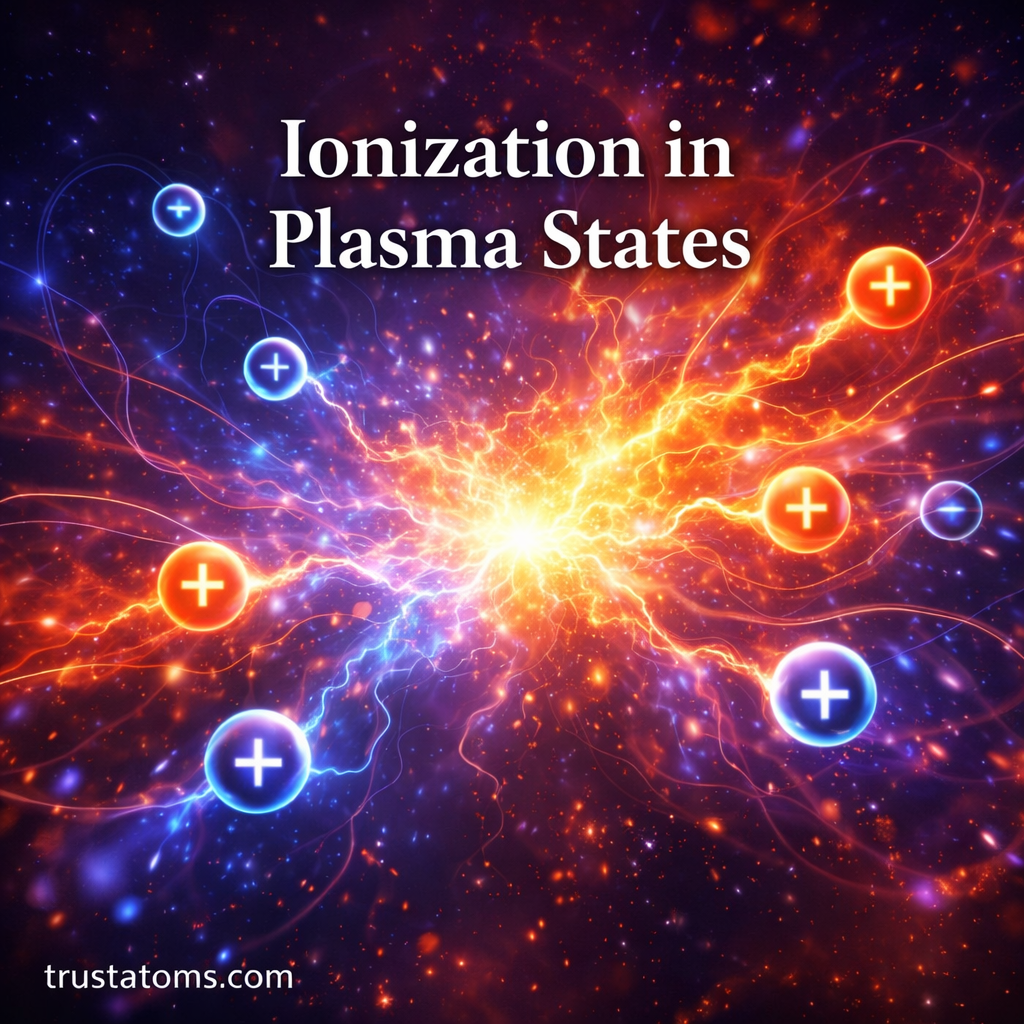
Ionization is the process by which an atom or molecule gains or loses electrons, becoming electrically charged.
- If an atom loses electrons, it becomes a positively charged ion.
- If it gains electrons, it becomes a negatively charged ion.
Under normal conditions, atoms are electrically neutral. They have equal numbers of protons (positive charge) and electrons (negative charge).
Ionization disrupts that balance.
This process requires energy — often in the form of heat, radiation, or strong electric fields.
What Is Plasma?
Plasma is a state of matter formed when a gas becomes so energized that many of its atoms are ionized.
In plasma:
- Electrons are no longer bound tightly to nuclei.
- Positive ions and free electrons move independently.
- The material becomes electrically conductive.
- It responds strongly to electric and magnetic fields.
Because of this, plasma behaves very differently from ordinary gases.
In fact, over 99% of the visible universe is in the plasma state — including stars, nebulae, and the interstellar medium.
How Ionization Creates Plasma
Ionization occurs when sufficient energy is added to a gas. This energy can come from:
- High temperatures
- Intense electromagnetic radiation
- Strong electric fields
- Particle collisions
As temperature increases:
- Gas molecules move faster.
- Collisions become more violent.
- Electrons are knocked free from atoms.
When enough atoms become ionized, the gas transitions into plasma.
This transition is not always sudden. Instead, it can occur gradually as ionization levels increase.
Degrees of Ionization
Not all plasma is fully ionized.
Physicists describe plasma using the degree of ionization, which refers to the fraction of atoms that are ionized.
There are two main types:
Partially Ionized Plasma
- Only a small percentage of atoms are ionized.
- Common in fluorescent lights and Earth’s upper atmosphere.
- Contains many neutral atoms alongside ions and electrons.
Fully Ionized Plasma
- Nearly all atoms are ionized.
- Found in stars and extremely hot laboratory plasmas.
- Strongly conductive and highly reactive to magnetic fields.
The level of ionization affects how plasma behaves and how it can be controlled.
Key Properties of Ionized Plasma
Ionization gives plasma unique physical properties not seen in solids, liquids, or gases.
1. Electrical Conductivity
Because it contains free-moving charged particles, plasma conducts electricity easily.
This makes plasma useful in:
- Plasma televisions (older models)
- Industrial cutting torches
- Fusion research
2. Response to Magnetic Fields
Charged particles spiral along magnetic field lines.
This property allows scientists to confine plasma in devices like tokamak reactors for nuclear fusion experiments.
3. Collective Behavior
Plasma particles don’t behave independently.
Instead, large groups of charged particles interact collectively through electric and magnetic forces. This creates waves, instabilities, and complex patterns.
Where Plasma Exists in Nature
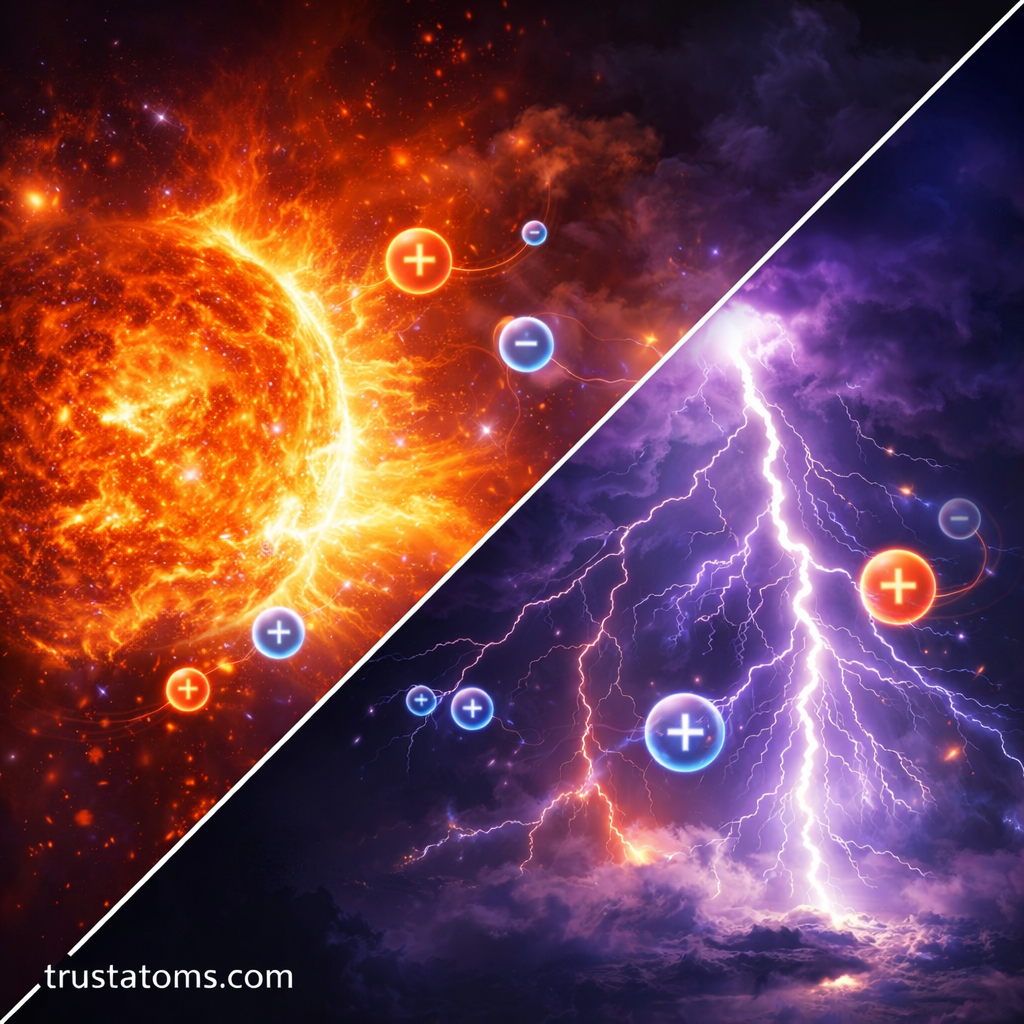
Ionization in plasma states is not rare — it’s everywhere in the cosmos.
Examples include:
- The Sun and other stars
- Lightning strikes
- The aurora borealis
- The solar wind
- Earth’s ionosphere
In stars, extremely high temperatures cause continuous ionization, maintaining plasma conditions through nuclear fusion reactions.
On Earth, lightning briefly ionizes air molecules, creating a conductive plasma channel.
Ionization Energy and Thresholds
Every element has a specific ionization energy — the minimum energy required to remove an electron from an atom.
Elements with:
- Low ionization energy lose electrons easily.
- High ionization energy require extreme conditions to ionize.
Hydrogen, the most abundant element in the universe, requires significant energy to ionize, which is why stars must reach millions of degrees to sustain plasma conditions.
Understanding ionization energy is essential in:
- Astrophysics
- Fusion reactor design
- Plasma propulsion systems
Ionization in Fusion and Energy Research
One of the most important modern applications of plasma physics is nuclear fusion research.
To achieve fusion:
- Hydrogen isotopes are heated to extreme temperatures.
- They become fully ionized plasma.
- Magnetic fields confine the plasma.
- Atomic nuclei collide and fuse, releasing energy.
Without ionization, fusion would be impossible.
Controlling ionized plasma remains one of the greatest engineering challenges in physics.
Plasma vs. Ordinary Gas
Although plasma begins as a gas, ionization changes its behavior dramatically.
Key differences:
- Gas particles are mostly neutral.
- Plasma particles are electrically charged.
- Gases do not respond strongly to magnetic fields.
- Plasma can be shaped and confined using magnetic fields.
This is why plasma is considered a distinct state of matter rather than just a “hot gas.”
Why Ionization in Plasma Matters
Ionization in plasma states is central to understanding:
- How stars shine
- How space weather affects satellites
- How lightning forms
- How fusion energy might power the future
It bridges atomic physics, electromagnetism, thermodynamics, and astrophysics.
Plasma physics also drives innovation in:
- Semiconductor manufacturing
- Space propulsion
- Medical sterilization technologies
- Advanced materials processing
As we explore deeper into space and pursue clean energy solutions, mastering plasma ionization becomes increasingly important.
Final Thoughts
Ionization is the key process that transforms ordinary gas into plasma — the most abundant state of matter in the universe.
By stripping electrons from atoms, ionization creates a dynamic environment of charged particles that behave collectively and respond to electromagnetic forces.
From the glowing surface of the Sun to cutting-edge fusion reactors, plasma and ionization shape both the cosmos and the future of energy technology.
Understanding ionization in plasma states isn’t just a physics concept — it’s a window into how the universe works.