Heat can move from one place to another in three primary ways:
- Conduction
- Convection
- Radiation
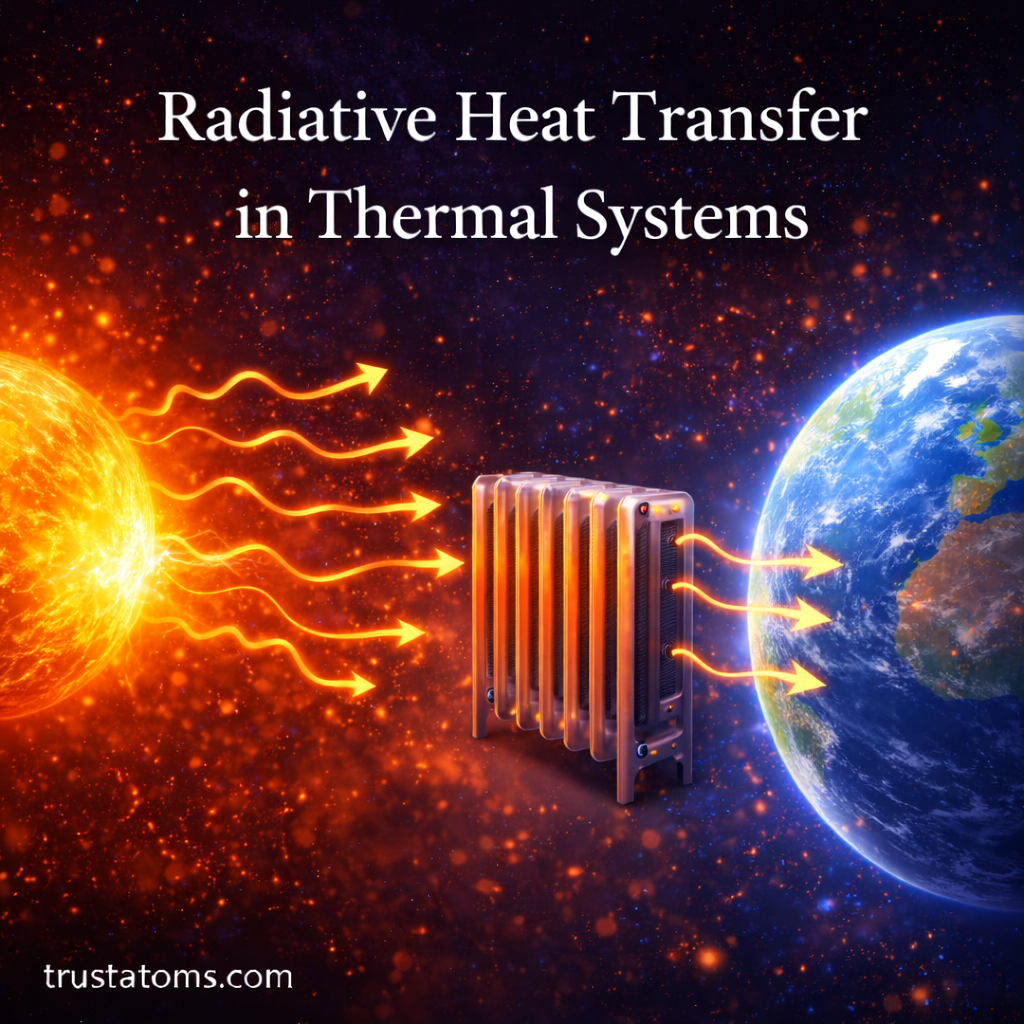
Radiative heat transfer is unique because it does not require matter. Unlike conduction and convection, radiation can transfer energy through empty space.
This is how heat from the Sun reaches Earth and how thermal energy escapes into space. In physics and engineering, understanding radiative heat transfer is essential for designing power plants, spacecraft, insulation systems, and high-temperature equipment.
In this article, we’ll explore how radiative heat transfer works, the physical laws that govern it, and why it plays a critical role in thermal systems.
What Is Radiative Heat Transfer?
Radiative heat transfer is the process by which thermal energy is emitted and absorbed in the form of electromagnetic waves.
All objects with a temperature above absolute zero emit thermal radiation.
Key characteristics:
- No medium required
- Energy travels at the speed of light
- Occurs through electromagnetic waves (primarily infrared)
- Depends strongly on temperature
The hotter an object is, the more radiation it emits.
How Thermal Radiation Works
Atoms and molecules in a material are constantly vibrating.
As temperature increases:
- Vibrations become more energetic
- Accelerating charges emit electromagnetic waves
- Energy radiates outward
This emitted radiation can be absorbed by other objects, raising their temperature.
This process continues until thermal equilibrium is reached.
The Stefan–Boltzmann Law
One of the most important principles governing radiative heat transfer is the Stefan–Boltzmann Law.
It states that the total energy radiated per unit surface area is proportional to the fourth power of the object’s absolute temperature.
This means:
- Small increases in temperature cause large increases in radiated energy.
- High-temperature systems lose heat very rapidly through radiation.
This principle is critical in high-temperature furnaces, combustion chambers, and stars.
Emissivity: Not All Surfaces Radiate Equally
Real materials do not radiate energy equally.
Emissivity is a measure of how efficiently a surface emits thermal radiation compared to an ideal emitter (a blackbody).
Values range from:
- 0 (perfect reflector)
- 1 (perfect emitter or blackbody)
Examples:
- Polished metals have low emissivity.
- Matte black surfaces have high emissivity.
Surface finish, material composition, and temperature affect emissivity.
Engineers carefully select materials based on their radiative properties.
Blackbody Radiation
A blackbody is an idealized object that absorbs all incoming radiation and emits the maximum possible radiation at a given temperature.
Blackbody radiation:
- Depends only on temperature
- Has a characteristic energy distribution
- Shifts toward shorter wavelengths as temperature increases
For example:
- Cooler objects radiate mostly infrared energy.
- Very hot objects glow red, then white, as visible wavelengths increase.
Blackbody theory was foundational in the development of quantum mechanics.
Radiation vs. Conduction and Convection
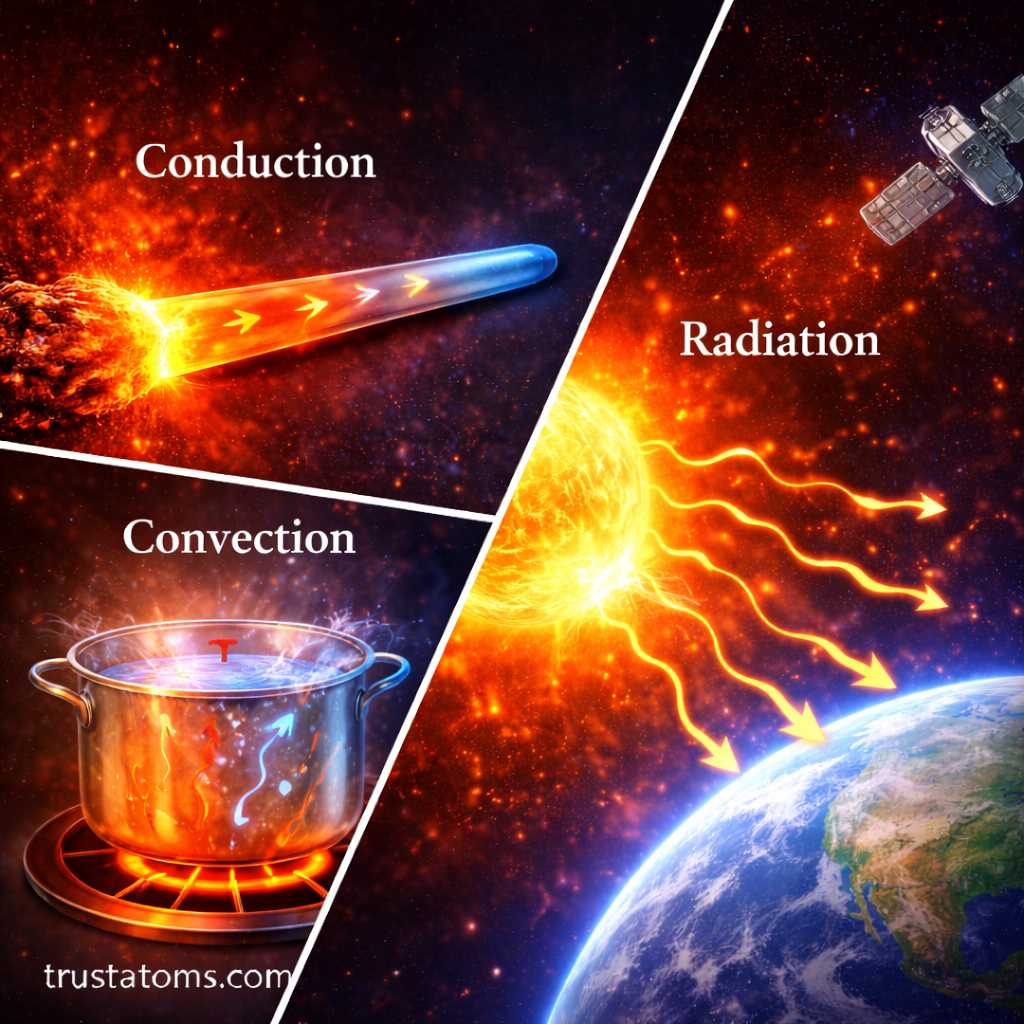
Radiative heat transfer differs fundamentally from the other two modes of heat transfer.
Conduction:
- Requires direct molecular contact
- Occurs in solids
Convection:
- Requires fluid motion
- Occurs in liquids and gases
Radiation:
- Requires no medium
- Occurs even in a vacuum
In space, radiation is the only heat transfer mechanism.
Radiative Heat Transfer in Engineering Systems
Radiation becomes especially important at high temperatures.
1. Power Plants
Boilers and combustion chambers emit significant radiative heat.
Designers must account for radiation to:
- Protect structural components
- Maximize efficiency
- Prevent overheating
2. Spacecraft Thermal Control
Spacecraft cannot rely on convection in vacuum.
They regulate temperature using:
- Radiators
- Reflective coatings
- Insulating layers
3. Building Insulation
Low-emissivity coatings on windows reduce radiative heat loss.
This improves energy efficiency in buildings.
Radiative Exchange Between Surfaces
When two objects face each other, they exchange thermal radiation.
The net heat transfer depends on:
- Temperature difference
- Surface emissivity
- Geometric orientation
- Distance between surfaces
Engineers calculate this exchange to design ovens, heat shields, and thermal enclosures.
The Role of Wavelength
Radiative heat transfer occurs across a spectrum of wavelengths.
Key points:
- Infrared radiation dominates at moderate temperatures.
- Visible radiation appears at very high temperatures.
- Shorter wavelengths correspond to higher energy radiation.
Understanding wavelength behavior helps in:
- Thermal imaging
- Climate modeling
- High-temperature material design
Radiative Heat Transfer in Climate Systems
Earth’s energy balance depends heavily on radiation.
The planet:
- Absorbs solar radiation.
- Emits infrared radiation back into space.
Greenhouse gases absorb and re-emit infrared radiation, influencing global temperature.
Radiative transfer models are essential in climate science.
When Radiation Dominates
Radiation becomes the dominant heat transfer mode when:
- Temperatures are very high
- Distances between objects are large
- Surrounding medium is a vacuum
- Surface emissivity is high
In industrial furnaces and stars, radiation accounts for most energy transfer.
Why Radiative Heat Transfer Matters
Radiative heat transfer is central to:
- Thermal engineering
- Astrophysics
- Energy system design
- Climate science
- Material science
It explains how stars shine, how spacecraft stay operational, and how high-temperature systems are safely managed.
Ignoring radiation in high-temperature systems can lead to major design failures.
Final Thoughts
Radiative heat transfer is a fundamental physical process that allows thermal energy to travel through electromagnetic waves without requiring matter.
Governed by temperature, emissivity, and surface properties, radiation plays a crucial role in both natural and engineered systems.
From the warmth of sunlight to the design of spacecraft and power plants, understanding radiative heat transfer is essential for mastering thermal systems in physics and engineering.