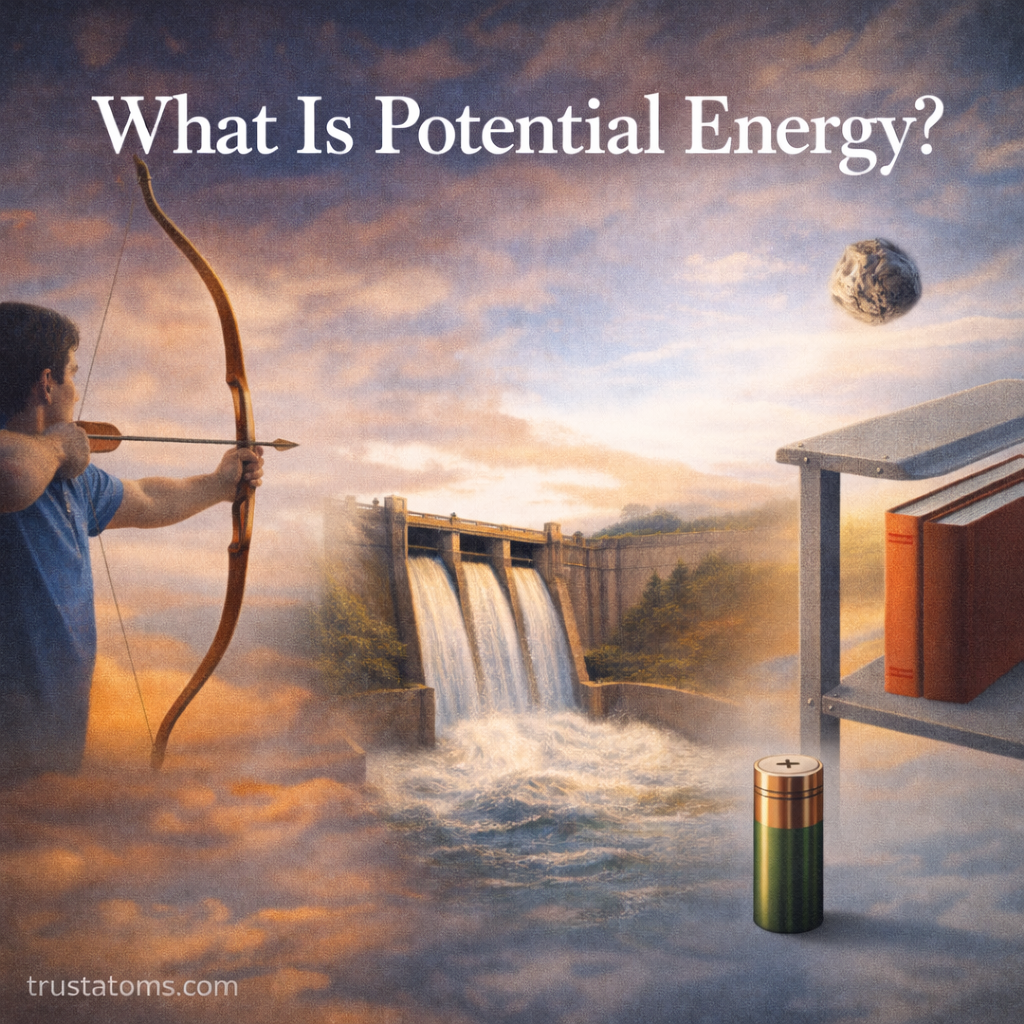
Potential energy is stored energy.
It is the energy an object has because of its position, condition, or configuration — not because it is moving.
From a stretched rubber band to water held behind a dam, potential energy represents stored power waiting to be released.
In this guide, you’ll learn:
- What potential energy is
- The main types of potential energy
- The gravitational potential energy formula
- Real-world examples
- How it connects to kinetic energy
What Is Potential Energy?
Potential energy is energy stored in an object due to:
- Its position
- Its height
- Its arrangement
- Its internal structure
Unlike kinetic energy (energy of motion), potential energy exists even when an object is completely still.
Gravitational Potential Energy
The most common type studied in physics is gravitational potential energy.
It depends on:
- Mass
- Height
- Gravitational acceleration
The Gravitational Potential Energy Formula
PE = mgh
Where:
- PE = potential energy (in joules, J)
- m = mass (in kilograms, kg)
- g = gravitational acceleration (9.8 m/s² on Earth)
- h = height above the ground (in meters)
Units of Potential Energy
Potential energy is measured in:
Joules (J)
Example Calculation

Imagine a 5 kg object sitting 10 meters above the ground.
Step 1: Identify values
m = 5 kg
g = 9.8 m/s²
h = 10 m
Step 2: Plug into formula
PE = 5 × 9.8 × 10
PE = 490 J
The object has 490 joules of gravitational potential energy.
What Affects Potential Energy?
Three factors influence gravitational potential energy:
1. Mass
More mass = more potential energy
2. Height
Greater height = more potential energy
3. Gravity
Stronger gravity = more potential energy
For example, the same object would have less potential energy on the Moon because gravity is weaker there.
Other Types of Potential Energy
Potential energy is not limited to gravity.
Elastic Potential Energy
Stored in stretched or compressed objects.
Examples:
- Rubber bands
- Springs
- Bows and arrows
The more you stretch or compress, the more energy is stored.
Chemical Potential Energy
Stored in chemical bonds.
Examples:
- Batteries
- Food
- Fuel
When bonds break or rearrange, energy is released.
Electrical Potential Energy
Stored due to electric charges and electric fields.
Used in circuits and capacitors.
Potential Energy vs Kinetic Energy
Potential energy is stored energy.
Kinetic energy is motion energy.
They are closely connected.
For example:
- A roller coaster at the top of a hill has maximum potential energy.
- As it rolls down, potential energy converts into kinetic energy.
- At the bottom, kinetic energy is highest.
Energy changes form but is not destroyed.
The Law of Conservation of Energy
Energy cannot be created or destroyed.
It can only change form.
Total energy in a closed system remains constant.
For example:
Potential energy at the top of a hill
= Kinetic energy at the bottom (ignoring friction)
This principle is fundamental in physics and engineering.
Real-Life Examples of Potential Energy
Potential energy is everywhere in daily life.
Water Behind a Dam
Water stored at height has gravitational potential energy.
When released, it turns turbines to generate electricity.
A Book on a Shelf
The higher the shelf, the more potential energy the book has.
A Drawn Bow
Stretching the bow stores elastic potential energy.
When released, it converts into kinetic energy.
Charged Battery
Chemical potential energy powers devices when converted to electrical energy.
Why Potential Energy Matters
Potential energy helps engineers and scientists:
- Design dams and power plants
- Build roller coasters
- Calculate projectile motion
- Analyze mechanical systems
- Understand planetary motion
It allows us to predict how much motion or force can occur once stored energy is released.
Key Takeaways
- Potential energy is stored energy.
- Gravitational potential energy uses the formula PE = mgh.
- It depends on mass, height, and gravity.
- Energy transforms between potential and kinetic.
- Total energy is conserved in a closed system.
Understanding potential energy is essential for mastering physics. It explains how stored energy becomes motion, power, and force in the physical world.
Every time something falls, stretches, charges, or compresses — potential energy is involved.