Why does light take the fastest path?
Why do planets follow smooth elliptical orbits?
Why does a hanging chain curve the way it does?
Across physics, the answer often comes down to one powerful idea: nature optimizes.
Variational principles reveal that many physical systems behave as if they are minimizing (or extremizing) something. Instead of focusing on forces directly, we focus on what quantity is optimized.
This article breaks down variational principles in a clear, practical way—connecting classical mechanics, optics, relativity, and even quantum theory.
What Is a Variational Principle?
A variational principle states that the actual path taken by a physical system makes a certain quantity stationary (usually minimized or maximized).
“Stationary” means:
- It could be a minimum
- It could be a maximum
- It could be a saddle point
- But small changes do not change the value to first order
In simple terms:
Nature chooses the path that makes a specific quantity “optimal.”
Instead of solving equations of motion directly, we ask:
What is being optimized?
The Calculus of Variations (The Math Behind It)
Variational principles rely on the calculus of variations, which differs from ordinary calculus.
- Ordinary calculus finds minima or maxima of functions.
- Calculus of variations finds minima or maxima of functions of functions.
Instead of minimizing a number, we minimize an entire path.
If a quantity called the functional S depends on a path q(t), then the real motion satisfies:
δS = 0
This leads to the Euler–Lagrange equation:
d/dt (∂L/∂q̇) − ∂L/∂q = 0
This single equation generates much of classical physics.
The Principle of Least Action
The most important variational principle in physics is the Principle of Least Action.
It was developed by physicists such as Pierre-Louis Maupertuis and later formalized by Joseph-Louis Lagrange and William Rowan Hamilton.
What Is Action?
Action (S) is defined as:
S = ∫ L dt
Where:
- L = Lagrangian
- L = T − V
- T = kinetic energy
- V = potential energy
The principle states:
The actual path taken by a system between two times makes the action stationary.
This single idea generates:
- Newton’s laws
- Planetary motion
- Oscillations
- Electromagnetism
- Even quantum mechanics
Example 1: Classical Mechanics
Instead of using Newton’s second law directly:
F = ma
We can derive it from the action principle.
For a particle moving in a potential field:
- Write the Lagrangian: L = T − V
- Insert into the action integral
- Apply Euler–Lagrange equation
- Newton’s law emerges automatically
This approach is more powerful because:
- It works for complex systems
- It generalizes to relativity
- It handles constraints elegantly
Example 2: Fermat’s Principle in Optics
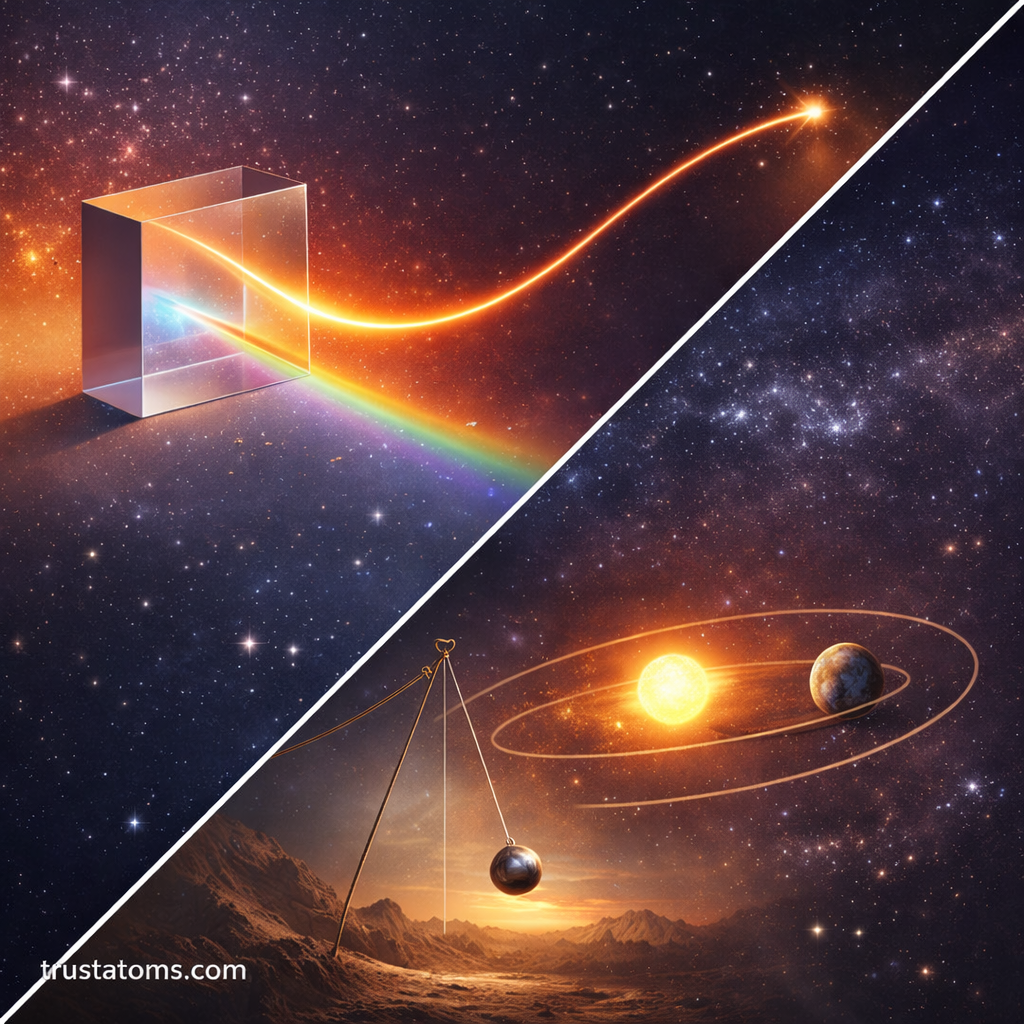
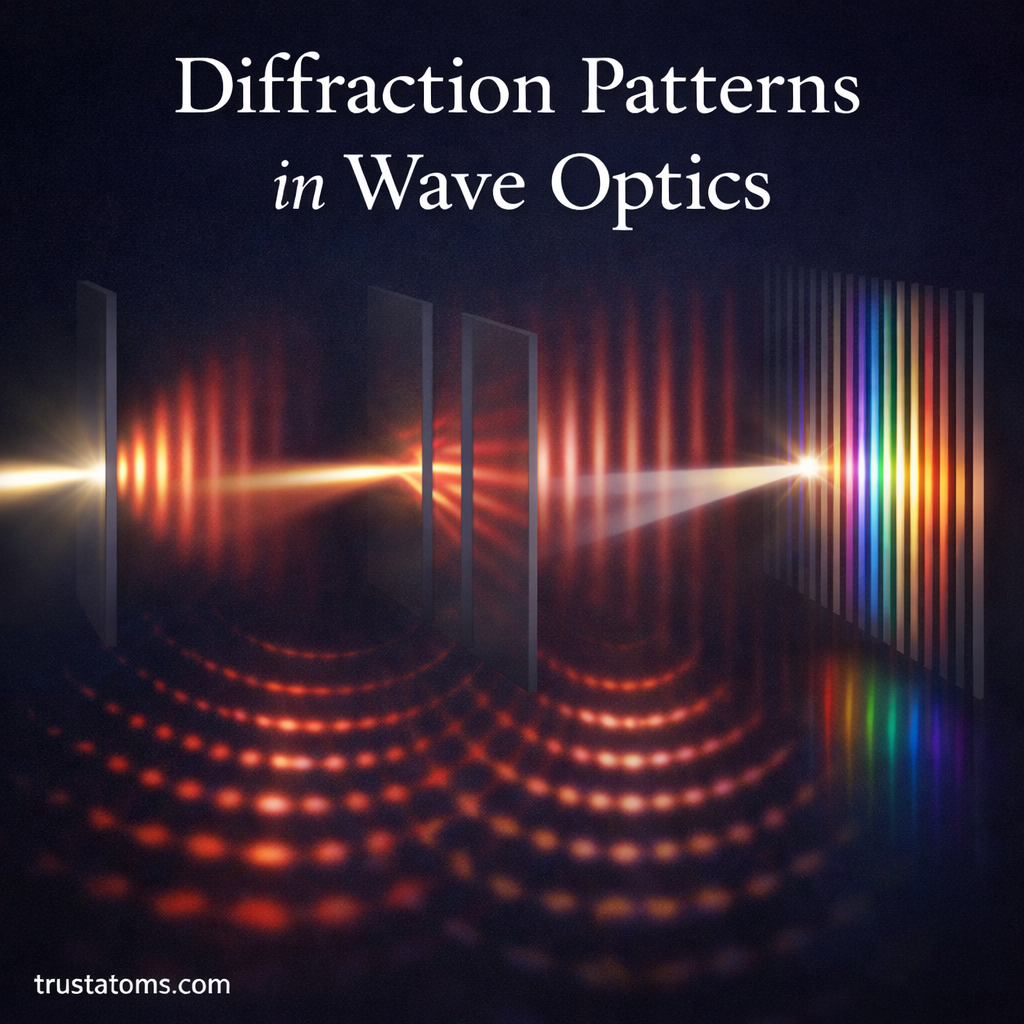
In optics, light follows a variational principle known as Fermat’s Principle.
It was proposed by Pierre de Fermat.
The principle states:
Light travels the path that takes the least time.
This explains:
- Reflection
- Refraction
- Snell’s Law
Instead of analyzing forces on light, we optimize travel time.
Nature behaves like an optimizer.
Example 3: General Relativity
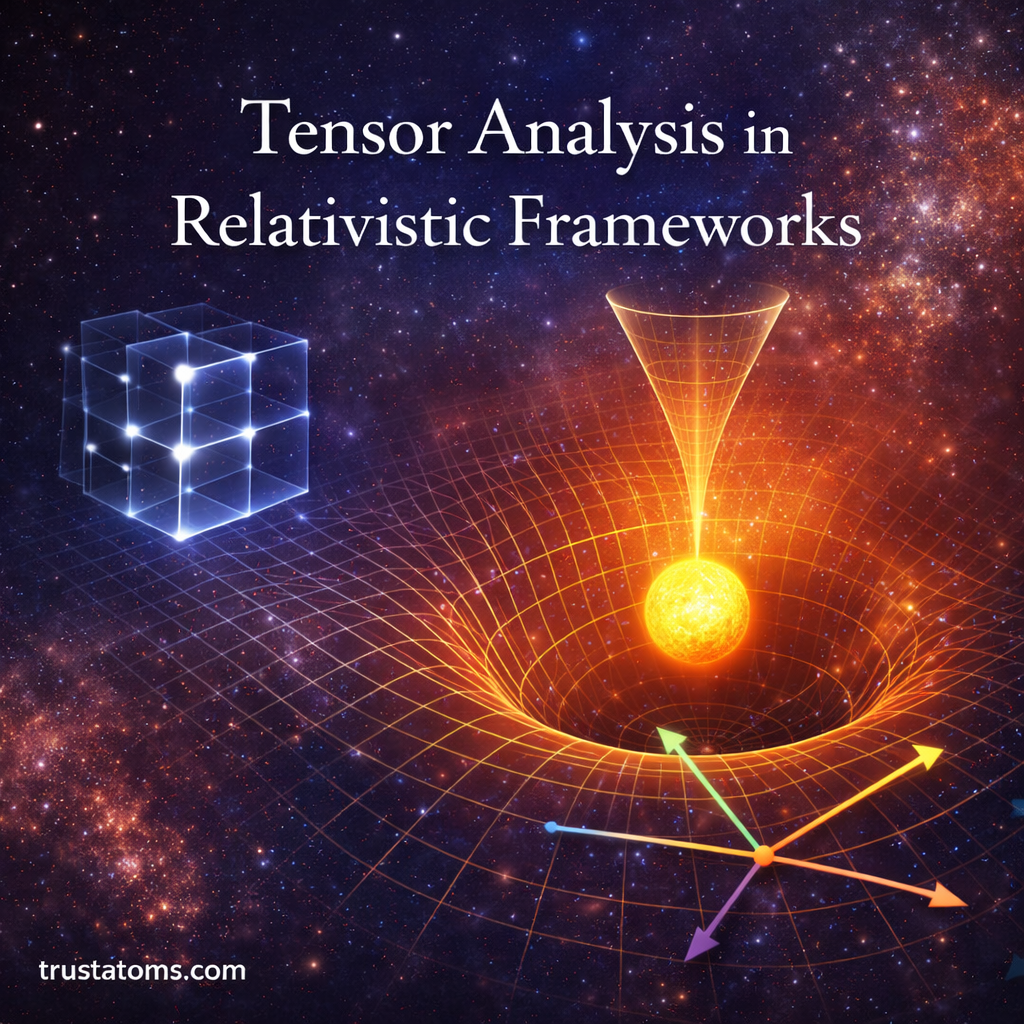
In General Relativity, gravity is not a force.
Instead:
- Mass curves spacetime
- Objects follow paths that extremize spacetime interval
Einstein’s field equations can be derived from a variational principle applied to spacetime geometry.
Even gravity obeys an optimization rule.
Example 4: Quantum Mechanics
In quantum mechanics, the variational principle appears in a new way.
The Schrödinger equation can be derived from an action principle.
Additionally, the variational method allows physicists to approximate ground state energies:
- Choose a trial wavefunction
- Minimize energy expectation value
- The lowest value approximates the true ground state
This method is widely used in:
- Atomic physics
- Molecular chemistry
- Condensed matter physics
Why Variational Principles Are So Powerful
They provide:
- A unifying framework across physics
- Coordinate-independent descriptions
- Elegant handling of constraints
- Path-based thinking instead of force-based thinking
Instead of asking:
“What force causes this?”
We ask:
“What quantity is being optimized?”
This shift simplifies many complex systems.
Constraints and Generalized Coordinates
Variational methods naturally handle constraints.
For example:
- A bead on a wire
- A pendulum
- A rolling wheel without slipping
Instead of resolving forces manually, we:
- Define generalized coordinates
- Write the Lagrangian
- Apply Euler–Lagrange equations
This reduces complicated force diagrams into structured mathematical steps.
The Deep Philosophical Insight
Variational principles suggest something profound:
Physical laws may not be fundamentally about forces.
They may be about optimization.
This perspective connects physics to:
- Geometry
- Symmetry
- Conservation laws
- Information theory
In fact, Noether’s Theorem (which links symmetries to conservation laws) emerges directly from variational principles.
If a system’s action is symmetric under:
- Time shifts → Energy conserved
- Space shifts → Momentum conserved
- Rotations → Angular momentum conserved
Optimization leads to conservation.
Common Misconceptions
1. Nature “chooses” the best path
It’s not conscious choice.
The optimization condition is mathematically equivalent to differential equations of motion.
2. It always minimizes
Not necessarily.
The action is stationary, not always minimum.
3. It replaces Newtonian physics
It doesn’t replace it—it generalizes it.
Where Variational Principles Appear Today
They are central in:
- Particle physics
- Field theory
- String theory
- Quantum field theory
- Engineering mechanics
- Control theory
- Machine learning (energy minimization frameworks)
Modern physics is built almost entirely on action principles.
Summary
Variational principles reveal a stunning idea:
Nature behaves as though it optimizes.
From:
- Light choosing the fastest route
- Planets following elegant orbits
- Particles minimizing action
- Spacetime shaping motion
The same mathematical structure governs them all.
Instead of focusing on forces, variational principles shift the question to:
What is being optimized?
And that single question unlocks much of modern physics.
Final Takeaway
If you understand variational principles, you understand the deep architecture of physical law.
They unify mechanics, optics, relativity, and quantum physics under one elegant framework:
The universe runs on optimization.