In classical mechanics, solving equations of motion can quickly become complicated.
But what if you could change coordinates in a way that preserves the physics while making the math easier?
That is exactly what canonical transformations do.
They are one of the most powerful tools in analytical mechanics, especially within Hamiltonian mechanics. Canonical transformations allow physicists to reformulate a problem into a simpler one — without changing the underlying physical behavior.
This article explains what canonical transformations are, why they matter, and how they connect to deeper ideas like symmetry and conservation laws.
What Are Canonical Transformations?
In Hamiltonian mechanics, a system is described using:
- Generalized coordinates q
- Generalized momenta p
Together, these form a coordinate system in phase space.
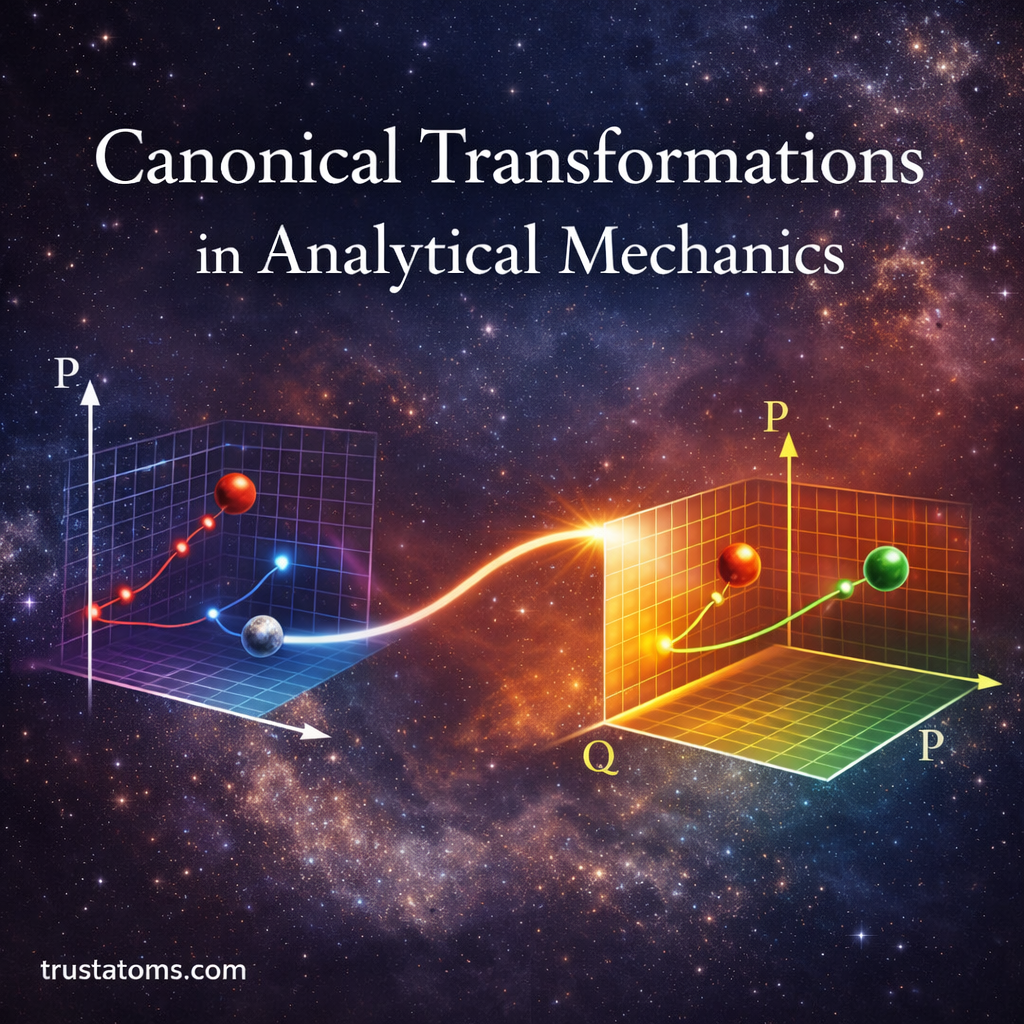
A canonical transformation is a change from one set of phase space variables:
(q, p)
to another set:
(Q, P)
such that the new variables preserve the form of Hamilton’s equations.
In simple terms:
A canonical transformation changes coordinates in phase space while keeping the structure of the physical laws intact.
This preservation of structure is what makes them special.
Quick Review: Hamiltonian Mechanics
Canonical transformations are built on Hamiltonian mechanics, developed by William Rowan Hamilton.
In this framework:
- The Hamiltonian (H) represents total energy.
- The equations of motion are: dq/dt = ∂H/∂p
dp/dt = −∂H/∂q
These equations define how systems evolve over time.
A canonical transformation keeps these equations in the same form when expressed in the new variables (Q, P).
Why Canonical Transformations Matter
They are powerful because they:
- Simplify difficult problems
- Reveal hidden symmetries
- Help identify conserved quantities
- Convert complicated systems into solvable ones
- Bridge classical and quantum mechanics
Instead of solving a hard problem directly, we transform it into an easier one.
What Does “Canonical” Mean?
“Canonical” refers to preserving the canonical structure of phase space.
More specifically, canonical transformations preserve:
- The form of Hamilton’s equations
- The symplectic geometry of phase space
- Poisson bracket relationships
This preservation ensures the physics remains unchanged.
If a transformation distorts the structure of phase space, it is not canonical.
Phase Space and Structure Preservation
Phase space is a geometric space where each point represents a full state of the system:
- Position coordinates
- Momentum coordinates
Canonical transformations preserve the area (or higher-dimensional volume) in phase space.
This property connects to Liouville’s theorem, which states:
The density of phase space points remains constant as a system evolves.
Canonical transformations maintain this structure even under coordinate changes.
Generating Functions: The Engine Behind Canonical Transformations
Canonical transformations are typically constructed using generating functions.
A generating function relates old and new variables and automatically ensures the transformation preserves Hamilton’s equations.
There are four common types of generating functions, depending on which variables they use:
- Function of old coordinates and new coordinates
- Function of old coordinates and new momenta
- Function of old momenta and new coordinates
- Function of old momenta and new momenta
Each choice leads to a consistent transformation rule.
Instead of guessing transformations, we build them systematically.
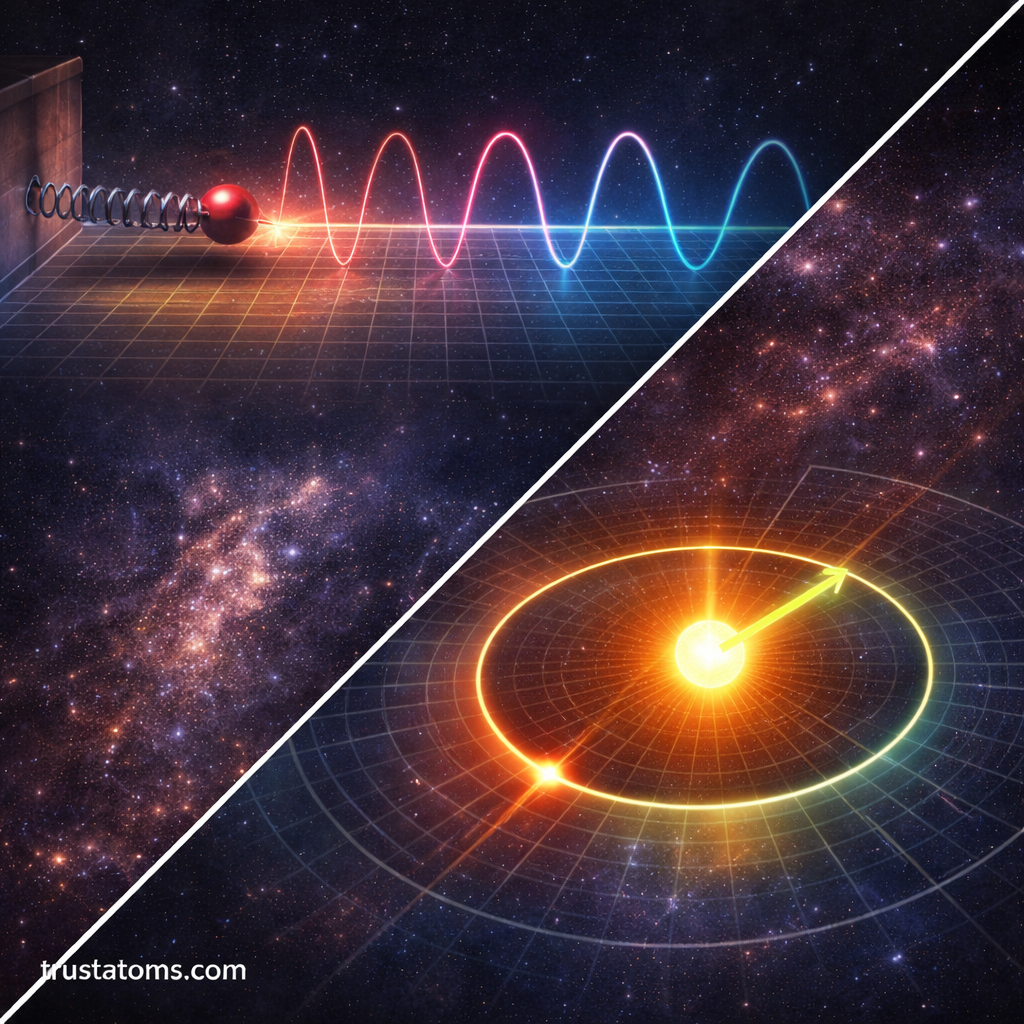
Example: Simplifying Oscillatory Motion
Consider a harmonic oscillator.
In standard coordinates, the equations involve sinusoidal motion.
Using a canonical transformation, we can shift to action-angle variables:
- The action variable becomes constant.
- The angle variable increases linearly with time.
This transformation makes periodic motion incredibly simple to analyze.
Instead of complicated trigonometry, the system becomes uniform circular motion in phase space.
Action-Angle Variables
One of the most important applications of canonical transformations is the introduction of action-angle variables.
These variables:
- Turn periodic systems into linear motion in angle space
- Make conserved quantities obvious
- Simplify perturbation theory
They are essential in:
- Celestial mechanics
- Quantum mechanics foundations
- Stability analysis
Poisson Brackets and Canonical Structure
Canonical transformations preserve Poisson brackets.
The Poisson bracket measures how two quantities change relative to each other in phase space.
If a transformation preserves the fundamental Poisson bracket relations, it is canonical.
This algebraic condition ensures the transformation keeps the physical dynamics intact.
Connection to Symmetry and Conservation Laws
Canonical transformations are deeply connected to symmetry.
When a system has symmetry:
- There exists a conserved quantity.
- A suitable canonical transformation can simplify the system using that conserved quantity.
This idea connects directly to Noether’s theorem, developed by Emmy Noether.
Symmetry → Conservation law
Canonical transformation → Simplified coordinates reflecting that conservation
This connection makes canonical transformations central to modern theoretical physics.
Canonical Transformations in Quantum Mechanics
Canonical transformations also appear in quantum mechanics.
In quantum theory:
- Classical variables become operators.
- Poisson brackets become commutators.
Unitary transformations in quantum mechanics are the analog of canonical transformations in classical mechanics.
This continuity explains why Hamiltonian methods transition so naturally into quantum theory.
Canonical Transformations vs. Ordinary Coordinate Changes
Not every coordinate change is canonical.
An ordinary coordinate transformation might:
- Change equations of motion
- Distort phase space structure
- Break Hamilton’s form
A canonical transformation:
- Preserves Hamilton’s structure
- Maintains symplectic geometry
- Keeps the physics unchanged
The difference is structural preservation.
Modern Applications
Canonical transformations are widely used in:
- Celestial mechanics
- Accelerator physics
- Plasma physics
- Statistical mechanics
- Quantum field theory
- Dynamical systems theory
In advanced physics, nearly every complex system is studied through Hamiltonian and canonical methods.
Intuitive Summary
Think of canonical transformations as:
A change of perspective that keeps the rules of motion intact.
They allow physicists to:
- Rotate phase space
- Shift variables
- Expose hidden structure
- Convert complexity into simplicity
The physical system does not change.
Only the description changes.
And sometimes, that change makes everything clearer.
Final Takeaway
Canonical transformations are not just mathematical tricks.
They are structural tools that preserve the geometry of motion.
By maintaining Hamilton’s equations and phase space structure, they allow us to:
- Simplify complex systems
- Reveal conservation laws
- Connect classical and quantum mechanics
In analytical mechanics, they represent one of the most elegant ways to understand motion — not by solving harder equations, but by choosing better coordinates.