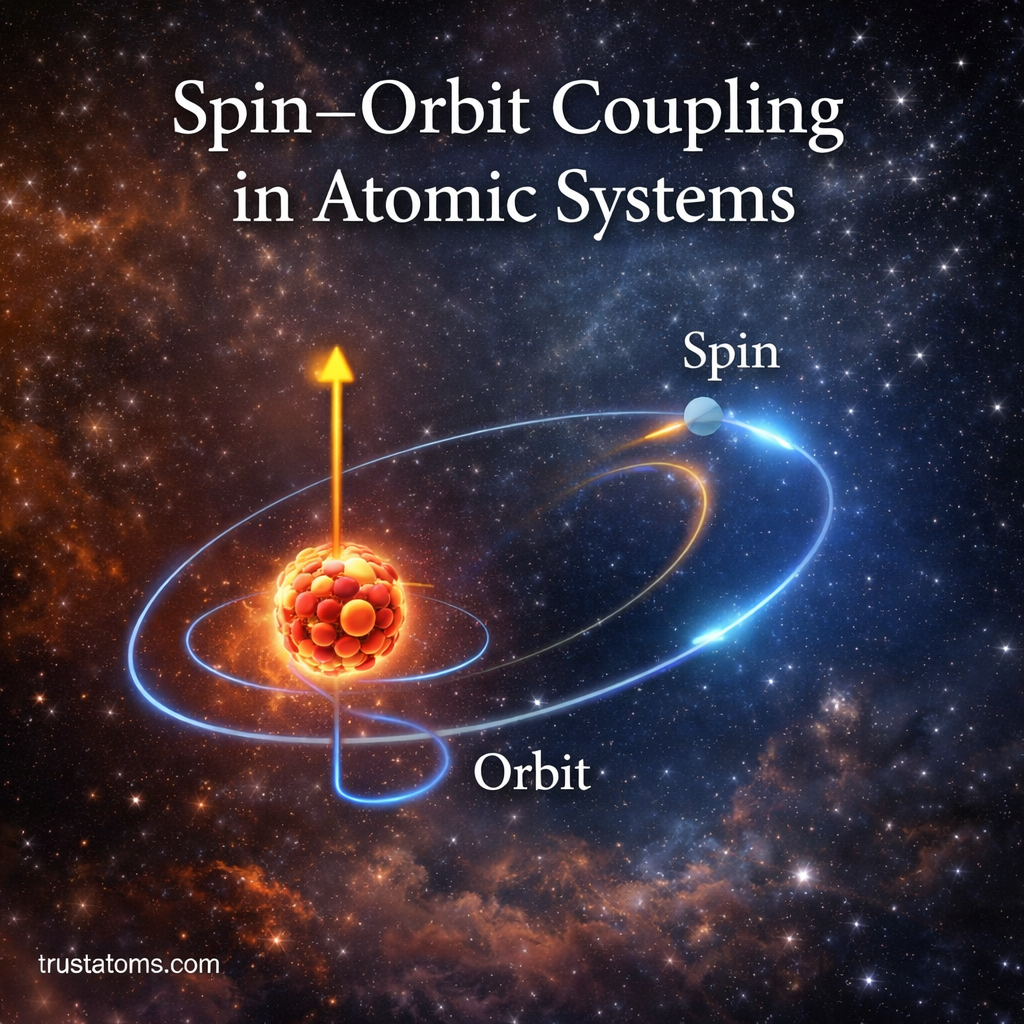
Spin–orbit coupling is one of the most fascinating effects in atomic physics. It explains why atomic energy levels split, why fine structure appears in spectral lines, and why quantum numbers matter in real, measurable ways.
At its core, spin–orbit coupling describes an interaction between:
- An electron’s intrinsic spin
- Its orbital motion around the nucleus
This subtle interaction has profound consequences — from atomic spectra to modern materials science.
Let’s break it down clearly and conceptually.
What Is Spin–Orbit Coupling?
Spin–orbit coupling (SOC) is a quantum mechanical interaction between an electron’s:
- Orbital angular momentum (its motion around the nucleus)
- Spin angular momentum (its intrinsic quantum rotation-like property)
In simple terms:
As an electron moves around the nucleus, it “feels” an effective magnetic field due to its motion. Its intrinsic magnetic moment (from spin) interacts with this field.
That interaction shifts the electron’s energy slightly.
Those tiny shifts produce measurable changes in atomic spectra.
Why Does It Happen?
The effect arises from two key ideas:
1. Moving Charges Create Magnetic Fields
From electromagnetism, we know:
- A moving charge produces a magnetic field.
- A magnetic moment interacts with magnetic fields.
An electron orbiting the nucleus experiences the electric field of the nucleus. In the electron’s rest frame, that electric field transforms into a magnetic field.
Its spin magnetic moment interacts with that magnetic field.
2. Relativistic Effects Matter
Spin–orbit coupling is fundamentally a relativistic effect.
It emerges naturally when combining:
- Quantum mechanics
- Special relativity
The full explanation comes from solving the Dirac equation for electrons in atoms.
Even though the effect is small compared to the main energy levels, it’s large enough to measure and crucial for understanding atomic structure.
Orbital Angular Momentum vs. Spin Angular Momentum
To understand spin–orbit coupling, we need to distinguish two types of angular momentum.
Orbital Angular Momentum (L)
- Comes from the electron’s motion around the nucleus.
- Associated with quantum number l.
- Produces magnetic effects similar to a tiny current loop.
Spin Angular Momentum (S)
- Intrinsic property of the electron.
- Not due to literal spinning.
- Associated with quantum number s = 1/2.
Each carries a magnetic moment.
When these interact, energy levels shift.
Total Angular Momentum (J)
Because spin and orbital angular momentum interact, they combine into a new conserved quantity:
Total angular momentum:
J = L + S
This leads to new quantum numbers:
- j = l + 1/2
- j = l − 1/2 (when allowed)
Each value of j corresponds to a slightly different energy.
This splitting is what we observe as fine structure.
Fine Structure in Atomic Spectra
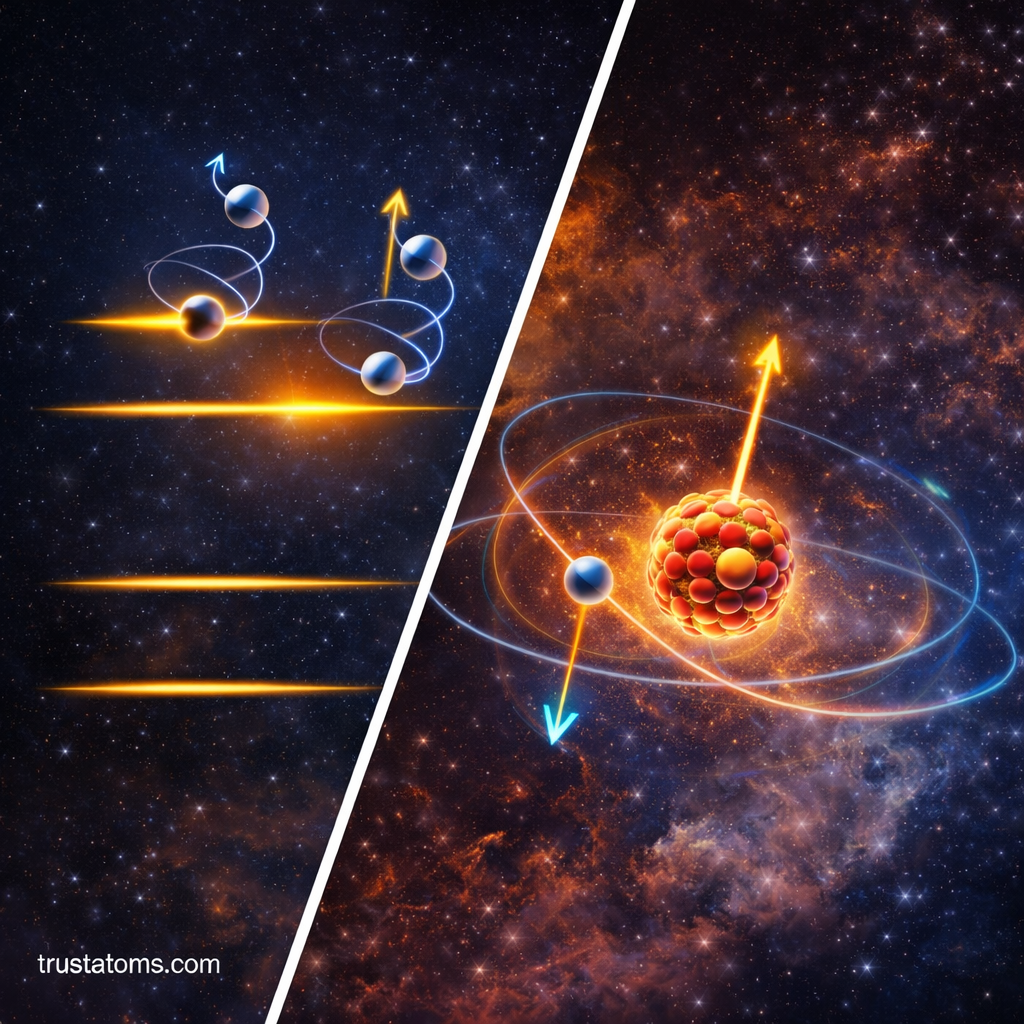
Without spin–orbit coupling, energy levels would depend only on the principal quantum number n (in hydrogen-like atoms).
With spin–orbit coupling included:
- Levels split into closely spaced sublevels.
- Spectral lines split into multiple components.
This fine splitting is called fine structure.
It was historically one of the clues that quantum mechanics needed refinement beyond early models.
How the Energy Shift Depends on Quantum Numbers
The magnitude of spin–orbit splitting depends on:
- The atomic number (Z)
- The orbital quantum number (l)
- The total angular momentum (j)
Key trends:
- Larger nuclear charge → stronger electric field → stronger coupling
- Heavier elements show stronger spin–orbit effects
- Electrons closer to the nucleus experience larger splitting
This is why spin–orbit coupling becomes especially important in heavy atoms.
Physical Interpretation (Intuitive Picture)
Here’s a helpful mental model:
- The electron orbits the nucleus.
- In its rest frame, the nucleus appears to circle around it.
- That motion generates a magnetic field.
- The electron’s spin magnetic moment interacts with that field.
Depending on whether spin and orbital angular momentum are aligned or anti-aligned:
- Energy is slightly lowered
- Or slightly raised
This produces two nearby energy states instead of one.
Spin–Orbit Coupling in Multi-Electron Atoms
In hydrogen, spin–orbit coupling is relatively simple.
In multi-electron atoms, things become more complex because:
- Electrons interact with each other.
- Coupling schemes become important.
Two main coupling schemes exist:
1. LS Coupling (Russell–Saunders Coupling)
Common in lighter atoms.
- Individual orbital momenta combine first.
- Individual spins combine.
- Then total L and total S combine into J.
2. jj Coupling
Important in heavy atoms.
- Each electron’s l and s combine first into j.
- Then all j values combine.
Spin–orbit interaction is stronger in heavy atoms, making jj coupling more appropriate.
Why Spin–Orbit Coupling Matters
Spin–orbit coupling is not just a textbook concept. It plays a major role in:
- Atomic spectroscopy
- Chemical bonding in heavy elements
- Magnetism
- Solid-state physics
- Topological insulators
- Spintronics
In condensed matter systems, strong spin–orbit coupling can lead to entirely new quantum phases of matter.
Real-World Consequences
Here are some observable outcomes of spin–orbit coupling:
- Splitting of spectral lines
- Fine structure in hydrogen emission
- Color variations in heavy-element compounds
- Magnetic anisotropy in materials
- Rashba and Dresselhaus effects in semiconductors
In modern materials science, spin–orbit coupling is central to designing quantum devices.
Common Misconceptions
“Is the electron literally spinning?”
No.
Spin is an intrinsic quantum property. It does not correspond to a classical spinning object.
“Is spin–orbit coupling large?”
In light atoms, it’s relatively small.
In heavy atoms, it becomes significant and sometimes dominant.
“Does it only affect isolated atoms?”
No.
Spin–orbit coupling is crucial in:
- Crystals
- Semiconductors
- Nanostructures
- Quantum materials
Summary: Why It’s Fundamental
Spin–orbit coupling:
- Connects quantum mechanics with relativity
- Explains fine structure in atomic spectra
- Determines total angular momentum states
- Becomes increasingly important in heavy elements
- Plays a central role in modern quantum materials
It’s a perfect example of how subtle quantum effects shape the physical world in measurable and technologically important ways.
Understanding spin–orbit coupling is essential for anyone studying advanced atomic physics, spectroscopy, or modern condensed matter physics.