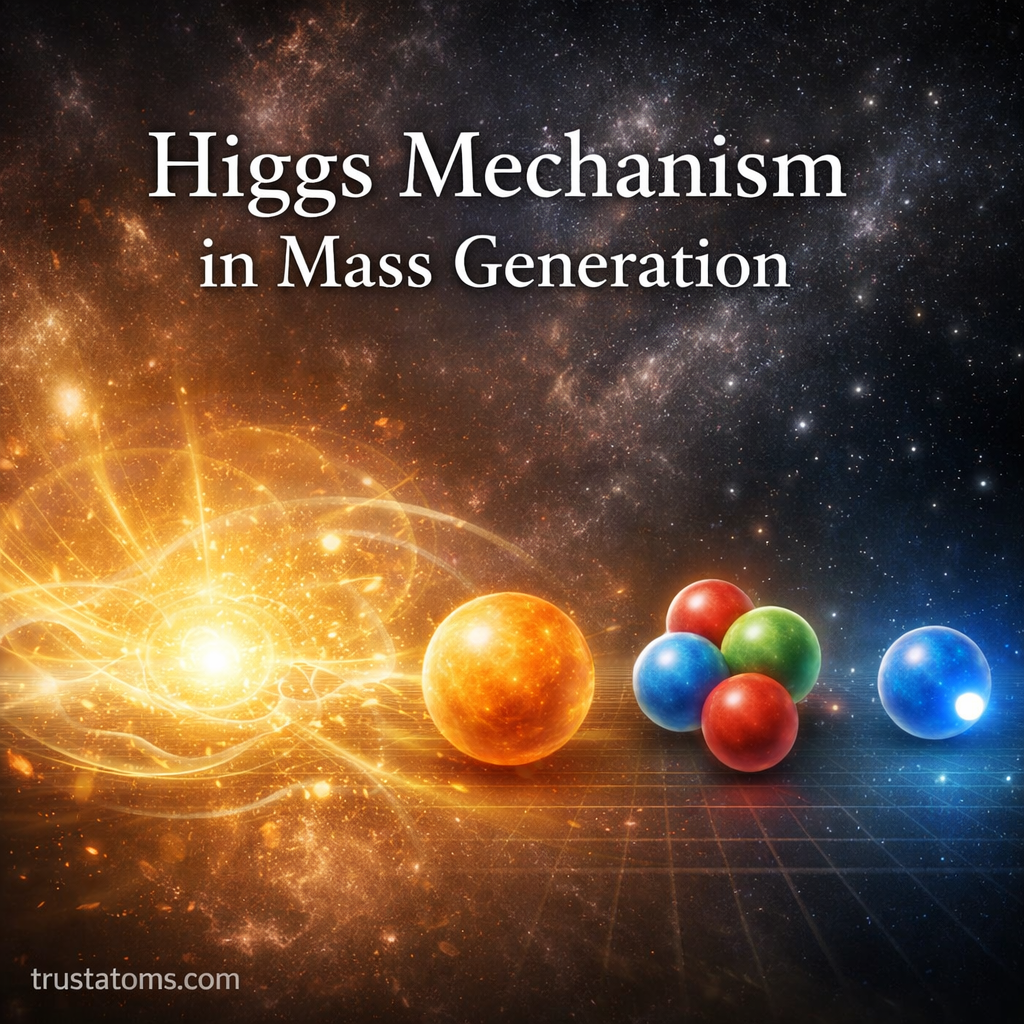
The Higgs mechanism is one of the most important ideas in modern physics. It explains how fundamental particles acquire mass without breaking the mathematical symmetry that governs the universe at its most basic level.
Before this concept was introduced, physicists had equations that worked beautifully — except for one major problem: they predicted that many particles should have no mass at all. The Higgs mechanism solved that puzzle and became a central pillar of the Standard Model of particle physics.
In this guide, we’ll explore what the Higgs mechanism is, how it works, and why it matters for understanding the structure of reality.
Why Mass Was a Problem in Physics
In quantum field theory, particles are not tiny solid objects. Instead, they are excitations (or vibrations) in underlying quantum fields.
The Standard Model describes three fundamental forces:
- Electromagnetism
- The weak nuclear force
- The strong nuclear force
The equations governing these forces rely on a principle called gauge symmetry. This symmetry keeps the mathematics consistent and predictive.
However, there was a major issue:
- Gauge symmetry requires certain force-carrying particles to be massless.
- But experiments showed that particles like the W and Z bosons (responsible for the weak force) are heavy.
Adding mass “by hand” into the equations breaks the symmetry and destroys the theory’s consistency.
Physicists needed a mechanism that:
- Preserved gauge symmetry
- Allowed particles to have mass
- Matched experimental results
That solution became known as the Higgs mechanism.
The Core Idea Behind the Higgs Mechanism
The Higgs mechanism introduces a new quantum field — the Higgs field.
Instead of particles simply “having mass,” the theory proposes:
- The Higgs field exists everywhere in space.
- Some particles interact strongly with this field.
- Others interact weakly or not at all.
- The strength of interaction determines the particle’s mass.
In simple terms:
Mass arises from interaction with the Higgs field.
An analogy often used (though imperfect) is movement through a medium:
- A particle that interacts strongly with the Higgs field moves as if through thick syrup — appearing heavy.
- A particle that barely interacts moves freely — appearing light.
- A particle that doesn’t interact at all remains massless (like the photon).
Spontaneous Symmetry Breaking
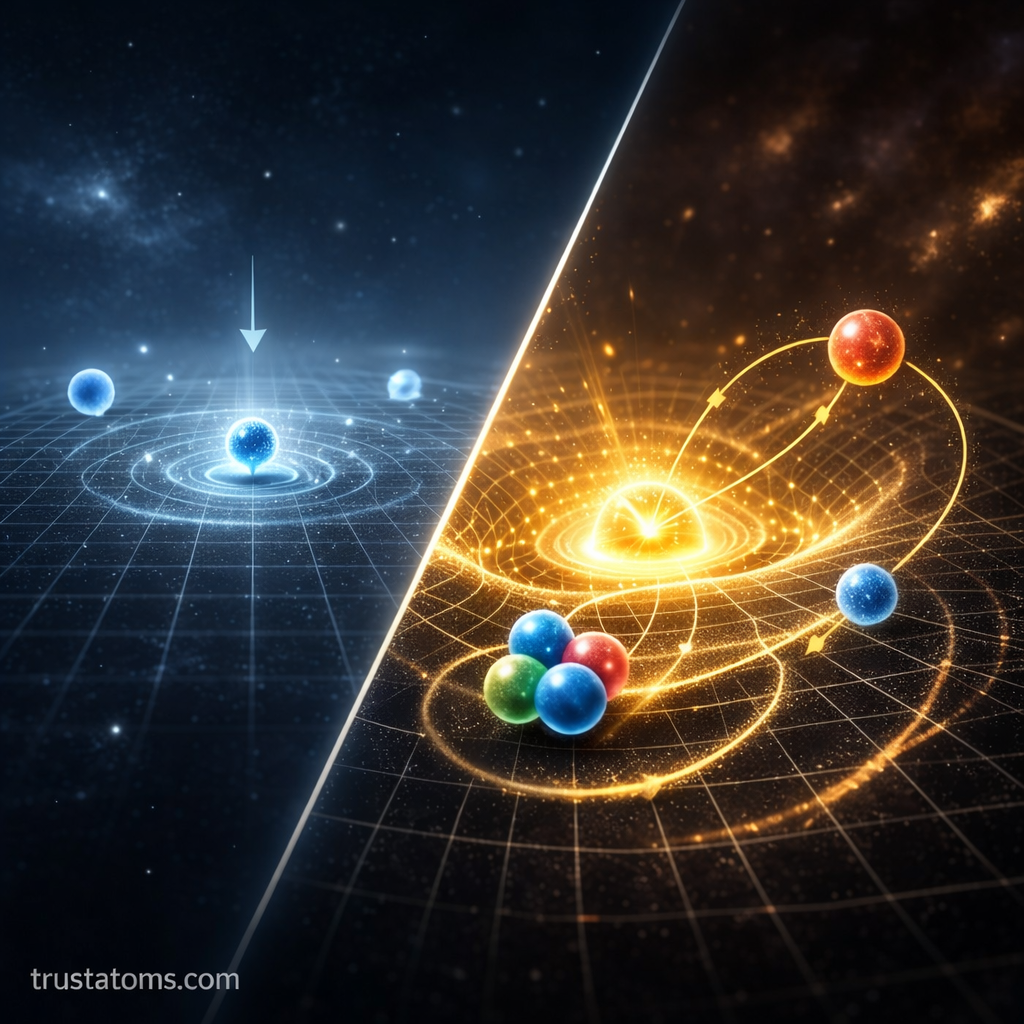
A key concept behind the Higgs mechanism is spontaneous symmetry breaking.
At very high energies (such as just after the Big Bang), the Higgs field had a symmetrical configuration. But as the universe cooled, the field settled into a new, stable state — not symmetric.
This change is called spontaneous symmetry breaking.
An everyday analogy:
Imagine a perfectly upright pencil balanced on its tip. The system is symmetrical in all directions. But once it falls, it chooses a specific direction — breaking the symmetry.
In the universe:
- The Higgs field settled into a nonzero value everywhere.
- This background value allows particles interacting with it to gain mass.
- The symmetry of the equations remains intact, but the vacuum state does not.
This subtle distinction preserves the mathematical structure while explaining mass.
What About the Higgs Boson?
The Higgs field itself is not directly visible. However, like all quantum fields, it can produce particles when excited.
That particle is the Higgs boson.
In 2012, scientists at the CERN announced the discovery of a particle consistent with the Higgs boson at the Large Hadron Collider.
This discovery confirmed that:
- The Higgs field exists.
- The Higgs mechanism is physically real.
- The Standard Model’s explanation of mass is correct (at least within tested limits).
The Higgs boson is not what “creates” mass directly. Instead, it is evidence of the field responsible for mass generation.
Which Particles Get Mass from the Higgs Field?
The Higgs mechanism gives mass to:
- W bosons
- Z bosons
- Quarks
- Charged leptons (like electrons)
However, it does not account for all mass in the universe.
For example:
- Most of the mass of protons and neutrons does not come directly from the Higgs field.
- Instead, it arises from the strong nuclear force binding quarks together.
This means the Higgs mechanism explains fundamental particle mass, but not the majority of visible matter’s mass.
Why the Higgs Mechanism Matters
The importance of the Higgs mechanism goes far beyond particle mass.
It:
- Preserves gauge symmetry in the Standard Model
- Explains why weak force particles are heavy
- Allows the Standard Model to remain mathematically consistent
- Provides a deeper understanding of early-universe physics
Without the Higgs mechanism:
- Atoms would not form properly
- The weak force would behave differently
- The structure of matter would be radically altered
In short, the universe as we know it would not exist.
Higgs Mechanism and the Early Universe
Just after the Big Bang:
- Temperatures were extremely high.
- The Higgs field likely had zero average value.
- All fundamental particles were effectively massless.
As the universe cooled:
- The Higgs field transitioned to its current state.
- Particles began acquiring mass.
- Forces differentiated into their present forms.
This transition was a major event in cosmic history, shaping everything from atomic formation to galaxy development.
Open Questions and Beyond the Standard Model
Although the Higgs mechanism successfully explains mass within the Standard Model, it raises new questions:
- Why does the Higgs field have the value it does?
- Why is the Higgs boson’s mass what it is?
- Is the Higgs field connected to dark matter?
- Could there be additional Higgs-like fields?
Some advanced theories propose:
- Supersymmetry
- Extra dimensions
- Multiple Higgs fields
So far, experiments have confirmed only one Higgs boson, but research continues.
Key Takeaways
The Higgs mechanism explains how particles gain mass through interaction with a universal field.
Here’s the essence:
- Mass is not an intrinsic property inserted into equations.
- It arises from interaction with the Higgs field.
- The mechanism preserves symmetry while allowing massive particles.
- The discovery of the Higgs boson confirmed the theory.
- It remains one of the greatest achievements of modern physics.
Understanding the Higgs mechanism reveals something profound:
Mass is not fundamental — interaction is.
And that insight reshaped our understanding of the universe at its deepest level.