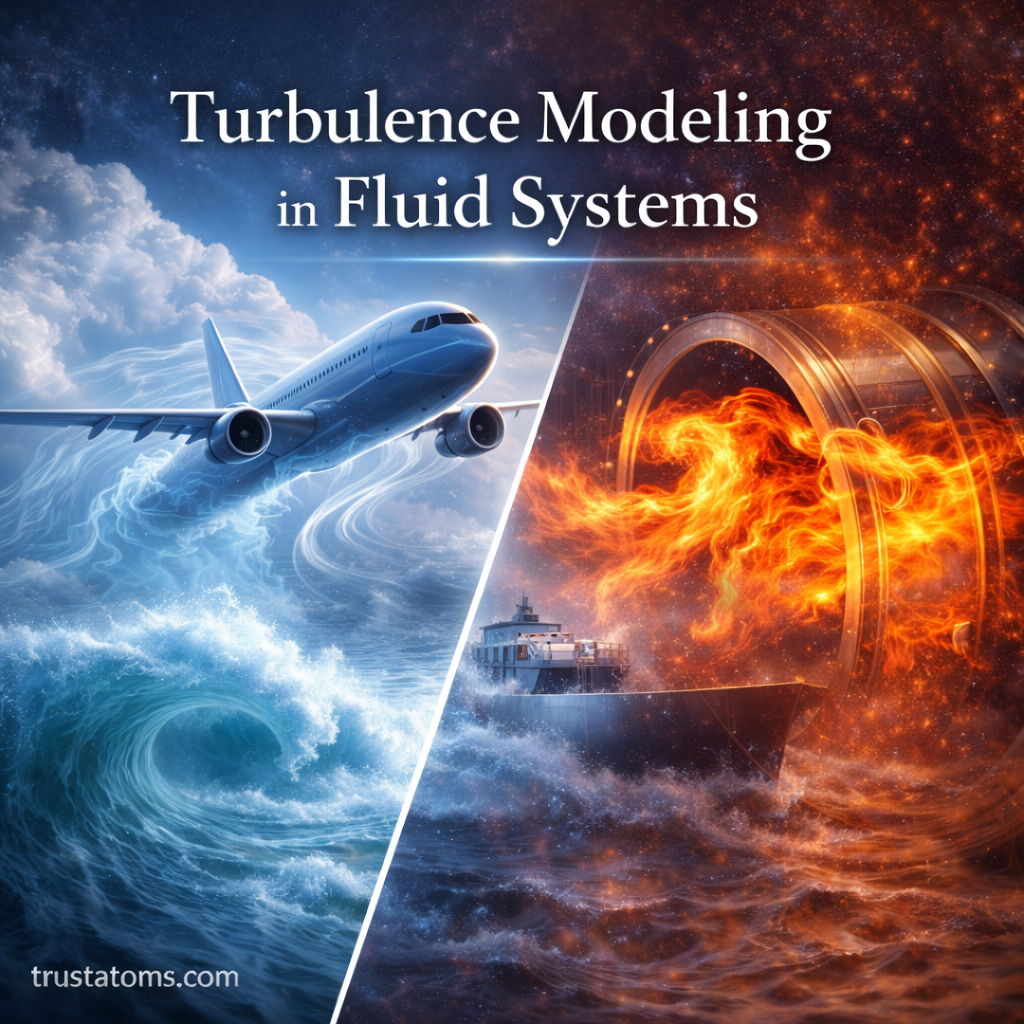
Turbulence is one of the most complex and fascinating phenomena in physics. From swirling smoke and crashing ocean waves to airflow over aircraft wings, turbulent motion appears everywhere in nature and engineering.
Despite being governed by well-known equations, turbulence remains one of the greatest unsolved challenges in classical physics.
Turbulence modeling helps scientists and engineers predict chaotic fluid motion when exact solutions are impossible. In this guide, we’ll explore what turbulence is, why it’s so difficult to describe, and the main modeling approaches used in fluid systems.
What Is Turbulence?
In fluid dynamics, flow generally falls into two categories:
- Laminar flow
- Turbulent flow
Laminar flow is smooth and orderly. Fluid moves in parallel layers with minimal mixing.
Turbulent flow is chaotic and irregular. It features:
- Swirling vortices
- Rapid velocity fluctuations
- Strong mixing
- Energy cascading across scales
Turbulence occurs when inertial forces dominate over viscous forces.
This balance is captured by a dimensionless quantity called the Reynolds number.
High Reynolds number → Turbulence likely
Low Reynolds number → Laminar flow likely
Why Turbulence Is So Difficult to Model
The motion of fluids is governed by the Navier–Stokes equations.
In theory, these equations describe fluid motion exactly. In practice:
- They are highly nonlinear
- They couple velocity and pressure
- They produce chaotic solutions at high Reynolds numbers
Turbulent flow contains motion across many scales:
- Large energy-containing eddies
- Intermediate cascades
- Tiny dissipative scales
Resolving all scales directly requires enormous computational power.
This is why turbulence modeling is necessary.
The Energy Cascade Concept
One key idea in turbulence theory is the energy cascade.
Here’s how it works:
- Energy enters at large scales (for example, from wind or flow boundaries).
- Large vortices break into smaller vortices.
- This process continues until motion reaches very small scales.
- At the smallest scales, viscosity converts kinetic energy into heat.
This cascade transfers energy from large to small scales without losing energy until dissipation occurs.
Understanding this process is central to turbulence modeling.
Main Approaches to Turbulence Modeling
Because direct solutions are impractical in most real-world systems, scientists use modeling techniques. The three primary approaches are:
- Direct Numerical Simulation (DNS)
- Reynolds-Averaged Navier–Stokes (RANS)
- Large Eddy Simulation (LES)
Each method balances accuracy and computational cost.
1. Direct Numerical Simulation (DNS)
DNS solves the Navier–Stokes equations without approximations.
It resolves:
- All spatial scales
- All time scales
- All turbulent structures
Advantages:
- Most accurate method
- No turbulence modeling assumptions
Disadvantages:
- Extremely computationally expensive
- Impractical for large or high-speed flows
DNS is mostly used for:
- Fundamental research
- Small systems
- Validation of other models
2. Reynolds-Averaged Navier–Stokes (RANS)
RANS simplifies turbulence by averaging the equations over time.
Instead of resolving fluctuations directly, it models their average effect.
Key features:
- Decomposes velocity into mean and fluctuating parts
- Introduces additional stress terms
- Requires closure models
Common RANS models include:
- k–epsilon model
- k–omega model
- Spalart–Allmaras model
Advantages:
- Computationally efficient
- Widely used in engineering
Disadvantages:
- Less accurate for complex flows
- May struggle with strong separation or transient effects
RANS is commonly used in:
- Aerospace design
- Automotive aerodynamics
- Industrial piping systems
3. Large Eddy Simulation (LES)
LES strikes a balance between DNS and RANS.
It:
- Resolves large turbulent structures directly
- Models only the smallest scales
Advantages:
- More accurate than RANS
- Captures unsteady flow features
Disadvantages:
- More computationally expensive than RANS
- Still requires modeling for small-scale turbulence
LES is widely used for:
- Atmospheric simulations
- Combustion modeling
- Environmental fluid studies
Comparing Turbulence Modeling Methods
Here’s a simplified comparison:
DNS
- Highest accuracy
- Highest computational cost
- Research-focused
RANS
- Lower accuracy
- Low computational cost
- Industrial standard
LES
- Moderate to high accuracy
- Moderate computational cost
- Research and advanced engineering
The choice depends on:
- Required precision
- Available computing power
- Engineering constraints
Real-World Applications of Turbulence Modeling

Turbulence modeling plays a critical role in many fields.
Aerospace Engineering
- Predicting lift and drag
- Optimizing aircraft wing shapes
- Studying jet engine flows
Meteorology and Climate Science
- Modeling atmospheric circulation
- Predicting storm formation
- Understanding ocean currents
Energy and Combustion
- Designing efficient engines
- Modeling fuel mixing
- Improving power plant efficiency
Environmental Engineering
- Tracking pollutant dispersion
- Modeling river flow
- Designing ventilation systems
Without turbulence models, modern engineering would be impossible.
Why Turbulence Remains an Open Problem
Even with powerful computers and advanced models, turbulence remains one of physics’ greatest challenges.
Reasons include:
- Nonlinearity of governing equations
- Sensitivity to initial conditions
- Multiscale interactions
- Chaotic behavior
In fact, proving the existence and smoothness of solutions to the Navier–Stokes equations is one of the Millennium Prize Problems in mathematics.
This highlights how fundamental and unresolved turbulence truly is.
Key Takeaways
Turbulence modeling allows scientists to predict chaotic fluid motion when exact solutions are not feasible.
Core ideas include:
- Turbulence involves chaotic, multiscale motion
- Energy cascades from large to small eddies
- Direct simulation is often impractical
- RANS and LES provide practical modeling approaches
Although turbulence is governed by known equations, its complexity makes it one of the most challenging problems in classical physics.
Understanding turbulence modeling is essential for aerospace engineering, climate science, energy systems, and environmental design.
At its heart, turbulence reminds us of a profound truth:
Even simple physical laws can produce astonishingly complex behavior.