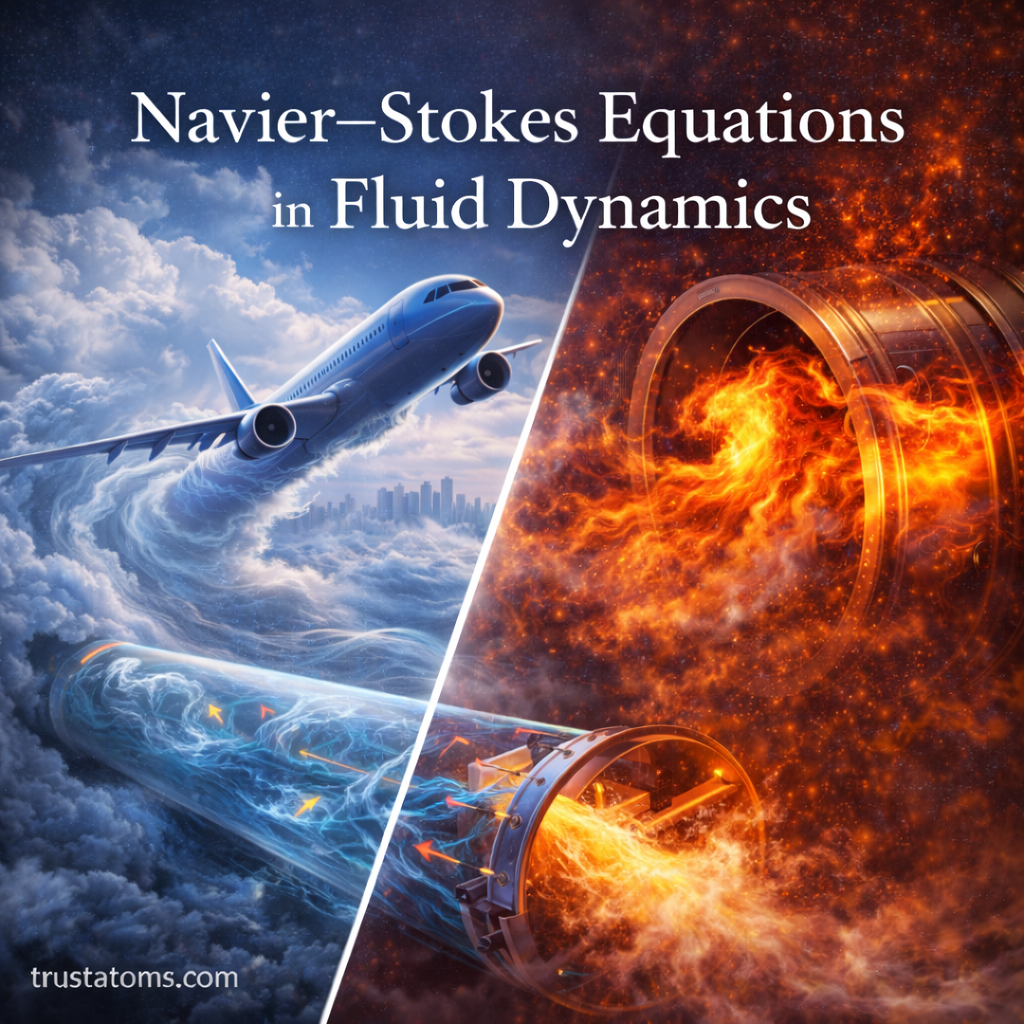
The Navier–Stokes equations are the fundamental mathematical framework used to describe fluid motion. From the airflow over an airplane wing to the circulation of oceans and the flow of blood through arteries, these equations govern how fluids move.
Despite being written down in the 19th century, the Navier–Stokes equations remain at the heart of modern physics, engineering, and applied mathematics. They are powerful, predictive — and notoriously difficult to solve.
In this guide, we’ll explore what the Navier–Stokes equations describe, why they matter, and why they remain one of the most challenging problems in science.
What Are the Navier–Stokes Equations?
The Navier–Stokes equations describe how velocity, pressure, density, and viscosity interact in a moving fluid.
They are built from three core physical principles:
- Conservation of mass
- Conservation of momentum
- Newton’s second law applied to fluid motion
In simple terms, the equations state:
The change in momentum of a fluid equals the forces acting on it.
These forces include:
- Pressure forces
- Viscous (frictional) forces
- External forces such as gravity
Key Physical Quantities in Fluid Motion
To understand Navier–Stokes, it helps to know the main variables involved.
Velocity Field
Instead of tracking individual particles, fluid dynamics describes a velocity field:
- Every point in space has a velocity
- Velocity can change over time
- Motion can be smooth or chaotic
Pressure
Pressure represents internal forces exerted by the fluid.
Pressure differences drive flow.
For example:
- High pressure pushes fluid toward low pressure
- Wind is driven by atmospheric pressure differences
Viscosity
Viscosity measures internal friction within a fluid.
High viscosity:
- Honey
- Oil
Low viscosity:
- Air
- Water
Viscosity resists motion and smooths velocity differences.
Conservation of Mass: The Continuity Equation
Before considering momentum, fluids must obey conservation of mass.
For incompressible fluids:
- Density remains constant
- The flow entering a region equals the flow leaving it
This principle ensures that matter is neither created nor destroyed in the fluid system.
Conservation of Momentum
The Navier–Stokes equations apply Newton’s second law to a fluid element:
Force = mass × acceleration
In fluids, acceleration has two components:
- Local acceleration (change over time)
- Convective acceleration (change due to motion through space)
This makes the equations nonlinear — a key reason they are difficult to solve.
Why the Navier–Stokes Equations Are Nonlinear
Nonlinearity arises because:
- The velocity field interacts with itself
- Fluid motion affects future fluid motion
This self-interaction leads to:
- Instabilities
- Vortex formation
- Turbulence
Small changes in initial conditions can produce dramatically different outcomes.
This sensitivity is why turbulent flows are so complex.
Special Cases and Simplifications
Because the full Navier–Stokes equations are difficult to solve, physicists often simplify them.
Common simplifications include:
1. Incompressible Flow
Assumes constant density.
Valid for:
- Water
- Low-speed air
2. Laminar Flow
Assumes smooth, orderly motion.
Occurs at:
- Low Reynolds numbers
- Slow velocities
3. Steady Flow
Assumes:
- No time dependence
- Conditions do not change over time
These simplifications make the equations more manageable.
The Reynolds Number and Flow Regimes
The Reynolds number determines whether flow is laminar or turbulent.
It compares:
- Inertial forces
- Viscous forces
Low Reynolds number:
- Viscosity dominates
- Smooth flow
High Reynolds number:
- Inertia dominates
- Turbulence likely
This single dimensionless number helps predict fluid behavior in many systems.
Real-World Applications of Navier–Stokes

The Navier–Stokes equations are used in nearly every field involving fluids.
Aerospace Engineering
- Designing aircraft wings
- Modeling jet engines
- Predicting drag and lift
Weather and Climate Science
- Simulating atmospheric circulation
- Modeling hurricanes
- Studying ocean currents
Biomedical Engineering
- Blood flow in arteries
- Respiratory airflow
- Drug delivery systems
Industrial Design
- Pipeline flow
- Chemical reactors
- Ventilation systems
Without Navier–Stokes, modern engineering would not exist.
Turbulence and the Millennium Prize Problem
One of the most famous unsolved problems in mathematics concerns the Navier–Stokes equations.
The challenge is to prove whether smooth, well-behaved solutions always exist in three dimensions.
This problem is one of the Clay Mathematics Institute’s Millennium Prize Problems, with a one-million-dollar reward.
The difficulty lies in:
- Nonlinearity
- Multiscale interactions
- Possible singularities
Despite centuries of progress, the question remains open.
Numerical Solutions and Computational Fluid Dynamics
Because analytical solutions are rare, scientists rely on computational methods.
Computational Fluid Dynamics (CFD) involves:
- Discretizing the equations
- Dividing space into small grid elements
- Solving numerically
CFD allows engineers to simulate:
- Airflow over vehicles
- Heat transfer
- Turbulent mixing
Modern supercomputers perform billions of calculations per second to approximate fluid motion.
Why Navier–Stokes Matters
The importance of Navier–Stokes goes beyond engineering.
It demonstrates a powerful truth:
Simple physical laws can produce extraordinarily complex behavior.
From smoke rising from a candle to galaxy-scale gas motion, the same equations apply.
They connect:
- Mathematics
- Physics
- Engineering
- Natural phenomena
Few equations in science are as universal.
Key Takeaways
The Navier–Stokes equations describe how fluids move by combining:
- Conservation of mass
- Conservation of momentum
- Effects of pressure and viscosity
They:
- Govern laminar and turbulent flow
- Apply to air, water, blood, and plasma
- Are nonlinear and mathematically challenging
Although written in compact mathematical form, they encode the dynamics of oceans, atmospheres, and industrial systems alike.
Understanding Navier–Stokes is essential to understanding fluid dynamics — and one of the deepest open questions in classical physics.