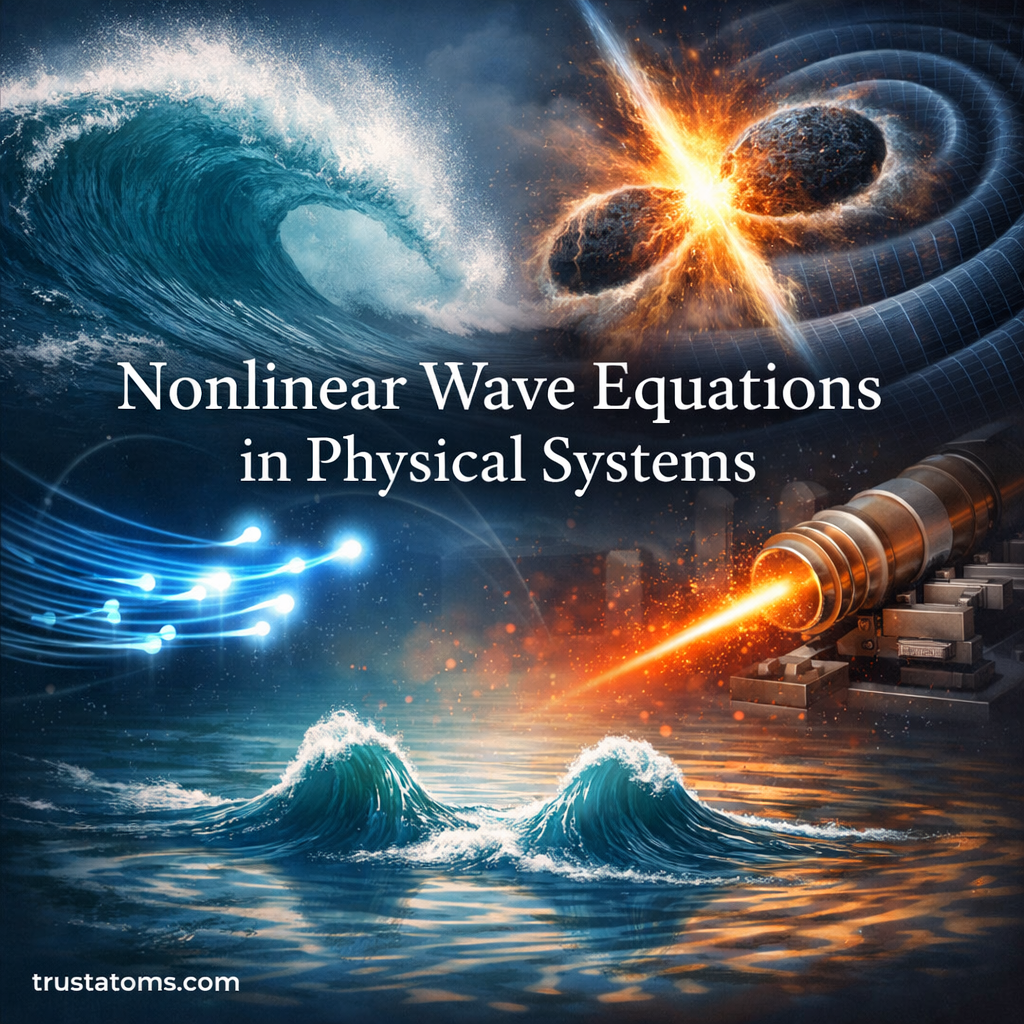
Waves are everywhere — from ocean swells and sound vibrations to light pulses in fiber optics and shock waves in space. While many wave phenomena can be described using simple linear equations, the real world is rarely that neat.
In many physical systems, waves interact with themselves, distort, steepen, and even form stable localized structures. These behaviors are governed by nonlinear wave equations — mathematical models that describe how waves evolve when their amplitude affects their speed, shape, or interaction with other waves.
Understanding nonlinear wave equations is essential in modern physics, engineering, and applied mathematics.
What Makes a Wave Equation Nonlinear?
A wave equation becomes nonlinear when the wave’s amplitude influences its propagation.
In a linear system:
- Waves pass through each other unchanged.
- Amplitude does not affect speed.
- Superposition applies (waves simply add together).
In a nonlinear system:
- Large waves can travel faster or slower than small waves.
- Waves can interact and permanently alter each other.
- Energy can concentrate into localized structures.
This amplitude-dependent behavior leads to rich and sometimes surprising physical effects.
Why Nonlinearity Appears in Nature
Nonlinear wave behavior typically emerges when:
- The wave amplitude is large.
- The medium has nonlinear material properties.
- Wave interactions become strong.
- Energy transport is intense or localized.
Examples include:
- Breaking ocean waves
- Shock waves in air
- Plasma oscillations
- Optical pulses in nonlinear crystals
- Gravitational waves interacting with curved spacetime
Linear approximations often work for small disturbances — but once the system is pushed beyond gentle oscillations, nonlinearity becomes unavoidable.
Classic Nonlinear Wave Equations
Several fundamental nonlinear wave equations appear across physics. Each models a specific type of nonlinear behavior.
1. The Korteweg–de Vries (KdV) Equation
The KdV equation describes shallow water waves and certain plasma waves. It is famous for predicting solitons — stable wave pulses that maintain their shape while traveling long distances.
Key features:
- Balances nonlinearity and dispersion
- Supports solitary wave solutions
- Explains long-lived ocean surface waves
This equation was historically important in understanding how waves can behave like particles.
2. The Nonlinear Schrödinger Equation (NLS)
The nonlinear Schrödinger equation models:
- Light pulses in fiber optics
- Bose–Einstein condensates
- Plasma waves
Unlike the linear Schrödinger equation in quantum mechanics, this nonlinear version includes terms that depend on wave intensity.
It predicts:
- Self-focusing beams
- Optical solitons
- Wave collapse under certain conditions
Modern high-speed internet relies on principles described by this equation.
3. The Sine–Gordon Equation
The sine–Gordon equation appears in:
- Crystal dislocations
- Superconducting Josephson junctions
- Field theory models
It supports stable “kink” solutions — wave structures that behave like particles.
These solutions have applications in condensed matter physics and even theoretical cosmology.
4. Burgers’ Equation
Burgers’ equation is one of the simplest nonlinear wave equations. It models:
- Traffic flow
- Shock waves
- Turbulence approximations
It demonstrates how nonlinearity can lead to steepening and shock formation — even without complex physics.
Solitons: A Hallmark of Nonlinear Waves
One of the most fascinating outcomes of nonlinear wave equations is the soliton.
A soliton is:
- A self-reinforcing solitary wave
- Stable over long distances
- Able to survive collisions with other solitons
Unlike ordinary waves that disperse and fade, solitons behave almost like particles.
They have been observed in:
- Water canals
- Optical fibers
- Plasma systems
- Bose–Einstein condensates
Solitons highlight how nonlinearity can create order instead of chaos.
Shock Waves and Wave Steepening
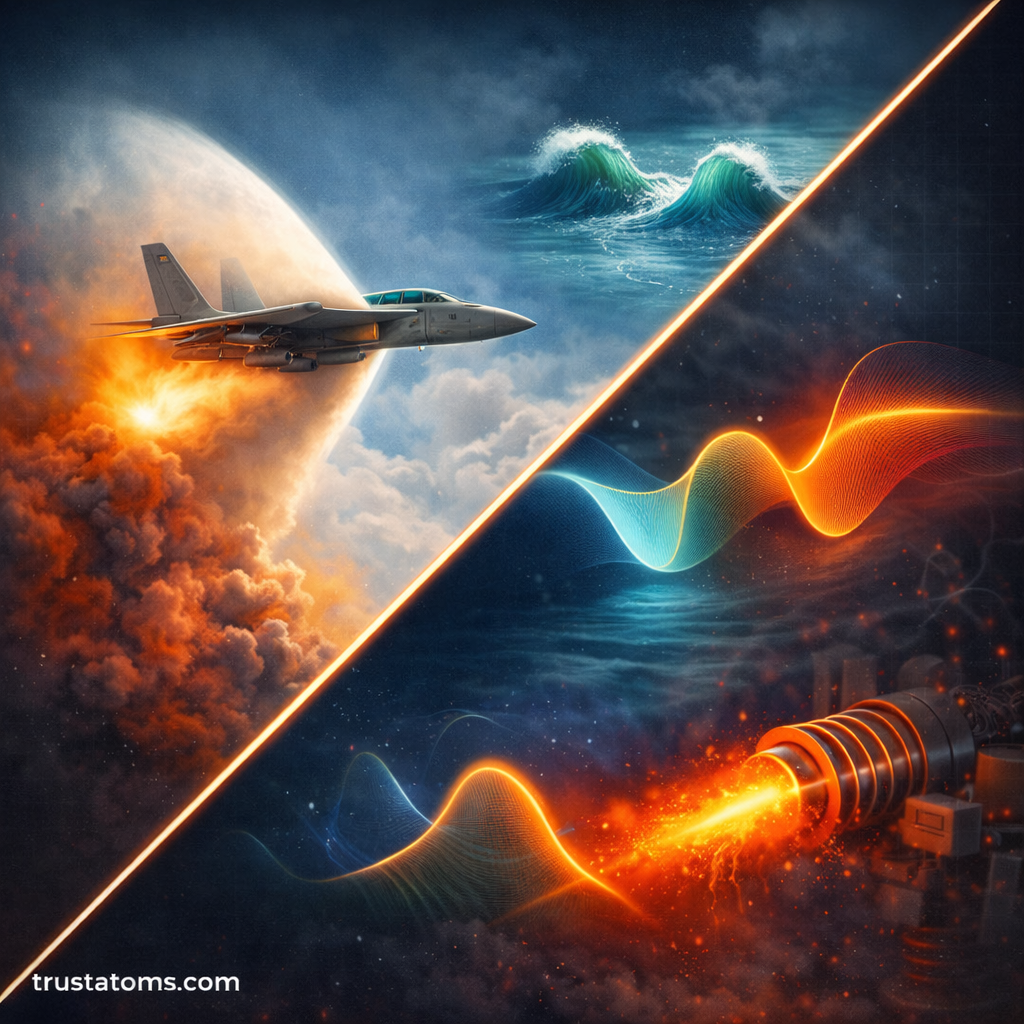
When nonlinearity dominates without sufficient dispersion, waves can steepen into shock fronts.
This occurs in:
- Supersonic flight
- Explosions
- Astrophysical jets
- Solar flares
In these cases:
- Wave speed increases with amplitude
- The wave front sharpens
- Discontinuities can form
Shock waves represent energy concentrated into extremely thin regions.
Nonlinear Waves in Modern Physics
Nonlinear wave equations are central to many active research areas.
Plasma Physics
Plasma oscillations in stars and fusion reactors are governed by nonlinear wave dynamics. These effects influence energy confinement and stability.
Optics and Photonics
High-intensity lasers produce nonlinear optical effects such as:
- Self-phase modulation
- Harmonic generation
- Optical solitons
These effects are critical in telecommunications and medical imaging.
Fluid Dynamics
Turbulence — one of physics’ hardest problems — involves nonlinear interactions between countless wave modes.
General Relativity
Einstein’s field equations are inherently nonlinear. This means gravitational waves can interact with spacetime in complex ways, especially in extreme environments like black hole mergers.
Mathematical Challenges of Nonlinear Equations
Unlike linear wave equations, nonlinear equations often:
- Cannot be solved exactly
- Exhibit chaotic behavior
- Require numerical simulations
- Produce unexpected instabilities
Physicists use tools such as:
- Perturbation theory
- Numerical solvers
- Stability analysis
- Conservation laws
Even small nonlinear terms can dramatically change system behavior.
Key Differences: Linear vs Nonlinear Waves
| Feature | Linear Waves | Nonlinear Waves |
|---|---|---|
| Superposition | Always valid | Often breaks down |
| Wave speed | Independent of amplitude | Depends on amplitude |
| Interactions | Pass through unchanged | Alter shape or speed |
| Solutions | Typically simple | Often complex or chaotic |
Nonlinear systems are typically harder to predict — but far more realistic.
Real-World Applications
Nonlinear wave equations are not just theoretical. They influence:
- Fiber optic communications
- Tsunami modeling
- Climate wave dynamics
- Shockwave medicine
- Earthquake wave propagation
- Astrophysical plasma behavior
Understanding them improves safety, efficiency, and technological performance.
Why Nonlinear Wave Theory Matters
Nature is fundamentally nonlinear. While linear approximations help us get started, they cannot fully capture:
- Extreme events
- Energy concentration
- Instabilities
- Emergent structures
Nonlinear wave equations provide the mathematical framework needed to understand how real systems behave under stress, intensity, and interaction.
From ocean waves to laser pulses to gravitational ripples in spacetime, nonlinear wave dynamics shape the universe at every scale.
As computing power increases and mathematical tools improve, our ability to analyze nonlinear wave systems continues to expand — unlocking deeper insights into the physics of complexity.
Final Thoughts
Nonlinear wave equations represent one of the most powerful and challenging areas of physics.
They explain:
- How waves steepen into shocks
- How stable solitons form
- How turbulence emerges
- How energy concentrates in extreme systems
In short, they describe how waves behave when reality refuses to stay simple.
For anyone studying advanced physics, engineering, or applied mathematics, mastering nonlinear wave dynamics opens the door to understanding some of the most fascinating and practical phenomena in the natural world.