Energy powers everything — from moving cars to shining stars. But one of the most important principles in physics tells us something surprising:
Energy cannot be created or destroyed.
This idea is known as the Law of Conservation of Energy. It is one of the most fundamental laws in science and applies to every physical system.
In this guide, you’ll learn:
- What the law states
- How it works mathematically
- Real-world examples
- How it connects to kinetic and potential energy
- Why it matters in physics and engineering
What Is the Law of Conservation of Energy?
The Law of Conservation of Energy states:
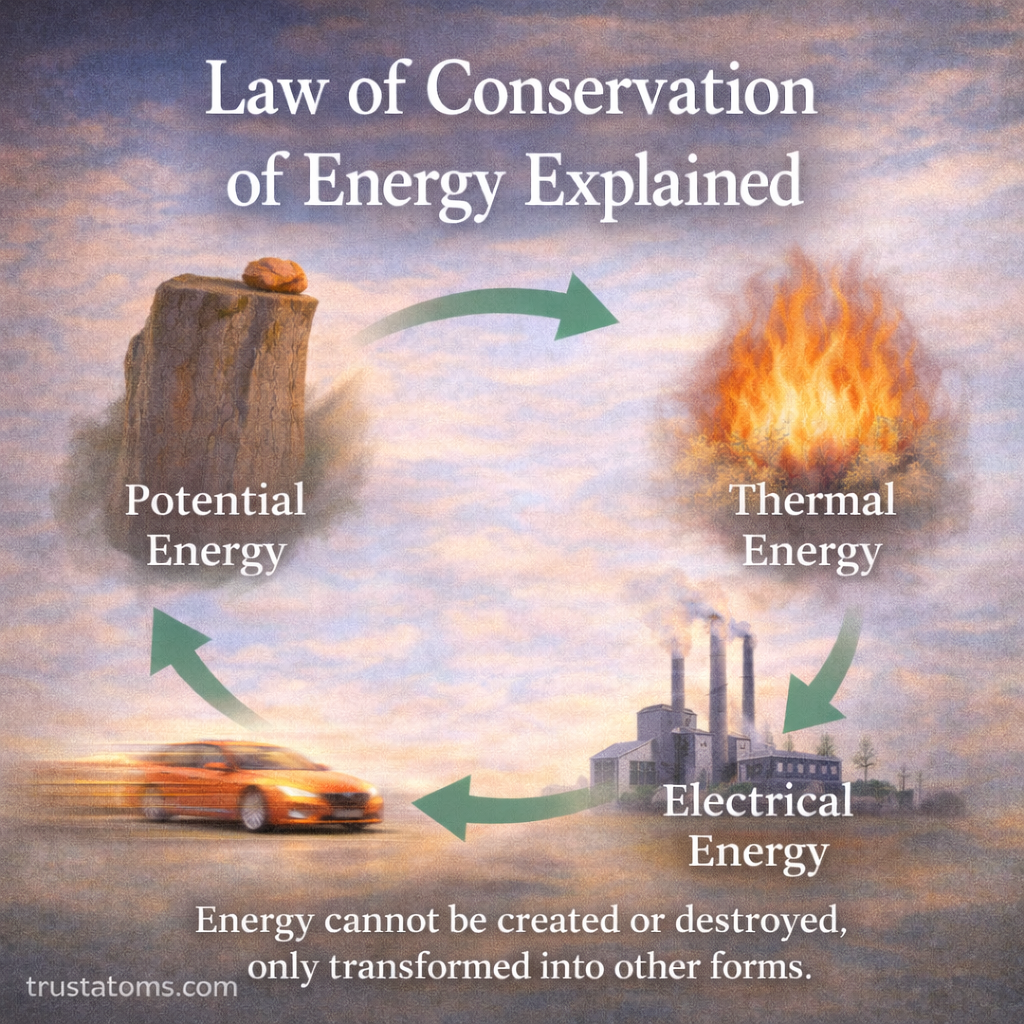
Energy cannot be created or destroyed — only transformed from one form to another.
In a closed system:
Total Energy Before = Total Energy After
Even though energy may change forms (for example, from potential to kinetic), the total amount remains constant.
What Is a Closed System?
A closed system is one where:
- No energy enters
- No energy leaves
Inside that system, energy may shift between forms, but the total stays the same.
In real life, perfectly closed systems are rare due to friction and heat loss, but the law still applies when accounting for all energy forms.
Mathematical Expression of Energy Conservation
In many mechanical systems:
Total Energy = Potential Energy + Kinetic Energy
E = PE + KE
If no energy is lost:
Initial Energy = Final Energy
For example:
mgh + ½mv² = constant
As potential energy decreases, kinetic energy increases — but their sum remains the same.
Example 1: Falling Object
Imagine a ball held at a height of 10 meters.
At the top:
- High potential energy
- Zero kinetic energy
As it falls:
- Potential energy decreases
- Kinetic energy increases
Just before hitting the ground:
- Near zero potential energy
- Maximum kinetic energy
The total energy remains constant (ignoring air resistance).
Example 2: Roller Coaster
At the highest point:
- Maximum gravitational potential energy
- Minimal kinetic energy
As it descends:
- Potential energy converts into kinetic energy
At the lowest point:
- Maximum kinetic energy
- Minimal potential energy
The total mechanical energy stays the same (if friction is negligible).
Example 3: Pendulum
A swinging pendulum constantly exchanges energy:
- At the highest point:
- Maximum potential energy
- Zero kinetic energy
- At the lowest point:
- Maximum kinetic energy
- Minimum potential energy
Energy shifts back and forth, but the total remains constant.
What About Friction and Heat?
In real-world systems, energy appears to “disappear” due to:
- Friction
- Air resistance
- Sound
- Heat
However, energy is not destroyed — it is converted into other forms, like thermal energy.
If we account for all forms of energy:
Total energy still remains conserved.
Forms of Energy That Can Transform
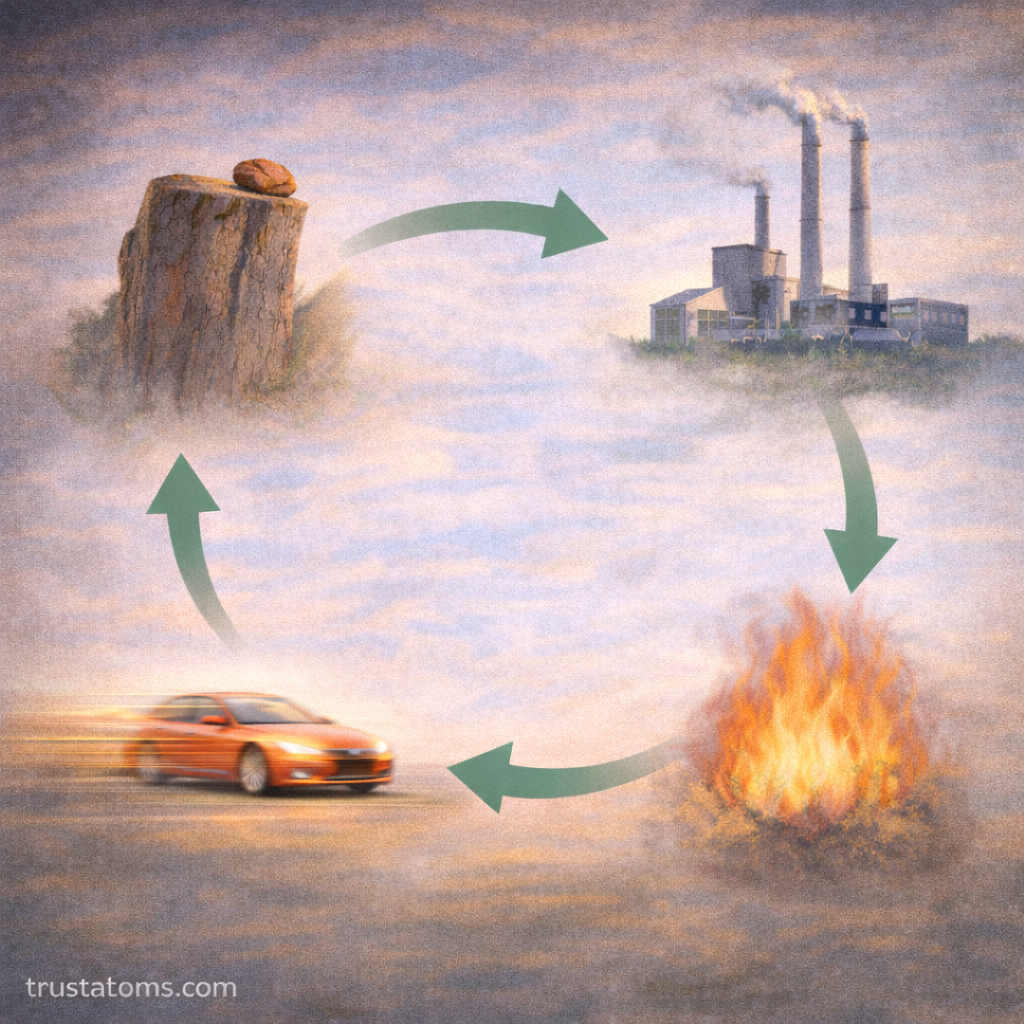
Energy can change between many forms:
- Kinetic energy
- Potential energy
- Thermal energy
- Chemical energy
- Electrical energy
- Nuclear energy
For example:
Chemical energy in gasoline → kinetic energy in a car → thermal energy from friction.
Why the Law of Conservation of Energy Is Important
This law is essential in:
- Engineering design
- Renewable energy systems
- Mechanical analysis
- Space exploration
- Thermodynamics
It allows scientists and engineers to predict how systems behave.
Without this principle, modern physics would not function.
Connection to the First Law of Thermodynamics
The First Law of Thermodynamics is essentially the conservation of energy applied to heat and work.
It states:
The change in internal energy of a system equals heat added minus work done.
This reinforces the same core idea:
Energy is conserved.
Common Misunderstandings
Here are a few misconceptions:
- Energy can “run out” — False. It only changes form.
- Moving objects create energy — False. Energy is transformed, not created.
- Friction destroys energy — False. It converts mechanical energy into heat.
Understanding these clarifies how the law truly works.
Key Takeaways
- Energy cannot be created or destroyed.
- It can only transform between forms.
- In a closed system, total energy remains constant.
- Potential and kinetic energy constantly exchange.
- The law applies to all areas of physics.
The Law of Conservation of Energy is one of the pillars of science. Whether analyzing a falling object, a power plant, or planetary motion, this principle ensures that energy always balances.
It’s not just a theory — it’s a universal rule governing the physical universe.