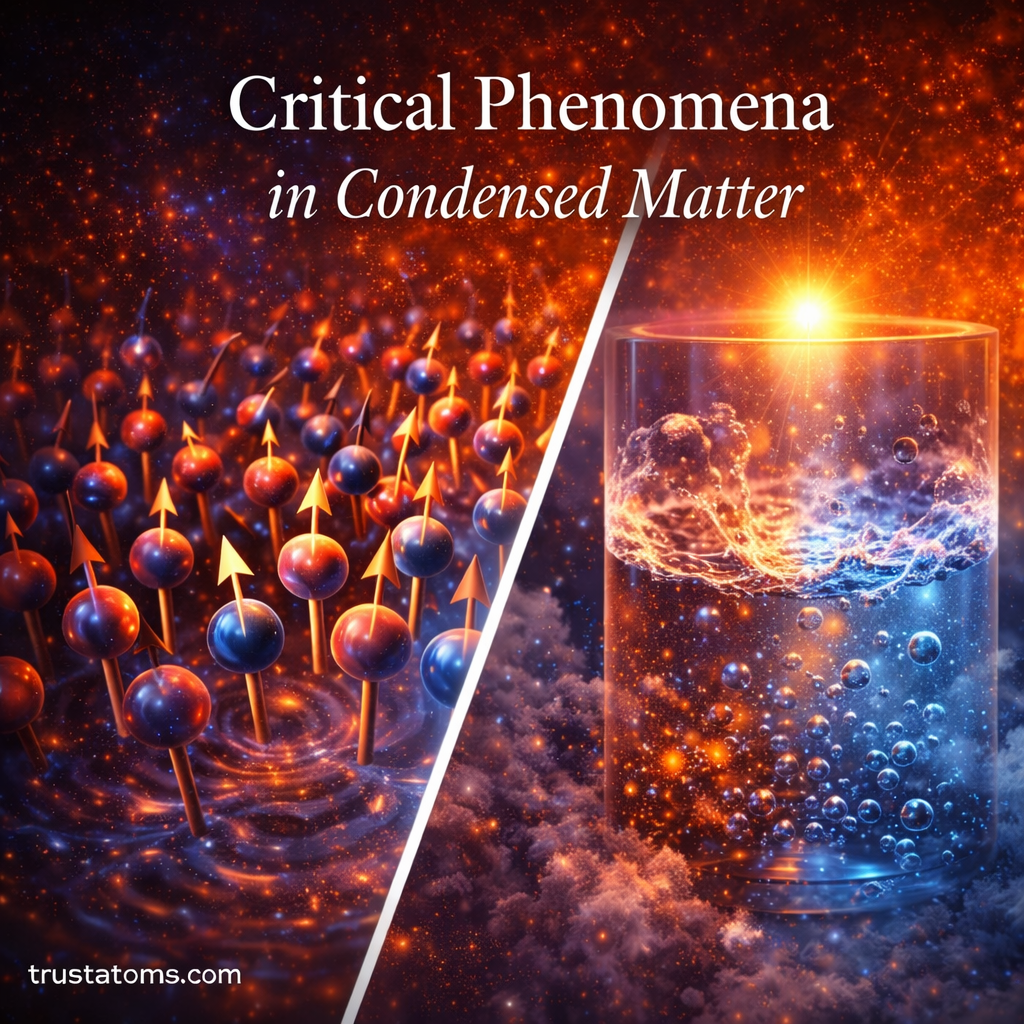
When matter approaches a phase transition, something remarkable happens. Physical properties begin to fluctuate wildly, correlations extend across large distances, and small disturbances can have system-wide effects.
These dramatic behaviors are known as critical phenomena.
From magnets losing their magnetization to fluids at the brink of boiling, critical phenomena in condensed matter physics reveal deep principles about collective behavior, universality, and scaling. Surprisingly, very different materials can behave in almost identical ways near their critical points.
In this guide, we’ll explore what critical phenomena are, why they occur, and why they matter far beyond traditional materials science.
What Is a Critical Point?
A critical point is a special condition during a continuous (second-order) phase transition where:
- Two phases become indistinguishable
- The order parameter changes continuously
- Fluctuations occur on all length scales
At the critical point:
- The system has no characteristic size scale
- Correlations extend infinitely (in theory)
- Small changes can produce large effects
Classic examples include:
- A ferromagnet at its Curie temperature
- A liquid–gas system at its critical temperature
- Superconductors at their transition temperature
The behavior near these points defines critical phenomena.
What Makes Critical Behavior Unique?
As a system approaches its critical temperature:
- Fluctuations grow larger
- Regions of correlated particles expand
- Physical properties follow power-law behavior
Unlike first-order transitions (like melting ice), critical transitions occur smoothly — but with dramatic internal restructuring.
Several physical quantities begin to diverge or vanish in characteristic ways:
- Heat capacity may spike
- Magnetic susceptibility may diverge
- Correlation length increases dramatically
This structured, predictable behavior is what physicists call critical phenomena.
Correlation Length and Fluctuations
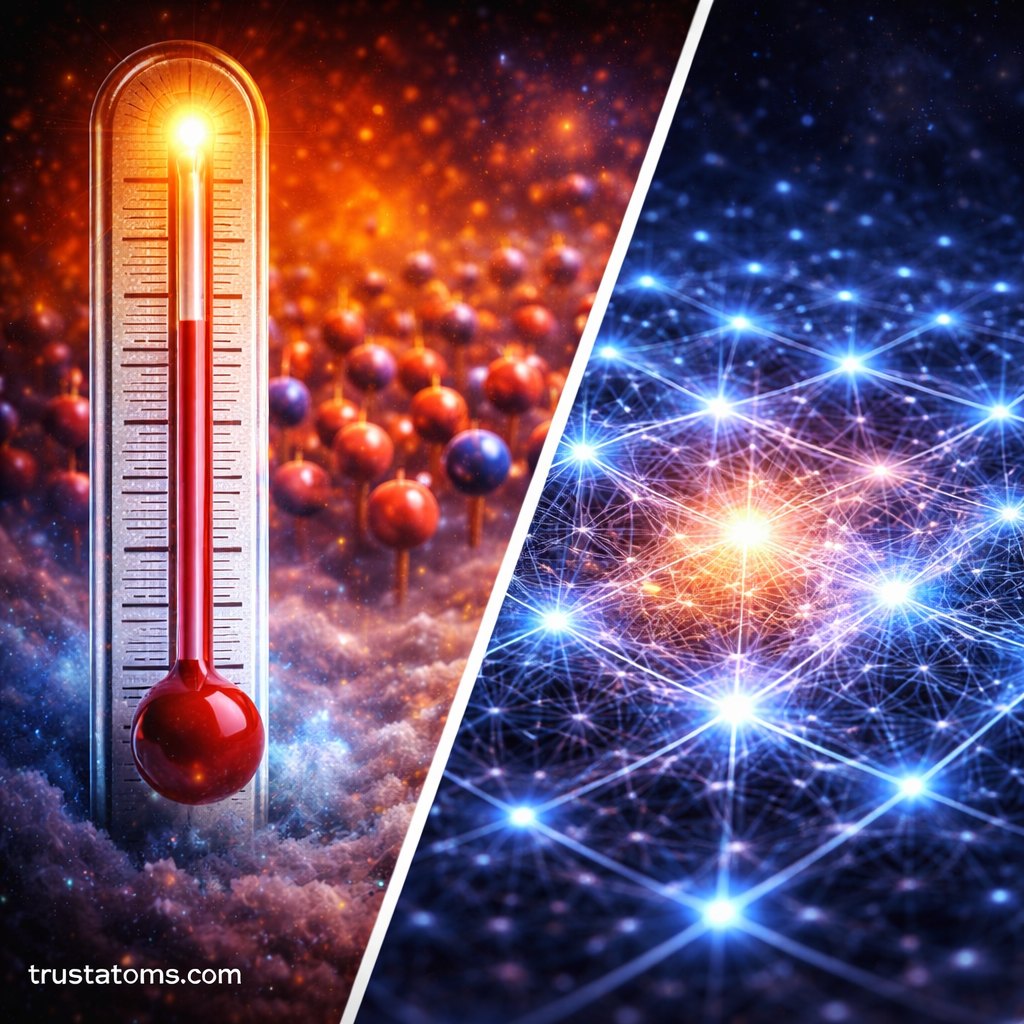
One of the most important ideas in critical phenomena is correlation length.
Correlation length measures:
How far the behavior of one particle influences another.
Far from a phase transition:
- Correlation length is small
- Only nearby particles influence each other
Near the critical point:
- Correlation length grows
- Large regions fluctuate together
- The system behaves collectively
In theory, at the exact critical point, the correlation length becomes infinite.
This scale-free behavior is central to critical phenomena.
Order Parameters and Scaling
An order parameter describes the degree of order in a system.
Examples:
- Magnetization in a ferromagnet
- Density difference in liquid–gas transitions
- Superconducting electron pair density
Near the critical point, the order parameter follows a scaling law:
It changes according to a power law as temperature approaches the critical value.
This predictable scaling is described using critical exponents.
Critical Exponents
Critical exponents are numbers that describe how physical quantities behave near the critical point.
For example:
- How heat capacity diverges
- How correlation length increases
- How magnetization approaches zero
Remarkably:
Different materials often share the same critical exponents.
This surprising result leads to one of the most important ideas in physics — universality.
Universality: Different Systems, Same Behavior
Universality means:
Systems with completely different microscopic structures can behave identically near a critical point.
For example:
- A magnet
- A fluid
- A binary alloy
May share identical scaling laws near their transitions.
What determines universality is not the detailed atomic structure, but:
- Dimensionality (2D vs 3D)
- Symmetry of the order parameter
- Nature of interactions
This reveals that critical phenomena are governed by deep, underlying principles.
Renormalization Group Theory
To explain universality, physicists developed renormalization group (RG) theory.
The core idea:
As you zoom out to larger and larger length scales, the system’s behavior simplifies.
Details at small scales become less important.
Near the critical point:
- The system looks similar at different scales
- It exhibits scale invariance
- Mathematical transformations reveal fixed points
Renormalization group theory explains why vastly different materials can share identical critical behavior.
It is one of the most powerful tools in theoretical physics.
Real-World Examples of Critical Phenomena
Critical phenomena appear in many condensed matter systems:
1. Ferromagnetic Transition
At the Curie temperature:
- Magnetization smoothly goes to zero
- Susceptibility diverges
- Correlation length grows
2. Liquid–Gas Critical Point
At the critical temperature:
- Liquid and gas phases merge
- Density difference disappears
- Large density fluctuations appear
3. Superconducting Transition
At the critical temperature:
- Electrical resistance drops to zero
- Cooper pairs form
- Long-range quantum coherence emerges
In each case, the system undergoes collective reorganization.
Scale Invariance and Fractals
Near critical points, systems often display scale invariance.
This means:
The system looks statistically similar at different magnifications.
Such behavior resembles fractals — structures that repeat patterns at multiple scales.
Scale invariance is why power laws appear in critical phenomena.
There is no single characteristic size governing behavior.
Why Critical Phenomena Matter
Critical phenomena are important because they:
- Reveal universal laws of collective behavior
- Connect condensed matter physics to quantum field theory
- Inform our understanding of phase transitions in the early universe
- Guide material design and engineering
They also influence practical applications, including:
- Magnetic storage materials
- Superconducting technologies
- Liquid mixture processing
Beyond materials science, similar scaling behaviors appear in:
- Neural networks
- Financial systems
- Epidemics
This suggests critical phenomena describe a broader class of complex systems.
The Big Picture
Critical phenomena in condensed matter physics show how collective behavior emerges when systems approach phase transitions.
As temperature or pressure changes:
- Fluctuations grow
- Correlations expand
- Scale invariance appears
- Universality dominates
Near critical points, matter behaves in ways that transcend its microscopic details.
By studying critical phenomena, physicists uncover principles that apply across materials, scales, and even disciplines.
What looks like chaotic fluctuation is, in fact, governed by elegant and universal laws.
Key Takeaways
- Critical phenomena occur near continuous phase transitions.
- Correlation length grows dramatically near the critical point.
- Physical quantities follow power-law scaling.
- Critical exponents define system behavior.
- Universality means different systems share identical critical behavior.
- Renormalization group theory explains scale invariance.
Critical phenomena remind us that complexity often arises from simple, universal rules operating at the edge of transformation.