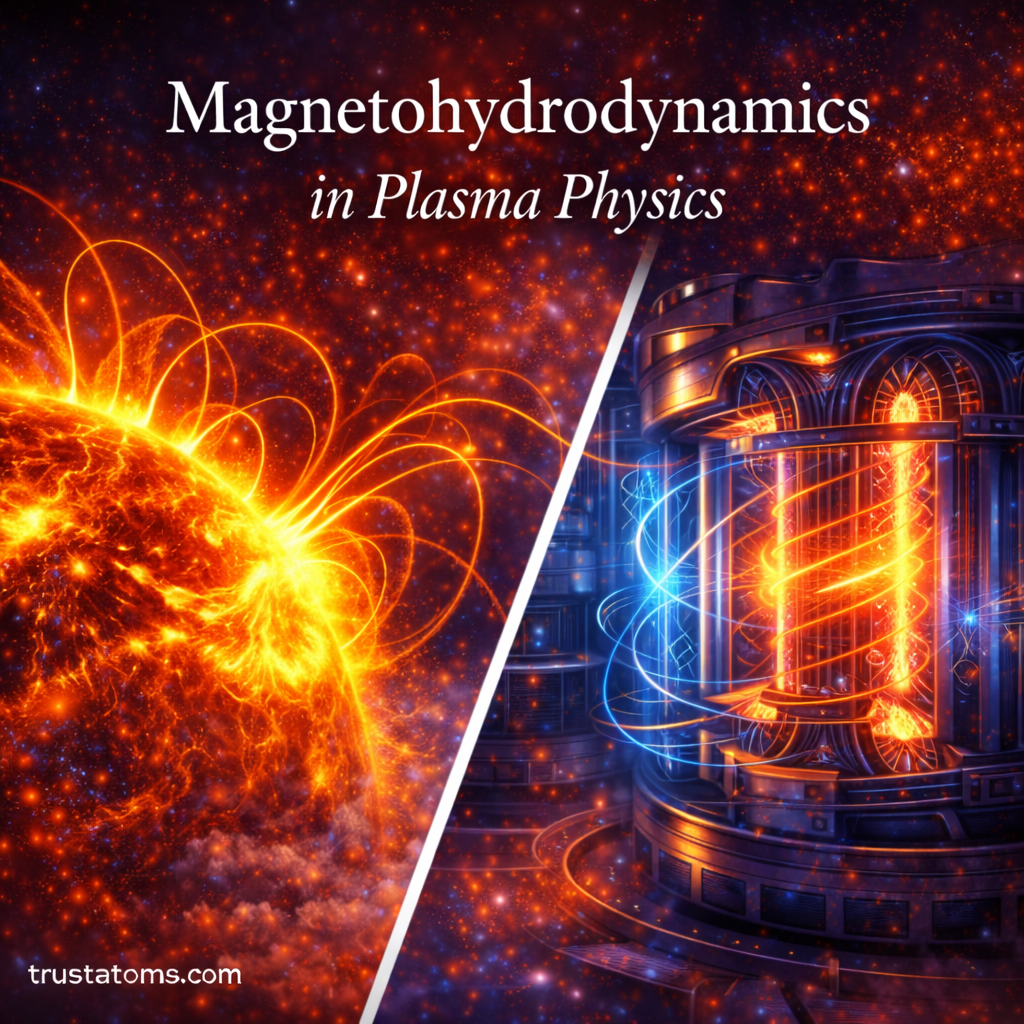
Magnetohydrodynamics (MHD) is the study of how electrically conducting fluids behave in the presence of magnetic fields. In plasma physics, this framework becomes especially powerful because plasma — often called the fourth state of matter — responds strongly to electromagnetic forces.
From the Sun’s solar flares to fusion reactors on Earth, magnetohydrodynamics helps scientists understand how plasma flows, twists, and sometimes becomes unstable.
In this guide, we’ll explore what magnetohydrodynamics is, how it applies to plasma physics, and why it plays a central role in astrophysics and energy research.
What Is Magnetohydrodynamics?
Magnetohydrodynamics combines two major areas of physics:
- Fluid dynamics (the study of flowing liquids and gases)
- Electromagnetism (the study of electric and magnetic fields)
MHD treats plasma as a conducting fluid influenced by magnetic and electric fields.
In simple terms:
It studies how magnetic fields interact with moving charged particles in a fluid-like system.
What Is Plasma?
Plasma is an ionized gas made of:
- Free electrons
- Positively charged ions
- Neutral particles (in some cases)
Unlike ordinary gases, plasma conducts electricity and responds strongly to magnetic fields.
Plasma is found in:
- The Sun and stars
- Lightning
- Neon signs
- Fusion experiments
- Interstellar space
Because plasma contains charged particles, magnetic forces strongly influence its motion.
Why Magnetic Fields Matter in Plasma
In neutral fluids like water, motion is governed mainly by pressure and viscosity.
In plasma, additional forces appear:
- Magnetic forces
- Electric forces
- Lorentz forces (acting on moving charges)
When plasma moves through a magnetic field:
- Currents are generated
- Magnetic fields are modified
- Feedback between motion and fields occurs
This coupling between fluid motion and magnetism is the core of magnetohydrodynamics.
The Basic Idea of MHD
Magnetohydrodynamics assumes plasma behaves like a continuous fluid rather than tracking individual particles.
It combines:
- Fluid motion equations
- Maxwell’s equations of electromagnetism
- Electrical conductivity properties
The result is a unified description of how:
- Magnetic fields evolve
- Plasma flows develop
- Instabilities form
Although simplified, MHD successfully describes many large-scale plasma behaviors.
Frozen-In Magnetic Fields
One of the most important ideas in ideal MHD is the “frozen-in” condition.
When plasma has very high conductivity:
- Magnetic field lines move with the plasma
- The field is effectively carried along by fluid motion
This means:
- Twisting plasma twists magnetic fields
- Stretching plasma stretches magnetic fields
- Reconnection events can release huge energy
This concept helps explain solar flares and magnetic storms.
Magnetic Pressure and Tension
Magnetic fields in plasma behave somewhat like elastic bands.
They exert:
- Magnetic pressure (pushing outward)
- Magnetic tension (pulling along field lines)
These forces influence plasma stability.
For example:
- Strong magnetic pressure can confine plasma
- Magnetic tension can stabilize certain disturbances
- Competing forces can cause instability
Understanding these effects is critical in fusion research.
MHD Waves
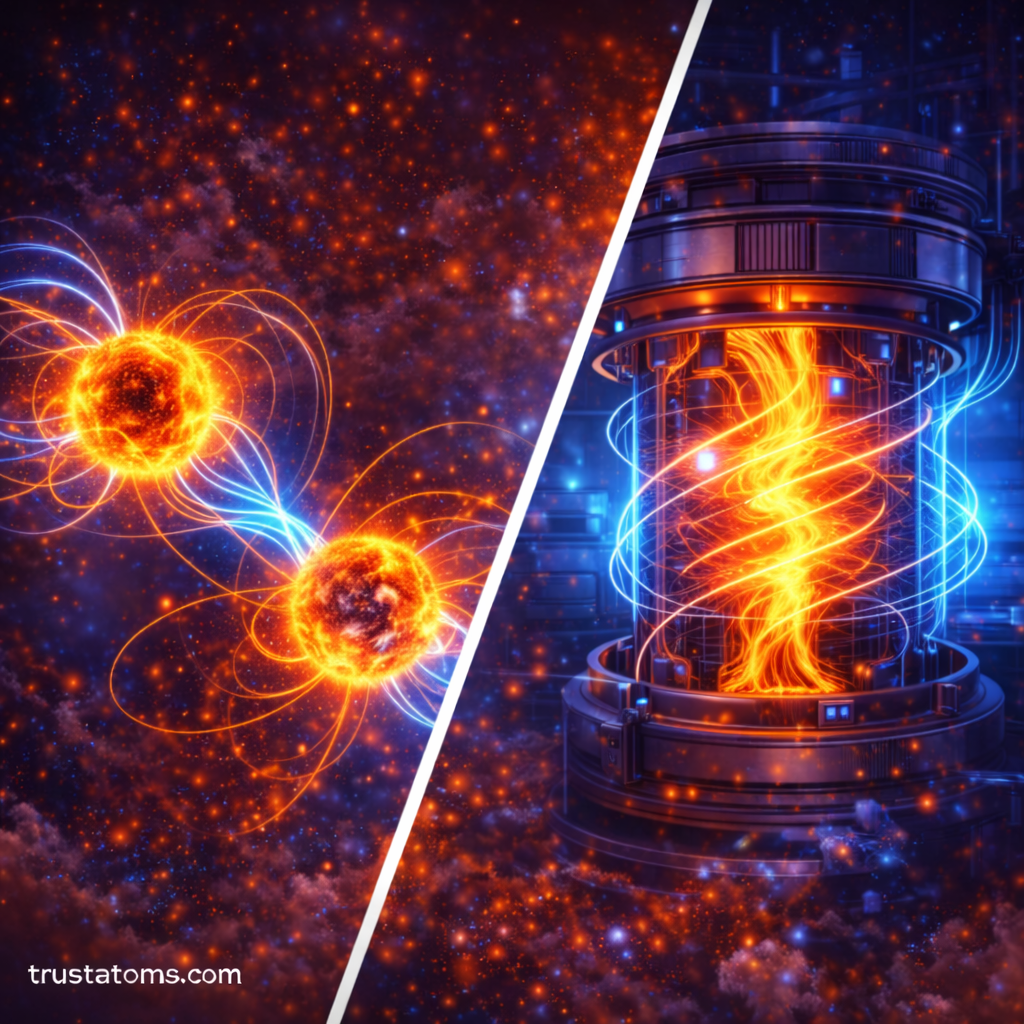
Magnetohydrodynamics predicts special types of waves in plasma.
Unlike ordinary sound waves, plasma supports:
- Alfvén waves
- Magnetosonic waves
- Slow and fast MHD modes
These waves propagate along magnetic field lines.
They are important in:
- Solar wind dynamics
- Space weather
- Astrophysical jets
MHD waves transport energy across vast cosmic distances.
Instabilities in Plasma
Plasma is often unstable under certain conditions.
Common MHD instabilities include:
1. Kink Instability
Occurs when magnetic field lines twist too much.
2. Rayleigh–Taylor Instability
Occurs when heavier plasma sits above lighter plasma in a gravitational field.
3. Tearing Mode Instability
Leads to magnetic reconnection, where magnetic field lines break and reconnect.
Instabilities can:
- Trigger solar eruptions
- Disrupt fusion devices
- Release enormous amounts of energy
Studying MHD instabilities helps scientists predict and control plasma behavior.
Magnetohydrodynamics in Fusion Research
One of the main goals of plasma physics is controlled nuclear fusion.
In fusion devices like tokamaks:
- Plasma must be confined
- Temperatures reach millions of degrees
- Magnetic fields contain the plasma
MHD theory helps researchers:
- Predict plasma stability
- Avoid disruptive instabilities
- Optimize magnetic confinement
Without magnetohydrodynamics, fusion reactor design would be impossible.
MHD in Astrophysics
Magnetohydrodynamics is also essential in astrophysics.
It explains phenomena such as:
- Sunspots
- Solar flares
- Accretion disks around black holes
- Stellar winds
- Galactic magnetic fields
Large-scale cosmic plasma behaves like a conducting fluid shaped by magnetic forces.
MHD provides the bridge between microscopic particle motion and macroscopic astrophysical structures.
Limitations of MHD
Although powerful, magnetohydrodynamics has limitations.
It assumes:
- Plasma behaves like a fluid
- Particle-level effects can be averaged
- Collisions are frequent enough for fluid behavior
In very low-density plasmas or small-scale systems, more detailed kinetic models are required.
Still, MHD remains extremely useful for large-scale plasma phenomena.
Why Magnetohydrodynamics Matters
Magnetohydrodynamics connects multiple areas of physics:
- Electromagnetism
- Fluid dynamics
- Thermodynamics
- Astrophysics
- Nuclear fusion research
It explains how magnetic fields:
- Shape stars
- Drive space weather
- Confine fusion plasma
- Generate cosmic jets
Few theories unify so many physical systems.
The Big Picture
Magnetohydrodynamics in plasma physics shows how electricity, magnetism, and fluid motion merge into a single dynamic system.
When plasma moves, magnetic fields respond.
When magnetic fields shift, plasma moves.
This feedback loop governs:
- Solar activity
- Magnetic storms
- Fusion confinement
- Cosmic plasma structures
MHD reminds us that plasma is not just a hot gas — it is a dynamic, magnetically structured medium shaping much of the visible universe.
Key Takeaways
- Magnetohydrodynamics studies conducting fluids in magnetic fields.
- Plasma is a highly conductive state of matter.
- Magnetic fields can be “frozen” into plasma motion.
- MHD waves transport energy in space plasmas.
- Instabilities can release vast amounts of energy.
- MHD is essential for fusion research and astrophysics.
Understanding magnetohydrodynamics helps us decode the behavior of stars, fusion reactors, and cosmic plasma across the universe.