Perturbation theory is one of the most important approximation tools in quantum physics. It allows physicists to solve complex quantum systems by starting with a simple, solvable model and then gradually adding small corrections.
In reality, most quantum systems cannot be solved exactly. Atoms in external fields, interacting particles, and complex molecules all involve mathematical equations that are too difficult to handle directly. Perturbation theory provides a practical and elegant way to get accurate predictions without solving everything from scratch.
In this guide, we’ll explore how perturbation theory works, why it matters in quantum mechanics, and where it is used in modern physics.
Why Exact Solutions Are Rare in Quantum Mechanics
Quantum systems are described by the Schrödinger equation. While the equation itself looks simple, solving it becomes extremely difficult when:
- Multiple particles interact
- External fields are present
- Potentials are complicated
- Energy levels shift due to interactions
Exact solutions exist for only a few ideal systems, such as:
- The hydrogen atom
- The particle in a box
- The quantum harmonic oscillator
Real-world systems are rarely this simple. That’s where perturbation theory becomes essential.
The Core Idea of Perturbation Theory
Perturbation theory works by breaking a complicated system into two parts:
- A solvable “base” system
- A small additional interaction (the perturbation)
Instead of solving the full complicated system directly, we:
- Solve the simple system first
- Treat the extra interaction as a small correction
- Calculate how energy levels and wave functions shift
This works well when the added interaction is weak compared to the original system.
Time-Independent Perturbation Theory
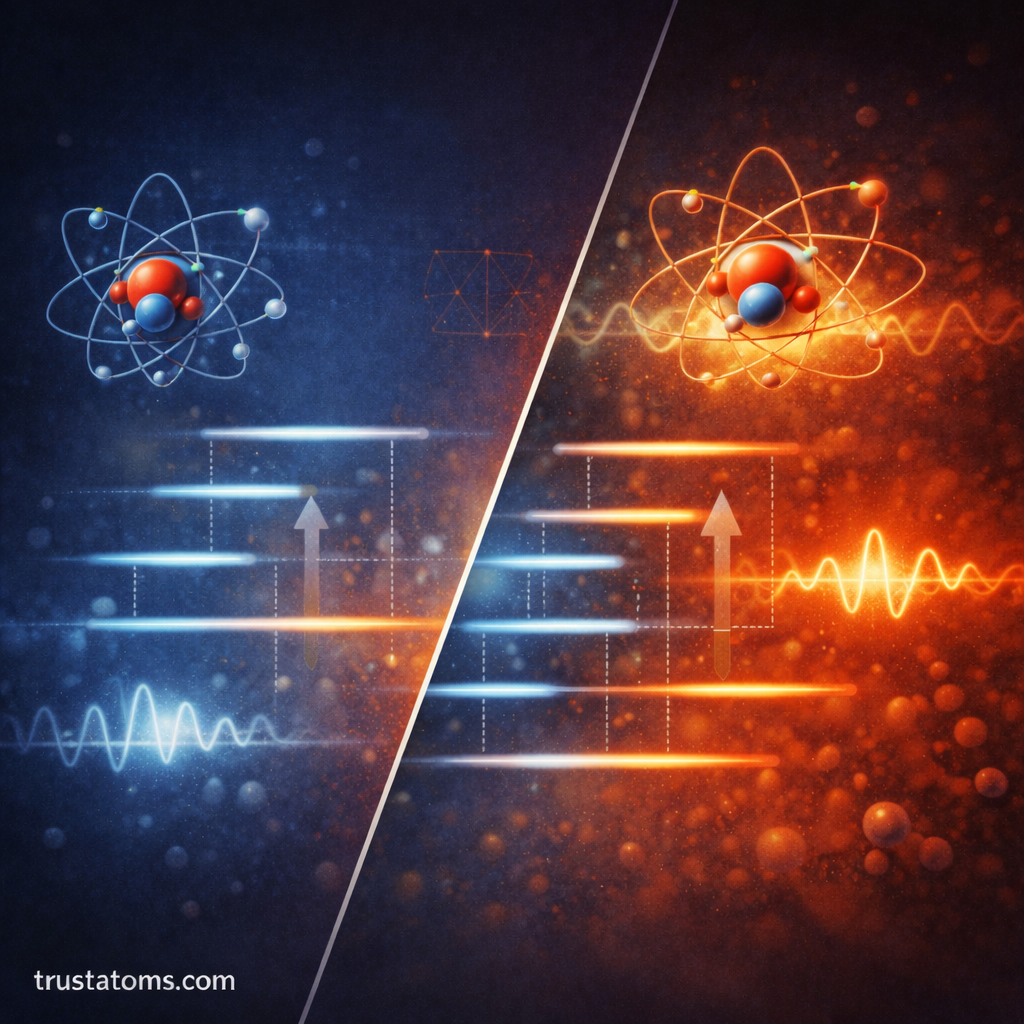
Time-independent perturbation theory applies when the added interaction does not change with time.
It is commonly used to calculate:
- Energy level shifts
- Fine structure corrections
- Effects of weak electric or magnetic fields
First-Order Corrections
At first order, perturbation theory:
- Adjusts energy levels slightly
- Uses the original wave functions
- Provides an approximation proportional to the strength of the perturbation
If the perturbation is small, first-order results are often remarkably accurate.
Higher-Order Corrections
When more precision is needed:
- Second-order corrections account for indirect interactions
- Additional terms improve accuracy
- Calculations become more complex
In many practical cases, only the first or second order is necessary.
Time-Dependent Perturbation Theory
Time-dependent perturbation theory is used when the interaction changes over time.
This is crucial for understanding:
- Absorption and emission of light
- Transitions between energy states
- Quantum transitions in atoms and molecules
It forms the foundation for:
- Spectroscopy
- Laser physics
- Quantum optics
One key result from time-dependent perturbation theory is the calculation of transition probabilities between states.
Example: The Stark Effect
A classic example of perturbation theory in action is the Stark effect.
When an atom is placed in an external electric field:
- Its energy levels shift
- Degeneracies may split
- Spectral lines change
These shifts can be calculated using perturbation theory by treating the electric field as a small correction to the atomic Hamiltonian.
Without perturbation theory, these calculations would be extremely difficult.
Degenerate Perturbation Theory
Sometimes, multiple states share the same energy. This situation is called degeneracy.
Standard perturbation theory fails in these cases because:
- Small interactions can mix degenerate states
- Energy splitting becomes non-trivial
Degenerate perturbation theory solves this by:
- Constructing a matrix within the degenerate subspace
- Diagonalizing it
- Determining new corrected energy levels
This method explains phenomena like fine structure and symmetry breaking.
Why Perturbation Theory Is So Powerful
Perturbation theory is widely used because it:
- Provides systematic approximations
- Maintains physical insight
- Avoids solving impossible equations
- Connects theory directly to experiments
It often reveals how small interactions produce measurable physical effects.
Limitations of Perturbation Theory
Despite its usefulness, perturbation theory has limits.
It works best when:
- The perturbation is small
- The system is close to the solvable model
It may fail when:
- Interactions are strong
- Energy differences are small
- The series does not converge
In strongly interacting systems, other methods such as numerical simulations or variational techniques may be required.
Perturbation Theory in Modern Physics
Perturbation theory is not limited to simple atomic systems.
It plays a critical role in:
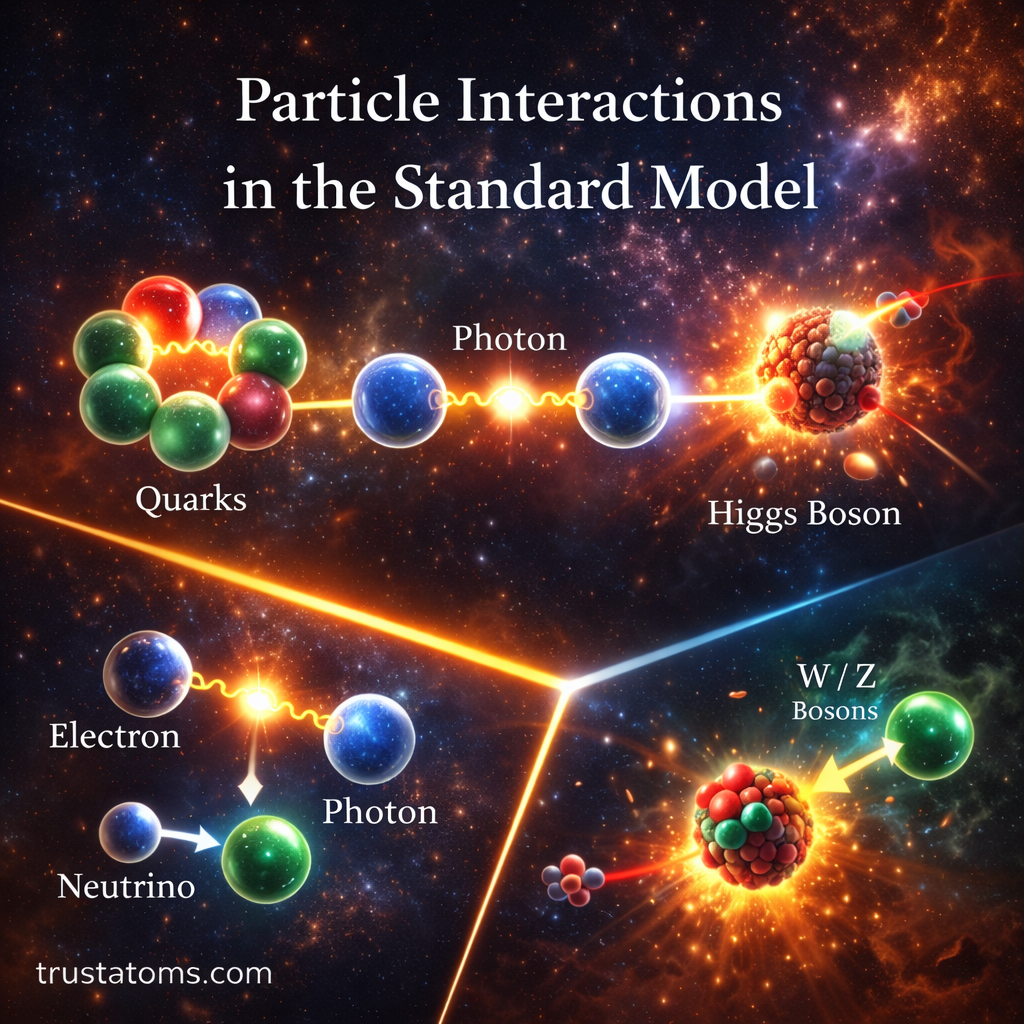
- Quantum field theory
- Particle physics
- Condensed matter physics
- Quantum electrodynamics
In fact, many of the most precise predictions in physics — including corrections to electron magnetic moments — rely on perturbative expansions.
Conceptual Understanding: Small Causes, Big Effects
One of the most important lessons from perturbation theory is this:
Small interactions can produce measurable consequences.
Tiny corrections can shift:
- Energy levels
- Spectral lines
- Transition probabilities
Perturbation theory provides the mathematical language for describing how slight disturbances influence quantum systems.
Final Thoughts
Perturbation theory is a cornerstone of quantum physics. By starting with a solvable system and adding small corrections, physicists can approximate complex quantum behavior with impressive accuracy.
From atomic spectra to particle interactions, perturbation theory bridges the gap between idealized models and real-world systems.
It demonstrates a central idea in physics: sometimes, understanding the effect of small changes is enough to reveal the deeper structure of nature.