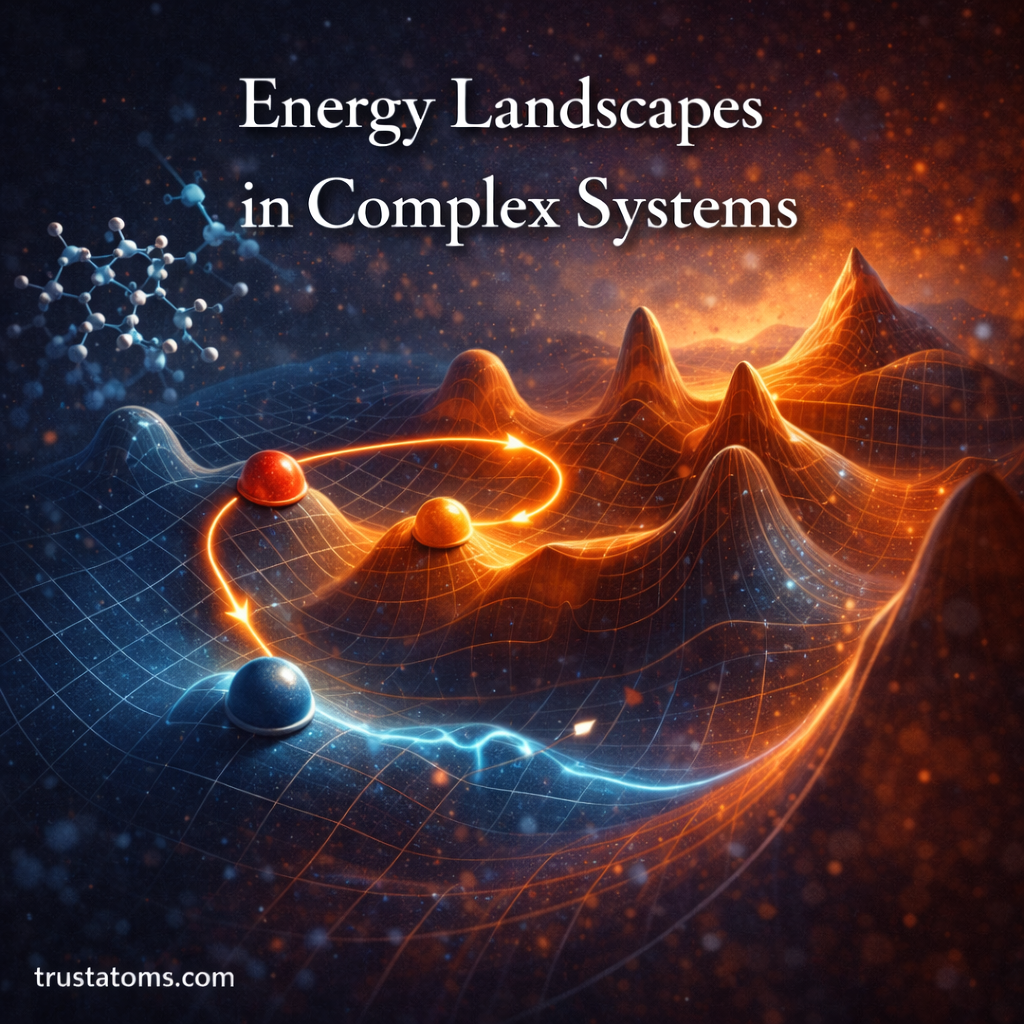
Energy landscapes are a powerful way to visualize and understand how complex systems behave. Instead of thinking about a system as a single state, physicists imagine a vast landscape of hills, valleys, and pathways — where each position represents a possible configuration and its height represents energy.
This concept appears across physics, chemistry, biology, and materials science. From protein folding to phase transitions, energy landscapes explain why systems settle into certain states and how they transition between them.
In this guide, we’ll explore what energy landscapes are, why they matter, and how they help us understand complex systems.
What Is an Energy Landscape?
An energy landscape is a conceptual map where:
- Each point represents a possible configuration of a system
- The vertical axis represents energy
- Valleys represent stable states
- Hills represent unstable or high-energy states
Systems naturally evolve toward lower energy states. In landscape terms, this means rolling downhill into valleys.
However, complex systems often contain:
- Multiple valleys (metastable states)
- Energy barriers between states
- Rugged terrain with many local minima
This complexity makes behavior rich and sometimes unpredictable.
Why Energy Landscapes Matter in Physics
Energy landscapes help physicists understand:
- Stability
- Transitions between states
- Equilibrium behavior
- Dynamical evolution
Rather than solving complicated equations directly, scientists analyze:
- The shape of the landscape
- The depth of valleys
- The height of barriers
The geometry of the landscape determines how a system behaves over time.
Simple Example: A Ball on a Surface
Imagine a ball placed on a surface:
- If the surface is smooth with one valley → the ball rolls to the bottom and stays there.
- If the surface has multiple valleys → the ball may get trapped in one.
- If barriers are high → transitions are rare.
- If thermal energy is present → the ball can occasionally jump barriers.
This simple picture captures the essence of energy landscapes in statistical physics.
Energy Landscapes in Statistical Mechanics
In statistical mechanics, systems consist of enormous numbers of particles.
Each possible arrangement of particles corresponds to:
- A unique configuration
- A specific energy
The total number of configurations can be astronomically large.
Instead of tracking every particle, physicists analyze:
- The distribution of energies
- The most probable configurations
- The structure of the landscape
At low temperatures:
- Systems settle into deep minima
At higher temperatures:
- Systems explore more of the landscape
Metastable States and Local Minima
In complex systems, not all valleys are equal.
There are:
- Global minima (lowest possible energy)
- Local minima (stable but not lowest)
A system can become trapped in a local minimum if:
- Energy barriers are large
- Temperature is low
- Fluctuations are weak
This explains phenomena such as:
- Supercooling
- Glass formation
- Hysteresis in magnetic systems
Metastability is a hallmark of rugged energy landscapes.
Energy Barriers and Transitions
Energy barriers determine how easily a system moves between states.
Important factors include:
- Barrier height
- Temperature
- External perturbations
If the barrier is high relative to thermal energy:
- Transitions are rare
- The system appears stable
If the barrier is low:
- Transitions occur frequently
- The system fluctuates between states
This interplay governs chemical reactions, magnetic flips, and molecular rearrangements.
Protein Folding as an Energy Landscape

One of the most famous applications of energy landscapes is protein folding.
Proteins:
- Start as flexible chains
- Explore many configurations
- Eventually settle into a functional structure
The folding process is often described as a “funnel-shaped” energy landscape:
- Many high-energy configurations at the top
- Fewer low-energy configurations at the bottom
- A smooth pathway toward stability
This model explains how proteins can fold reliably despite enormous configuration space.
Spin Glasses and Rugged Landscapes
Some systems have extremely complex landscapes.
Spin glasses, for example, exhibit:
- Many nearly equal minima
- Frustrated interactions
- Highly irregular energy surfaces
These systems show:
- Slow dynamics
- Memory effects
- Aging behavior
Their rugged landscapes make prediction difficult and fascinating.
Optimization and Energy Landscapes
Energy landscape ideas extend beyond physics.
In optimization problems:
- Solutions correspond to minima
- The objective function acts like energy
- Algorithms search for low-energy states
Examples include:
- Machine learning
- Neural networks
- Logistics optimization
Understanding landscape structure helps design better algorithms.
Visualizing High-Dimensional Landscapes
In reality, energy landscapes exist in extremely high dimensions.
For systems with many particles:
- Each particle adds dimensions
- Landscapes cannot be fully visualized
- Simplified projections are used
Despite this complexity, the “hills and valleys” metaphor remains powerful and accurate.
Why Energy Landscapes Are So Powerful
Energy landscapes unify many ideas in physics:
- Stability as valley depth
- Transitions as barrier crossings
- Equilibrium as minimum energy
- Dynamics as movement through configuration space
They provide both:
- Qualitative insight
- Quantitative predictive power
Instead of focusing on microscopic chaos, scientists analyze macroscopic structure.
Conceptual Insight: Systems Seek Stability — But Not Always Perfection
One of the key lessons of energy landscapes is:
Systems seek lower energy, but they do not always find the lowest possible state.
They may:
- Become trapped
- Fluctuate
- Transition slowly
This explains why real-world systems often display:
- Imperfections
- Delays
- Hysteresis
- Complex time evolution
Energy landscapes reveal that complexity emerges naturally from simple energetic rules.
Final Thoughts
Energy landscapes offer a unifying framework for understanding complex systems. By visualizing configurations as positions on a multidimensional terrain, physicists gain deep insight into stability, transitions, and long-term behavior.
From protein folding to magnetic materials, from glass formation to optimization algorithms, the structure of the landscape determines the destiny of the system.
In the end, energy landscapes remind us that complexity is not random chaos — it is structured by energy, barriers, and geometry.