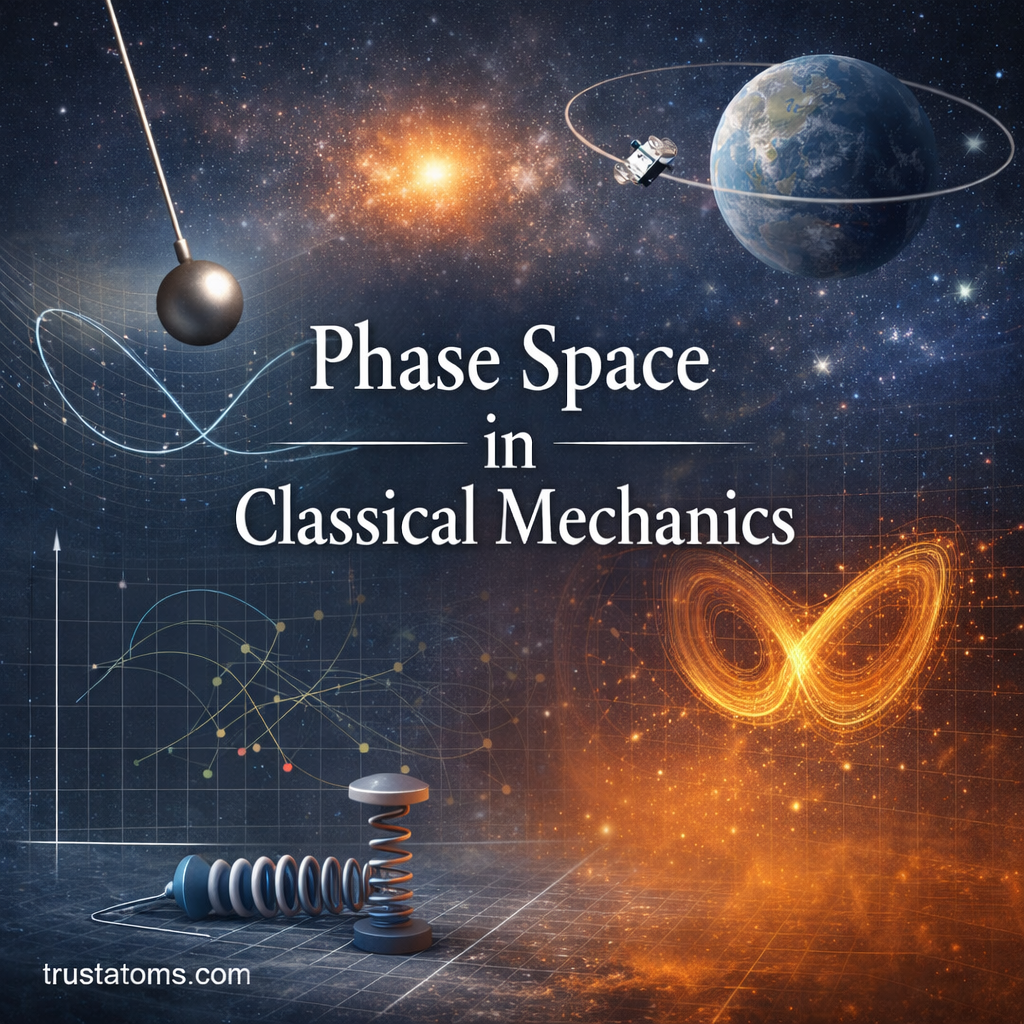
In classical mechanics, understanding motion is not just about tracking position over time. Physicists often need a deeper framework — one that captures the entire state of a system at once.
That framework is called phase space.
Phase space is one of the most powerful visualization tools in physics. It allows scientists to analyze stability, predict long-term behavior, and understand complex systems — from swinging pendulums to planetary motion.
In this guide, we’ll explain phase space in classical mechanics clearly and practically, without heavy mathematics.
What Is Phase Space?
Phase space is an abstract space where each point represents a complete state of a physical system.
In classical mechanics, a system’s state is defined by:
- Position
- Momentum (or velocity)
Instead of plotting position versus time, phase space plots:
Position on one axis
Momentum (or velocity) on the other axis
Every possible state of the system corresponds to one point in this space.
As the system evolves over time, that point moves — creating a trajectory.
Why Phase Space Is Important
Phase space provides advantages that ordinary graphs cannot:
- It shows long-term behavior at a glance
- It reveals stability or instability
- It identifies periodic motion
- It exposes chaotic dynamics
- It simplifies multi-variable systems
Rather than focusing on time directly, phase space focuses on how states relate to each other.
This shift in perspective makes complex systems easier to analyze.
A Simple Example: The Mass–Spring System
Consider a mass attached to a spring.
In normal motion analysis, we track position as a function of time.
In phase space:
- The horizontal axis represents position
- The vertical axis represents momentum or velocity
For an ideal, frictionless spring:
- The trajectory forms a closed loop (an ellipse)
- The motion repeats indefinitely
- Energy remains constant
This closed curve tells us the system is stable and periodic.
Phase Space Trajectories
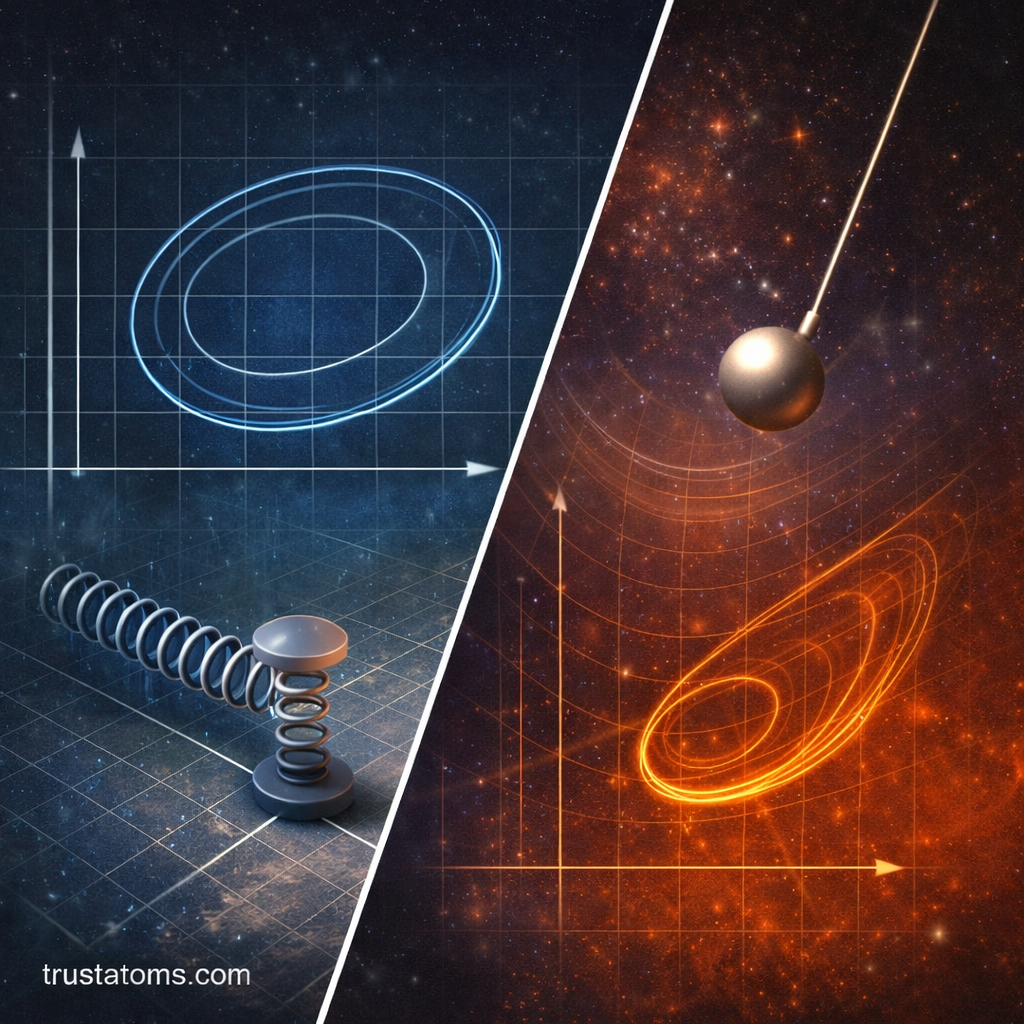
As time passes, the system traces a path in phase space called a trajectory.
Different types of motion produce different trajectory shapes.
1. Periodic Motion
Closed loops indicate repeating motion.
Examples:
- Pendulums (small angles)
- Springs
- Planetary orbits (simplified cases)
2. Damped Motion
If friction or resistance exists:
- The trajectory spirals inward
- Energy decreases
- The system moves toward equilibrium
3. Unstable Motion
If a system is unstable:
- Trajectories move away from equilibrium
- Small disturbances grow over time
Phase space makes these behaviors immediately visible.
Equilibrium Points in Phase Space
An equilibrium point is where the system remains if undisturbed.
In phase space, equilibrium appears as a single point.
There are different types:
- Stable equilibrium → Nearby trajectories circle or spiral toward it
- Unstable equilibrium → Nearby trajectories move away
- Saddle points → Stable in one direction, unstable in another
Identifying these points helps determine system stability.
Degrees of Freedom and Higher-Dimensional Phase Space
For simple systems like a mass-spring, phase space is two-dimensional.
But more complex systems require additional dimensions.
Each degree of freedom adds:
- One position coordinate
- One momentum coordinate
For example:
- A particle moving in 3D space → 6-dimensional phase space
- Two interacting particles → 12-dimensional phase space
While we can’t visualize higher dimensions directly, the mathematical framework still applies.
Liouville’s Theorem
One important principle in classical mechanics is Liouville’s Theorem.
It states:
The volume of phase space occupied by a system remains constant over time (for conservative systems).
This means:
- Energy-conserving systems do not compress or expand in phase space
- The flow of trajectories behaves like an incompressible fluid
This concept is fundamental in statistical mechanics.
Phase Space and Hamiltonian Mechanics
Phase space becomes especially powerful in Hamiltonian mechanics.
In this framework:
- Position and momentum are treated symmetrically
- The Hamiltonian function represents total energy
- Equations of motion describe how points move in phase space
Hamiltonian mechanics simplifies:
- Orbital dynamics
- Electromagnetic systems
- Advanced mechanical systems
It forms the bridge between classical and quantum mechanics.
Phase Portraits
A phase portrait is a graphical representation of trajectories in phase space.
It shows:
- Equilibrium points
- Stability patterns
- Direction of motion
- Long-term system behavior
Phase portraits are widely used in:
- Nonlinear dynamics
- Control systems
- Population modeling
- Engineering stability analysis
They allow researchers to predict system behavior without solving equations exactly.
Phase Space and Chaos
Chaotic systems behave very differently in phase space.
Instead of:
- Closed loops
- Smooth spirals
Chaotic systems produce:
- Strange attractors
- Fractal structures
- Highly sensitive trajectories
Even small differences in starting conditions produce completely different paths.
Phase space visualization is essential for studying chaos theory.
Real-World Applications of Phase Space
Phase space analysis is used across physics and engineering.
Astronomy
- Orbital stability
- Planetary interactions
- Gravitational systems
Engineering
- Mechanical vibrations
- Structural stability
- Robotics control
Climate Science
- Atmospheric circulation models
- Ocean system dynamics
Plasma and Particle Physics
- Charged particle motion
- Magnetic confinement systems
In every case, phase space provides insight into long-term behavior.
Key Takeaways
- Phase space represents all possible states of a system.
- Each point corresponds to a specific position and momentum.
- Trajectories show how systems evolve over time.
- Closed loops indicate periodic motion.
- Spirals indicate damping.
- Diverging paths indicate instability.
- Higher-dimensional phase spaces describe more complex systems.
- Phase space is central to Hamiltonian mechanics and chaos theory.
Understanding phase space transforms how we analyze motion — shifting from time-based thinking to state-based thinking.
Final Thoughts
Phase space in classical mechanics is more than a graphing tool. It’s a conceptual shift.
By representing full system states instead of isolated variables, physicists gain deeper insight into stability, energy conservation, periodic motion, and chaos.
From simple springs to planetary systems, phase space provides a unified way to understand motion at every scale.
Once you begin thinking in phase space, classical mechanics becomes clearer, more visual, and far more powerful.