Every equation in physics rests on a deeper foundation — physical constants and dimensional structure.
From gravity to electromagnetism, from quantum mechanics to cosmology, the laws of nature depend on fixed quantities that do not change across space or time. These are called physical constants.
But constants alone are not enough. They only make sense within a dimensional framework — a system that defines how quantities like length, time, mass, and charge relate to one another.
In this guide, we’ll explore:
- What physical constants are
- Why dimensions matter
- The structure of fundamental units
- How constants shape the laws of physics
- Why dimensional analysis is a powerful scientific tool
What Are Physical Constants?
Physical constants are fixed numerical values that appear in the laws of physics.
They are not measured differently depending on location or conditions. Instead, they represent universal properties of nature.
Some well-known examples include:
- The speed of light in vacuum
- The gravitational constant
- Planck’s constant
- The elementary charge
- Boltzmann’s constant
These constants act as bridges between physical quantities.
For example:
- The speed of light connects space and time
- Planck’s constant connects energy and frequency
- The gravitational constant connects mass and force
Without these constants, equations would have no physical scale.
Fundamental vs Derived Constants
Physical constants can be grouped into two categories.
Fundamental Constants
These define the structure of physical law at the deepest level.
Examples include:
- Speed of light
- Planck’s constant
- Gravitational constant
- Elementary charge
They are not derived from other constants.
Derived Constants
These are combinations of fundamental constants.
Examples include:
- Fine-structure constant
- Stefan–Boltzmann constant
- Gas constant
Derived constants often emerge from more basic relationships.
Dimensional Foundations of Physics
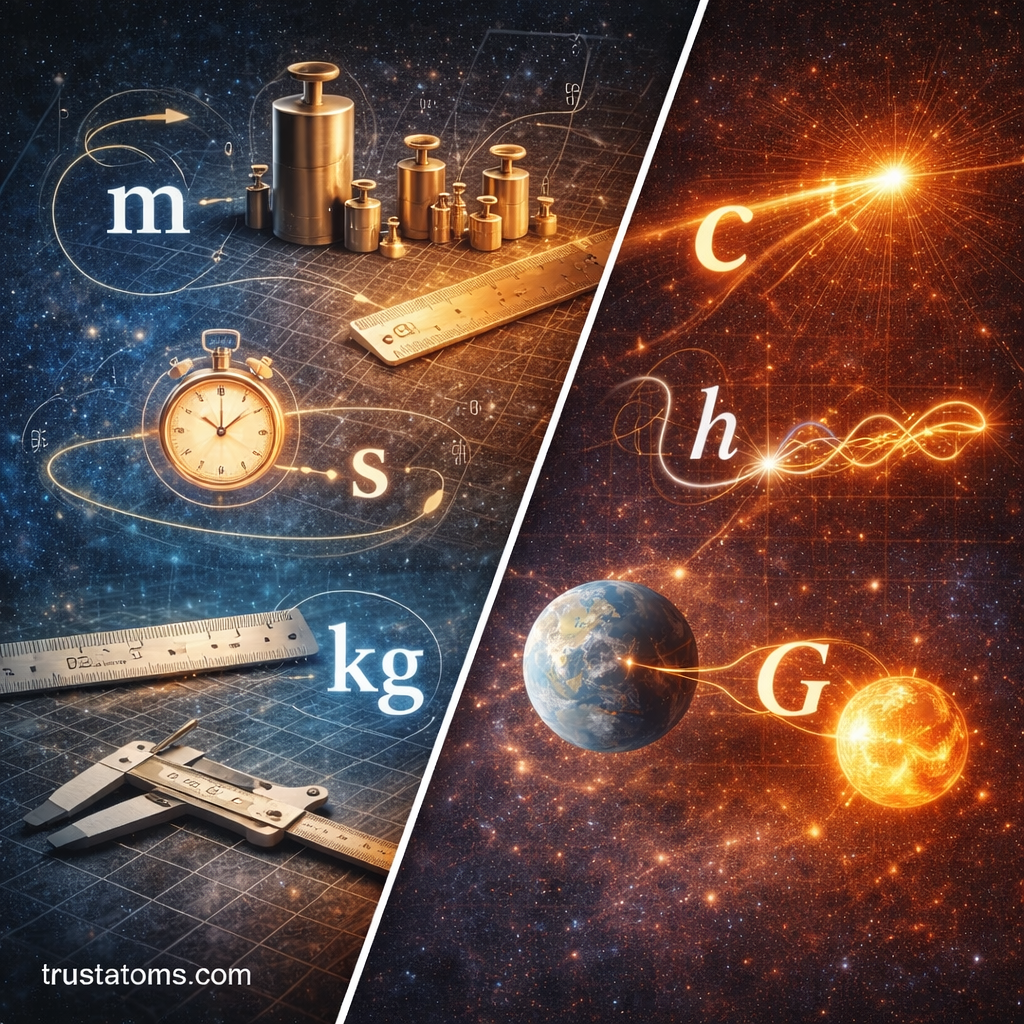
Every measurable quantity has dimensions.
Common base dimensions include:
- Length
- Time
- Mass
- Electric current
- Temperature
- Amount of substance
- Luminous intensity
These form the foundation of the International System of Units (SI).
All physical quantities can be expressed in terms of these base dimensions.
For example:
- Velocity → length divided by time
- Force → mass × length ÷ time²
- Energy → mass × length² ÷ time²
Understanding dimensions ensures equations are physically meaningful.
Why Dimensions Matter
Dimensions act as a consistency check in physics.
An equation must balance dimensionally.
For example:
- You cannot add time to mass
- You cannot equate force directly to energy
Dimensional analysis helps:
- Detect errors in equations
- Derive relationships between quantities
- Estimate unknown quantities
- Simplify complex problems
Even without knowing full equations, dimensional reasoning can reveal how systems behave.
The Role of Units in Physics
Units are human-defined scales attached to dimensions.
Examples:
- Meter (length)
- Second (time)
- Kilogram (mass)
- Coulomb (electric charge)
While units may vary between systems (SI, CGS, natural units), the dimensions remain consistent.
Physics cares about dimensions first — units are conventions layered on top.
Natural Units and Dimensional Reduction
In advanced physics, scientists sometimes redefine units so certain constants equal 1.
For example:
- Setting the speed of light equal to 1
- Setting Planck’s constant equal to 1
This simplifies equations and reveals deeper symmetries.
Natural units show that many physical constants are not arbitrary — they define relationships between dimensions.
For example:
- Speed of light links space and time
- Planck’s constant links energy and frequency
- Gravitational constant links mass and spacetime curvature
Dimensionless Constants
Some constants have no dimensions at all.
These are especially important because they do not depend on unit systems.
A famous example is the fine-structure constant.
Dimensionless constants often:
- Determine interaction strengths
- Define ratios of physical effects
- Reveal fundamental properties of nature
Because they are pure numbers, they are considered especially fundamental.
Dimensional Analysis in Practice
Dimensional analysis is widely used across physics.
Example 1: Estimating Period of a Pendulum
The period depends on:
- Length
- Gravitational acceleration
Dimensional reasoning shows that the period must scale with the square root of length divided by gravity.
Even without solving equations, dimensions guide the relationship.
Example 2: Energy of a Moving Object
Energy depends on:
- Mass
- Velocity
Dimensional structure shows energy must involve mass multiplied by velocity squared.
Dimensional reasoning narrows possibilities dramatically.
Physical Constants and the Structure of Laws
Physical laws are not random formulas. They follow dimensional necessity.
For example:
- Force laws must produce units of force
- Energy equations must produce units of energy
- Wave equations must balance time and space dimensions
Constants ensure dimensional balance while encoding physical meaning.
Without constants:
- Gravity would lack strength
- Light would lack speed
- Quantum effects would lack scale
Constants give the universe its measurable structure.
How Constants Define the Universe
If fundamental constants were slightly different:
- Stars might not form
- Chemistry might not exist
- Atoms might not be stable
- Life might be impossible
Physical constants determine:
- Strength of gravity
- Strength of electromagnetic force
- Quantum behavior of matter
- Rate of cosmic expansion
They shape the entire structure of reality.
Key Takeaways
- Physical constants are fixed universal quantities.
- Dimensions define the structure of measurable quantities.
- All equations must balance dimensionally.
- Fundamental constants connect physical quantities.
- Dimensionless constants reveal deep properties of nature.
- Dimensional analysis is a powerful predictive tool.
- Constants determine the large-scale structure of the universe.
Physics is not just about equations — it is about consistent dimensional foundations.
Final Thoughts
Physical constants and dimensional foundations form the skeleton of physics.
Constants provide scale and strength to interactions. Dimensions provide structure and coherence to equations.
Together, they ensure that physical laws are not arbitrary — they are mathematically consistent and universally applicable.
Understanding this framework transforms physics from a collection of formulas into a logically structured system grounded in measurable reality.