At the deepest level, everything in the universe is governed by a small set of fundamental interactions.
From the motion of planets to the structure of atoms, from nuclear reactions in stars to the chemistry of life, all physical phenomena arise from just four fundamental forces.
In theoretical physics, understanding these interactions is the key to understanding reality itself.
In this guide, we’ll explore:
- The four fundamental interactions
- How they differ in strength and range
- How modern physics describes them
- The search for a unified theory
What Are Fundamental Interactions?
Fundamental interactions (or fundamental forces) are the basic ways particles influence one another.
They are not reducible to anything simpler.
Every physical process — whether microscopic or cosmic — can be explained by one or more of these interactions.
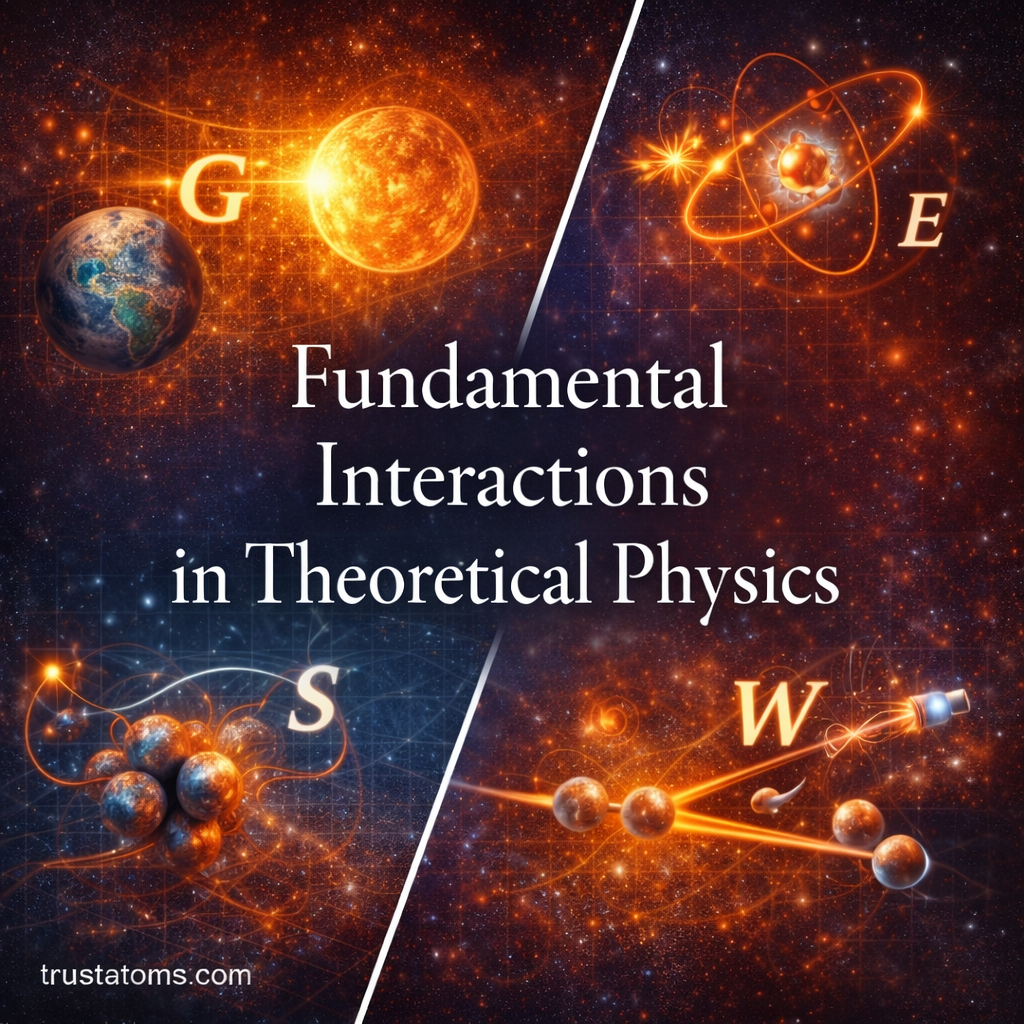
There are four known fundamental interactions:
- Gravitational interaction
- Electromagnetic interaction
- Strong nuclear interaction
- Weak nuclear interaction
Each plays a distinct role in the structure of matter and the evolution of the universe.
The Gravitational Interaction
Gravity is the force of attraction between masses.
It governs:
- Planetary motion
- Star formation
- Galaxy structure
- Black holes
- The expansion of the universe
Key Features
- Always attractive
- Infinite range
- Weakest of the four forces
- Dominates large-scale structures
In classical physics, gravity is described by Newton’s law of universal gravitation.
In modern theoretical physics, gravity is described by Einstein’s general theory of relativity, where gravity is not a force in the traditional sense but a curvature of spacetime.
Despite being the weakest force at the particle level, gravity becomes dominant at astronomical scales because it accumulates with mass.
The Electromagnetic Interaction
The electromagnetic force acts between electrically charged particles.
It governs:
- Atomic structure
- Chemical bonding
- Light
- Electricity and magnetism
- Modern technology
Key Features
- Can attract or repel
- Infinite range
- Much stronger than gravity
- Responsible for nearly all everyday forces
Electromagnetism is described by quantum electrodynamics (QED), one of the most precise theories ever developed.
Photons act as the force carriers of electromagnetic interaction.
Without electromagnetism:
- Atoms would not exist
- Chemistry would not occur
- Light would not propagate
The Strong Nuclear Interaction
The strong interaction binds quarks together to form protons and neutrons.
It also holds protons and neutrons together inside atomic nuclei.
Key Features
- Extremely strong at short distances
- Very short range
- Overcomes electromagnetic repulsion inside nuclei
The strong interaction is described by quantum chromodynamics (QCD).
Its force carriers are gluons.
Unlike electromagnetism, the strong force becomes weaker at larger distances but stronger at smaller scales — a property known as confinement.
Without the strong force:
- Nuclei would not exist
- Atoms heavier than hydrogen would not form
- Stars could not fuse elements
The Weak Nuclear Interaction
The weak interaction is responsible for radioactive decay and certain nuclear reactions.
It governs processes such as:
- Beta decay
- Neutrino interactions
- Fusion in stars
Key Features
- Very short range
- Weaker than electromagnetism and strong force
- Essential for nuclear transformations
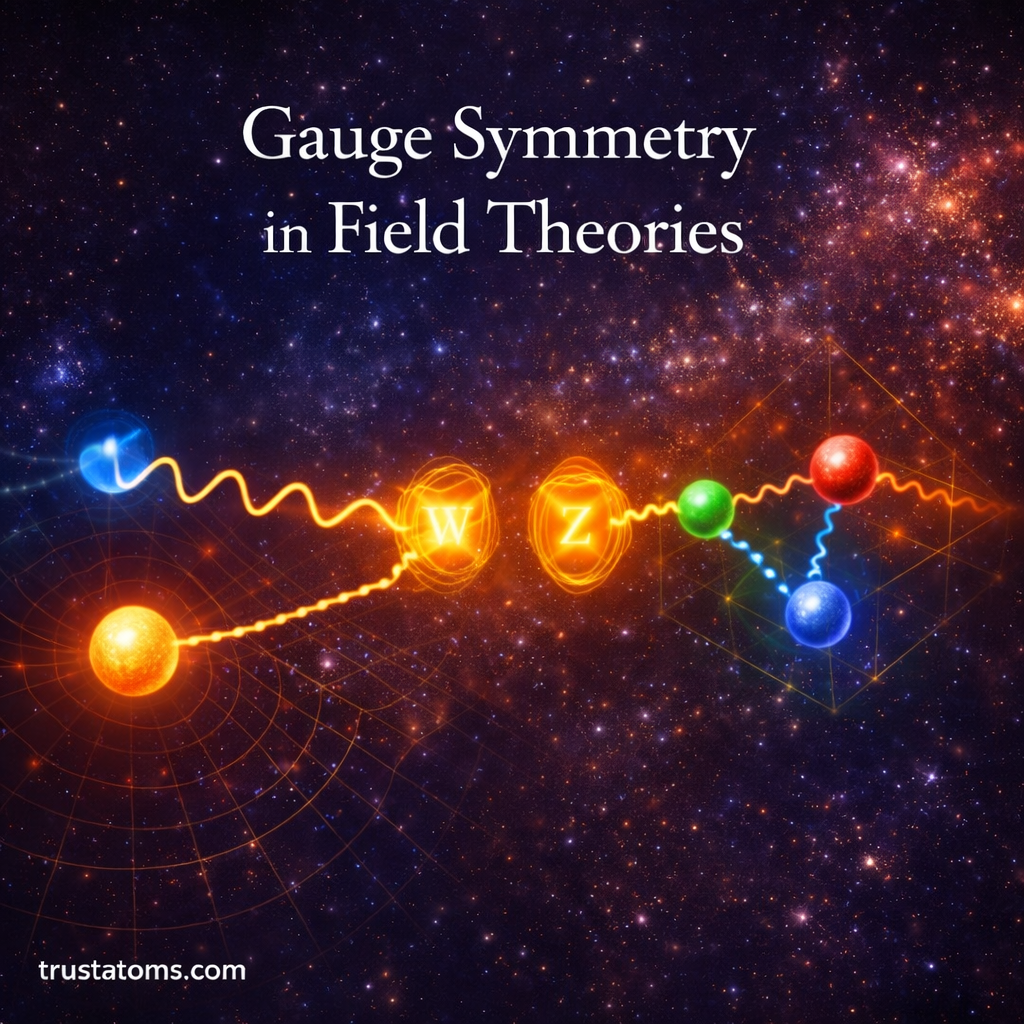
The weak interaction is mediated by heavy particles known as W and Z bosons.
Though less noticeable in daily life, the weak force is essential for:
- Stellar energy production
- Formation of elements
- Early universe evolution
Relative Strength of the Forces
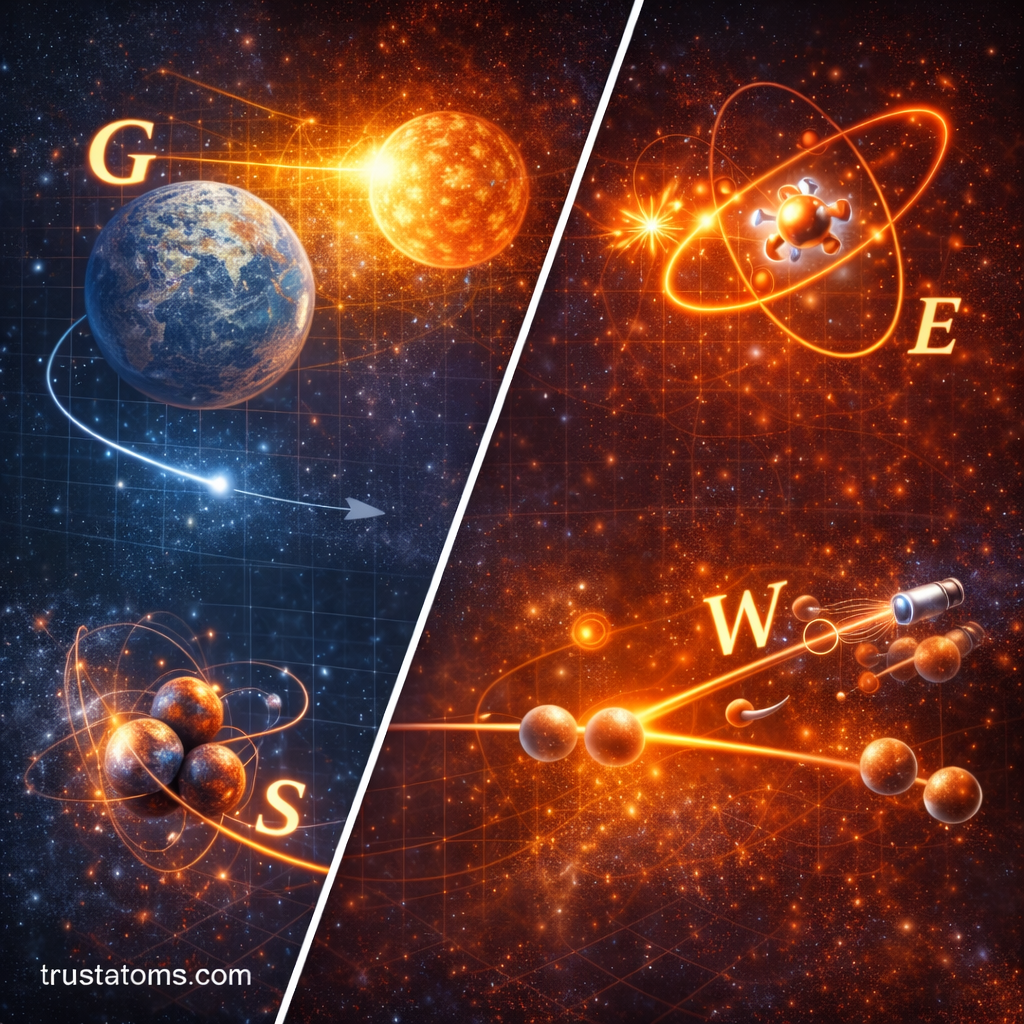
At the particle level, the forces vary dramatically in strength.
Approximate relative strengths:
- Strong force → strongest
- Electromagnetic force → weaker than strong
- Weak force → weaker than electromagnetic
- Gravity → vastly weaker than the others
Gravity is roughly 10³⁸ times weaker than the strong force at subatomic scales.
Yet at cosmic scales, gravity dominates because it acts on all mass and never cancels out.
Force Carriers in Quantum Field Theory
In modern theoretical physics, interactions are explained using quantum field theory.
Each fundamental force has a corresponding force carrier particle:
- Gravity → hypothesized graviton (not yet observed)
- Electromagnetism → photon
- Strong force → gluon
- Weak force → W and Z bosons
These particles mediate interactions between matter particles.
Instead of classical forces pulling or pushing, particles exchange force carriers.
Unification of Forces
One of the greatest goals in theoretical physics is unification.
Historically:
- Electricity and magnetism were unified into electromagnetism
- Electromagnetism and weak force were unified into the electroweak interaction
The next major goals are:
- Grand Unified Theory (GUT) → unify strong and electroweak forces
- Theory of Everything → unify gravity with quantum forces
Currently, gravity remains incompatible with quantum field theory at extreme scales.
String theory and quantum gravity research aim to bridge this gap.
Why Fundamental Interactions Matter
Understanding fundamental interactions allows physicists to:
- Predict particle behavior
- Explain atomic stability
- Model stellar evolution
- Study black holes
- Understand the early universe
Every complex structure — from molecules to galaxies — emerges from these four basic interactions.
Key Differences at a Glance
Gravity
- Acts on mass
- Infinite range
- Governs cosmic structure
Electromagnetism
- Acts on electric charge
- Infinite range
- Governs atoms and chemistry
Strong Interaction
- Acts on quarks and gluons
- Very short range
- Governs nuclear binding
Weak Interaction
- Governs particle decay
- Very short range
- Enables nuclear transformations
The Ongoing Quest in Theoretical Physics
Modern research continues to explore:
- Dark matter interactions
- Quantum gravity
- Extra dimensions
- Symmetry breaking
- Early universe force unification
Though four interactions currently explain known physics, unanswered questions remain.
The ultimate aim is a unified framework describing all forces under one consistent theory.
Final Thoughts
The four fundamental interactions form the backbone of theoretical physics.
They explain everything from the stability of atoms to the expansion of the universe.
While gravity shapes galaxies and electromagnetism powers technology, the strong and weak forces govern the heart of matter itself.
Understanding these interactions brings us closer to answering one of humanity’s deepest questions:
What are the basic rules that govern reality?