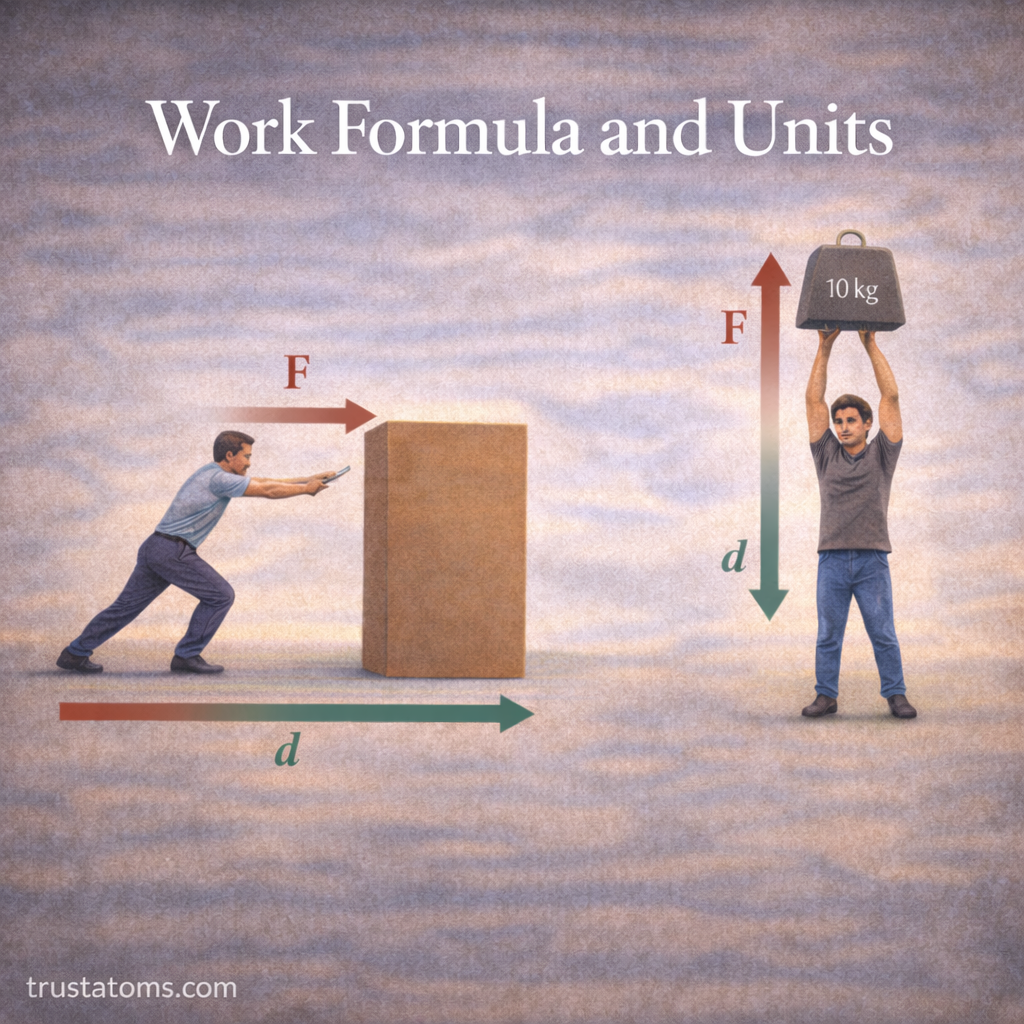
In physics, work has a precise definition. It doesn’t simply mean effort — it refers to energy transferred when a force causes an object to move.
Understanding the work formula and its units is essential for mastering mechanics, energy, and motion.
In this guide, you’ll learn:
- The work formula
- The full equation with angles
- The SI units of work
- Step-by-step calculation examples
- How work connects to energy
What Is the Work Formula?
The basic formula for work is:
W = F × d
Where:
- W = work
- F = force (in newtons, N)
- d = displacement (in meters, m)
Work occurs only when force causes displacement in the direction of the force.
If there is no movement, no work is done.
Full Work Formula (When Force Is at an Angle)
In many real-world situations, force is not applied perfectly in the direction of motion.
The complete formula is:
W = F × d × cos(θ)
Where:
- θ (theta) = angle between force and displacement
Why Cosine Is Used
- If θ = 0° → cos(0°) = 1 → maximum work
- If θ = 90° → cos(90°) = 0 → no work
- If θ > 90° → work is negative
Only the component of force in the direction of motion contributes to work.
Units of Work
The SI unit of work is the joule (J).
1 joule = 1 newton × 1 meter
J = N·m
Because:
1 newton = 1 kg·m/s²
So:
1 joule = 1 kg·m²/s²
Work and energy share the same unit because work transfers energy.
Example 1: Simple Horizontal Push
A person pushes a box with:
- Force = 40 N
- Distance = 5 m
W = 40 × 5
W = 200 J
The person does 200 joules of work.
Example 2: Lifting an Object
A 15 kg object is lifted 3 meters upward.
Step 1: Find the force needed (weight).
F = mg
= 15 × 9.8
= 147 N
Step 2: Calculate work.
W = 147 × 3
W = 441 J
441 joules of work were done lifting the object.
Example 3: Force Applied at an Angle
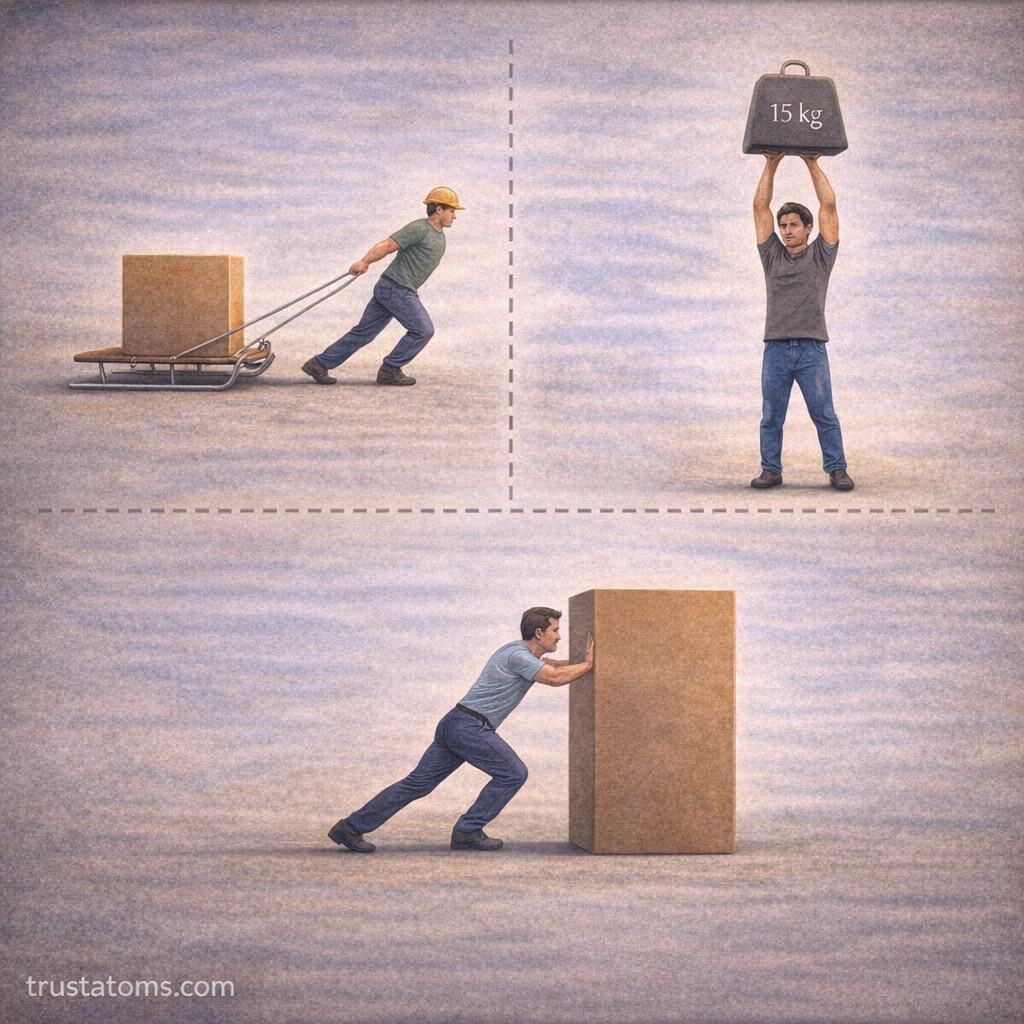
A worker pulls a sled with:
- Force = 100 N
- Distance = 6 m
- Angle = 30°
W = 100 × 6 × cos(30°)
cos(30°) ≈ 0.866
W ≈ 100 × 6 × 0.866
W ≈ 519.6 J
Approximately 520 joules of work are done.
Positive vs Negative Work
Positive Work
Occurs when force and motion are in the same direction.
Example:
Pushing a cart forward.
Negative Work
Occurs when force opposes motion.
Example:
Friction slowing a moving object.
Negative work reduces kinetic energy.
When Is Work Equal to Zero?
Work equals zero when:
- There is no displacement.
- Force is perpendicular to motion.
- No force is applied.
Example:
Holding a heavy object still results in zero work (in physics).
Relationship Between Work and Energy
The Work-Energy Theorem states:
Work done on an object = Change in kinetic energy
W = ΔKE
If you apply work to an object, you change its energy.
For example:
- Push a car → it gains kinetic energy
- Lift an object → it gains potential energy
Work is the mechanism that transfers energy.
Why Understanding Work Units Matters
Knowing the units helps you:
- Check calculations for accuracy
- Convert between units
- Understand energy relationships
- Solve physics problems correctly
Unit consistency is critical in physics equations.
Quick Summary
- Work formula: W = F × d
- Full formula: W = F × d × cos(θ)
- Unit of work: joule (J)
- 1 J = 1 N·m
- Work transfers energy
- Work can be positive, negative, or zero
The work formula and its units form the foundation of classical mechanics. Once you understand how force, displacement, and energy connect, many physics problems become much easier to solve.
Master the formula, understand the units, and you’ll unlock a core principle of motion and energy.