Atoms are the fundamental building blocks of matter. Everything you can see, touch, and even breathe is made of atoms — from water and air to stars and living cells.
In chemistry, understanding what an atom is helps explain how substances form, why elements behave differently, and how chemical reactions occur. This article breaks down the concept of the atom in clear, simple terms.
The Basic Definition of an Atom
An atom is the smallest unit of an element that still retains the properties of that element.
For example:
- A gold atom is the smallest piece of gold that is still gold.
- A hydrogen atom is the smallest unit of hydrogen that behaves like hydrogen.
If you break an atom apart further, you no longer have the same element — you’re left with smaller particles that make up the atom itself.
What Are Atoms Made Of?
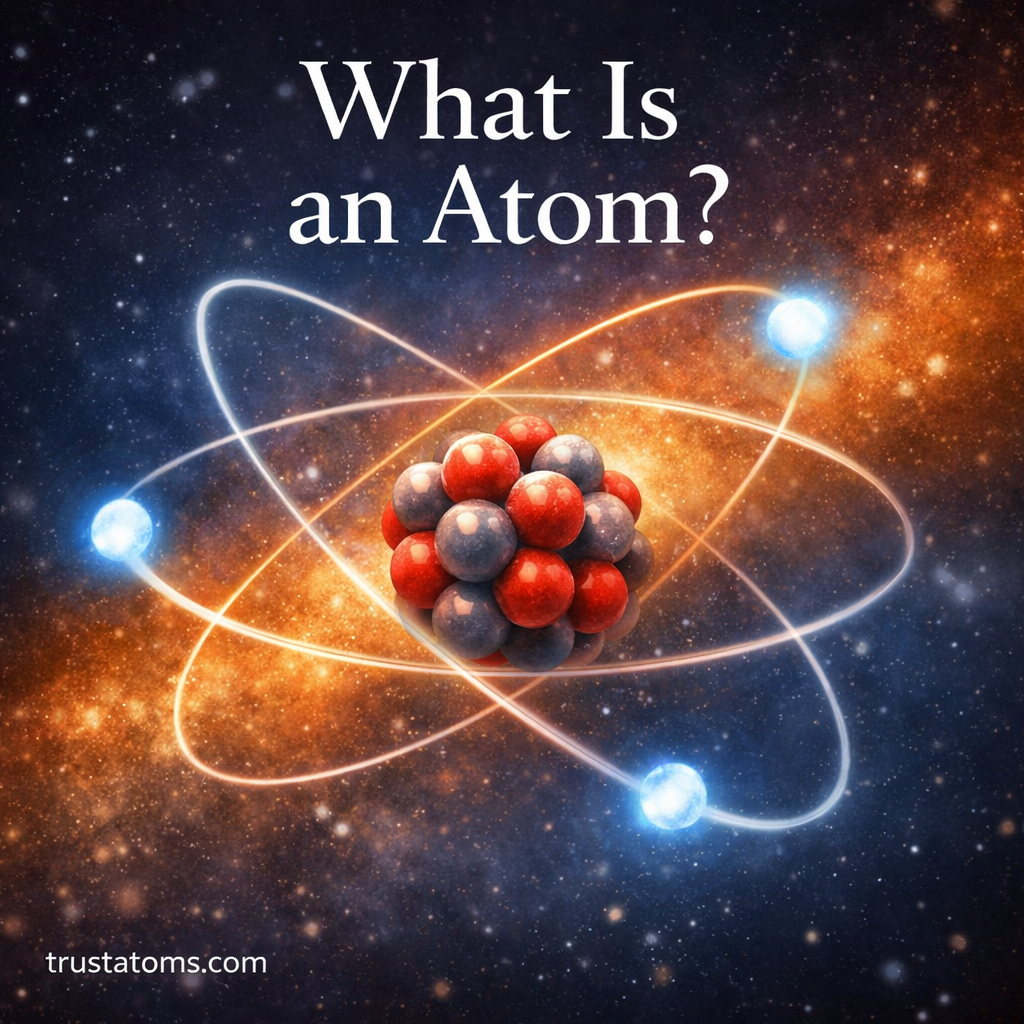
Atoms are composed of three main subatomic particles:
1. Protons
- Positively charged particles
- Located in the center of the atom (the nucleus)
- Determine the identity of the element
2. Neutrons
- Neutral (no charge)
- Also located in the nucleus
- Contribute to the atom’s mass
3. Electrons
- Negatively charged particles
- Move around the nucleus in regions called electron clouds
- Responsible for chemical reactions and bonding
The nucleus (containing protons and neutrons) is extremely small but holds nearly all the atom’s mass.
The Structure of an Atom
Atoms consist of two main regions:
The Nucleus
- Dense central core
- Contains protons and neutrons
- Very small compared to the entire atom
The Electron Cloud
- Surrounds the nucleus
- Contains electrons
- Represents the space where electrons are most likely to be found
Although we often imagine atoms as tiny solar systems, electrons don’t orbit the nucleus in neat circular paths. Instead, they exist in probability regions determined by quantum mechanics.
How Small Is an Atom?
Atoms are incredibly small:
- About 100 million atoms lined up side by side would measure roughly one centimeter.
- The diameter of a typical atom is about 0.1 nanometers.
To put this into perspective:
- A human hair is about 80,000–100,000 atoms wide.
- A single drop of water contains trillions upon trillions of atoms.
Even though atoms are tiny, their arrangement determines everything about the physical world.
How Atoms Form Elements
An element is defined by the number of protons in its atoms. This number is called the atomic number.
For example:
- Hydrogen has 1 proton.
- Carbon has 6 protons.
- Oxygen has 8 protons.
If you change the number of protons, you change the element entirely.
The periodic table organizes all known elements based on their atomic numbers and properties.
How Atoms Form Molecules
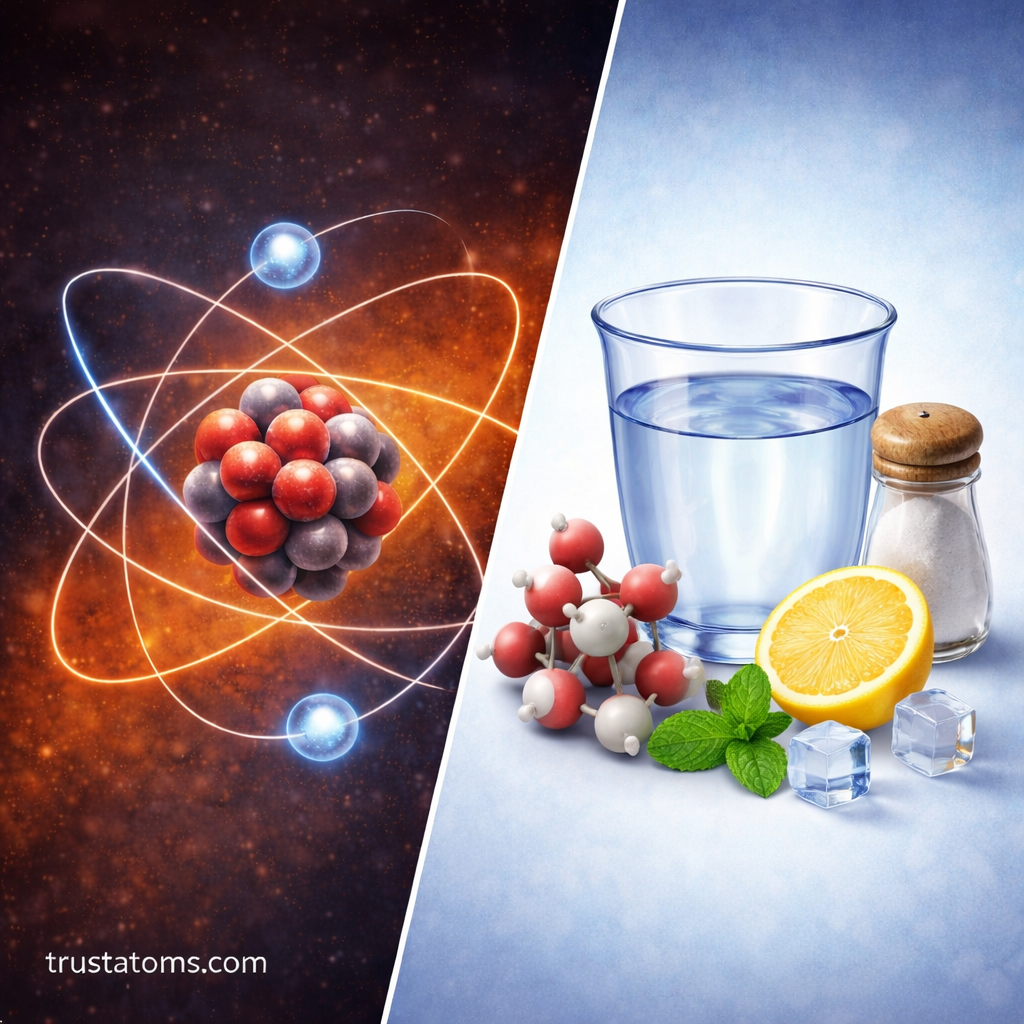
Atoms rarely exist alone. They often bond with other atoms to form molecules.
Examples include:
- Water (H₂O): Two hydrogen atoms bonded to one oxygen atom
- Carbon dioxide (CO₂): One carbon atom bonded to two oxygen atoms
Atoms bond because of interactions between their electrons. The way electrons are arranged determines how atoms combine and what substances they form.
A Brief History of Atomic Theory
The idea of atoms has evolved over centuries.
Early Greek Philosophy
The word “atom” comes from the Greek word atomos, meaning “indivisible.” Ancient philosophers proposed that matter was made of tiny particles.
John Dalton (Early 1800s)
Dalton introduced the first modern atomic theory:
- Matter is made of atoms.
- Atoms of a given element are identical.
- Atoms combine in fixed ratios to form compounds.
J.J. Thomson (1897)
Discovered the electron, proving atoms were divisible.
Ernest Rutherford (1911)
Discovered the nucleus through the gold foil experiment.
Niels Bohr (1913)
Proposed that electrons move in specific energy levels.
Modern Quantum Model
Today, atoms are described using quantum mechanics, which explains electron behavior as probability distributions rather than simple orbits.
Why Atoms Matter in Chemistry
Atoms explain:
- Why substances have different properties
- Why reactions release or absorb energy
- Why some elements are reactive and others are stable
- How matter changes during chemical reactions
All chemical reactions involve atoms rearranging to form new substances. The atoms themselves are not destroyed — they simply reorganize.
Key Takeaways
- An atom is the smallest unit of an element.
- Atoms are made of protons, neutrons, and electrons.
- The number of protons determines the element.
- Atoms bond together to form molecules.
- Modern atomic theory is based on quantum mechanics.
Understanding atoms is the foundation of chemistry. Once you grasp what atoms are and how they behave, concepts like chemical reactions, bonding, and the periodic table become much easier to understand.