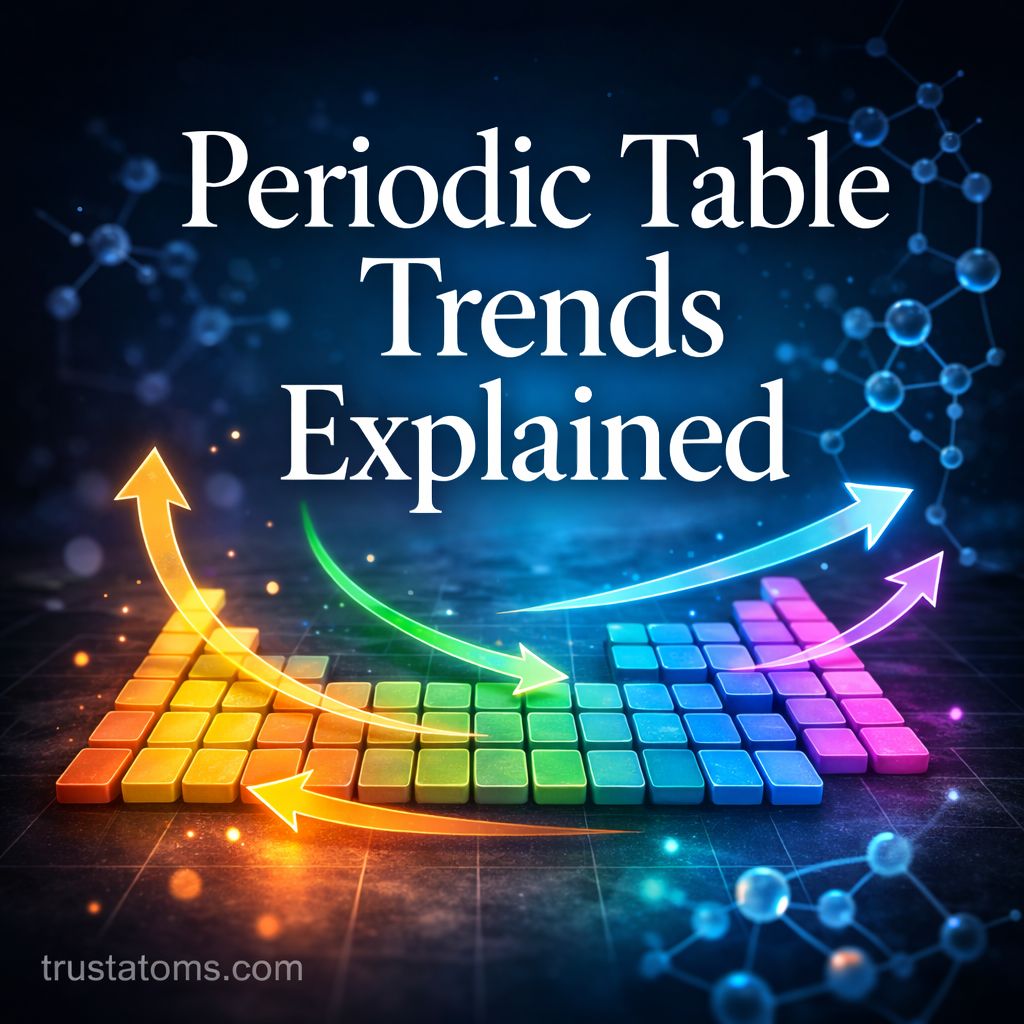
The periodic table isn’t just a list of elements — it’s a powerful map that reveals predictable patterns in chemistry.
When you understand periodic table trends, you can predict how elements behave, how reactive they are, how tightly they hold onto electrons, and even how large their atoms are — without memorizing every single element.
In this guide, we’ll break down periodic trends in a simple, practical way so you can recognize the patterns quickly and apply them confidently.
What Are Periodic Trends?
Periodic trends are predictable patterns in element properties that appear as you move:
- Across a row (left to right) — called a period
- Down a column (top to bottom) — called a group
These trends happen because of changes in:
- Atomic number
- Electron configuration
- Shielding effect
- Nuclear charge
Instead of seeing the periodic table as 100+ separate facts, think of it as a repeating system of patterns.
The Four Major Periodic Trends

There are four core trends you need to understand:
- Atomic radius
- Ionization energy
- Electronegativity
- Electron affinity
Let’s break each one down clearly.
Atomic Radius Trend
Atomic radius refers to the size of an atom.
Across a Period (Left → Right)
Atomic radius decreases.
Why?
As you move across a row:
- The number of protons increases
- The positive nuclear charge increases
- Electrons are pulled closer to the nucleus
Result: atoms get smaller.
Down a Group (Top → Bottom)
Atomic radius increases.
Why?
As you move down:
- New electron shells are added
- Inner electrons shield outer electrons
- Outer electrons are farther from the nucleus
Result: atoms get larger.
Quick Rule:
Atomic size increases down and to the left.
Ionization Energy Trend
Ionization energy is the energy required to remove an electron from an atom.
Across a Period
Ionization energy increases.
Smaller atoms hold electrons more tightly.
It becomes harder to remove an electron.
Down a Group
Ionization energy decreases.
Larger atoms have outer electrons farther from the nucleus.
They’re easier to remove.
Quick Rule:
Ionization energy increases up and to the right.
Electronegativity Trend
Electronegativity measures how strongly an atom attracts electrons in a chemical bond.
Across a Period
Electronegativity increases.
Atoms become better at attracting electrons.
Down a Group
Electronegativity decreases.
Outer electrons are farther away and less tightly controlled.
Quick Rule:
Electronegativity increases up and to the right.
The element in the upper-right (excluding noble gases) has the highest electronegativity.
Electron Affinity Trend
Electron affinity describes how much an atom “wants” to gain an electron.
Across a Period
Electron affinity generally increases.
Atoms on the right side are close to having a full outer shell, so gaining an electron is favorable.
Down a Group
Electron affinity generally decreases.
Larger atoms don’t attract additional electrons as strongly.
Why These Trends Exist
All periodic trends are driven by three main forces:
1. Nuclear Charge
More protons = stronger pull on electrons.
2. Shielding Effect
Inner electrons block some of the nucleus’s pull on outer electrons.
3. Distance from the Nucleus
The farther electrons are from the nucleus, the weaker the attraction.
These three ideas explain almost every periodic pattern.
Reactivity Trends
Periodic trends directly affect how reactive elements are.
Metals
Metal reactivity increases:
- Down a group
- Toward the left side
Why?
Metals react by losing electrons, and larger atoms lose electrons more easily.
Nonmetals
Nonmetal reactivity increases:
- Up a group
- Toward the right side
Why?
Nonmetals react by gaining electrons, and smaller atoms attract electrons more strongly.
Summary of Directional Trends
Here’s a simplified directional guide:
Atomic Radius
⬇ Increases down
⬅ Increases to the left
Ionization Energy
⬆ Increases up
➡ Increases to the right
Electronegativity
⬆ Increases up
➡ Increases to the right
Electron Affinity
⬆ Generally increases up
➡ Generally increases to the right
If you remember just one mental image:
Properties that involve attracting or holding electrons get stronger toward the top right.
Why Periodic Trends Matter
Understanding periodic trends allows you to:
- Predict chemical bonding
- Estimate reactivity
- Compare element strength
- Understand compound formation
- Solve chemistry problems faster
Instead of memorizing individual facts, you can rely on patterns.
And that’s exactly why the periodic table is considered one of the most powerful tools in science.
Final Thoughts
Periodic trends transform the periodic table from a chart of symbols into a predictive system.
When you understand:
- Atomic size
- Electron attraction
- Electron removal energy
You understand the logic behind chemical behavior.
Chemistry becomes less about memorization and more about recognizing patterns — and the periodic table is the roadmap that makes those patterns visible.