Mass number is a key concept in chemistry that helps us understand the structure of atoms.
While atomic number tells us how many protons an atom has, mass number tells us something slightly different — and just as important.
In this guide, we’ll break it down clearly and simply.
What Is Mass Number?
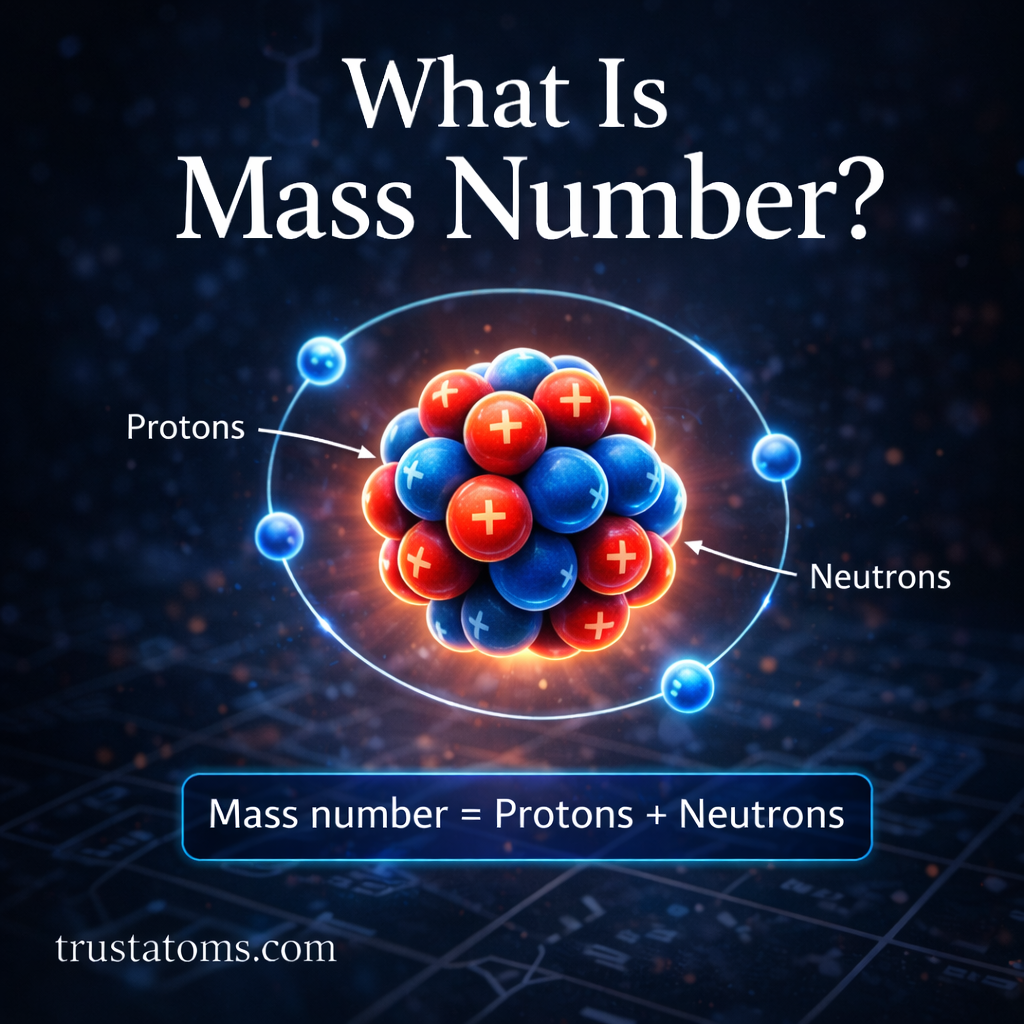
Mass number is the total number of protons and neutrons in the nucleus of an atom.
Mass Number = Protons + Neutrons
Unlike atomic mass (which is an average and often includes decimals), mass number is always a whole number.
For example:
- Carbon-12 → 6 protons + 6 neutrons = 12
- Oxygen-16 → 8 protons + 8 neutrons = 16
- Sodium-23 → 11 protons + 12 neutrons = 23
The mass number represents a specific version of an element.
How Mass Number Is Different from Atomic Number
It’s easy to confuse these two terms, but they mean different things.
Atomic number:
- Counts protons only
- Defines the element
- Never changes for that element
Mass number:
- Counts protons + neutrons
- Can vary for the same element
- Identifies a specific isotope
For example:
All carbon atoms have:
- 6 protons → Atomic number = 6
But carbon atoms can have:
- 6 neutrons → Mass number = 12
- 7 neutrons → Mass number = 13
- 8 neutrons → Mass number = 14
Same element. Different mass numbers.
Why Neutrons Matter
Neutrons are neutral particles found in the nucleus alongside protons.
They:
- Add mass to the atom
- Help stabilize the nucleus
- Can vary in number without changing the element
When the number of neutrons changes, the mass number changes — but the atomic number stays the same.
This variation creates isotopes.
What Is an Isotope?
An isotope is a version of an element with the same number of protons but a different number of neutrons.
For example:
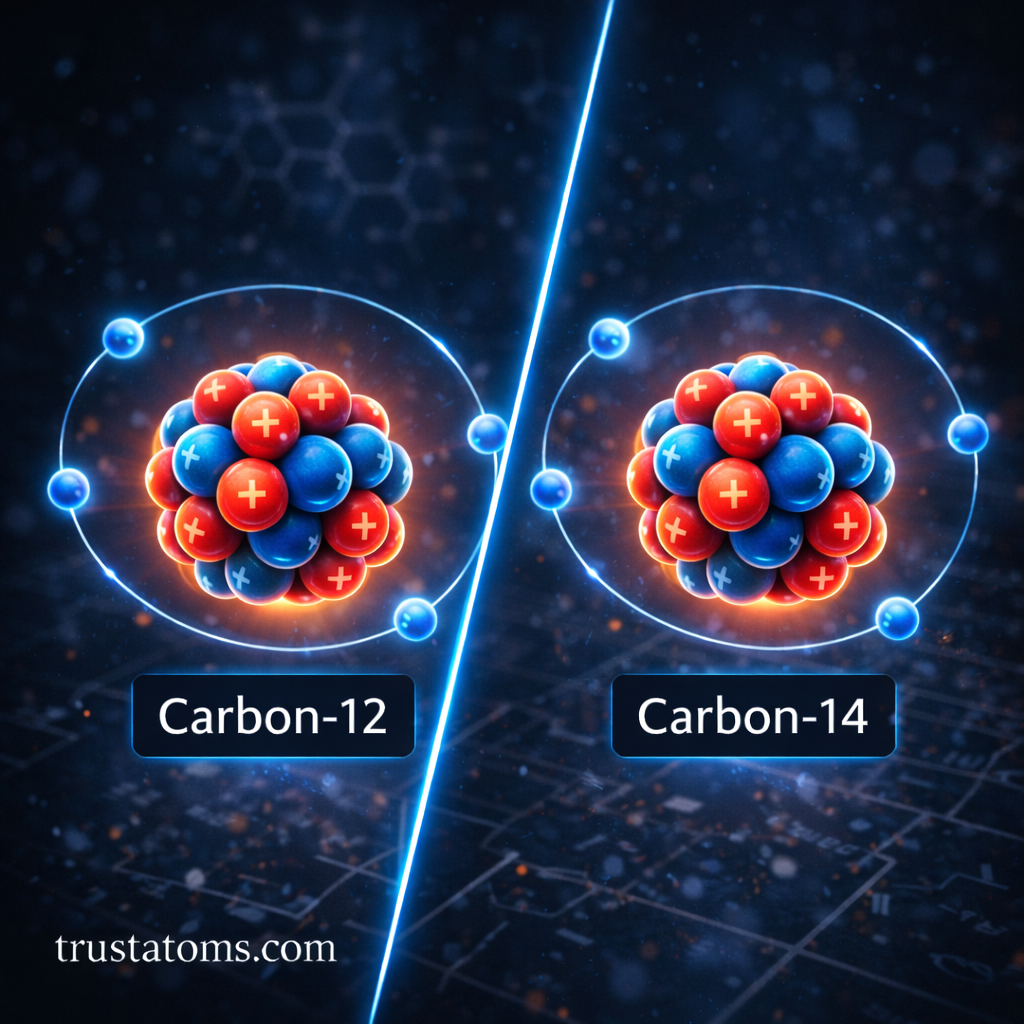
Carbon-12:
- 6 protons
- 6 neutrons
- Mass number = 12
Carbon-14:
- 6 protons
- 8 neutrons
- Mass number = 14
Both are carbon because they have 6 protons.
But they have different mass numbers because they have different neutron counts.
How Mass Number Is Written
Mass number is often written next to the element name.
For example:
- Hydrogen-1
- Carbon-12
- Uranium-238
It can also appear in nuclear notation form:
Mass number (top number)
Atomic number (bottom number)
But in most general chemistry contexts, you’ll simply see it written like this:
Element–Mass Number
Example:
Carbon-14
Mass Number vs Atomic Mass
These terms are related but not identical.
Mass number:
- Whole number
- Counts protons + neutrons
- Refers to a specific isotope
Atomic mass:
- Decimal number
- Weighted average of all natural isotopes
- Found on the periodic table
For example:
Carbon’s atomic mass on the periodic table is about 12.01.
But individual carbon atoms have mass numbers of 12, 13, or 14.
One is an average. The other is exact for a specific atom.
Why Mass Number Is Important
Mass number helps scientists:
- Identify specific isotopes
- Study radioactive decay
- Calculate nuclear reactions
- Understand atomic stability
- Determine neutron count
It plays a major role in nuclear chemistry and physics.
For example, Carbon-14 is used in radiocarbon dating to estimate the age of ancient objects.
How to Calculate Mass Number
If you know:
- The number of protons
- The number of neutrons
You can calculate mass number easily.
Step-by-step:
- Find the atomic number (this equals protons).
- Determine the number of neutrons.
- Add them together.
Example:
An atom has:
- 17 protons
- 18 neutrons
Mass number = 17 + 18 = 35
That atom is Chlorine-35.
Quick Summary
- Mass number = protons + neutrons
- It is always a whole number
- It identifies a specific isotope
- It is different from atomic mass
- Changing neutrons changes mass number
If you remember one thing:
Mass number tells you how heavy a specific atom is based on its nucleus.
Final Thoughts
Mass number helps us move beyond basic element identity and understand the full structure of atoms.
It explains why atoms of the same element can have slightly different weights — and why some isotopes are stable while others are radioactive.
Once you understand mass number, isotopes and nuclear chemistry start to make much more sense.